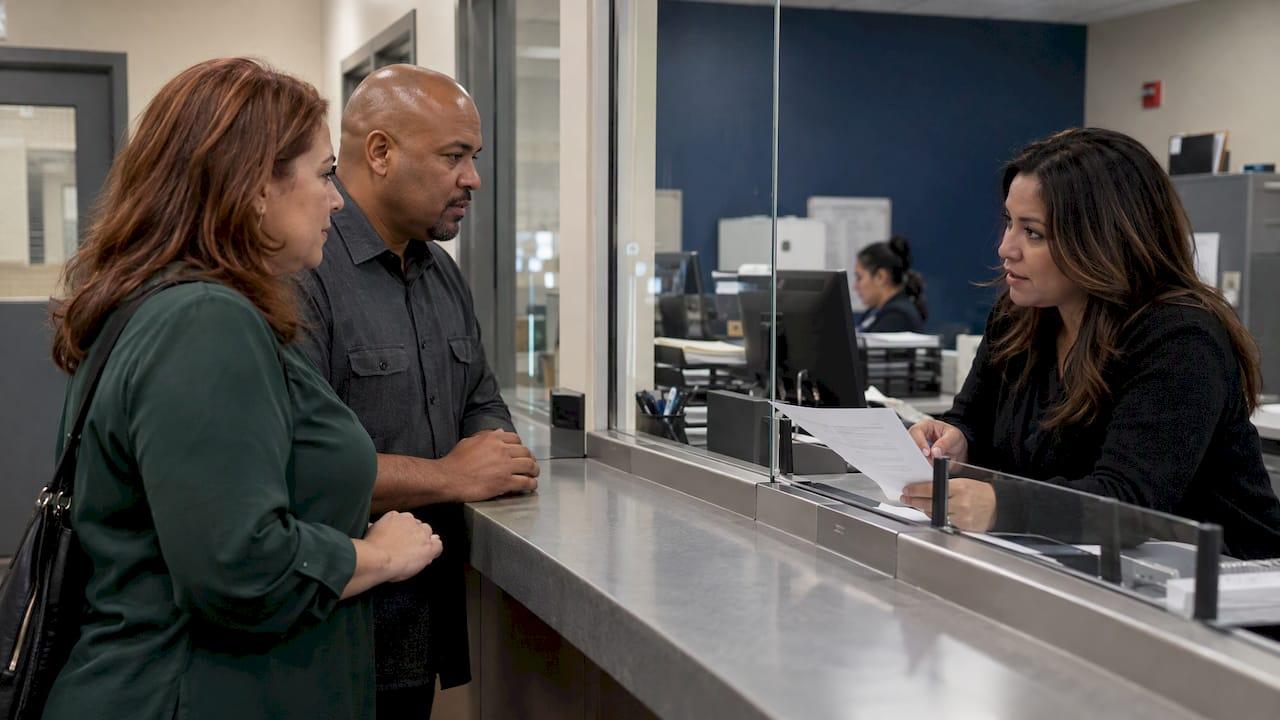
Carjacking is a violent felony in California, so bail is set higher and reduced less easily than for most charges. A family can still get a person out. You need the right bail figure, a co-signer who understands the obligation, and a bondsman who works the case directly. We post carjacking bonds in all 58 counties, consultations are free, and you can reach us 24/7. Here is how the system works, what it costs and what to do in the first hours.
TL;DR
- Carjacking under Penal Code 215 is a felony punishable by three, five or nine years in state prison, and judges treat it as a serious offense when setting bail.
- Each county has its own bail schedule. Riverside County's 2026 schedule lists carjacking at $50,000, but a judge can change that amount at arraignment.
- A bond premium is 10% of the bail amount with us, or 8% for attorneys, so a $50,000 bail means a $5,000 premium.
- The person who co-signs is responsible for making sure the defendant appears in court. Missing a date can cost the full bail amount.
- Call early. Release can start as soon as the jail has the booking information and a bond is written.
Table of Contents
- What counts as carjacking in California
- How carjacking bail is set
- The possible outcomes at arraignment
- What a carjacking bail bond costs
- Arranging release step by step
- What happens if a court date is missed
- If a 1275 hold applies
- Why a carjacking charge needs a bondsman who knows felony cases
- Get a carjacking bond started
- FAQ
- Sources
What counts as carjacking in California
California Penal Code 215 defines carjacking as taking a motor vehicle from another person, or from their immediate presence, against their will, by force or fear. The intent can be to keep the vehicle permanently or only temporarily. That second part matters: an arrest does not require that the vehicle was never returned.
The same statute sets the punishment at three, five or nine years in state prison. A prosecutor can charge carjacking and robbery together, but the person cannot be punished under both for the same act. Those two facts explain why bail starts high. The charge is a serious felony, and judges see it that way before any evidence is heard.
How carjacking bail is set
Two things work together: the county bail schedule and the judge.
The county bail schedule
Under Penal Code 1269b, the superior court judges in each county adopt and revise a countywide bail schedule for bailable felonies and misdemeanors every year. The same section requires extra bail to be added for each aggravating or enhancing factor charged in the complaint. The California Department of Insurance points out that schedules are local, so the court where the case is filed is where the real figure comes from.
Here is what a schedule looks like. Riverside County's 2026 felony and misdemeanor bail schedule, adopted effective October 24, 2025, lists carjacking under PC 215 at a presumptive $50,000 and marks it as an Arraignment Review offense. In the same schedule, first-degree robbery is $40,000 and kidnapping during a carjacking (PC 209.5) is $1,000,000. Related charges are tiered, and the added charge can change the number a lot.

Other counties publish different figures. If your case is in Los Angeles, Orange, San Diego, San Bernardino or Alameda County, we have a page for each: Los Angeles County, Orange County, San Diego County, San Bernardino County and Alameda County. Our main carjacking bail bond page covers the rest of the state.
What the judge adds at arraignment
The schedule amount is a starting point. Los Angeles County's 2026 felony bail schedule says pre-arraignment amounts do not bind the judge at arraignment, which typically happens within 48 hours of arrest. It also says people booked on crimes listed in PC 1270.1 are not eligible for non-financial release conditions before arraignment.
At arraignment, Penal Code 1275 tells the judge to weigh public safety, the seriousness of the offense, the prior record and the likelihood the person will return. Public safety comes first. Seriousness includes alleged injury or threats to the victim and alleged use of a firearm or deadly weapon.
For a person charged with a serious or violent felony, the same section says a court must find and record "unusual circumstances" before lowering bail below the schedule amount. Showing up to earlier hearings or having no new offenses does not count. In practice, a carjacking bail reduction takes a real argument from the defense attorney, not just a request.
What the 2026 Supreme Court ruling changed
In 2026 the California Supreme Court decided Kowalczyk. It holds that when a court needs monetary bail, the amount must be reasonably attainable, based on an individual assessment that includes the defendant's finances. Bail cannot be set at an unreachable amount as a way to keep someone in custody. The Judicial Council's Staff Memorandum 2026-09 explains that cash bail may be considered only after clear and convincing evidence that no non-financial condition would protect safety and secure the person's return.
The same memo notes that for serious or violent offenses like carjacking, the "unusual circumstances" requirement of PC 1275(c) still applies. So a defense attorney can raise affordability at the hearing, and your family should have a bond plan ready for whatever amount the judge sets.
The possible outcomes at arraignment
The California Courts arraignment guide lists the options for a person still in custody:
- Release on their own recognizance, meaning a written promise to return.
- Release under supervision, such as home detention or an ankle monitor.
- Bail is set, and the person stays in jail until it is posted.
- Bail is denied, and the person stays in custody until the case ends.
The San Francisco Superior Court's bail fact sheet adds that courts are to consider less restrictive options first, such as electronic monitoring, pretrial check-ins, supportive housing or treatment. Defendants who plead not guilty are presumed innocent, with a right to release or affordable bail subject to limited exceptions.
If bail is set, the court's criminal division page in Monterey County describes the three forms it can take: cash, a surety bond from a licensed bail agency, or a property bond secured by real estate. For most families, a bond is the route that does not require handing over the whole amount.
What a carjacking bail bond costs
A bond means a licensed bail agency guarantees the full bail to the court, and you pay a premium for that guarantee. Our premium is 10% of the bail amount. Attorneys receive an 8% rate.
A worked example with the Riverside schedule figure:
| Bail amount | Premium at 10% | Premium at 8% (attorney rate) |
|---|---|---|
| $50,000 | $5,000 | $4,000 |
| $40,000 | $4,000 | $3,200 |
| $100,000 | $10,000 | $8,000 |
The premium is the fee for the service. The bail amount itself is the guarantee behind it. We offer 0% down options and payment plans for qualified co-signers, and the first consultation is free, so the premium does not have to be paid in one sum at the jail. See our bail bond cost page for how the figure is worked out, and our $500 down bail bond page if cash on hand is the obstacle.
Arranging release step by step
Under Penal Code 1269b, jail staff, police officers and court clerks may accept bail in the amount set by the warrant, schedule or court order, in cash or through a surety bond from a certified insurer. When bail is posted, the person is discharged from custody on that offense.
1. Collect the booking details
Have the full legal name, date of birth, the jail where the person is held and the booking number if you can get it. The charge and bail amount are on the jail's inmate lookup or can be read to you by the jail. Charges can change between booking and arraignment, so an early figure may not be the final one.
2. Call a bondsman who handles the case directly
We work without a call center or middleman, so the person you talk to is the one writing the bond. We cover all 58 counties, offer bilingual support in Spanish, Hindi and Arabic, and are available 24/7. Our online bail bond service lets a family member handle the paperwork from a phone, which matters when you are not in the same city or state. If you are out of state, our guide on bailing someone out from another state walks through it.
3. Decide who will co-sign
The co-signer is the adult who takes responsibility for the bond. Pick someone who has stable income and can be reached by phone, and who is willing to make sure the defendant gets to every hearing. This is the person we talk through payment plans with.
4. Sign, pay the agreed premium and wait for release
Once the bond is written and posted, the jail processes the release. Timing depends on how busy the jail is, so ask when you call. A carjacking arrest often involves an arraignment-review hold, so the clock can be longer than for a minor charge.
5. Plan every court date
Write each hearing date down and plan the ride. We stay with the case through every court date, so the defendant and co-signer are not left to track it alone.
What happens if a court date is missed
This is the part that costs families money. Under Penal Code sections 1305 and 1306, a missed appearance can lead the court to forfeit the bond. A California Court of Appeal decision, People v. American Contractors Indemnity, explains the timeline. The surety has 185 days after the clerk mails the forfeiture notice to bring the defendant in, which can be extended by up to 180 days for good cause. After that, the court has 90 days to enter judgment for the full bail amount.
That is why a co-signer should treat every hearing as fixed. If the defendant misses one by accident, call us the same day.
If a 1275 hold applies
Some releases need an extra step. Under PC 1275.1, the court may require proof that the money used for bail came from a lawful source. We handle these holds and explain them on our PC 1275 hold page. If your case involves one, tell us at the first call so the paperwork starts right away.
Why a carjacking charge needs a bondsman who knows felony cases
A carjacking bond is a large bond. Even the $50,000 presumptive amount in one county produces a $5,000 premium, and charges that add weapon or kidnapping allegations move the figure far higher. We write bonds from $1,000 to $1,000,000 and handle every charge category and jail type, which includes our felony bail bond service. For a family, the useful differences are a direct answer on cost, a plan for the co-signer and someone who knows the process in your county.
Our view
We talk to families at the worst moment of their year, and a carjacking arrest makes it harder because the amounts are high and the rules are strict. A judge who must find unusual circumstances to lower bail is not going to be moved by a family's urgency. What the family can control is speed and preparation.
That is why we work directly with each family instead of passing the call along. You should know the premium before you sign, you should know what the co-signer is responsible for, and you should have a plan for each court date. Our 0% down options and payment plans for qualified co-signers exist so a high bail does not mean waiting in jail while a family raises cash. Attorneys get the 8% rate applied automatically.
The sooner we have the booking details, the sooner we can start.
Jake
Get a carjacking bond started
If someone you love has been booked on a carjacking charge, call us with the jail and booking details. We will tell you the bail amount in that county, what the 10% premium comes to and what a payment plan could look like. The consultation is free, and we are available around the clock across California.
Start with our carjacking bail bonds page or reach us through the Jake Hernandez Bail Bonds home page.
FAQ
Can you get bail for a carjacking charge in California?
Usually yes, but the amount is high and a judge has wide discretion. Under the state's rules, bail may be denied only for offenses named in Article 1, section 12 of the California Constitution, according to the Kowalczyk decision. Most carjacking defendants are given a bail figure, and a bond is how most families post it.
How much is bail for carjacking in California?
It depends on the county. Riverside County's 2026 schedule lists carjacking at $50,000, and added charges such as kidnapping during a carjacking raise it sharply. The judge can change the amount at arraignment. Call us with the county and booking details for the current figure.
Can bail be lowered for a carjacking charge?
It can be, but for a serious felony the judge must find and record unusual circumstances before going below the schedule amount, under Penal Code 1275(c). A defense attorney makes that argument at the hearing. Our attorney rate of 8% also lowers the premium on the bond itself.
What is the premium on a $50,000 carjacking bond?
At our 10% premium, it is $5,000. An attorney who retains us pays 8%, which is $4,000. Qualified co-signers can ask about 0% down options and payment plans.
Does the co-signer owe money if the defendant misses court?
A missed court date can lead to forfeiture of the bond, and the court can enter judgment for the full bail amount after the statutory periods run. The co-signer should keep every hearing date and call us right away if one is missed.
Sources
- California Penal Code 215
- California Penal Code 1269b
- California Penal Code 1275
- California Department of Insurance, Bail Bonds
- Riverside County Superior Court, 2026 Felony and Misdemeanor Bail Schedule
- Los Angeles County 2026 Felony Bail Schedule
- California Courts Self Help Guide, The arraignment
- San Francisco Superior Court, Bail fact sheet 2024
- Monterey County Superior Court, Criminal division
- Kowalczyk, California Supreme Court decision
- Staff Memorandum 2026-09, Bail and Pretrial Release
- People v. American Contractors Indemnity (2003)