
A bail hearing is a judicial risk assessment where a judge decides whether your loved one can be released before trial and under what conditions. Families who know how to navigate the bail hearing process give their loved ones a real advantage. The judge's decision affects employment, housing, and family stability, not just freedom. Bail hearings typically occur within 24–72 hours of arrest, with 48 hours considered the standard for minimizing harm. Jakehernandezbailbonds works with California families every day to move through this process quickly and with confidence.
How to navigate a bail hearing as a family: what you need to know
The bail hearing process follows a predictable structure. A judge reviews the case, hears from the defense attorney, and decides on release conditions. The hearing rarely lasts more than 10 minutes. That brevity makes preparation the deciding factor.

Judges assess flight risk and public safety, not guilt. Community ties, stable employment, and a fixed address carry more weight than the nature of the charge. That means the facts your family can document directly shape the outcome.
Several outcomes are possible from a single hearing:
- Personal recognizance release: The defendant is released on a written promise to appear, with no money required.
- Monetary bail: A set dollar amount must be posted before release.
- Conditional release: The judge attaches requirements such as check-ins, travel restrictions, or substance testing.
- Bail denial: The defendant is held without bail, typically in cases involving serious charges or a documented flight risk.
Weekends and holidays can push a hearing back by a full day or more. If your loved one was arrested on a Friday night, the hearing may not happen until Monday morning. Knowing this timeline helps you prepare without panic.
Pro Tip: Contact a licensed bail bondsman the same day as the arrest. Jakehernandezbailbonds offers free 24/7 consultations, so you can get answers before the hearing even starts.
What documents should families gather before a bail hearing?
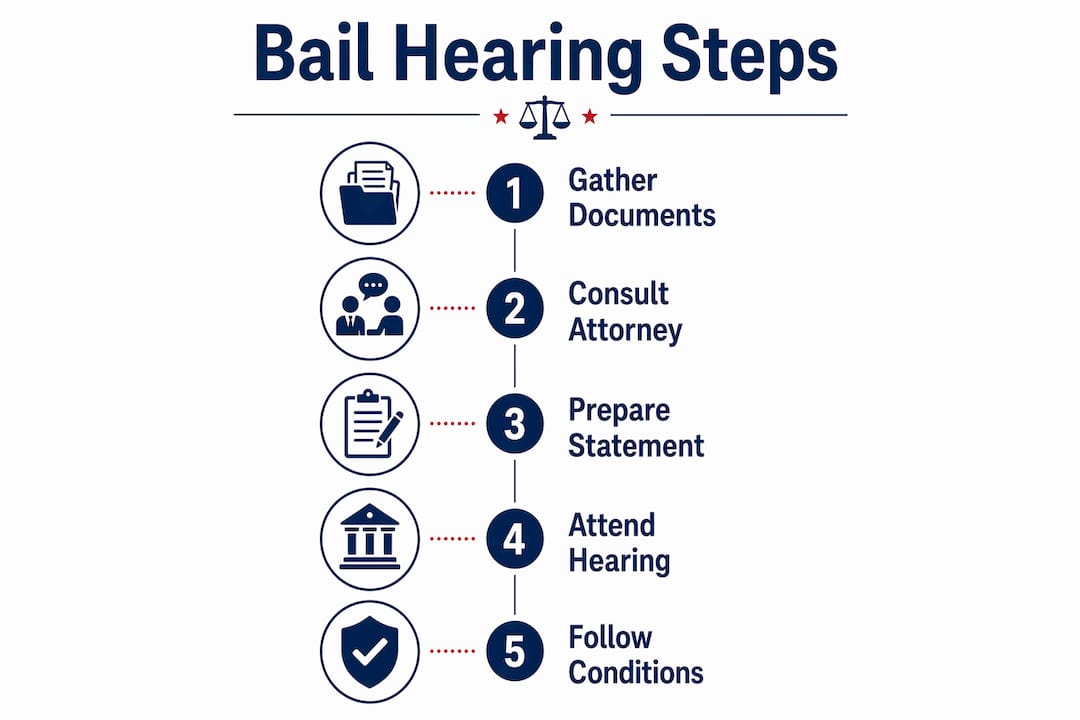
Preparation is the single most effective thing a family can do before a bail hearing. Judges make bail decisions quickly, relying on concise, factual presentations rather than emotional arguments. Your job is to give the defense attorney the material to build that case.
Gather these documents as soon as possible:
- Proof of employment: A recent pay stub, an employer letter, or a work schedule showing your loved one has a job to return to.
- Proof of residence: A lease agreement, utility bill, or mortgage statement confirming a stable home address.
- Medical records: Any documentation of ongoing treatment, prescriptions, or appointments that require the defendant to remain in the community.
- Character references: Letters from employers, clergy, teachers, or community leaders who can speak to your loved one's reliability and ties to the area.
- Arrest timeline: A brief, factual summary of events surrounding the arrest, written clearly and without legal jargon.
Submit all documents through the defense attorney, never directly to the judge or court clerk. Attorneys know how to present evidence in the format judges expect. Handing documents directly to court staff can create confusion and may even be seen as improper contact.
Keep a single organized folder, physical or digital, with copies of everything. If the attorney needs something fast, you can send it within minutes.
Pro Tip: Write the arrest timeline in bullet points, not paragraphs. Judges respond to clear, scannable facts. Anything that reads like a personal plea will be set aside.
How can families support a loved one during and after the bail hearing?
Family support during the bail hearing process is most effective when it stays behind the scenes. Families function best as case managers, organizing documents and coordinating logistics rather than speaking in court. An unscripted statement from a family member can introduce facts that complicate the defense.
Here is what effective family support looks like in practice:
- Stay calm in the courtroom. Emotional outbursts, even sympathetic ones, reflect poorly on the defendant. Dress professionally and sit quietly.
- Avoid social media entirely. Anything posted about the arrest can become evidence. This includes comments, shares, and even private messages.
- Communicate only through the attorney. Sharing arrest details with law enforcement or posting online creates inadvertent evidence. Route all information through defense counsel.
- Plan financially before the hearing ends. Know your budget for bail. Jakehernandezbailbonds offers bonds from $1,000 to $1,000,000, with 0% down options and payment plans for qualified co-signers.
- Understand the release timeline. After bail is posted, release typically takes 4–12 hours, though weekends or high-volume arrest periods can extend that window.
- Monitor bail conditions carefully. Once released, your loved one must comply with every court-ordered condition. Missing a check-in or violating a travel restriction can result in immediate re-arrest.
Pro Tip: Create a shared digital calendar with all court dates, check-in requirements, and condition deadlines. One missed date can undo everything you worked for at the hearing.
Common mistakes families make at bail hearings
Families who are unprepared often make errors that directly hurt their loved one's case. Most of these mistakes come from good intentions combined with a lack of information about how the bail hearing process actually works.
The most damaging mistakes include:
- Trying to speak at the hearing without being called. Family members who volunteer statements can introduce harmful facts or contradict the defense attorney's argument.
- Talking to police about the arrest. Law enforcement may use anything you say to build a stronger case against your loved one.
- Posting on social media. Even a sympathetic post can be screenshotted and submitted as evidence of flight risk or public danger.
- Waiting too long to hire an attorney. Pretrial detention pressures defendants to accept guilty pleas. Early legal intervention preserves the presumption of innocence and gives the defense time to prepare.
- Ignoring unaffordable bail. Families sometimes assume that if bail is set, they must pay it in full or accept detention. That is not true. Bail reduction motions are a legal right.
- Submitting documents directly to the court. Always route paperwork through the defense attorney.
"The most common mistake I see families make is showing up to court ready to tell the judge their side of the story. The hearing is not the place for that. Your job is to give your attorney the facts and let them do the talking."
Early preparation eliminates most of these risks. Families who gather documents, stay quiet in court, and work closely with defense counsel give their loved ones the strongest possible chance at a fair bail decision.
What to do if bail is denied or unaffordable
A high bail amount or an outright denial is not the end of the road. Families have legal options, and using them quickly matters.
- Request a bail reduction hearing. Your attorney can file a motion asking the judge to lower the bail amount. Courts consider changed circumstances such as new employment, secured housing, or a family support plan as grounds for reduction.
- Explore non-monetary release options. Electronic monitoring, home confinement, and personal recognizance release are all alternatives to cash bail. These options are especially relevant in California, where courts have been actively reconsidering money bail standards.
- Work with a licensed bail bondsman. A bail bond typically costs a percentage of the total bail amount. Jakehernandezbailbonds offers flexible payment plans and 0% down options for qualified co-signers, which makes even large bail amounts manageable.
- File supporting documentation. A motion for bail reduction is stronger when backed by proof of employment, a signed lease, and letters from community members. Give your attorney everything you have.
- Attend follow-up hearings. Bail decisions can be revisited as the case develops. Continued legal advocacy and consistent court appearances demonstrate that your loved one is not a flight risk.
| Option | When to use it |
|---|---|
| Bail reduction motion | Bail is set but unaffordable; new circumstances exist |
| Personal recognizance | Low-risk defendant with strong community ties |
| Electronic monitoring | Judge wants supervision without monetary bail |
| Bail bond service | Bail is set and family needs financial assistance |
| Continued legal advocacy | Bail denied; case circumstances may change |
The worst response to unaffordable bail is waiting passively. Every day in pretrial detention increases pressure on the defendant to accept a plea deal, regardless of guilt.
Key Takeaways
Families who prepare documents, communicate through defense counsel, and act quickly give their loved ones the best chance at a fair bail outcome.
| Point | Details |
|---|---|
| Timing is critical | Bail hearings occur within 24–72 hours; preparation must start immediately after arrest. |
| Documents drive decisions | Proof of employment, residence, and community ties are the most persuasive evidence at a hearing. |
| Stay behind the scenes | Families should organize and inform, not speak in court or post on social media. |
| Bail denial is not final | Reduction motions and non-monetary alternatives are legal rights families can pursue. |
| Financial options exist | Bail bond services like Jakehernandezbailbonds offer 0% down and payment plans for qualified co-signers. |
What I have learned from watching families go through this
After years of working with families across California, the pattern I see most often is this: families who treat the bail hearing like a performance lose. Families who treat it like a project management problem win.
The courtroom is not where your effort shows. It shows in the folder your attorney opens. It shows in the one-page summary that lists your loved one's employer, their address, their doctor, and their community ties. Judges set bail in under 10 minutes. They are not reading long letters. They are scanning for risk factors and looking for reasons to say yes to release.
The emotional instinct is to do more, say more, explain more. I understand that. But the families who get their loved ones home fastest are the ones who channel that energy into documentation and logistics, not courtroom drama.
One thing I tell every family: do not wait to find out what bail will be set at before you start preparing. Gather the documents, contact an attorney, and understand your financial options before the hearing happens. If bail comes in at a number you cannot cover, you need a plan ready, not a panic.
The legal system moves fast at the bail stage and slow everywhere else. That 24–72 hour window is your best opportunity to influence the outcome. Use it.
— Jake
Jakehernandezbailbonds is ready when your family needs help
When bail is set and every hour matters, Jakehernandezbailbonds is available 24/7 across all 58 California counties. Whether your loved one is held near San Diego Central Jail or Men's Central Jail in Los Angeles, the team responds fast with no call center, no middleman, and no runaround.
Bonds range from $1,000 to $1,000,000. Qualified co-signers can access 0% down and flexible payment plans. Bilingual support is available for Spanish-speaking families. Consultations are always free. Reach out to Jakehernandezbailbonds now and get your loved one home as quickly as the law allows.
FAQ
What happens at a bail hearing?
A judge reviews the defendant's flight risk and public safety record, then sets release conditions. The hearing typically lasts under 10 minutes and focuses on facts, not guilt.
How long after arrest does a bail hearing happen?
Bail hearings generally occur within 24–72 hours of arrest. Weekends and holidays can push the timeline back by a full day.
What documents help at a bail hearing?
Proof of employment, a current address, medical records, and character references are the most useful documents. All should be submitted through the defense attorney, not directly to the court.
Can families speak at a bail hearing?
Family members are generally not called to speak at a bail hearing. Unscripted statements can introduce harmful facts. The most effective role is organizing documents and supporting the defense attorney.
What can families do if bail is unaffordable?
Families can work with defense counsel to file a bail reduction motion based on changed circumstances such as new employment or secured housing. A licensed bail bondsman can also provide financial assistance through payment plans.