
Any U.S. citizen or lawful permanent resident who is 18 or older, plus certain qualifying nonprofits and law firms, can serve as an immigration bond sponsor. The core obligation is simple to state and hard to carry out: you guarantee the detained person shows up for every immigration hearing and ICE check-in, and you're on the hook financially if they don't. Before anything else, gather the detainee's A-number, confirm the bond amount set by the judge or ICE, pull your own original ID and proof of status, and figure out whether you're posting through CeBONDS (ICE) or at a local ERO office.
- Confirm eligibility: citizen, LPR, or approved nonprofit/law firm
- Get the A-number and exact bond amount from the detention facility
- Decide CeBONDS (electronic) versus in-person posting before you drive anywhere
- Bring original ID and proof of immigration status, not copies
Key Takeaways
Sponsoring an immigration bond means guaranteeing court attendance and accepting financial liability that can last years, so document accuracy and honest risk assessment matter more than speed.
| Point | Details |
|---|---|
| Eligibility is narrow | Sponsors must be 18+, a U.S. citizen or LPR, or a qualifying nonprofit/law firm. |
| Cash vs. surety is a real tradeoff | Cash bonds are refundable but tie up funds; surety premiums are gone permanently. |
| Documentation errors cause most delays | Mismatched names and expired IDs are the leading cause of rejected postings. |
| Refunds require two forms | Form I-305 and Form I-391 must go to the DHS Debt Management Center together. |
| A licensed local option exists | Jake Hernandez Bail Bonds posts immigration bonds statewide in California with bilingual support and 0% down options. |
Table of Contents
- What an Immigration Bond Sponsor Actually Guarantees
- Who Qualifies as a Sponsor and What ICE Wants in Hand
- How to Post the Bond: CeBONDS, Cashier's Checks, and Bond Companies
- Writing a Sponsor Letter That Actually Helps at the Hearing
- What You're On the Hook for After Release
- Getting Your Money Back: Refunds and Cancellation Paperwork
- The Small Mistakes That Sink a Bond Posting
- How Jake Hernandez Bail Bonds Supports Immigration Bond Sponsors
- What the Process Actually Rewards, and What It Punishes
- Get Help Posting an Immigration Bond Today
- Forms and Guides Worth Bookmarking
- Sources
What an Immigration Bond Sponsor Actually Guarantees
An immigration bond, sometimes called a delivery bond, is a financial contract between three parties: the obligor (you, the sponsor), the U.S. government (the beneficiary), and the detained person (the principal). Post the bond and ICE releases the detainee while their case moves through court. Miss a hearing and the government keeps the money.
Two versions of this contract show up in practice. A cash bond means you deposit the full amount yourself, in cash-equivalent form, and get it back later if the case resolves and every condition is met. A surety bond works through a Treasury-certified bond company that fronts the money for a nonrecoverable premium, usually a percentage of the total bond, so you never see that premium again regardless of the outcome.
By the numbers: The statutory minimum for a delivery bond sits at $1,500, but immigration judges routinely set amounts far higher based on flight risk, criminal history, and community ties. Bond amounts commonly vary widely depending on case complexity and other factors.
- Cash bond: full refund possible, but funds are locked up for the life of the case
- Surety bond: faster access to release, but the premium is gone for good
- Bond amount depends on the judge's assessment, not a fixed schedule
Who Qualifies as a Sponsor and What ICE Wants in Hand
Eligibility rules are narrower than most people expect. You need to be at least 18, hold U.S. citizenship or lawful permanent resident status, and have the legal capacity to sign a binding contract. Qualifying nonprofits and law firms can also post bonds electronically on a client's behalf, which is one reason immigration attorneys sometimes handle this step directly.
Once eligibility is settled, the paperwork determines whether your visit to the bond window goes smoothly or turns into a wasted trip. Bring these, and bring originals:
- Original passport, green card, or naturalization certificate proving your status
- A government-issued photo ID (driver's license or state ID)
- Social Security number or Taxpayer Identification Number documentation
- Proof of your residential address, typically a recent utility bill
- The detainee's full legal name and A-number, matched exactly
- The bond amount and the name of the facility where they're held
Name mismatches cause more rejected postings than any other single error. If your bank account, ID, and the bond paperwork spell your name three different ways, fix that before you show up, according to guidance in Form I-352 explained.
Pro Tip: Call the field office the morning you plan to post the bond and ask which documents they want to see in person. Policies vary by location, and a five-minute call beats a two-hour drive for nothing.
How to Post the Bond: CeBONDS, Cashier's Checks, and Bond Companies
You have three real paths to getting the bond posted, and they don't move at the same speed.
CeBONDS, ICE's electronic portal, lets eligible sponsors and certain law firms or nonprofits post and verify cash bonds online. When you use it, Fedwire transfers clear noticeably faster than ACH transfers; this matters when someone is sitting in detention waiting on release. If speed is the priority, ask specifically about Fedwire.
In-person posting means showing up at an ERO bond acceptance window, usually open on a limited daily schedule, and paying with a cashier's check or money order made payable to the U.S. Department of Homeland Security. Personal checks and cash are frequently refused without advance arrangement, so calling ahead isn't optional if you want to avoid a second trip.
A surety company, often called a bail bond service, posts the bond for you in exchange for a premium. This route costs more overall since the premium is gone for good, but it frees up your own cash and moves faster when a family can't tie up thousands of dollars for months or years while a case works through court.
| Method | Speed | Cost structure |
|---|---|---|
| CeBONDS with Fedwire | Fastest electronic option | Full bond amount, refundable |
| In-person cashier's check | Depends on office hours | Full bond amount, refundable |
| Surety/bail bond company | Often same-day | Nonrefundable premium |
Whichever path you choose, get Form I-352 signed and Form I-305 in hand before you leave. That receipt is the only proof the bond posted, and you'll need it later for a refund.
Writing a Sponsor Letter That Actually Helps at the Hearing
A sponsor letter is often the single most persuasive document in the bond hearing packet, according to the ICE bond guide. Judges want to see that the detained person has a real place to go and someone accountable for their appearance in court.
Write it yourself, or have the sponsor write it directly, and cover these points in order:
- Your name, immigration status, and how you can prove it (citizen, LPR)
- Your relationship to the detainee, stated plainly, no vague language
- Your residential street address, never a PO box, where the person will live
- A direct statement that you will house and support them upon release
- Your signature, printed name, and date at the bottom
Attach a copy of your ID and a recent utility bill showing your name and address. If the letter isn't originally written in English, include a translator's statement. Keep it to one page. Judges read dozens of these; specificity beats sentiment every time.
What You're On the Hook for After Release
Signing the bond contract doesn't end your involvement. It starts a period of legal responsibility that can stretch for years, until one of a few specific events closes it out: deportation, a grant of relief such as asylum or a green card, formal termination of the case, or the person's death.
While the bond is active, you're expected to keep the person showing up to every hearing and every ICE check-in, and to help them file Form AR-11 whenever they move, since immigration authorities require an updated address on file. Staying reachable yourself matters too. ICE and the court will contact the sponsor, not just the detainee, if something goes wrong.
Missing even one hearing can trigger forfeiture. ICE typically notifies the obligor by mail when a bond is breached, and once forfeiture is declared, the full deposited amount is gone.
- Deportation, relief granted, case termination, or death ends bond liability
- Missed hearings can mean total forfeiture of a cash deposit
- Surety companies can pursue guarantors or seize collateral pledged for a bond
- Keep your own contact information current with ICE, not just the detainee's
Getting Your Money Back: Refunds and Cancellation Paperwork
Refunds hinge entirely on two forms. Form I-305, the receipt you got when the bond posted, has to be paired with Form I-391 to formally cancel the bond and request the refund.
- Confirm the case has reached a bond-canceling event (removal, relief, termination)
- Submit I-305 and I-391 together to the DHS Debt Management Center
- Expect processing to take weeks to months, not days
- If I-305 is lost, file an affidavit explaining the loss instead of the missing receipt
- Keep your mailing address current, since Treasury sends the refund check by mail
Losing I-305 doesn't kill your refund, but it adds a real administrative delay. Keep the original in a safe, findable place from day one.
The Small Mistakes That Sink a Bond Posting
Most rejected or delayed bonds trace back to a handful of avoidable errors, not to anything complicated about the case itself.
- Names that don't match exactly across ID, bank records, and bond paperwork
- Expired identification documents that field officers won't accept
- Personal checks or cash offered where only cashier's checks or money orders work
- Showing up outside the office's posting hours without calling first
- Leaving the office without Form I-305 in hand
Pro Tip: Photograph every document before you leave the house. If a clerk questions a detail, you can pull up a backup image on your phone instead of driving home to get it.
How Jake Hernandez Bail Bonds Supports Immigration Bond Sponsors
Families dealing with an ICE detention often don't have weeks to learn this process on the fly. Jake Hernandez Bail Bonds works immigration bond cases across California, offers bilingual support in Spanish, Hindi, and Arabic, and takes calls around the clock.
- Statewide coverage across all 58 California counties, including complex holds
- 0% down options and payment plans for qualified co-signers
- Free consultations before you commit to anything
- Support with paperwork so sponsors don't navigate ICE forms alone
If you're weighing whether to post cash yourself or use a bond service, a quick call gets you a straight answer on cost and timeline.
What the Process Actually Rewards, and What It Punishes
Most guides on this topic treat the paperwork as the hard part. It isn't. The hard part is the months or years of ongoing responsibility that start the moment the bond posts, and that's the piece too many sponsors underestimate before they sign.

The conventional advice, "gather your documents and post the bond," treats this like a one-time transaction. It's not. A cash bond ties up real money for the entire life of a case that can drag on for years, during which you remain personally accountable for someone else's court attendance. That's a very different commitment than writing a check.
What should come first, before any document collection, is an honest conversation about whether the sponsor can absorb that risk: financially if the case goes long, and practically if the person needs housing, transportation to hearings, or help filing an address change. A surety bond exists precisely for families who can't sit on tied-up cash for years, and it deserves more consideration than it usually gets in generic checklists that push everyone toward posting cash without asking whether that's actually the right fit.
The sponsor letter matters more than people assume, too. A specific, well-documented letter with a real street address and a signed statement of support often carries more weight than the bond amount itself.
— Jake
Get Help Posting an Immigration Bond Today
If you're standing in this situation right now, and someone you love is detained and waiting on a bond to be posted, you don't have to figure out CeBONDS, Form I-352, or bond acceptance hours on your own tonight.
Jake Hernandez Bail Bonds handles immigration and federal bond cases across California, including complex holds, with 0% down options and payment plans for qualified co-signers. Before you call, have the detainee's A-number, the name of the detention facility, and your own photo ID ready; that's usually enough for a free consultation to start. The team posts the bond, secures Form I-305 on your behalf, and stays available for court-date questions afterward, so you're not managing the paperwork alone while worrying about a family member. Visit Jake Hernandez Bail Bonds or call anytime, day or night, to get a straight answer on cost and next steps. If you want to estimate cost first, the bail bond cost calculator breaks down premium percentages and payment plan options before you commit.
Forms and Guides Worth Bookmarking
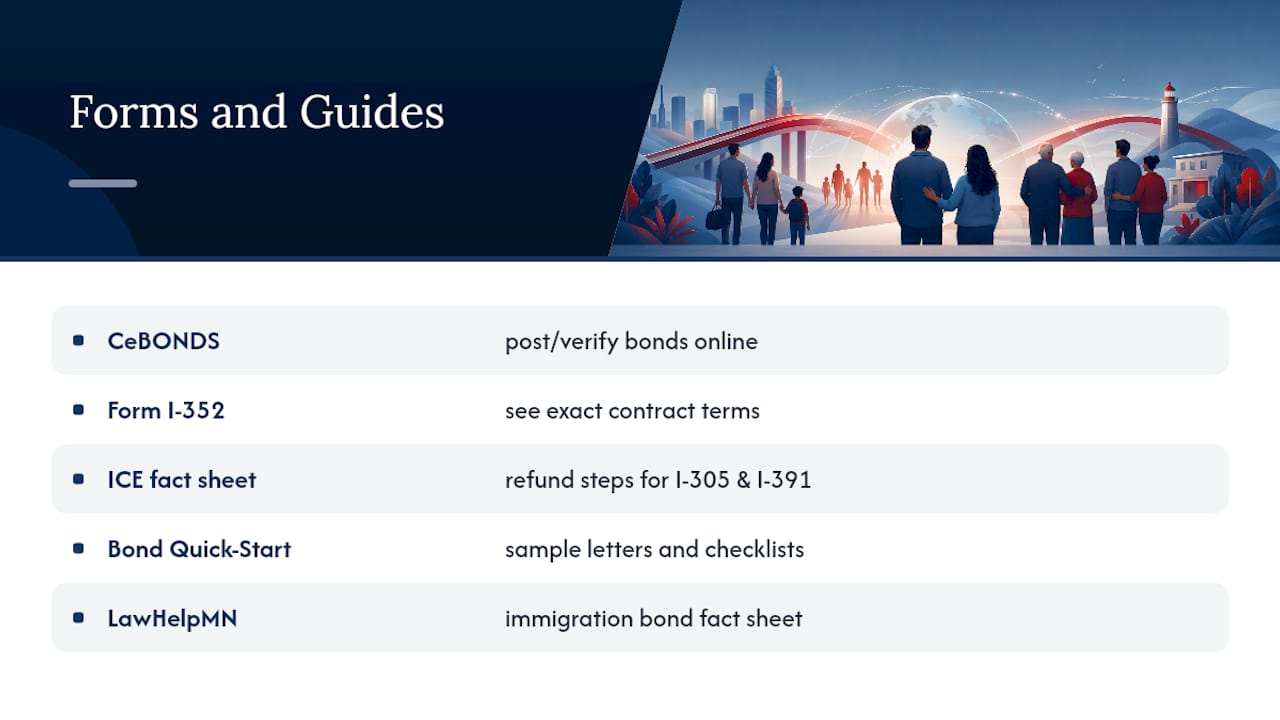
For anything official, go straight to CeBONDS to post or verify a bond electronically, and pull Form I-352 to see the exact contract terms you're signing. The ICE bond fact sheet covers I-305 and I-391 refund steps in plain language. For sample sponsor letters and quick-start checklists, the Bond Quick-Start Guide from Immigrant Justice and LawHelpMN's immigration bond fact sheet are both worth saving before your hearing date arrives.
Sources
- CeBONDS (ICE)
- Form I-352: Immigration Bond (ICE)
- Immigration bond sponsor requirements and responsibilities (LegalClarity)
- How to Get a Bond (ICE bond guide)