
The fastest way to find an inmate is to match the jurisdiction to the right database before you search. For a recent arrest, start with the county jail or sheriff's roster. For a sentenced state prisoner, go to that state's Department of Corrections locator. For a federal inmate, use the BOP Inmate Locator. If immigration custody is possible, check the ICE detainee lookup. VINELink works as a multi-jurisdiction fallback when you're unsure.
Before you open any search tool, gather:
- Full legal name (first, middle, last — exactly as it appears on a government ID)
- Date of birth
- Booking number, BOP register number, or state ID if you have it
- The county or state where the arrest likely occurred
Pro Tip: An agency-issued ID number eliminates name-matching errors entirely. A name search can return dozens of results or miss someone with a common name or alias. If anyone gave you a booking number or register number, use that first.
Table of Contents
- How does an inmate location lookup work, step by step?
- Which official locator tools should you use, and when?
- What do inmate numbers and ID formats actually mean?
- How do you read custody-status fields in a locator result?
- Why might an inmate not show up, and what should you do?
- What to do after you find the inmate — or if you can't
- How current are locator databases, and when should you check again?
- Key Takeaways
- What families searching for inmates often get wrong
- When you need help securing release quickly
- Official sources to bookmark
How does an inmate location lookup work, step by step?
The process follows a simple sequence: gather identifiers, pick the right database, run the search, and verify the result.
-
Confirm the jurisdiction — Was the arrest federal (drug trafficking, bank fraud, immigration offense) or local? Federal cases go to the BOP. State felony convictions go to the state DOC. Recent arrests almost always sit in a county jail first.
-
Choose your search tool. County sheriff roster for local arrests, state DOC locator for sentenced prisoners, BOP Inmate Locator for federal cases. If you're unsure, start at the county level and escalate.
Pro Tip: If the online result seems off or the status is unclear, call the facility's booking desk directly. Staff can confirm custody even when the website hasn't updated yet.
Which official locator tools should you use, and when?
The U.S. corrections system is split across the Federal Bureau of Prisons, 50 state DOCs, and over 3,000 local county jails. No single master database covers all of them.
- BOP Inmate Locator: — Covers federal inmates incarcerated from 1982 to the present. Search by name or BOP register number. Note that projected release dates may be affected by First Step Act recalculations — treat those dates as estimates.
- State DOC locators: — Each state runs its own system. A person typically moves from a county roster to the state DOC database after sentencing and transfer. California uses CDCR; Texas uses TDCJ. Search by name, state ID, or TDCJ/CDCR number depending on the state.
- County jail and sheriff rosters: The primary source for anyone arrested in the last few days. The Alameda County Sheriff's Inmate Locator, for example, lets you search by PFN (Personal File Number), full name, or date of birth, and requires a human-verification step. Most county sites work similarly.
- ICE Detainee Locator: — For anyone who may be held on immigration grounds. Search at ICE.gov by country of birth, first name, last name, and date of birth.
| Tool | Scope | Best for |
|---|---|---|
| BOP Inmate Locator | Federal inmates, 1982–present | Federal charges, federal prisons |
| State DOC locator | Sentenced state prisoners | Post-conviction, state facilities |
| County/sheriff roster | Local jails, recent arrests | Arrests within the last days or weeks |
| VINELink | Multi-jurisdiction aggregator | Uncertain jurisdiction, notifications |
| ICE Detainee Locator | Immigration detention | Immigration holds |
What do inmate numbers and ID formats actually mean?
Every agency issues its own identifier, and knowing which one you have tells you exactly where to search.

| ID Type | Format | Where it's used | How to search |
|---|---|---|---|
| BOP Register Number | #####-### | Federal Bureau of Prisons | BOP Inmate Locator, register number field |
| State DOC ID (e.g., CDCR#) | Varies by state, often 6 digits | State prison system | State DOC locator, ID field |
| Booking Number | Alphanumeric, assigned at intake | County jail | Sheriff/jail roster, booking number field |
| PFN (Personal File Number) | Alphanumeric, county-specific | County jail (e.g., Alameda) | County sheriff locator |
The BOP register number format is five digits, a hyphen, then three digits. The three-digit suffix identifies the district where the person was sentenced, not where they're housed. That distinction matters: a person sentenced in the Central District of California may be housed in a federal facility in another state entirely.
If you only have a partial number or an alias:
- Try the full legal name plus date of birth in the same database
- Check whether the person uses a middle name as a first name
- Ask the arresting agency for the booking number — they are required to provide it
- Search court dockets (PACER for federal cases, state court websites for state cases) to find the assigned case number, which often leads to the booking number
How do you read custody-status fields in a locator result?
Status labels vary slightly by agency, but the core categories are consistent.
- Not in BOP Custody: — The federal system has no current record. This could mean the person was released, transferred to state custody, or never entered the federal system.
Common fields you'll see alongside the status: facility name, housing unit (sometimes withheld for security), register or booking number, projected release date, and a charge summary.
Pro Tip: Federal projected release dates are not final. The BOP explicitly notes that First Step Act recalculations can affect these dates. If a release date matters for planning, call the facility's case management office to confirm.
Why might an inmate not show up, and what should you do?
A blank result doesn't mean the person isn't in custody. The most common reasons a search fails:
- Wrong jurisdiction: You searched the state DOC but the person is still in county jail awaiting trial.
- Booking not yet complete: Booking involves fingerprinting, photographing, and data entry. On a busy weekend or holiday, this can take a full day or longer before the roster updates.
- Transfer void: When someone moves between facilities, they can disappear from both the sending and receiving databases for 7–14 days while in transit or during intake processing.
- Name or alias mismatch: The system holds the legal name from the ID presented at booking. A nickname, hyphenated name, or spelling variation won't match.
- Sealed or protected record: Juvenile records, witness protection placements, and some protective-custody situations are not publicly visible.
- Private facility: Inmates held in contractor-run facilities may not appear in standard public feeds. Search the contracting government agency's system first.
Prioritized checklist when a search returns nothing:
- Check the county jail roster for the county where the arrest occurred
- Call the booking desk at that county jail
- Search VINELink by name and date of birth
- Check state DOC if more than a few days have passed
- Search court dockets for a filed case
- Check the ICE detainee locator if immigration custody is possible
- Contact an attorney or a licensed bail bonds agent if you still can't locate the person
What to do after you find the inmate — or if you can't
If you found them: Confirm the booking number and facility address. Ask the facility about visitation schedules, approved mail formats, and phone account setup. Ask about the bail amount — if bail has been set, you can move quickly.
If you can't find them: Call the arresting agency or the sheriff's department for the county where the arrest happened. Search the courthouse docket for a filed case. Register for VINELink notifications so you get an alert the moment a record appears, without having to keep re-running searches manually.
For county-level searches in California, county sheriff sites typically show bail amount, charges, and next court date once booking is complete.
Pro Tip: When you call a bail bonds agent, have the booking number, the full legal name, the facility name, the bail amount, and the charges ready. That information lets an agent start the paperwork immediately rather than spending time tracking down details you could have gathered from the locator.
How current are locator databases, and when should you check again?
Expect delays at every level. County jail rosters typically update within a few hours of completed booking, but during high-volume periods — weekends, holidays, large-scale arrests — that window can stretch to 24 hours or more. The BOP Inmate Locator updates regularly but carries an explicit notice that First Step Act recalculations may affect projected release dates, so those figures are not guaranteed.
The most disruptive gap is the transfer void. When an inmate moves between facilities, both the sending and receiving systems may show no record for up to 7–14 days. If someone disappeared from a locator after appearing there previously, a transfer is the most likely explanation.
- State DOC update lag: — Varies by state; call the DOC records office if the online result seems stale
Key Takeaways
Jurisdiction is the single most important variable in any inmate search — start at the county level and escalate to state, federal, or ICE only as the facts require.
| Point | Details |
|---|---|
| Match jurisdiction first | Start with county jail for recent arrests; escalate to state DOC, BOP, or ICE based on charge type. |
| Use ID numbers over names | Booking numbers and register numbers eliminate name-matching errors and return faster, cleaner results. |
| Expect booking and transfer delays | Rosters can lag 24 hours after arrest; transfers create a 7–14 day void in both sending and receiving databases. |
| VINELink as a fallback | When jurisdiction is unclear, VINELink aggregates data from thousands of facilities and sends automatic notifications. |
| Jakehernandezbailbonds for fast release | Once bail is set, Jakehernandezbailbonds covers all 58 California counties with 24/7 service and 0% down options. |
What families searching for inmates often get wrong
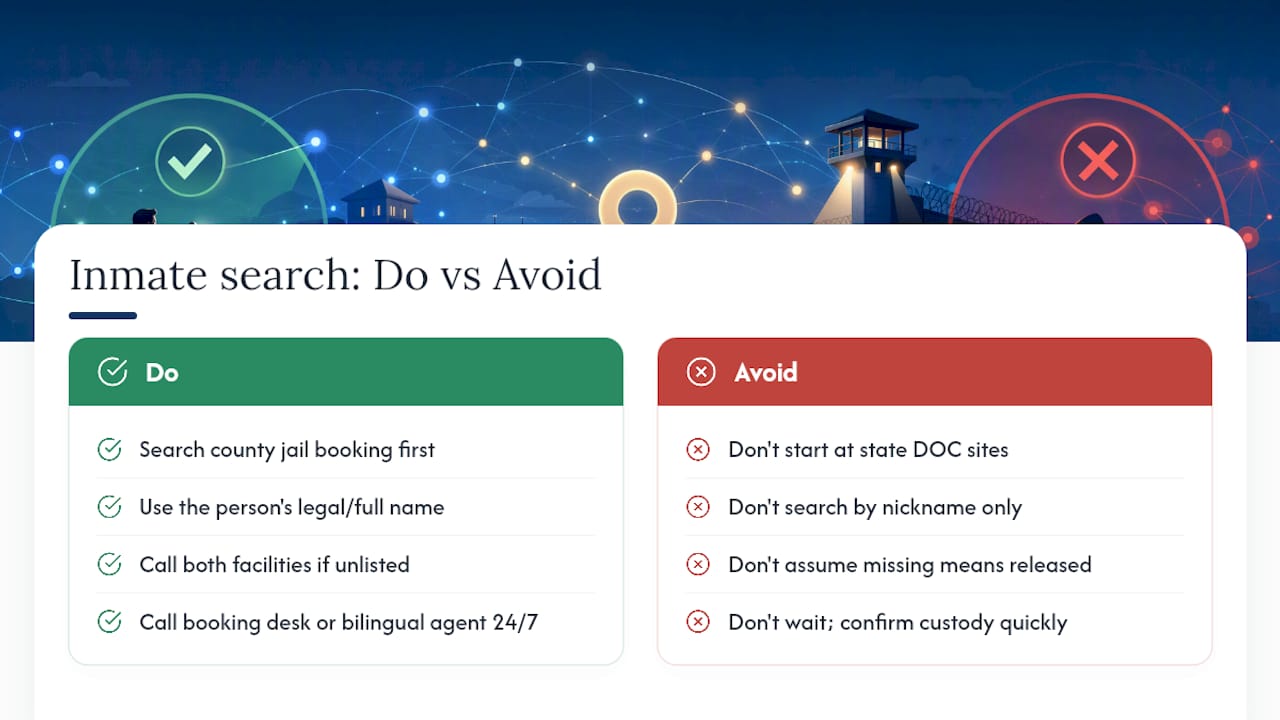
Most people start their search in the wrong place. They go straight to a state DOC website when the person is still sitting in a county jail waiting for arraignment. Or they search by a nickname and get zero results, then assume the person isn't in custody. Both mistakes are easy to fix once you understand how the system is structured.
The other thing families underestimate is the transfer void. Someone can be in the system one day and invisible the next — not because they were released, but because they're physically in transit between facilities. That gap causes real panic. Knowing it exists, and knowing to call both facilities directly, changes everything.
Speed matters in these situations. The sooner you confirm custody and bail status, the sooner you can act. That's why having a 24/7 resource — whether it's a direct call to the booking desk or a bilingual bail bonds agent who can walk you through the process in Spanish, Hindi, or Arabic — makes a concrete difference when hours count.
When you need help securing release quickly
Once you've confirmed custody and bail has been set, the next step is straightforward: contact a licensed bail bonds agent who knows the facility and can move fast.
Jakehernandezbailbonds covers every jail in California across all 58 counties, with agents available 24/7 and free consultations at no obligation. Bonds start at $1,000 and go up to $1,000,000, with 0% down options and flexible payment plans for qualified co-signers. Bilingual support in Spanish, Hindi, and Arabic means no one gets slowed down by a language barrier when time is critical. Use the bail bond cost calculator to get an instant estimate based on the bail amount, then call to start the paperwork. The faster you have the booking number and bail amount in hand, the faster release happens.
Official sources to bookmark
These are the primary sources to trust for inmate location data in the United States. When results conflict across databases, the official agency source for the correct jurisdiction takes precedence.
- Inmate Locator
- Why Is an Inmate Not Showing Up in Search? - LegalClarity
- How to Find Someone in Jail in California | My Rights Law
- USA.gov
If you're uncertain which level of the system holds someone, start at the county, use VINELink as a cross-check, and escalate from there. Bookmarking the BOP locator, VINELink, and your state's DOC page covers the majority of searches.
This article provides general information about public inmate locator tools and is not legal advice. Confirm current custody status and legal rights with the relevant agency or a qualified attorney.