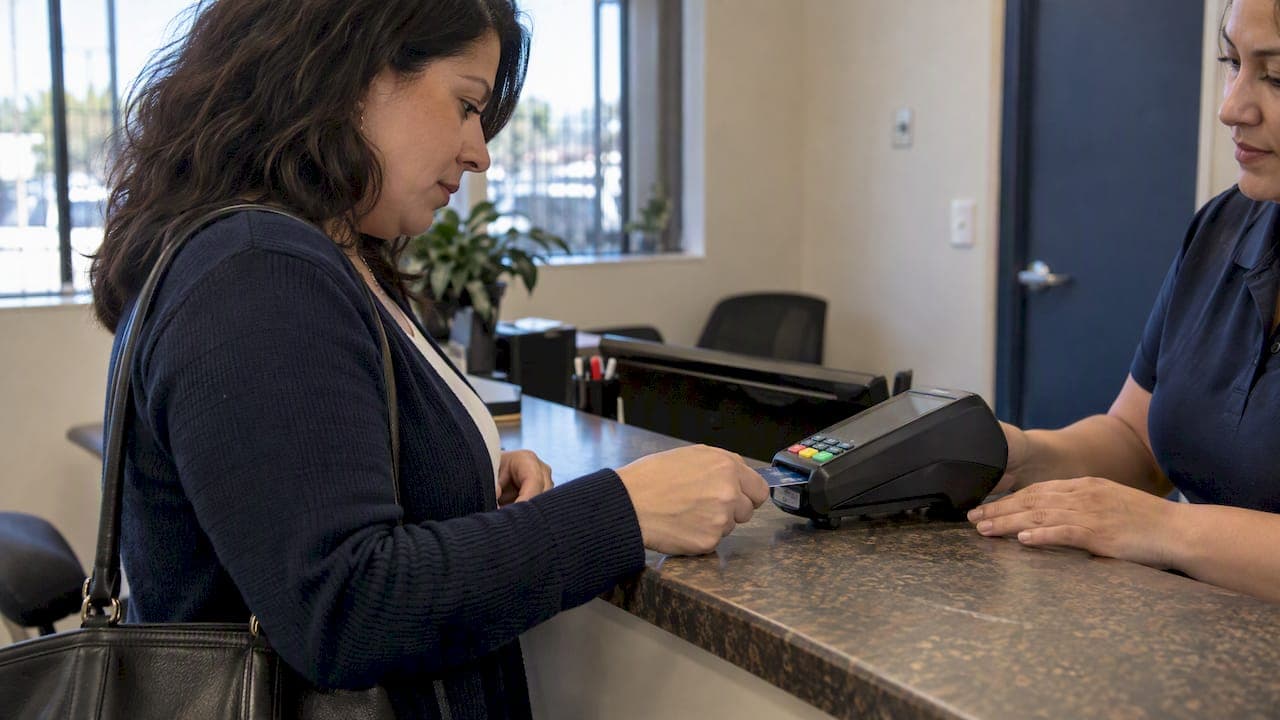
Yes, in many cases, but it depends entirely on who you're paying and what county you're in. Some jails and courts accept cards directly or through a kiosk, others route payments through a third-party processor, and bail bondsmen almost always take cards for the premium. When a direct card payment to the jail isn't available or fast enough, a licensed bondsman can offer a direct path to release.
TL;DR:
- Before paying, verify the booking number and final bail amount, then confirm the facility’s exact portal, accepted cards, and any transaction cap.
- Card processors may charge 2.75% to 7%, plus fixed charges; convenience fees are generally nonrefundable, even when the bail itself is returned.
- Ask your card issuer whether a large payment will trigger a fraud hold or count as a cash advance, which can add separate fees.
- A bondsman charges a premium or down payment rather than the full bail amount; confirm the amount, payment plan, and refund recipient before authorizing payment.
Table of Contents
- How credit card bail payments actually work
- Where you can actually use a credit card
- Step-by-step checklist to pay bail with a credit card now
- Fees, convenience charges, and refund rules to expect
- Troubleshooting: declines, timing delays, and transaction limits
- When hiring a bondsman helps
- Practical priorities when the clock is running
- How we can help right now
- FAQ
- Sources
How credit card bail payments actually work
Three distinct payment paths exist, and each treats your card differently. Direct court or sheriff payments often run through a contracted third-party processor rather than the agency itself. Two examples show up across the country: GovPayNet, used by many sheriff and court agencies for 24/7 card payments, and ePay-It, used by several California courts. Some counties also let you pay at a kiosk inside the jail lobby, though policies vary widely from one county to the next.
These processors act as the merchant of record on your statement, not the court or jail. That matters because they set their own convenience fees, card-type restrictions, and single-transaction caps, separate from whatever the court's own rules say.
Paying a bail bondsman with a card works differently still. You're not posting the full bail amount to the court. You're covering the bond premium, typically a percentage of the total bail, or a down payment toward it. That distinction changes both how much you pay upfront and what happens to your money afterward. Our guide comparing bondsman and cash bail walks through that difference in more detail.

Where you can actually use a credit card
Coverage varies by county, so confirm specifics before you try to pay. In practice, here's where cards tend to work:
County court portals and sheriff cashiering offices sometimes accept cards directly online or in person, but you need the exact portal name and accepted card brands before you attempt a transaction. Snohomish County, for example, uses GovPayNet, which takes major credit, debit, and prepaid cards around the clock, though the service fee percentage varies by agency.
Court systems built around ePay-It, a processor used by multiple California superior courts, generally accept Visa, Mastercard, American Express, and Discover, then add a nonrefundable convenience fee plus a fixed charge on top, shown as its own line item on your statement, according to the ePay-It FAQ.
Licensed bail bondsmen are usually the most flexible option. They typically accept cards for the premium or a down payment and can arrange release without you ever posting full cash bail to the jail.
Step-by-step checklist to pay bail with a credit card now
Work through these steps in order to avoid wasted trips and declined payments:
- Verify the booking details and exact bail amount through the jail's inmate records system before attempting any payment.
- Confirm whether the facility accepts cards directly or only through an online portal, and get the exact web address or kiosk location plus required identifiers like the booking number.
- Check your credit limit and call your card issuer to pre-authorize a large charge, asking whether it will post as a cash advance and what fees that carries.
- If paying a bondsman, confirm exactly what the card covers, premium percentage, down payment, or service fees, and ask about available payment-plan options.
- Keep every transaction receipt and confirm who is entitled to any future refund, since that goes to whoever posted the bail, not necessarily the cardholder.
Pro Tip: Call your card issuer before you leave the house. A surprise fraud hold at the jail counter can cost you an hour you don't have.
Fees, convenience charges, and refund rules to expect
Card payments for bail almost always come with a markup, and it rarely gets refunded.
- Convenience or service fees commonly fall between about 2.75% and 7% depending on the processor and jurisdiction, and some portals tack on a fixed charge as well.
- Fees collected by the processor or court are typically nonrefundable, even after the underlying bail amount is returned.
- Cardholder costs like cash-advance fees or issuer surcharges can apply on top of the processor's fee, so check your cardholder agreement first.
Some jurisdictions charge as much as a 7% service fee on card-based bail payments through GovPayNet, on top of whatever your card issuer charges separately. Refunds of the bail itself go to whoever posted it and follow the court's own refund timeline, which our California bail refund guide breaks down in more detail, but the convenience fee stays with the processor regardless of the outcome.
Troubleshooting: declines, timing delays, and transaction limits
A few problems account for most failed bail payments, and each has a fast fix.
- Declines: Call your bank immediately. Issuers often block large or unfamiliar charges automatically, so ask about daily limits or fraud holds before trying the card again.
- Timing gaps: Booking information and the bail amount may not be finalized right away. Verify availability through inmate records before you travel or attempt payment, since delays of several hours after booking are common.
- Transaction caps: Some portals limit single payments, similar to Alaska's online system, which caps transactions at $99,999 including fees and excludes certain card brands. If you hit a cap, check whether you can split the payment across cards, or call a licensed bondsman to bridge the gap instead.
When hiring a bondsman helps
A bondsman makes the most sense when the bail amount is large, your card keeps getting declined, the arrest happens after hours, or speed matters more than anything else.
When you call, expect a short process: we verify the booking, walk through the payment method that works for your situation, provide documentation for future refunds or exoneration, and stay available for court-date follow-up. That last piece matters more than people expect. A missed court date complicates everything, and having someone track it with you removes one more thing to worry about during an already stressful week.

Practical priorities when the clock is running
When someone calls about a bail payment, the first thing I ask is whether they've actually confirmed the booking number and bail amount yet. Most delays come from people trying to pay before the jail has finalized those details, not from the payment method itself.
My second recommendation is always the same: call your card issuer before you try to pay anything, and have a backup plan ready, whether that's a second card or a bondsman, in case the first option stalls. That's part of why we built our service the way we did: direct, practitioner-led conversations instead of a call center routing you through scripts, with bilingual support to help overcome language barriers during an arrest.
For readers dealing with a nighttime arrest specifically, this 60-minute playbook for posting bail at night covers some of the same ground from a slightly different angle.
— Jake
How we can help right now
If a direct card payment to the jail isn't working, whether it's declined, capped, or simply not offered at that facility, some bail bondsmen can offer a faster route to release.
What we offer:
- Statewide California coverage across all 58 counties, with free consultations any time of day.
- Online bail bond requests you can start from your phone without visiting an office first.
- Bilingual support in Spanish, Hindi, and Arabic for families navigating the process in their own language.
- Specific options for felony, misdemeanor, and $500 down bail bonds, depending on your situation.
Call us directly or start a request through our main bail bonds page for immediate assistance, day or night.
This article is general information, not a substitute for advice from a qualified lawyer. Consult a qualified legal professional about your own circumstances before acting on anything here.
FAQ
How much does a $75,000 bail bond cost?
The premium is typically a percentage of the total bail amount rather than a fixed figure. At our standard 10% premium rate, the premium is 10% of the bail amount, though an 8% attorney discount applies for qualifying cases.
What if you can't afford to pay bail?
Reaching out before the court date matters more than waiting until funds are available, since delays can affect release timing.
How much is bail on a $1,000 bond?
On a bond that small, the premium would be calculated at roughly the standard 10% rate, based on standard premium pricing. Some bondsmen set minimum premiums for very small bonds, so confirming the exact cost before paying is worth the call.
How much would you have to pay on a $50,000 bond?
At a standard 10% premium, the premium is 10% of the bond amount, per current premium rates. With an 8% attorney discount applied, the premium rate is 8% for qualifying cases.
Can you pay a bail bondsman with a credit card?
Most licensed bail bondsmen accept credit cards for the bond premium or a down payment, which is different from posting the full cash bail directly to the court. Confirm exactly what the charge covers and whether a payment plan is available before you authorize the transaction.
Sources
- Bond types and payments — Indy (example county guidance)
- Posting bail online — Alaska Court System
- Posting bail — Snohomish County (GovPayNet example)
- ePay-It FAQ (example Superior Court ePay-It page)