In Santa Clara County, bail moves through four stages: booking, a release review, setting or confirming the bail amount, and posting it. You can post it as cash at the jail or through a licensed bail bond agency. Most families use a bond, which typically costs 10% of the bail amount. This guide explains each stage, who to call, what it costs, and what changes if the case is in Placer County instead.
TL;DR
- After an arrest, a person may be released on their own recognizance (OR) before any bail is needed. If not, a judge reviews release within days and can set bail.
- Call the Administrative Booking Unit at (408) 299-2305 to confirm the bail amount and where the person is held.
- You can post the full bail in cash, or pay a non-refundable fee to a bail bond agency. The fee is commonly 10% of the bail.
- A bond co-signer is responsible for the defendant's court appearances, and may be asked for collateral on larger bails.
- Placer County uses a different jail system and court schedule, so check its posting rules before you go.
Table of Contents
- What happens first: booking and the release review
- How to find the bail amount and confirm where someone is held
- Your options for posting bail
- What bail costs: worked examples
- The bond process, step by step
- How long release takes
- Our perspective: what families get wrong
- Placer County: how the process differs
- Bailing someone out from far away
- Start a bond with us
- Frequently asked questions
- Sources
What happens first: booking and the release review
Bail is not the first step. After an arrest, the person is booked into custody. Santa Clara County's Sheriff explains that a judge sets bail based on the crime, criminal history and likelihood of appearing, and that after bail is posted the defendant may be released until scheduled court proceedings, according to the Sheriff's Administrative Booking page.
The county also screens for release without bail. A person booked on a new arrest may be released before court on their own recognizance, which means a signed promise to appear, unless they are ineligible. Serious or violent charges and a history of failing to appear are examples of reasons for ineligibility. If the person is not released at booking, they go to a judicial review and arraignment within a few days.
At that review, the county's Pretrial Services prepares a report with a risk assessment, criminal history and demographic information. According to Santa Clara County Pretrial Services, the judge can then order:
- OR release: the person signs a release order, follows its terms and appears at every hearing.
- Supervised OR (SORP): the same, plus conditions that may include treatment, domestic-violence counseling, GPS or continuous alcohol monitoring.
- Continued detention: with a probable-cause review and individualized bail.
If release is initially denied, a court date is scheduled within three business days. A person released on SORP must call Pretrial Services on the first business day between 2 p.m. and 4 p.m. at (408) 918-7900.
What this means for you: in the first hours after an arrest, the bail amount you see may not be final. If a family member has just been booked, ask whether an OR review is coming before you pay anything.
How to find the bail amount and confirm where someone is held
Before you spend money, confirm three things: the person is in custody, the bail amount, and the charges. The Administrative Booking Unit provides public custody information, including bail and projected release date. The number is (408) 299-2305, per the Sheriff's booking page.
Have these ready when you call:
- The person's full legal name and date of birth.
- The approximate time and place of the arrest.
- A booking number, if you were given one.
Court bail schedules are a starting point, not a promise. A judicial officer can set bail above or below the schedule in a given case, so the number the jail gives you is the one that counts.
If you are not sure about the charge level, our pages on felony bail bonds in Santa Clara County and misdemeanor bail bonds explain how bail typically differs between them.
Your options for posting bail
Once bail is available, there are two main routes.
Option 1: Cash bail
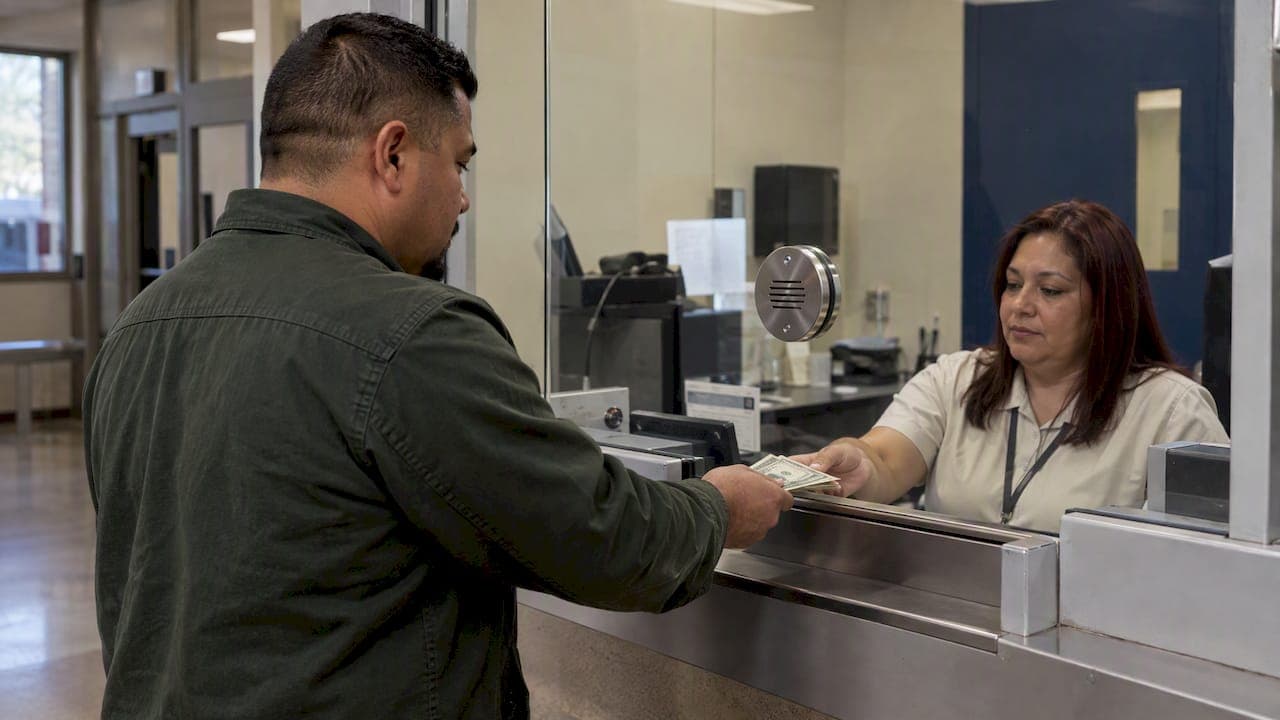
You pay the full amount at the jail lobby cashier. Santa Clara County accepts cash, bank cashier's checks and money orders. Checks and money orders should be payable to the Santa Clara County Judicial District, and the Sheriff lists bail posting as available from 5:00 a.m. to midnight, per the Administrative Booking page.
The money is not gone, but it is tied up. After all proceedings end, the court generally mails the posted funds by check in about four to six weeks, according to the same page. For a $25,000 bail, that means $25,000 out of your account for the length of the case.
Option 2: A bail bond
A licensed bail agent posts a bond with the jail for the full amount, and you pay the agent a non-refundable fee. The California Department of Insurance's overview of the state's bail system says agents commonly charge 10% of the bond, and gives $2,500 as the fee on $25,000 bail. It also says the agent may require collateral or a lien, particularly on high bail, and that the bond company takes responsibility for the defendant's court appearances.
Cash versus bond at a glance
| Cash bail | Bail bond | |
|---|---|---|
| Upfront cost on $25,000 bail | $25,000 | Commonly 10%, or $2,500 |
| Do you get the money back? | Yes, generally in about four to six weeks after the case ends | No, the fee is non-refundable |
| Who is responsible for appearances | The defendant, with your deposit at stake | The bond company, with the co-signer accountable |
| Collateral | None | Possible, especially on high bail |
The trade-off is simple. Cash costs more up front but comes back. A bond costs less up front and the fee does not come back. If you cannot tie up the full amount, or would rather keep your savings available, a bond is the usual route.
What bail costs: worked examples
The common 10% rate makes the math easy, using the percentage the Department of Insurance cites above:
| Bail amount | Fee at 10% |
|---|---|
| $10,000 | $1,000 |
| $25,000 | $2,500 |
| $50,000 | $5,000 |
| $100,000 | $10,000 |
Our premium is the 10% rate, and attorneys receive an 8% rate. You can see both on our bail bond cost page. Many families ask about the amount due on day one. If a full premium is out of reach, our $500 down bail bonds page explains the lower-down-payment options, and payment plans are available for qualified co-signers.
So a $100,000 bail means a $10,000 premium at the standard rate. On $100,000, an attorney-referred bond at 8% would be $8,000. These are straight percentage calculations, and the final paperwork shows your exact figure.
The bond process, step by step
Here is how a bond typically goes once you know the bail amount.
- Call a licensed agent. Give the defendant's name, booking number if you have one, and the bail amount. A good agent will tell you the premium before you commit.
- Pick the co-signer. This is the person who signs the bond agreement and agrees to be responsible. Agents typically ask about identity, income and ties to the area, and may ask for collateral on larger bails.
- Sign and pay. Many agents, including us, can handle signing online through our online bail bonds process, so you do not have to travel to an office.
- The agent posts the bond. The bond is delivered to the jail, and the jail processes the release.
- Release and court dates. The defendant leaves custody once processing is finished and must attend every hearing.
For a longer statewide walkthrough, see how bail bonds work in California. For the San Jose side of the county specifically, our San Jose bail process guide covers the local details.
How long release takes
Nobody can promise a clock time, because the jail controls processing. Release depends on how busy booking is, whether the person has holds from other agencies, and whether paperwork is complete and correct. A hold from another county or an immigration detainer can stop a release even after bail is posted. The Administrative Booking Unit gives projected release-date information at (408) 299-2305, so call it if you are waiting.
Three things most often slow a release:
- Wrong or missing information. A misspelled name or incorrect booking number can send paperwork back.
- Other holds. A warrant elsewhere or a probation hold may keep the person in custody. We handle complex holds such as 1275 holds, so mention anything you know about the person's history up front.
- Immigration detainers. These follow a separate path from criminal bail. Our page on immigration bail bonds in Santa Clara County explains what is different.
Our perspective: what families get wrong
We see the same few mistakes over and over, and most of them come from panic, not carelessness.
The first is paying the first number someone quotes. Bail percentages are regulated, and the standard fee is commonly 10%. Ask for the premium in dollars before you sign anything. The second is not asking about collateral until the end. On a large bail, an agent may ask for it, and you want that conversation first. The third is treating the co-signer role lightly. When you sign, you are taking on responsibility for the defendant showing up, and a missed court date can cost you.

We built our service around being reachable by the person who actually knows your case. There is no call center between you and the agent. We are available 24/7, free consultations are standard, and we work in Spanish, Hindi and Arabic as well as English, because arrests do not happen on business hours or in one language. Once the bond is posted, our job is not over. We help you keep track of every court date, because a missed hearing is the most avoidable way for a bond to go wrong.
If you are unsure whether to use a bond at all, that is a fair question. If the person is likely to be released on OR at the review, you may not need one. Ask first, then decide.
— Jake
Placer County: how the process differs
Some readers searching this topic have a case in Placer County, which sits in a different part of the state with its own jails and court. The core idea is the same, but the details are not.
- Where and when. Placer County says bail can be posted at the Auburn Jail or South Placer Jail 24/7. Accepted forms are cash, cashier's check, certified check, money order or bail bond, per the county's Posting Bail page.
- After 7 p.m. The county advises anyone posting a bond after 7 p.m. to contact the specific jail before arriving.
- Who delivers bonds. Bonds must be delivered by a licensed bail agent. The agent needs the bail amount, the charges, the court case number, the court date and department, and the jail identification number.
- Inmate funds. Money on an inmate's trust account can be used to pay bail on the inmate's instruction to a bail agent, according to the 2024 inmate rulebook.
- Bail schedule. The Placer County Superior Court publishes a Uniform Bail & Penalty Schedule that took effect January 1, 2026, on its fee schedule page. Check that page for the current version.
In short, if you are bailing someone out of Placer County, confirm which jail holds them, gather the case number and court date, and call the jail before arriving late in the evening. We cover all 58 California counties, so the same agent can help whichever county the arrest happened in.
Bailing someone out from far away
Many co-signers are not in the Bay Area at all. Parents, spouses and partners often live in another state. You do not need to be in Santa Clara County to arrange a bond. Paperwork can be signed electronically, and the agent handles delivery to the jail. Our guide on bailing someone out of a California jail from another state walks through identification, payment and what to expect.
Start a bond with us
If you have a bail amount and need to move, call us any time, day or night. We give free consultations, explain the premium in dollars before you sign, and apply the attorney discount automatically when an attorney is involved. Our California bail bonds service covers all 58 counties, including Santa Clara and Placer, with felony, misdemeanor, federal and immigration bonds.
Frequently asked questions
How does the bail process work in Santa Clara County?
After booking, the person may be released on their own recognizance if eligible. If not, a judge reviews release within a few days and can set bail or order continued detention. Once bail is set, you can post cash at the jail or use a licensed bail agent.
How much does a $25,000 bail bond cost in California?
The California Department of Insurance says agents commonly charge 10% of the bond, which is $2,500 on $25,000 bail. That fee is non-refundable. The agent may also ask for collateral, especially on higher bail amounts.
How much is a bond on $100,000 bail?
At the common 10% rate, the fee is $10,000. Attorneys can qualify for an 8% rate with us, which would be $8,000 on the same bail. A co-signer also takes on responsibility for the defendant's court appearances.
Can I get my money back if I pay cash bail?
Yes, generally. The Sheriff says that after all proceedings the court typically mails the posted funds by check in about four to six weeks. A bond fee, by contrast, does not come back.
Is Placer County bail different from Santa Clara County bail?
The basic options are the same, but the jails, hours and court schedules differ. Placer County accepts bail 24/7 at its Auburn and South Placer jails and asks that bonds posted after 7 p.m. be cleared with the jail first.
Sources
- Administrative Booking, Santa Clara County Sheriff
- Pretrial investigations and releases, Santa Clara County Pretrial Services
- An Exploration of California's Bail System, California Department of Insurance
- Posting Bail, Placer County
- Information and Rules for Inmates, Placer County (2024)
- Fee Schedule, Placer County Superior Court