
Bail is almost always available after a domestic violence arrest in California, but the process runs on different rules than a typical charge. Every arrest for a qualifying domestic violence offense triggers a mandatory hearing under California Penal Code § 1270.1 before a judge can release someone below the county's scheduled amount or on their own recognizance. Expect the county bail schedule to set the starting number, protective order conditions to follow, and a short clock. Contact a defense attorney and a bail agent right away.
TL;DR:
- The district attorney's office can request a bail amount higher than the county schedule if they believe it is insufficient for the case's circumstances.
- The typical bail for a misdemeanor domestic battery is between $10,000 and $20,000, while felony assault charges often start around $50,000.
- The mandatory PC 1270.1 hearing must be scheduled at least two court days before bail can be set or modified, delaying immediate release in many cases.
- Protective orders issued at arrest or arraignment generally include no contact and stay-away conditions, with firearm restrictions being standard for those subject to orders.
- Fast release relies on prompt coordination with counsel and bail agents, as delays from holds or higher bail requests can extend custody even after bond posting.
Table of Contents
- How Does Domestic Violence Bail Work in California?
- What Bail Amounts Are Common for Domestic Violence Charges?
- What Do Judges Weigh When Setting or Changing Bail?
- What Happens at the PC 1270.1 Hearing?
- Protective Orders and Release Conditions to Expect
- Cash Bail vs. a Bail Bond: What Actually Gets Someone Out Faster?
- What Should You Do First After a Domestic Violence Arrest?
- What I've Learned Coordinating Bail in Domestic Violence Cases
- Get Statewide Help With Domestic Violence Bail Right Now
- Primary Sources for California Domestic Violence Bail Law
- Sources
How Does Domestic Violence Bail Work in California?
The process starts with booking. Once police book someone on a domestic violence charge, the arresting agency logs the charge that controls which line of the county bail schedule applies. Every county sets its own uniform bail schedule, so the same charge can carry a different presumptive amount in Los Angeles County than it does in Riverside or Sacramento County.
From there, timing takes over. Under Penal Code § 825, the person in custody must be brought before a magistrate within 48 hours of arrest, not counting Sundays and holidays. That deadline runs alongside the notice requirements built into PC 1270.1, which means the same 48 hour window that governs arraignment also shapes when the special domestic violence bail hearing gets scheduled.
Two other statutes matter here and often surprise families:
- PC § 1269c lets the arresting officer request bail higher than the county schedule if the officer believes the scheduled amount is inadequate for the circumstances of the case.
- PC § 1275.1 allows a judge to place a hold on bail funds if there's reason to believe the money used to post bail came from illegal activity, which can freeze a bond even after it's arranged.
Both of those provisions can add delay on top of the 1270.1 hearing itself, and neither provision is negotiable once invoked. That's the practical reason speed matters so much in the first hours after an arrest: the person handling the case, whether that's a defense attorney or a bail agent, needs time to gather documentation before the hearing clock runs out. Waiting a day to make calls can mean an extra day or more in custody.
What Bail Amounts Are Common for Domestic Violence Charges?
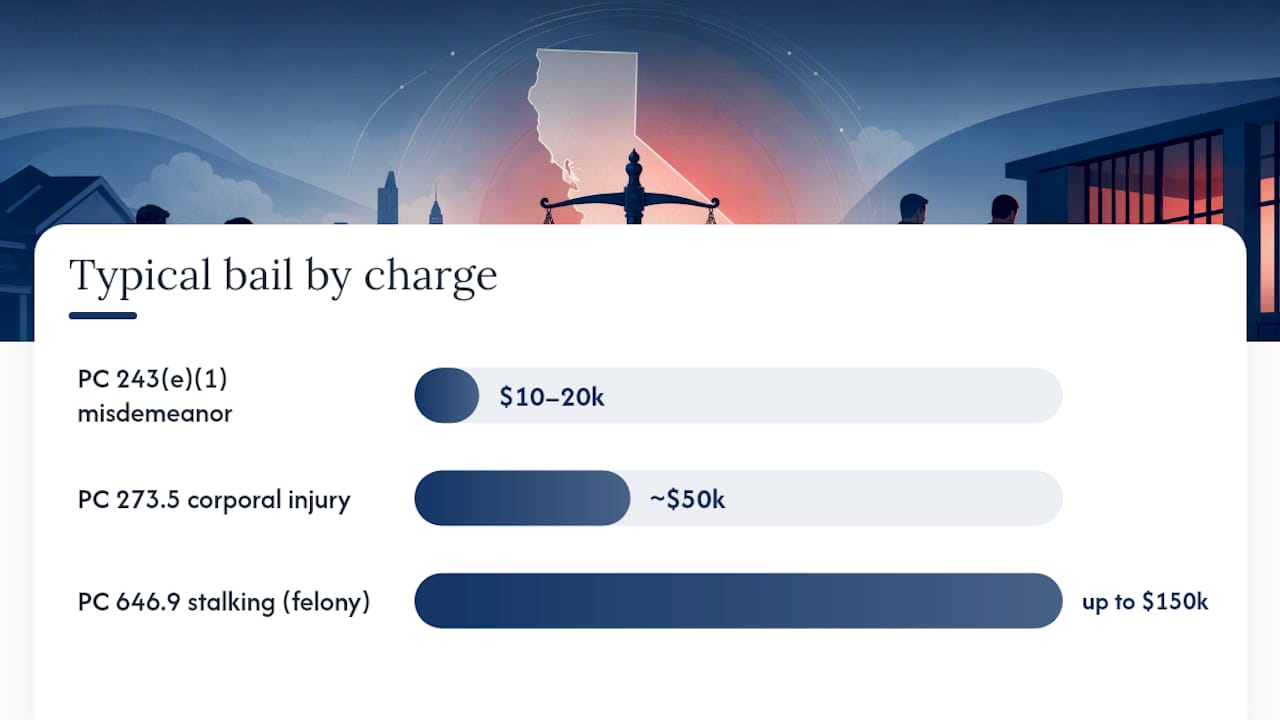
Bail numbers vary by county, but the charge itself drives most of the difference. Misdemeanor domestic battery under PC 243(e)(1) typically sits in a lower band than felony corporal injury under PC 273.5, and prior convictions push both categories higher fast.
Rough figures from county schedules and legal practice data show the general pattern:
- PC 243(e)(1) domestic battery (misdemeanor): often $10,000 to $20,000 for a first offense, depending on the county.
- PC 273.5 corporal injury to a spouse or cohabitant (wobbler, often filed as a felony): commonly starts near $50,000 in several large counties.
- PC 273.6 violation of a protective order: bail typically scales with whether the underlying conduct also involved new violence, so amounts range widely by county and by whether it's a repeat violation.
- PC 646.9 stalking: felony schedules can run considerably higher than corporal injury cases, with some counties listing amounts up to $150,000 when the charge includes qualifying priors or a pattern of conduct.
Prior convictions change the math directly. A first-time PC 273.5 arrest might land at the county's base felony figure, while a second arrest with a prior domestic violence conviction on record can see that number rise significantly under the same schedule. County uniform bail schedules list these tiers explicitly, and San Bernardino, Los Angeles, Orange, and San Diego counties each publish their own version with different dollar figures for identical charges.
Finding the right number means finding the right document. Every county superior court posts its current bail schedule online, and the booking charge, not the police report narrative, determines which line applies. If you're not sure which charge was booked, call the jail and ask directly. That single phone call often clears up more confusion than anything else in the first hour after an arrest.
What Do Judges Weigh When Setting or Changing Bail?
Public safety comes first. California courts treat protection of the alleged victim and the broader community as the primary factor in domestic violence cases, ahead of flight risk or even the county schedule amount itself. Under PC § 1275, a judge setting, reducing, or denying bail must also weigh:
- The seriousness of the alleged offense and any use of a weapon.
- The defendant's criminal history, especially prior domestic violence convictions.
- Ties to the community, including employment, housing, and family in the area.
- Flight risk based on past court appearance history.
- The defendant's ability to pay, which can support non-monetary release conditions in appropriate cases.
When a judge departs from the standard schedule, whether raising or lowering the amount, state law requires the reasons go on the record. That record typically documents which factors drove the decision, which matters later if the defense wants to file a motion to reduce bail.
Pro Tip: Bring documented mitigation to the hearing, not just verbal assurances. A signed employment letter, a lease showing local residence, and a written treatment or supervision plan carry more weight with a judge than a family member simply saying the defendant "isn't a flight risk."
What Happens at the PC 1270.1 Hearing?
This hearing is the single biggest difference between domestic violence bail and bail for almost any other charge category. PC 1270.1 applies to a defined list of offenses, including corporal injury to a spouse or cohabitant, violation of a protective order, stalking, and several other domestic violence related crimes. If the booking charge falls on that list, no judge can set bail below the county schedule or grant OR release without holding this hearing in open court first.
Here's how it typically plays out:
- The court must give written notice at least two court days before the hearing to the prosecutor and, where applicable, the defense.
- If the defendant hasn't yet retained an attorney, the court appoints counsel for the limited purpose of that hearing, though that appointment doesn't automatically continue for the rest of the case.
- The judge hears argument on the statutory factors, reviews any protective order requests, and either affirms the schedule amount or issues a modified order with reasons stated on the record.
Missing this window carries a real cost. Someone who can't prepare in time, or who has no attorney lined up when the notice period starts, often stays in custody through arraignment simply because there was no time to build a case for a lower amount. That's why the bail motion hearing process benefits so much from early preparation rather than scrambling once notice arrives.
Protective Orders and Release Conditions to Expect
Almost every domestic violence release comes with strings attached, and they start before the bail hearing even happens. Officers can issue an Emergency Protective Order (EPO) at the scene of the arrest, which typically lasts several days and can order no contact with the alleged victim immediately, before a judge ever reviews the case.
At arraignment, the court often replaces that EPO with a criminal protective order covering the length of the case. These orders commonly include:
- No contact with the alleged victim, directly or through a third party.
- A stay-away distance from the victim's home, workplace, or school.
- GPS or electronic monitoring in higher-risk cases.
- Drug or alcohol testing and curfew restrictions.
One condition applies almost automatically: under Penal Code § 29825, a person subject to a domestic violence protective order cannot own or possess firearms while that order is active, and courts require surrender of any weapons already owned. Research from the Public Policy Institute of California notes that while overall domestic violence reports have declined, the severity of reported incidents has risen, part of why courts treat these firearm and no-contact conditions so strictly even when bail itself gets posted quickly.
Cash Bail vs. a Bail Bond: What Actually Gets Someone Out Faster?
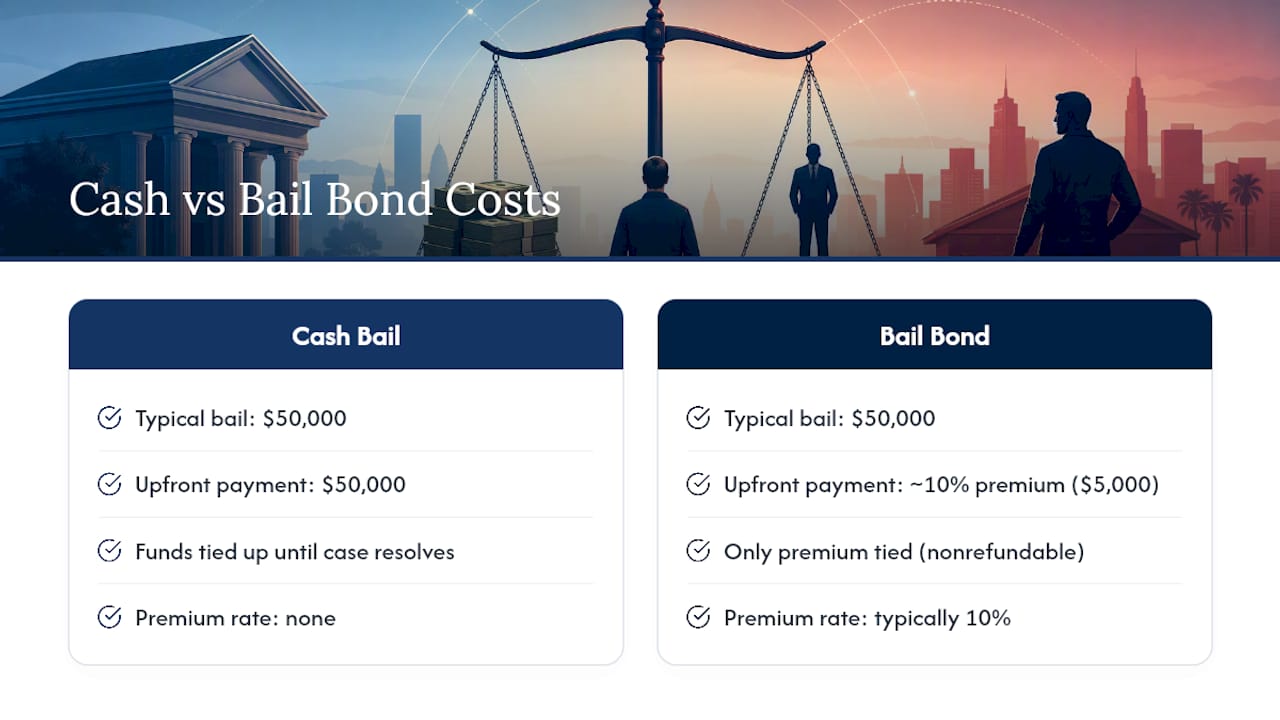
Posting the full bail amount in cash is legal, but it ties up that entire sum until the case resolves. A bail bond works differently: a licensed bail agent guarantees the full bail amount to the court, and the family pays a percentage of that total as a nonrefundable premium, typically 10% under California's standard rate. On a $50,000 felony domestic violence bond, that's a $5,000 premium rather than $50,000 in tied-up cash.
Families working with Jake Hernandez Bail Bonds get a few things that matter in a domestic violence case specifically: statewide coverage across all 58 counties, 24/7 availability since arrests don't wait for business hours, payment plans and 0% down options for qualified co-signers, and bilingual support in Spanish, Hindi, and Arabic for families navigating an already stressful process in a second language. The bail bond cost calculator breaks down premium structures before you commit to anything.
Even with a bond arranged, release isn't always instant. A PC 1275 hold on the source of bail funds, an officer's request for higher bail under PC 1269c, or simple booking backlog at the jail can all push release back by hours, sometimes longer.
Pro Tip: Ask the bail agent whether the arresting agency has flagged a PC 1275 hold before you finalize payment. Knowing that up front saves you from arranging a bond that can't be executed yet.
What Should You Do First After a Domestic Violence Arrest?
The first two hours matter more than almost any other point in the case. Here's the order that actually helps:
- Call the jail to confirm the exact booking charge, the county, and the booking number. The charge determines the schedule amount, so guessing wastes time.
- Contact a defense attorney and a licensed bail bond company at the same time, not sequentially. Gather government ID, proof of employment, proof of residence, and names of people who can speak to community ties.
- Do not contact the alleged victim if any protective order, emergency or criminal, is already in place, even to apologize or explain. Doing so can itself become a new criminal charge.
- Never give a recorded statement to police without an attorney present, regardless of how minor the underlying incident seems.
Pro Tip: Write down the exact time of arrest as soon as you learn about it. That timestamp determines the 48 hour magistrate deadline and the two court day notice window for the PC 1270.1 hearing, and having it in writing prevents confusion later.
What I've Learned Coordinating Bail in Domestic Violence Cases
Families almost always assume that once they have the bail money, release happens immediately. It doesn't work that way in a domestic violence case, and that gap between expectation and reality causes more stress than the arrest itself. The PC 1270.1 hearing exists precisely because lawmakers decided these cases need judicial eyes on release conditions before money changes hands, not after.
What actually moves cases forward isn't panic, it's preparation. Getting a defense attorney on the phone in the same hour as the bail agent, rather than treating those as separate errands, consistently produces faster and cleaner outcomes than waiting to see what the court schedules first.
Compliance matters just as much as speed. A fast release that ignores a no-contact order or a firearm surrender requirement creates a second legal problem on top of the first one.
— Jake
Get Statewide Help With Domestic Violence Bail Right Now
Jake Hernandez Bail Bonds gets families through the PC 1270.1 hearing window faster than trying to navigate county bail schedules alone, with statewide coverage across all 58 California counties and agents available 24/7 because arrests don't follow business hours.
When you call, have the inmate's full name, booking number, county of arrest, and a photo ID ready so the agent can start working the case immediately instead of tracking down basic details first. For felony domestic violence charges carrying higher scheduled amounts, the felony bail bonds page walks through how complex holds get resolved. Visit Jake Hernandez Bail Bonds or call now to start the release process today.
Primary Sources for California Domestic Violence Bail Law
Verify these directly before a hearing:
- Penal Code § 1270.1: governs the mandatory domestic violence bail hearing and notice timing.
- Jake Hernandez Bail Bonds' penal code overview: plain language summaries of the statutes referenced throughout this article.
- Your county superior court website: posts the current uniform bail schedule for every charge category.
This article is general information, not a substitute for advice from a qualified lawyer. Consult a qualified legal professional about your own circumstances before acting on anything here.
Sources
- California Penal Code § 1270.1
- Bail for Domestic Violence Charges in California — My Rights Law
- How Much Is Bail for Domestic Violence in California? — LegalClarity