An arrestee's prior criminal history directly affects whether a California judge grants release, how high bail is set, and what terms a bail agent will require from you as a co-signer. Under California Penal Code §1275, judges must weigh public safety, offense seriousness, prior record, and likelihood of appearance before setting any bail amount. The California Department of Insurance (CDI) regulates bail agents statewide, and agents run their own underwriting review of that same history before agreeing to post bond.
Key facts to know right now:
- PEN §1275 is the statutory anchor: public safety is the primary consideration, and prior record is explicitly listed.
- Each of California's 58 superior courts maintains its own bail schedule; judges start there and may depart based on history.
- The CDI oversees agent licensing and rate filings; the standard nonrefundable premium is 10% of the bail amount.
- Call a licensed bail agent like Jakehernandezbailbonds immediately, and gather the documents listed in Section 5 before you make that call.
Table of Contents
- How California judges use criminal history when setting bail
- How bail bond companies evaluate criminal history and set bond terms
- Concrete steps families and co-signers can take to speed release
- What the timeline and costs look like when history is a factor
- How a criminal record affects sentencing, parole, and probation
- How criminal records affect employment and housing
- Legal rights to access and correct your criminal record
- How different jurisdictions handle criminal records
- Expungement and record sealing in California
- Key Takeaways
- What families often get wrong about criminal history and bail
- Jakehernandezbailbonds is ready when you need to move fast
How California judges use criminal history when setting bail
California Penal Code §1275 lays out four factors judges must consider: protection of the public, seriousness of the offense, previous criminal record, and probability of appearance. Public safety sits first. That ordering matters because a judge can deny bail entirely on safety grounds, regardless of how strong the other factors look.
Each of California's 58 superior courts sets its own bail schedule, listing dollar amounts by charge category. Judges typically open with the schedule figure, then adjust. Lowering bail below schedule for a serious or violent felony requires a finding of "unusual circumstances," per the CRPC Staff Memorandum 2022-10. Raising it above schedule is easier and happens routinely when the record shows repeat offenses or active supervision.
Beyond the schedule, judges rely on several additional inputs:
- Pretrial risk-assessment tools, used by many California counties, assign point scores based on factors like age, prior convictions, and failures-to-appear (FTAs).
| Factor | Effect on bail |
|---|---|
| Prior violent felony conviction | Raises amount; may trigger safety-based denial |
| Recent FTA on record | Raises amount; increases flight-risk score |
| Active parole/probation hold | Blocks release until hold resolved |
| Immigration detainer | Blocks release regardless of bail posted |
| Clean record, strong ties | Supports lower amount or OR release |
Pro Tip: Before the arraignment, ask the jail's booking desk whether any holds are active. A bail agent cannot post bond on a hold that hasn't been cleared, and knowing this early saves hours.
How bail bond companies evaluate criminal history and set bond terms
Bail agents run their own underwriting review, separate from the judge's decision. The CDI requires agents to charge filed rates, and the standard nonrefundable premium is 10% of the bail amount. But the premium is just the starting point.
When a defendant's record raises red flags, agents adjust terms in several ways:
- Higher collateral requirements — property, vehicles, or cash held against the risk of a skip.
- Larger down payment — instead of a payment plan, the agent may require more upfront.
- Stronger co-signer vetting — credit checks, employment verification, and proof of local ties become more rigorous.
- Outright denial — agents can decline to write a bond for defendants with absconding history, active immigration detainers, or outstanding warrants in multiple counties.
The specific triggers that most commonly change terms:
- Violent prior convictions within the last five years.
- Any prior FTA on a bond the agent or a colleague wrote.
- Absconding history (defendant left jurisdiction while on bond).
- Active immigration detainer (agent cannot recover the defendant if ICE takes custody).
- Outstanding warrants that haven't been cleared.
Pro Tip: Disclose everything upfront. Agents who discover undisclosed history mid-process often pause or cancel the bond. Honesty at the start gets you to a faster answer, even if that answer is a higher down payment.
Jakehernandezbailbonds offers 0% down and payment-plan options for qualified co-signers, along with attorney and military discounts. Bringing complete documentation to the first call shortens the underwriting review significantly.
Concrete steps families and co-signers can take to speed release
Speed is the variable families control most directly. Here is what to gather before you call:
- Government-issued photo ID (yours, not just the defendant's).
- Proof of your relationship to the defendant (utility bill, lease, or family documents).
- Proof of residence and employment for both you and the defendant.
- Recent paystubs or bank statements showing ability to pay the premium.
- The defendant's booking number, full legal name, and the jail facility name.
- Any existing court records, probation/parole paperwork, or prior bail documents.
- The county bail schedule amount if you can find it online.
Once you have those documents, here is the sequence that tends to move fastest:
- Call a licensed bail agent immediately — agents can begin underwriting before arraignment, so the bond is ready to post the moment bail is set.
- Disclose all known history — FTAs, holds, prior bonds, and pending cases. Surprises cause delays.
- At the arraignment, emphasize ties — stable employment, family in the area, length of residence, and any prior appearances without incident all support a lower bail argument.
- Ask about nonfinancial conditions — under Humphrey, the judge must consider alternatives to cash bail; an attorney can raise this directly.
- Confirm no holds are active — verify with the jail before the agent posts bond.
Pro Tip: A bail hearing guide can help you understand exactly what the judge will ask and what the agent needs to confirm before posting.
What the timeline and costs look like when history is a factor
Arraignment is required without unnecessary delay, typically within 48 hours of arrest (excluding weekends and holidays), per the CRPC Staff Memorandum. Criminal history can stretch that window considerably.
| Scenario | Typical timeline | Estimated premium |
|---|---|---|
| Nonviolent charge, clean record | Release usually within a couple of days | 10% of the bail amount |
| Prior FTA, nonviolent charge | Additional time for verification may be required | Premium may be higher depending on circumstances |
| Violent prior, elevated bail | Release may take several days; additional collateral may be needed | Premium typically higher proportionate to bail amount |
| Active hold (parole/warrant) | Release is delayed until hold is cleared; timeframe varies | Premium amount affected by bail and collateral requirements |
The premium is nonrefundable regardless of outcome. If the case is dismissed after bond is posted, the agent keeps the premium. Payment plans are common in California, and Jakehernandezbailbonds structures plans around what co-signers can realistically manage.
Active holds are the biggest timeline wildcard. An outstanding warrant in a neighboring county can add days while the detaining agency processes the transfer or recall. Immigration detainers operate on federal timelines entirely outside the state court's control.
How a criminal record affects sentencing, parole, and probation
The significance of criminal records extends well past the bail hearing. At sentencing, California's Three Strikes Law can double a sentence for a second serious or violent felony and mandate 25 years to life for a third. Prior convictions also affect which probation conditions a judge imposes and whether probation is available at all.
Parole eligibility turns heavily on institutional behavior and prior record. Defendants with histories of violence or repeated violations face longer parole terms and stricter supervision conditions. Probation violations, when the underlying record already shows prior failures, are treated more seriously and are more likely to result in custody rather than a warning.
How criminal records affect employment and housing
For co-signers and families thinking beyond the immediate release, the impact of criminal history on daily life is substantial. California's "ban the box" law (AB 1008) prohibits most employers from asking about convictions on initial applications, but background checks still occur later in the hiring process. Convictions for violent offenses, theft, or fraud remain visible and regularly result in disqualification.
Housing is similarly affected. Private landlords routinely run background checks, and federally subsidized housing programs have their own exclusion rules for certain conviction types. A recent felony conviction can effectively close off entire categories of rental housing.
Legal rights to access and correct your criminal record
Every person in California has the right to request their own criminal history from the California Department of Justice (DOJ) through a Live Scan fingerprint submission. If the record contains errors, such as charges that were dismissed or arrests that did not result in conviction, you can petition the DOJ for correction. Inaccurate records can inflate bail amounts and affect underwriting, so correcting them before a future arrest matters.
If you need immediate legal guidance on how your record may affect your case strategy, a criminal defense attorney can review your history and advise on both record accuracy and courtroom strategy.
How different jurisdictions handle criminal records
California's approach differs meaningfully from other states. California maintains a centralized criminal history database through the DOJ, but each county's bail schedule, risk-assessment tool, and prosecutorial charging practices vary. Los Angeles County's bail schedule differs from San Diego's or Sacramento's for the same charge.
Federally, criminal records are maintained through the FBI's National Crime Information Center (NCIC). Federal courts use the U.S. Sentencing Guidelines, which assign criminal history points that directly determine sentencing ranges. A defendant with a Category VI criminal history score faces dramatically longer sentences than a Category I defendant for the identical offense.
Expungement and record sealing in California
California Penal Code §1203.4 allows expungement of many misdemeanor and felony convictions after probation is completed. Expungement does not erase the record entirely but allows the defendant to state they were not convicted for most employment purposes. It does not restore firearm rights or affect sex offender registration requirements.
For arrests that did not result in conviction, Penal Code §851.87 allows sealing of the arrest record. Sealed records are not visible to most employers or landlords, though law enforcement retains access.
Critically for bail purposes: expunged or sealed records can still be considered by judges and bail agents in future proceedings. The factors judges weigh include the full history accessible to law enforcement, not just what appears on a standard background check.
Key Takeaways
A defendant's criminal record shapes every stage of the California pretrial process, from the bail amount a judge sets to the collateral a bail agent requires from you as a co-signer.
| Point | Details |
|---|---|
| Judges follow PEN §1275 | Public safety is primary; prior record, FTAs, and holds all raise bail or trigger denial. |
| County bail schedules are the floor | Lowering below schedule for serious/violent felonies requires a finding of unusual circumstances. |
| Agents underwrite independently | Violent priors, FTAs, and active holds can increase collateral, raise down payments, or produce a denial. |
| Premium is nonrefundable | The 10% premium is kept by the agent even if the case is dismissed after bond is posted. |
| Jakehernandezbailbonds covers all 58 counties | 0% down and payment plans are available for qualified co-signers; call with booking info and documents ready. |
What families often get wrong about criminal history and bail
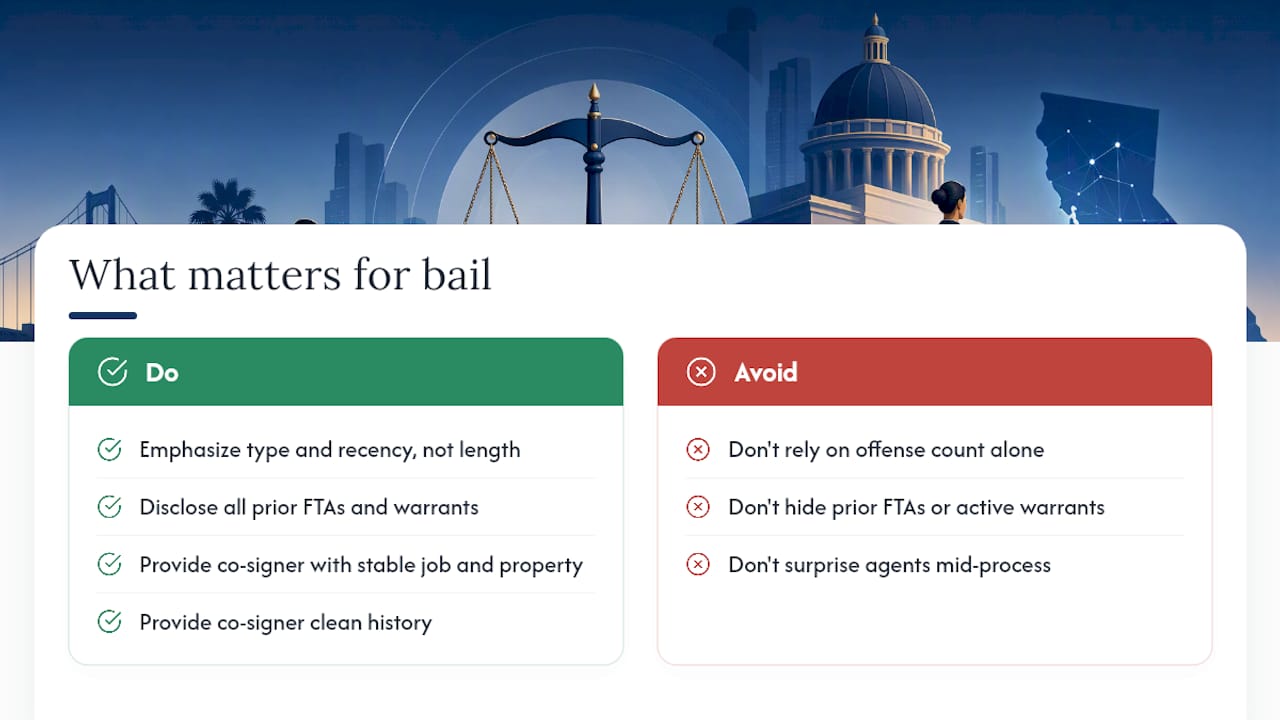
The conventional wisdom is that a long record automatically means no bail. That is too simple. What actually drives outcomes is the type and recency of the history, not the length of the list. A defendant with eight minor misdemeanors from a decade ago often presents a lower risk profile than someone with a single violent felony from two years ago. Judges and agents both read the pattern, not just the count.
The other thing families underestimate is how much the co-signer's profile matters. When a defendant's record is problematic, a co-signer with stable employment, local property, and a clean history can shift the agent's risk calculation enough to get a bond written that would otherwise be declined. Your credibility is part of the underwriting.
Disclose everything. Every time a family hides a prior FTA or an active warrant hoping it won't come up, it comes up, and it comes up at the worst possible moment. Agents who find surprises mid-process slow down or stop entirely. The families who move fastest are the ones who walk in with complete information and let the agent work with the full picture from the start.
Jakehernandezbailbonds is ready when you need to move fast
When criminal history complicates a bail situation, the difference between a same-day release and a multi-day wait often comes down to how quickly a licensed agent can begin underwriting. Jakehernandezbailbonds handles bonds from $1,000 to $1,000,000 across all 58 California counties, including complex holds, federal bonds, and immigration cases.
Free consultations are available 24/7. Bilingual support in Spanish, Hindi, and Arabic means no family gets left waiting for a translator. Bring the defendant's booking number, the facility name, and your ID, and the team can begin the process immediately. For qualified co-signers, 0% down and flexible payment plans are on the table from the first call.
Start your free consultation now or call anytime, day or night. Have the booking information ready and Jakehernandezbailbonds will handle the rest.