
"Zero down" bail is real in specific cases, but it almost never erases what you owe. It usually means a bondsman defers the premium into a payment plan, accepts collateral instead of cash, or you qualify for own recognizance release, where a judge lets someone out with no bond at all. The legal obligation, and often the full 10% premium, still exists somewhere in the arrangement.
TL;DR:
- Zero down bail usually involves a payment plan, collateral, or judicial discretion, but the full premium often remains due regardless of the agreement type.
- Co-signers are legally responsible for the entire bail amount if the defendant fails to appear, with collateral seizure and civil suits common remedies.
- Valid zero-down offers depend on a clear written agreement, accurate licensing, and transparency about default consequences, not on vague advertising claims.
- Most "zero down" bail offers are risk-based, with shorter repayment terms and tighter follow-up to reduce agency losses.
- Confirm bail options directly with providers and avoid agencies that refuse to provide a detailed written breakdown of terms and costs.
Table of Contents
- How Does 0 Down Bail Actually Work?
- What Do Co-Signers Actually Agree To?
- How Do Bondsmen Underwrite a Zero-Down Offer?
- How Do You Verify a Zero-Down Bail Claim?
- What Should You Do Right Now If Someone Is in Jail?
- How a Licensed Bondsman Approaches Zero-Down Requests
- Get a Straight Answer on Your Bail Options Tonight
- Where to Verify Bail Rules in Your State
- Sources
- FAQ
How Does 0 Down Bail Actually Work?
Nobody hands out free bail. When an agency or a court advertises "zero down," one of four things is happening underneath the marketing.
Own recognizance (OR) release is the only outcome where genuinely no money changes hands. A judge decides the defendant can be trusted to show up based on flight risk, community ties, and the charge itself. It's entirely up to judicial discretion, and availability shifts by county and even by courtroom, since state bail practices vary significantly across jurisdictions.
Payment plans are the most common version of "0 down." A bondsman posts the full bail with the court, then lets the co-signer pay the premium in installments instead of upfront. The premium itself doesn't shrink. Premium financing structures simply spread that cost over weeks or months, sometimes with added fees.
Collateral-only arrangements swap cash for an asset, a car title, home equity, jewelry, that the agency can seize if the defendant skips court. No money moves, but real property is now on the line.
Court deposit programs, where a defendant can post a percentage directly with the court instead of hiring a bondsman, exist in some counties but are far less common than bondsman-financed bail in California.
A closer breakdown:
- OR release: no bail, no bondsman, judge's call only
- Payment plans: bail posted in full, premium paid over time
- Collateral-only: an asset secures the bond instead of cash
- Court deposit: rare, jurisdiction-specific, paid straight to the court
What Do Co-Signers Actually Agree To?
Signing as a co-signer, also called an indemnitor, means signing a contract to cover the entire bail amount if the defendant fails to appear. That's the part most families gloss over when they're relieved to get someone home.
The premium you pay a bondsman is nonrefundable no matter what happens next, even if the charges get dropped the next morning. Bail bond companies collect that 10% to 15% fee as their earned revenue for taking on the risk, separate from the bail principal itself.
If the defendant misses a court date, here's what typically follows:
- The agency attempts to locate the defendant, often through a recovery agent
- Collateral pledged against the bond can be seized and sold
- The agency can file a civil suit against the co-signer for the full bail amount
- Wage garnishment or liens against property are legal remedies in many states
- Courts generally allow a forfeiture window of several weeks to months before the bond is fully forfeited
Statistic Callout: On a $50,000 bail, the standard premium runs $5,000 to $7,500, and that amount is gone permanently the moment the bond is posted, regardless of the case outcome.
Picture a co-signer who puts up a car title for a $20,000 bond. The defendant misses two hearings and disappears. The agency now has the legal right to repossess that car and can still sue for any remaining balance the collateral doesn't cover. That's the real shape of "zero down."
How Do Bondsmen Underwrite a Zero-Down Offer?
A bondsman isn't being generous when they waive the down payment. They're pricing risk, the same way a lender does before approving a loan.
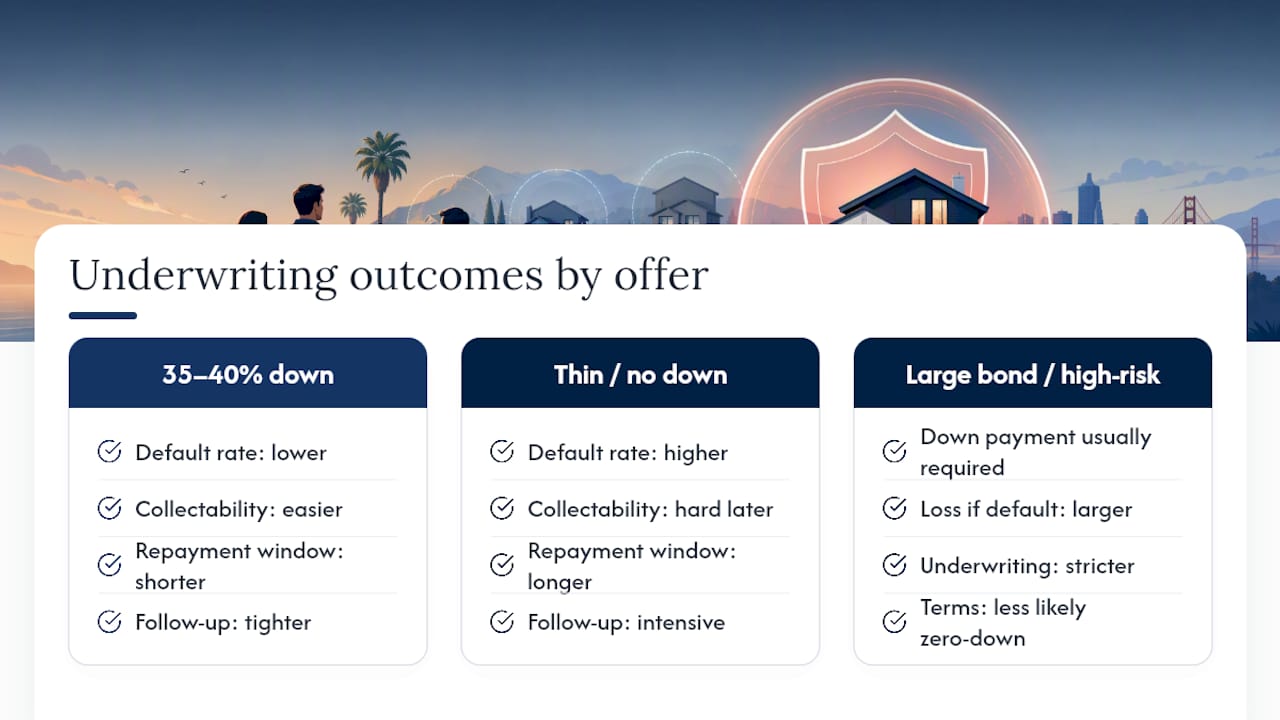
Underwriting for a zero-down bond typically weighs the co-signer's credit history and ties to the community, the defendant's flight risk and criminal history, the size of the bail itself, and how long the payment term will stretch. Larger bonds or higher-risk defendants almost always require some down payment, because a bigger balance owed means a bigger loss if the case goes sideways.
Agencies that skip a meaningful down payment tend to see it come back to bite them. Shorter terms and down payments in the 35% to 40% range correlate with lower default rates, while thin or nonexistent down payments create receivables that are hard to collect later. That's why a legitimate zero-down offer usually comes with a shorter repayment window and tighter follow-up, not looser terms.
Pro Tip: Ask the agency directly what happens if a payment is missed before you sign anything. A reputable bondsman will have a written default protocol ready to show you, not a vague answer.
How Do You Verify a Zero-Down Bail Claim?
"No money down" is a sales hook as often as it's a real offer, and industry guidance consistently warns families to treat it as a starting point for questions, not a finished deal.
Before signing anything, work through this checklist:
- Request written terms covering the total amount due, payment schedule, all fees, and what collateral is required
- Confirm the agency's license status through your state's insurance department or regulator website
- Compare the quoted premium against your state's statutory rate, since most states cap or standardize bail premiums and a quote that ignores that cap is a red flag
- Watch for pressure tactics, refusal to put terms in writing, or vague answers about what happens on a missed payment
- Ask whether the payment plan qualifies as a consumer credit contract, since some courts have treated premium financing that way, which can trigger disclosure requirements that protect you
If an agency can't or won't produce a written schedule with every number on it, that's the moment to walk away and call someone else.
What Should You Do Right Now If Someone Is in Jail?
The first hour after an arrest is chaotic, and that's exactly when families make expensive mistakes. Slow down enough to do these steps in order.
- Call the jail's inmate information line to confirm booking status, charges, and the exact bail amount set
- Ask any bondsman you contact for the minimum required upfront, the total premium owed, and the full repayment schedule before you agree to anything
- Find out whether collateral is required, and if so, exactly what asset and what happens to it on default
- Gather your ID, proof of address, proof of employment, and titles or deeds for any asset you might pledge as collateral
- Expect release itself to take one to several hours after paperwork is signed, depending on the jail's processing speed, but understand the payment obligation and court dates continue long after that
Pro Tip: Save every text, email, and signed document from the bondsman. If a dispute over payment terms comes up months later, that paper trail is your only real protection.
Our cosigner responsibilities guide walks through what you're legally on the hook for before you put your name on anything, and it's worth reading before, not after, you sign.
How a Licensed Bondsman Approaches Zero-Down Requests
I'll say this plainly: most "0 down" advertising in this industry oversimplifies a decision that deserves a straight answer, not a slogan. A licensed bail bond provider operating statewide across California with bilingual support and 24/7 availability shapes how I think about this topic.
What I've seen work for families isn't the lowest possible number up front. It's clarity. Our bail bond cost calculator exists so families can see the actual premium and discount structure before they're standing in a lobby making a decision under stress.
A reputable bondsman explains the collateral risk and the default consequences before you sign, not after. If an agency won't do that, keep calling.
— Jake
Get a Straight Answer on Your Bail Options Tonight
Jake Hernandez Bail Bonds is the direct alternative to guessing your way through a bail agency's fine print. Every plan comes with the terms written out clearly: the 10% premium, the 8% attorney discount where it applies, and 0% down options for qualified co-signers, explained by a person on the phone, not a call center script.
Service covers all 58 California counties, around the clock, with bilingual support in Spanish, Hindi, and Arabic. If you're facing a felony charge, our felony bail bonds page details what to expect, and if the bail is smaller, our $500 down bail bonds option may fit better than a full-premium plan. For anyone who can't get to an office right now, online bail bonds let you start the paperwork remotely.
Before you commit to any agency, ask for the consumer notice tied to your payment-financing agreement in writing. Then call Jake Hernandez Bail Bonds for a free consultation and get your specific numbers, not a general estimate, before you decide anything.
Where to Verify Bail Rules in Your State
For the legal mechanics behind bail pricing, the LegalClarity breakdown of bail bond revenue and the University of Washington Law School analysis of bail practices are solid starting points. For premium-financing disclosure rules, review the court opinion on bail bond financing. Always confirm current rules through your state's insurance department or regulator site directly.
This article is general information, not a substitute for advice from a qualified lawyer. Consult a qualified legal professional about your own circumstances before acting on anything here.
Sources
- How Do Bail Bond Companies Make Money: Fees and Premiums - LegalClarity
- Bail and bail bondsman (University of Washington Law School analysis)
- Can You Bail Someone Out of Jail With No Money Down? | US Bail Finder
- CERTIFIED FOR PUBLICATION (court ruling / opinion PDF)
FAQ
Is 0% Down Bail Actually Free?
No. Zero down usually means the down payment is waived while the full premium, typically 10% of the bail amount, is still owed through a payment plan. Jake Hernandez Bail Bonds offers 0% down options for qualified co-signers, but the premium remains due under the agreed schedule.
What's the Only Way to Get Out of Jail With No Money at All?
Own recognizance release is the sole outcome where no cash or premium is required, and it depends entirely on a judge's decision about flight risk and community ties. This differs from a zero-down bond arrangement, which still involves a bondsman and a premium owed over time.
What Happens if the Defendant Skips Court on a Payment Plan?
The co-signer becomes liable for the full bail amount, and the agency can pursue collateral seizure, civil suit, or wage garnishment to recover it. Courts typically allow a forfeiture window before the bond is fully forfeited, giving some time to locate the defendant.
How Much Does Jake Hernandez Bail Bonds Charge?
The standard premium is 10% of the bail amount, with an 8% discounted rate available when an attorney is retained. Exact costs for a specific bail amount are best confirmed using the company's bail bond cost calculator.
Can a Payment Plan Count as a Consumer Credit Agreement?
In some legal contexts, yes. Premium-financing arrangements have been treated as consumer credit contracts, which can require specific disclosure notices to protect the co-signer before they sign.