
Cosigning a California bail bond makes you contractually liable for the full bail amount if the defendant skips court, on top of the premium you already paid and any collateral you pledged. You're also on the hook for the bail agent's recovery costs if things go sideways. California adds specific protections here: rate-filing rules through the Department of Insurance, disclosure requirements for property liens, and consumer-credit scrutiny on financed premiums.
TL;DR:
- Co-signers are liable for the full bail amount if the defendant fails to appear in court, beyond just paying the premium and pledging collateral.
- The typical premium in California is 10% of the bail amount, with financing arrangements requiring clear disclosures and written agreements.
- California law mandates timely reconveyance of collateral or property liens after the bond is exonerated, requiring co-signers to follow up if delays occur.
- If the defendant misses a court date, the co-signer becomes liable for the full bail amount, and prompt action with the bail agent can prevent forfeiture.
- Proper documentation, understanding of payment and collateral terms, and immediate legal consultation protect co-signers from long-term financial and legal risks.
Table of Contents
- What Are Cosigner Responsibilities Under a Bail Bond Contract?
- What Does Cosigning a Bail Bond Actually Cost You?
- What Legal Protections Do California Cosigners Have?
- What Should You Ask Before You Cosign a Bail Bond?
- What Happens if the Defendant Misses a Court Date?
- How Does Cosigning a Bail Bond Affect Your Credit?
- What Recourse Do Cosigners Have if the Defendant Defaults?
- Do Cosigner Rules Change by State or Loan Type?
- How Do You Get Released From Cosigner Obligations?
- What Long-Term Financial Risks Should Cosigners Watch For?
- Common Cosigner Mistakes and the Safeguards We Recommend
- Get Licensed Bail Help That Explains Every Cosigner Obligation Upfront
- Sources
What Are Cosigner Responsibilities Under a Bail Bond Contract?
The document you sign is called an indemnity agreement, and it's the whole ballgame. By signing, you promise three things: to pay the bail agent's premium (or keep up with a payment plan), to reimburse the full bond amount if the defendant fails to appear, and to cooperate with the agent's efforts to track the defendant down if needed. If you're pledging a car, home equity, or savings as collateral, the agreement spells out exactly what the agent can do with that asset if the bond is forfeited.
Most agents will ask for a handful of things before they'll post the bond:
- A government-issued ID and proof of your address
- Verification of income or assets, especially if collateral is involved
- Contact information for the defendant and often a second reference
- Signed indemnity agreement and, when property secures the bond, a separate lien disclosure
Your obligations start the moment the bond posts, not when the defendant walks out of jail. According to LegalClarity's breakdown of the California bail process, the agent submits the bond to the court or jail, the defendant is released, and from that point forward you're contractually bound until the case resolves and the bond is exonerated.
What Does Cosigning a Bail Bond Actually Cost You?
The premium is the nonrefundable fee for the bond, and in California it's most commonly 10% of the total bail amount set by the court. A $50,000 bail means a $5,000 premium in most cases, plus any reasonable expenses the agent documents, like travel to a jail in a remote county.
Not every co-signer pays that 10% up front. Some agents offer financing, splitting the premium into installments. The Attorney General and the Insurance Commissioner have taken the position that certain premium financing arrangements function as consumer credit, which means co-signers are entitled to plain-language notices about the terms. Skipping that disclosure can limit an agent's ability to collect later.
Collateral adds another layer. If you're pledging real property, Penal Code 1276.5 requires the licensee to give you a bold, written disclosure about the lien before accepting it. Cash, vehicle titles, and jewelry come with fewer statutory hoops but still deserve a signed receipt.
Before agreeing to any 0% down or payment-plan offer, get these in writing:
- The total premium owed and the payment schedule
- Whether missed payments trigger collateral seizure or bond surrender
- The exact reconveyance timeline if property secures the bond
Pro Tip: Ask for an itemized breakdown of the premium versus any add-on fees before you sign anything. A legitimate agent will not hesitate to put that in writing.
You can compare payment structures ahead of time using a bail bond cost calculator that models 10%, 8% attorney-referral rates, and 0% down scenarios side by side.
What Legal Protections Do California Cosigners Have?
The California Department of Insurance licenses and regulates every bail agent in the state, and its Enforcement Branch investigates complaints and can pursue administrative or criminal charges under Insurance Code 1814 when agents overcharge or misrepresent terms. That oversight is your first line of defense if something feels off.
A few protections matter enough to know before you sign anything:
- Agents cannot solicit you directly. Under state rules, a licensed bail agent must be solicited by the arrestee, their attorney, or an adult friend or family member, not the other way around.
- If real property secures the bond, the licensee must reconvey title within 30 days after exoneration or full payment, and you can petition the superior court for damages and fees if they don't.
- Financed premiums may qualify for consumer-credit protections, meaning missing disclosures can become a defense against collection.
Keep every document the agent gives you, and photograph anything you sign before handing it back. If an agent pressures you to skip the written disclosure on a property lien, or won't commit to a reconveyance date, that's a legal red flag, not just an inconvenience. At that point, a consult with an attorney who handles bail or consumer-credit disputes is worth the hour it takes.
What Should You Ask Before You Cosign a Bail Bond?
Before you put your name on anything, get answers to these questions from the bail agent, in writing when possible.
- What is the total cost, including premium, fees, and any collateral requirements?
- Is the premium being paid in full or financed, and what happens if a payment is missed?
- What exactly serves as collateral, and what is the process for getting it back?
- When and how will the bond be exonerated once the case concludes?
- What is the timeline for reconveyance if real property is involved?
Hold on to the signed indemnity agreement, any financing disclosure, your payment receipt, a copy of the bond itself, and the written reconveyance terms. These five documents are what protect you if a dispute ever comes up.
Pro Tip: If an agent can't give you a straight answer on reconveyance timing, treat that as a pause button, not a formality to skip past.
What Happens if the Defendant Misses a Court Date?
Missing even one hearing can trigger forfeiture, and the court doesn't wait long to act. Once forfeiture is declared, you become liable for the full bail amount, not just the premium you already paid.
From there, the bail agent typically moves fast:
- Attempts to locate the defendant and get them back to court within the statutory grace period
- Surrenders the defendant to custody if found, which can reinstate the bond
- Moves to collect on collateral or pursue you directly for the forfeited amount and recovery costs if the defendant stays missing
Your best move the moment you learn about a missed date is calling the bail agent immediately, before forfeiture proceedings advance further. Some courts allow a short window to explain the absence or get the defendant back before the bond is formally forfeited. An attorney can sometimes petition for relief from forfeiture, but that's a legal maneuver with a real deadline, not a guaranteed outcome.
How Does Cosigning a Bail Bond Affect Your Credit?
Signing the indemnity agreement itself doesn't get reported to credit bureaus the way a loan does, because a bail bond isn't a traditional credit product. That's the good news. The exposure comes from what happens next.
If the defendant fails to appear and the bond is forfeited, you're personally liable for the full bail amount. If you can't pay it, that debt can end up with a collections agency, and collections accounts absolutely show up on your credit report and can drag your score down for years. The same is true if you financed the premium and fall behind on payments. A financing agreement that qualifies as consumer credit can be reported like any other installment debt, complete with late-payment marks.
The safest way to protect your credit is to treat every dollar tied to the bond as a real financial obligation from day one, not a contingent one. Keep payments current, confirm the defendant's court dates yourself when you can, and stay in direct contact with the bail agent so you're never caught off guard by a forfeiture notice. If a collections issue does arise from a bail debt, dispute inaccuracies with the credit bureau promptly and keep every document related to the bond as evidence.
What Recourse Do Cosigners Have if the Defendant Defaults?
Defaulting doesn't leave you without options, even though it puts you on the financial hook. Your indemnity agreement is a two-way contract, and that cuts both ways.
If the bail agent failed to give you required disclosures, particularly around financed premiums or property liens under Penal Code 1276.5, you may have a defense against collection or a claim for damages. The Attorney General's position on premium financing exists precisely because co-signers were being pursued for debts without ever receiving plain-language terms.
You can also pursue the defendant. Many indemnity agreements include a right for the co-signer to seek reimbursement from the defendant directly for any amount you paid on their behalf, separate from whatever the bail agent is owed. That's a civil claim, and small claims court is a realistic venue if the amount qualifies.
If a licensee mishandled collateral, missed a reconveyance deadline, or misrepresented the terms, you can file a complaint with the Department of Insurance, which has authority to investigate and discipline agents. In property-lien cases specifically, you can petition the superior court for reconveyance plus damages and attorney's fees if the licensee refused to release the lien within the statutory window. None of this undoes the original liability, but it can limit how much you actually end up paying and who else shares the cost.
Do Cosigner Rules Change by State or Loan Type?
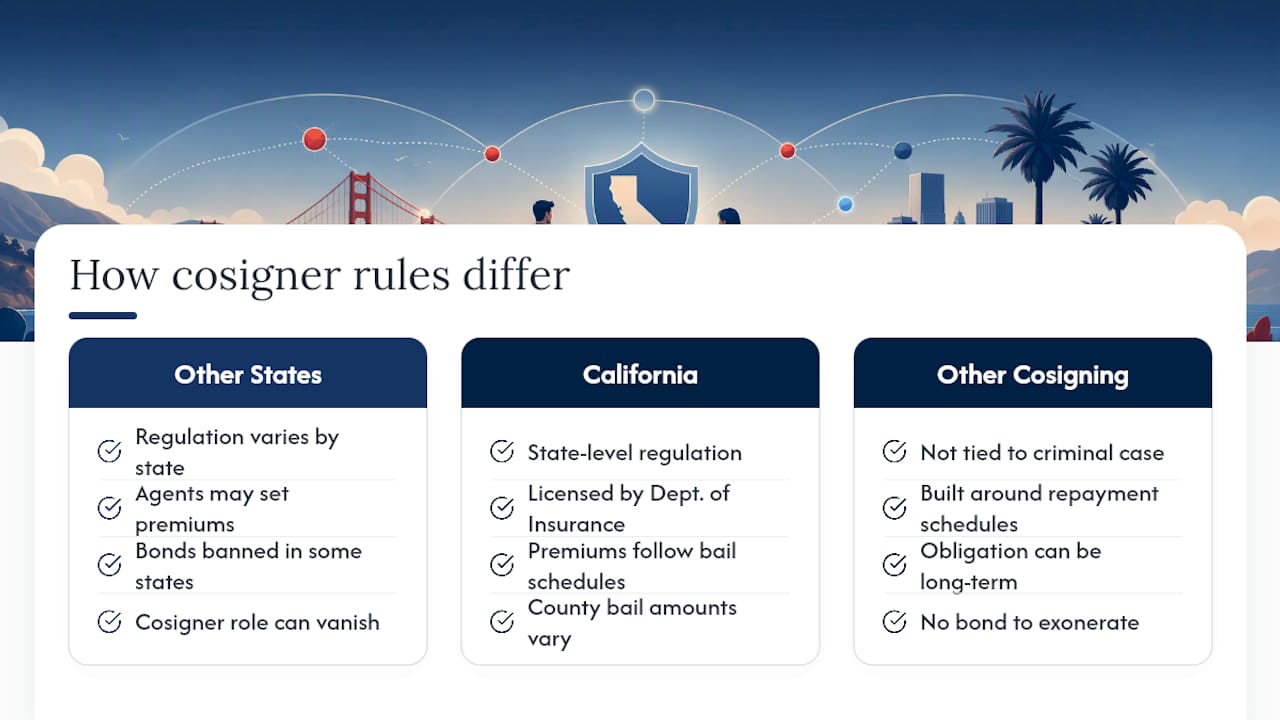
Bail bond rules are set state by state, and California's framework isn't universal. States without rate regulation let agents charge whatever premium the market bears, sometimes well above 10%. Some states ban commercial bail bonds entirely and rely on cash bail or pretrial release programs instead, which changes the co-signer's role completely since there's no bond to indemnify.
Within California, the core obligations stay consistent statewide since bail agents are licensed and regulated at the state level through the Department of Insurance, not county by county. What varies is practical: bail schedules differ by county, so the same charge can carry a different bail amount in Los Angeles County versus a smaller county, which changes your premium and collateral exposure accordingly.
It's also worth separating bail bond cosigning from other forms of cosigning entirely, since the two get confused constantly. Cosigning a bail bond is a promise tied to a specific criminal case with a defined resolution date, the case closes, the bond exonerates, your obligation ends. That's structurally different from other cosigner arrangements built around long-term repayment schedules. The bail version is shorter in duration but can carry a bigger single-event financial hit if forfeiture happens.
How Do You Get Released From Cosigner Obligations?
Your obligation ends automatically once the bond is exonerated, meaning the defendant has attended every required court appearance and the case has concluded, through dismissal, acquittal, conviction and sentencing, or another final disposition. At that point, the court notifies the bail agent, and the agent is required to release any lien on your collateral.
If real property secured the bond, don't assume the paperwork clears itself. Penal Code 1276.5 gives the licensee 30 days after the exoneration notice or full payment to reconvey title, and you should follow up in writing if that deadline passes. Waiting quietly is the biggest mistake co-signers make here.
There's no early exit if you simply change your mind mid case. Some agents will let you substitute a new co-signer or add collateral to release an existing pledge, but that's a negotiated arrangement, not a right, and it requires the agent's agreement. The one universal path off the hook is the case reaching its end, so staying engaged, confirming court dates, and keeping the defendant accountable is the most effective way to move that timeline forward rather than leave it to chance.
What Long-Term Financial Risks Should Cosigners Watch For?
The premium and any collateral you pledge upfront are just the entry cost. The bigger risk sits further down the road, in scenarios most co-signers don't picture when they're standing in a jail lobby trying to get someone released quickly.
A forfeited bond can mean liability for the entire bail amount, which for felony cases can run into tens of thousands of dollars, plus the agent's recovery expenses if they had to track the defendant down. If you can't pay that in one shot, you could be facing a lawsuit, a lien on property you own, or a collections account that follows you for years. And because the case can stretch on for months, your collateral, whether it's a car title or home equity, stays tied up the entire time, unavailable for anything else, even if you need it for an emergency of your own.

There's also the relationship risk that doesn't show up in any contract: cosigning ties your financial future to another person's choices for the length of their case. If they miss one hearing because of a scheduling mix-up or a genuine crisis, you absorb the consequence regardless of intent. That's why treating this as a real financial commitment, not a favor with no downside, matters from the first conversation, not after something goes wrong.
Common Cosigner Mistakes and the Safeguards We Recommend
The biggest mistake I see is co-signers treating the indemnity agreement like a formality instead of the binding contract it is. People sign under stress, in a jail lobby, without reading the collateral clause or asking what reconveyance actually means for their situation.
The fix is simple, if not always easy in the moment: insist on plain-language disclosures before you sign anything, verify the payment terms and reconveyance timeline in writing, and keep copies of every document. That's not paranoia, it's the exact protection state law already gives you.
At Jake Hernandez Bail Bonds, we build our process around that reality. Bilingual support around the clock, flexible payment plans, and clear terms upfront exist because co-signers deserve to understand what they're agreeing to, not just sign where they're told.
— Jake
Get Licensed Bail Help That Explains Every Cosigner Obligation Upfront
Jake Hernandez Bail Bonds is the alternative to guessing your way through fine print at 2 a.m. When you cosign through us, you get the premium, payment terms, and collateral requirements explained in plain language before you sign, not after.
We're licensed to work statewide across all 58 California counties, with bilingual support in Spanish, Hindi, and Arabic available 24/7. Qualified co-signers can access 0% down options and flexible payment plans, and every consultation is free, so you can ask every question on your checklist before committing to anything.
Have the defendant's full name, booking number, and the county jail on hand, and we'll walk you through the exact cost and paperwork for your situation. Start with the bail bond cost calculator to see your options, or call our team directly through Jakehernandezbailbonds for immediate help, day or night.
This article is general information, not a substitute for advice from a qualified lawyer. Consult a qualified legal professional about your own circumstances before acting on anything here.
Sources
- Bail Bonds
- Attorney General Bonta: California Laws Protect Co-Signers of Bail Bonds | State of California - Department of Justice - Office of the Attorney General
- California Code, PEN 1276.5