
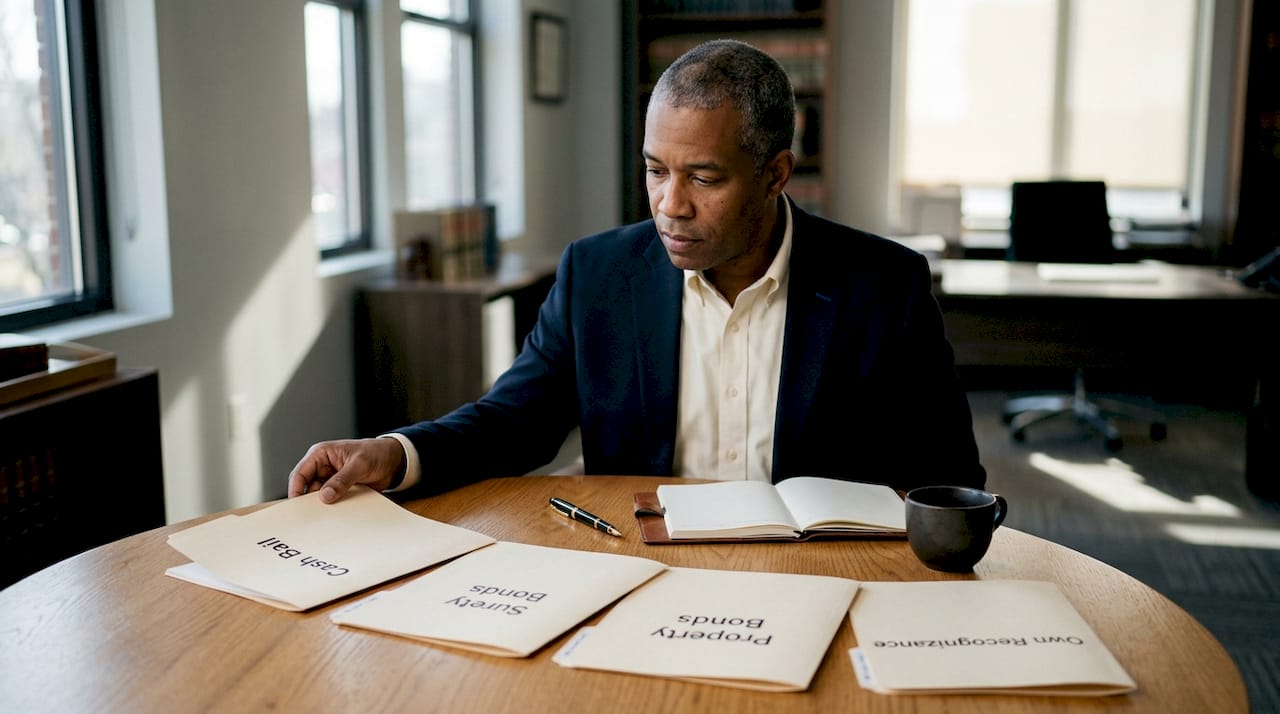
Types of bail bonds in California define how an arrested person can secure release from jail before trial. The four main options are cash bail, surety bonds, property bonds, and release on own recognizance (OR). Each carries different costs, risks, and eligibility requirements. California law, shaped by the landmark In re Humphrey decision and regulated by the California Department of Insurance, governs how courts set and approve bail. Understanding your options before a crisis hits can save your family thousands of dollars and days of unnecessary detention.
1. What are the types of bail bonds in California?
California recognizes four primary bail bond types: cash bail, surety bonds, property bonds, and own recognizance release. Courts also have the authority to deny bail entirely in cases involving serious violent felonies or when a defendant poses an extreme flight risk. The California Department of Insurance licenses and regulates all bail bondsmen operating in the state. Knowing which type applies to your situation is the first decision you will face after an arrest.
Arraignment must occur within 72 hours of an arrest in California. That tight window means families often need to act fast, with little time to research options from scratch.
2. What is cash bail and when is it used in California?
Cash bail is the direct payment of the full bail amount to the court in exchange for the defendant's release. No bondsman is involved. The court holds the money until the case concludes, then returns it in full if the defendant appears at every required hearing.
Cash bail works best when the bail amount is manageable and the defendant wants to avoid paying a non-refundable premium to a bondsman. A $10,000 bail paid in cash comes back to you at the end of the case. That same $10,000 bail handled through a surety bond costs $1,000 upfront and you never see that money again.
Pros of cash bail:
- Full refund if the defendant appears at all hearings
- No third-party bondsman involved
- Simple, direct process with the court
Cons of cash bail:
- Requires the full bail amount upfront, which can reach hundreds of thousands of dollars
- Money is tied up for the duration of the case, which can last months or years
- Not realistic for most families when bail is set at $50,000 or higher
Pro Tip: If you pay cash bail, keep all court receipts. The refund process requires documentation, and missing paperwork can delay your return by weeks.
3. How surety bail bonds work and their advantages in California
A surety bond is the most common bail option in California. A licensed bail bondsman posts the full bail amount with the court on the defendant's behalf. The family or defendant pays the bondsman a premium, typically 10% of the total bail amount, as the fee for this service.
The 10% premium is non-refundable regardless of the case outcome. If the defendant is found not guilty, charges are dropped, or the case is dismissed, the bondsman keeps the fee. That is the cost of the service, not a deposit. For a $50,000 bail, the premium runs around $5,000, which is far more accessible than posting $50,000 in cash.
Key features of surety bonds:
- Premium is set at 10% of the bail amount by California law
- A cosigner (also called an indemnitor) takes on legal responsibility if the defendant skips court
- Collateral such as a vehicle, jewelry, or real estate may be required for high-bail cases
- The bondsman can revoke the bond and return the defendant to custody if they violate conditions
Pro Tip: Ask Jakehernandezbailbonds about 0% down options and payment plans before assuming you cannot afford a surety bond. Qualified cosigners may unlock flexible terms that make release possible the same day.
Surety bonds are the go-to option when cash is limited and the bail amount is high. The tradeoff is accepting a permanent fee in exchange for immediate access to a licensed professional who handles the court paperwork and posting process for you.
4. Understanding property bonds as collateral for bail in California
A property bond uses real estate as collateral instead of cash. The property owner pledges equity in their home or land to the court to cover the bail amount. Courts require the property's equity to equal at least 150% of the bail amount in most California counties.
The court places a lien on the property once the bond is approved. If the defendant appears at all hearings, the lien is removed at the end of the case. If the defendant fails to appear, the court may foreclose on the property to recover the bail amount. That is a serious risk that families must weigh carefully.
Property bond considerations:
- Requires a formal property appraisal and court approval, which takes days or weeks
- The property must be located in California
- Equity must significantly exceed the bail amount to qualify
- Foreclosure is a real consequence of a missed court date
Pro Tip: Property bonds are rarely the fastest option. If speed matters, a surety bond through a licensed agent like Jakehernandezbailbonds will get your loved one out faster while the property bond process is still pending.
Property bonds make sense when a family has substantial home equity, the bail amount is very high, and there is time to complete the approval process. They are not suited for emergency bail situations where release within hours is the goal.
5. What is release on own recognizance (OR) and who qualifies in California?
Release on own recognizance means the court releases the defendant without requiring any money. The defendant signs a written promise to appear at all future court dates. No cash, no bondsman, no collateral.
OR release is typically granted for low-risk defendants with non-violent charges and a reliable history of appearing in court. Judges weigh factors like community ties, employment, prior criminal record, and the severity of the current charge. California courts have moved toward prioritizing non-monetary release options, and cash bail should only be set when non-monetary conditions are insufficient to protect public safety and court attendance.
Who typically qualifies for OR release:
- First-time offenders with no prior failures to appear
- Defendants charged with minor misdemeanors
- Individuals with strong community ties, stable employment, and local family
- Cases where the prosecution does not argue the defendant is a flight risk
The risk of OR release falls entirely on the defendant. Missing a court date results in an immediate arrest warrant and potential new criminal charges for failure to appear. No bondsman is watching, and no collateral is at stake, which means the defendant's word is the only guarantee.
6. Comparing bail bond types: features, costs, and suitability
Choosing the right option depends on three factors: how much bail is set at, how much cash your family can access immediately, and how quickly you need the defendant released.
| Bond Type | Upfront Cost | Refundable? | Collateral Needed | Best For |
|---|---|---|---|---|
| Cash bail | 100% of bail | Yes, if all hearings attended | None | Low bail amounts, available funds |
| Surety bond | 10% premium | No | Sometimes, for high bail | Most situations, limited cash |
| Property bond | None in cash | Lien released if compliant | Real estate equity | High bail, significant home equity |
| OR release | $0 | N/A | None | Low-risk defendants, minor charges |
Legal experts recommend consulting a defense attorney immediately after arrest to argue for lower bail or OR release, potentially saving thousands of dollars before a bond is ever posted. A bail reduction hearing is often the most overlooked tool available to defendants and their families.
Pro Tip: Use the bail bond cost calculator at Jakehernandezbailbonds to see exactly what a surety bond will cost before you commit. Knowing the number removes the guesswork from a stressful situation.
Key Takeaways
The right bail bond type in California depends on your financial resources, the bail amount set by the court, and how quickly you need the defendant released.
| Point | Details |
|---|---|
| Cash bail is fully refundable | Pay the full amount to the court and get it back if all hearings are attended. |
| Surety bond premium is permanent | The 10% fee paid to a bondsman is never returned, regardless of case outcome. |
| Property bonds carry foreclosure risk | Missing a court date can result in the court seizing the pledged real estate. |
| OR release costs nothing | Defendants with low-risk profiles and non-violent charges may qualify for no-money release. |
| Legal counsel can reduce bail | Requesting a bail reduction hearing before posting any bond can lower the total cost significantly. |
Jake's take on picking the right bail bond type
Most families I talk to have never thought about bail before the phone call comes. They hear a dollar amount and panic, assuming they have to come up with the full sum in cash. That misunderstanding costs people money every single day.
The In re Humphrey decision changed California courts in a real way. Judges must now conduct individualized assessments that include a defendant's ability to pay before setting bail. That means bail amounts are not fixed in stone at the moment of arrest. A good defense attorney can walk into arraignment and argue for a lower number or push for OR release, and courts are legally required to consider it.
My honest advice: before you post any bond, find out if the bail amount can be reduced. California's bail reforms prioritize individualized risk assessment over rigid schedules. That shift benefits defendants who engage the process early. Paying a 10% premium on a $100,000 bail is $10,000 gone forever. Paying 10% on a $40,000 bail after a successful reduction hearing is $4,000. The difference is real money that stays with your family.
Surety bonds are the right call for most people because they make release possible without liquidating savings. But knowing all four options before you commit means you make a choice, not just a reaction.
— Jake
Jakehernandezbailbonds: available 24/7 across all of California
When a family member is arrested, the clock starts immediately. Jakehernandezbailbonds covers all 58 California counties and handles surety bonds from $1,000 to $1,000,000, with 0% down options and payment plans for qualified cosigners.
Consultations are free, bilingual support is available, and agents are reachable 24 hours a day, 7 days a week. There is no call center, no middleman, and no delay. Whether you need help near a local detention facility or anywhere across the state, Jakehernandezbailbonds is ready to post bail and get your loved one home fast.
FAQ
What are the main types of bail bonds in California?
California recognizes four types: cash bail, surety bonds, property bonds, and release on own recognizance. Each differs in cost, refundability, and eligibility requirements.
Is the 10% bail bond premium refundable in California?
No. The premium paid to a licensed bail bondsman is non-refundable even if the case is dismissed or the defendant is found not guilty.
Who qualifies for release on own recognizance in California?
OR release is typically granted to low-risk defendants with non-violent charges, no prior failures to appear, and strong community ties. The judge makes the decision at arraignment.
How long does a property bond take to process in California?
Property bonds require a formal appraisal and court approval, which typically takes several days to weeks. They are not suited for situations requiring immediate release.
Can bail be reduced after it is initially set in California?
Yes. Following the In re Humphrey decision, California judges must consider a defendant's ability to pay. A defense attorney can request a bail reduction hearing at arraignment or shortly after.