
A bail schedule is a preset list of monetary bail amounts tied to specific criminal charges, used by booking officers to set bail immediately after an arrest. Families often encounter this document in the first hours after a loved one is taken into custody, before any judge has reviewed the case. Misdemeanor bail typically ranges from $500 to $10,000, while felony amounts start at $20,000 and can exceed $100,000 for violent offenses. Understanding what a bail schedule is, and what it is not, gives your family a real advantage when time matters most.
What is a bail schedule and how does it work?
A bail schedule is an administrative reference document, not a court order. Booking officers at county jails use it to assign a bail amount the moment a charge is entered into the system, allowing an arrestee to post bail and leave before ever seeing a judge. The schedule lists charges by code section and assigns a dollar amount to each one.
Each of California's 58 counties maintains its own bail schedule, which means the same charge can carry a very different price tag depending on where the arrest happened. That geographic variation surprises most families, who assume bail amounts are uniform statewide.

Here is how bail amounts typically break down by offense category in California:
| Offense category | Typical bail range |
|---|---|
| Misdemeanor (non-violent) | $500–$5,000 |
| Misdemeanor (with priors) | $5,000–$10,000 |
| Felony (non-violent) | $20,000–$50,000 |
| Felony (violent or serious) | $50,000–$100,000+ |
Three core factors explain why bail amounts vary across counties:
- Local judicial philosophy. Some counties favor lower bail to reduce pretrial detention. Others set higher amounts as a matter of policy.
- Jail capacity. When a county jail is overcrowded, booking staff may apply lower schedule amounts to move people through faster.
- Crime rate and community standards. High-crime jurisdictions sometimes adopt higher baseline amounts for repeat offense categories.
Pro Tip: Look up your county's current bail schedule online before the arraignment. Most California superior court websites publish the schedule as a PDF, and knowing the number in advance helps you plan your next move.
What limitations do bail schedules have compared to bail hearings?
Bail schedules exist for speed, not for risk assessment. A booking officer applies the schedule mechanically. No one at that stage evaluates flight risk, danger to the community, or whether the amount is actually affordable for the defendant.
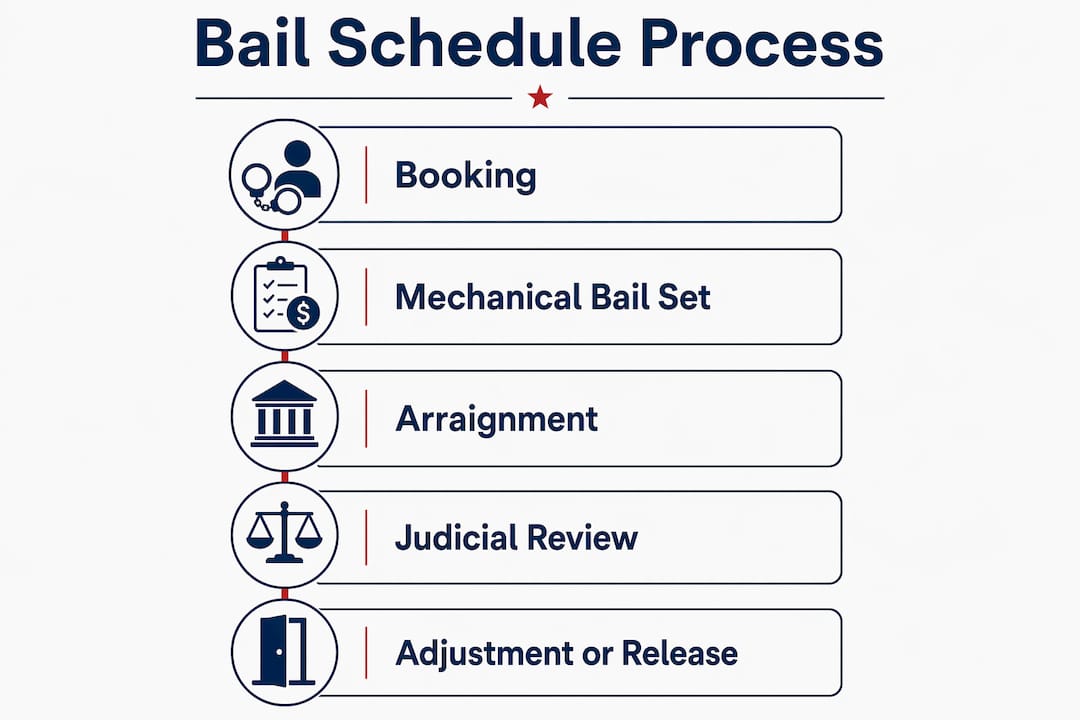
Judges do that work later, at the arraignment or a dedicated bail hearing. At that point, the schedule amount becomes a starting point, not a ceiling. Judges may lower or waive bail entirely based on the facts of the case, including the defendant's financial situation, community ties, and criminal history.
California's legal framework shifted significantly in april 2026. The California Supreme Court ruling S277910 now requires judges to perform an individualized assessment of every defendant's financial circumstances in noncapital cases. A judge cannot simply rubber-stamp the schedule amount if the defendant cannot realistically pay it.
One detail families often miss is the role of mandatory add-ons. Bail schedules include mechanical add-ons for factors like firearm use or prior convictions, which can push a $20,000 felony bail to $100,000 or more before a judge ever sees the case. These add-ons apply automatically at booking, with no judicial input.
Pro Tip: If the schedule amount includes add-ons that seem disproportionate, document the specific enhancements listed on the booking sheet. Your attorney can use that information to argue for a reduction at the bail hearing.
How is bail amount set after an arrest in California?
The bail-setting process moves through two distinct stages. At booking, the schedule amount applies automatically. At the first court appearance, usually the arraignment, the judge takes over.
Families typically wait 24 to 72 hours between booking and arraignment, during which the schedule amount is the only number in play. Posting bail during that window means paying the schedule amount in full or working with a licensed bail bond agent. Waiting for the arraignment gives the judge a chance to lower the amount, but it also means more time in custody.
At the arraignment, judges weigh several factors when deciding whether to adjust bail:
- Criminal history. Prior convictions, especially for similar offenses, push bail higher.
- Community ties. Long-term residence, steady employment, and family connections in the area support lower bail.
- Flight risk. Prior failures to appear in court are a major red flag for judges.
- Severity of the current charge. Charges involving violence or weapons carry heavier weight.
- Financial ability to pay. Under the 2026 California Supreme Court ruling, this factor now carries legal weight, not just moral weight.
The most common mistake families make is treating the schedule amount as final. Families who prepare evidence of community ties and financial hardship before the arraignment give the defense attorney real material to work with. That preparation can mean the difference between a $50,000 bail and a $10,000 bail.
Pro Tip: Gather pay stubs, a lease or mortgage statement, and letters from employers or community members before the arraignment. Judges respond to concrete evidence, not general claims.
What should families do after learning the bail schedule amount?
Knowing the schedule amount is step one. Acting on that knowledge quickly is step two. Here is a practical sequence for families navigating the process in California:
- Confirm the charge and the schedule amount. Call the jail's booking line or check the county jail's online inmate locator to find out what charge was entered and what bail was set.
- Assess whether you can post bail directly. If the full bail amount is within reach, you can post cash bail directly with the jail. Most families cannot cover $20,000 or more in cash, which is where bail bonds become the practical option.
- Contact a licensed bail bond agent. A bail bond agent typically charges 10% of the total bail amount as a non-refundable premium. On a $50,000 bail, that is $5,000. Use a bail bond cost calculator to understand your exact cost before committing.
- Prepare for the arraignment. Even after posting bail through a bond, attend the arraignment. The judge may lower bail further, which can reduce the bond premium on future cases or result in a partial refund depending on your agreement.
- Ask about a bail reduction hearing. If bail was not reduced at arraignment, your attorney can request a separate bail reduction hearing. Experienced defense attorneys recommend preparing evidence of employment, community ties, and prior conduct to support a reduction request.
- Know which jail your family member is in. California has dozens of county detention facilities, and each one processes bail differently. Knowing the specific facility speeds up the release process considerably.
The bail schedule amount is a quick-release mechanism for jails, not a limit on what the court can do at a formal hearing. Families who understand that distinction move faster and make better decisions under pressure.
Key Takeaways
A bail schedule sets the starting bail amount at booking, but a judge holds the real authority to raise, lower, or waive bail at the arraignment or a formal hearing.
| Point | Details |
|---|---|
| Bail schedule definition | A preset list of bail amounts tied to specific charges, applied automatically at booking. |
| County variation in California | Each of California's 58 counties has its own schedule, so the same charge can carry very different bail amounts. |
| Mandatory add-ons matter | Firearm use or prior convictions can mechanically raise bail from $20,000 to $100,000+ before a judge reviews the case. |
| 2026 California ruling | Judges must now assess each defendant's financial ability to pay, making bail reductions more achievable. |
| Families should prepare | Gathering proof of employment, community ties, and financial hardship before arraignment strengthens the case for lower bail. |
What I've learned from watching families navigate bail schedules
Most families I work with are shocked by the bail schedule amount. They see $75,000 on a booking sheet and assume that number is locked in. It is not. The schedule is an administrative shortcut built for jail efficiency, not for justice. Judges are the ones with actual authority, and the 2026 California Supreme Court ruling gave defendants real legal standing to challenge amounts that are genuinely unaffordable.
The families who do best are the ones who stay calm and move fast on two tracks at once. They post bail through a bond to get their loved one home quickly, and they prepare for the arraignment to seek a reduction. Waiting passively for the court date without posting bail costs days or weeks of unnecessary detention.
One thing I tell every family: the bail schedule is not your enemy, and it is not your final answer. It is a number on a form that a booking officer filled out in under five minutes. A judge, with the right information in front of them, can change that number. Your job is to give the judge that information.
The counties I cover across California each have their own schedule quirks. Los Angeles County runs higher on many felony categories than San Diego County does for the same charge. Knowing your specific county's schedule, and knowing which facility holds your family member, puts you ahead of most people walking into this process cold.
— Jake
Jakehernandezbailbonds is ready when the schedule amount hits
When a bail schedule amount lands and your family needs to act fast, Jakehernandezbailbonds covers all 58 California counties, 24 hours a day, 7 days a week. There are no call centers and no middlemen. You speak directly with a licensed agent who knows your local jail system and your county's bail schedule.
Bonds start at $1,000 and go up to $1,000,000, with 0% down options and payment plans available for qualified co-signers. Free consultations are available any time, and bilingual service means no family gets left behind because of a language barrier. Whether your family member is at Men's Central Jail in Los Angeles or a facility anywhere else in the state, Jakehernandezbailbonds is ready to move the moment you call.
FAQ
What is a bail schedule used for?
A bail schedule is a preset list of bail amounts tied to specific criminal charges, used by booking officers to set bail immediately after an arrest without waiting for a judge.
Can a judge change the bail schedule amount?
Yes. Judges can raise, lower, or waive bail at the arraignment or a bail hearing. Under California's 2026 Supreme Court ruling, judges must consider the defendant's financial ability to pay.
Why do bail amounts vary by county in California?
Each of California's 58 counties maintains its own bail schedule, so the same charge can carry a significantly different bail amount depending on where the arrest occurred.
What are bail schedule add-ons?
Add-ons are mandatory increases applied at booking for factors like prior convictions or firearm use. They can raise a base felony bail from $20,000 to $100,000 or more before any judge reviews the case.
How does a bail bond work with a bail schedule amount?
A bail bond agent posts the full bail schedule amount on your behalf in exchange for a non-refundable premium, typically 10% of the total bail. On a $50,000 bail, that premium is $5,000.