Speed in the bail process is the single factor that determines how quickly a defendant returns home and begins building a legal defense. Every hour spent in custody compounds risk: job loss, housing instability, and pressure to accept unfavorable plea deals all increase with time. Why speed matters in bail is not a procedural detail. It is the difference between a defendant who controls their case and one who is controlled by it. This guide explains the bail timeline, the real costs of delay, 2026 reform changes, and the exact steps families can take right now to move faster.
Why does speed matter in bail?
Speed in bail determines the outcome of far more than just the release date. Defendants held pretrial face increased risk of job loss, housing instability, and professional disruption. The pressure of sitting in a cell makes people accept plea deals they would otherwise reject. That single consequence can follow a person for life.
The standard industry term for this window is "pretrial detention," and it carries measurable legal weight. A defendant who returns home can meet with their attorney, gather evidence, and appear in court as a free person. A defendant still in custody cannot do any of those things effectively. Fast bail significance, in legal terms, is about preserving the ability to mount a real defense.
Inconsistent release timelines often depend on a defendant's zip code, not the facts of the case. Identical arrests in different jurisdictions can produce release times that differ by days. That disparity is not a minor inconvenience. It is a structural inequity that families must understand and work around.

What is the typical timeline for bail and release?
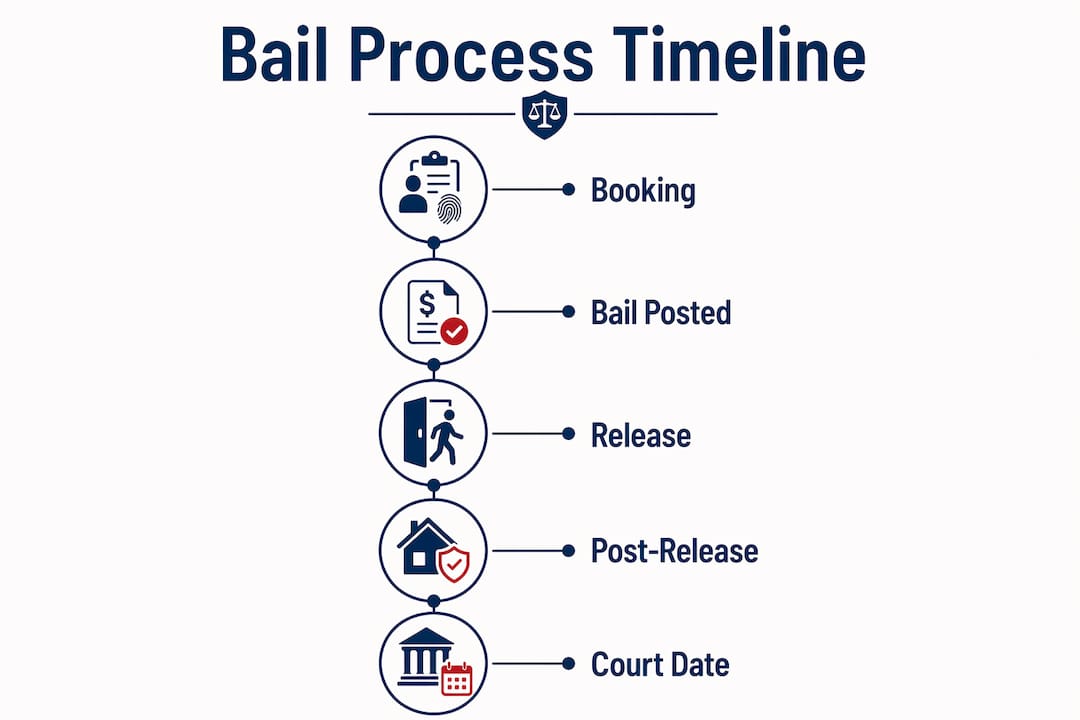
Total bail release time varies from about 6 hours to over 72 hours depending on charge severity and jurisdiction. Understanding each stage helps families know where delays happen and where they can push back.
| Stage | Typical Duration | Key Variables |
|---|---|---|
| Booking and processing | 2–6 hours | Facility volume, charge type |
| Bail hearing (if required) | 24–72 hours | Charge severity, court schedule |
| Bail bondsman processing | 1–4 hours | Paperwork completeness, co-signer availability |
| Release after bail posted | 2–8 hours | Jail staffing, time of day |
| Police station posting | 20 minutes to 1 hour | Minor charges, immediate posting |
Booking is the first bottleneck. A busy county jail on a Friday night processes arrests far more slowly than a quiet Tuesday morning at a local police station. Families who understand this can make smarter decisions about where and when to post bail.
Posting bail at a central county jail slows release because centralized facilities require specialized internal protocols, extra approvals, and verification steps. A local police station posting, by contrast, can result in release in as little as 20 minutes to 1 hour for eligible charges. That gap is significant.
Release after bail is posted takes an additional 2–8 hours and slows further during nights, weekends, and holidays due to reduced jail staffing. Families who post bail at 2:00 AM on a Saturday should plan for the longer end of that range. Knowing this in advance reduces panic and helps families set realistic expectations.
How do bail delays hurt defendants and families?
The consequences of slow bail extend well beyond discomfort. Every additional hour in custody creates new risks across three areas: employment, housing, and legal standing.
- Employment: Employers rarely hold positions for employees who miss work without notice. A 48-hour detention can cost a defendant their job before they ever see a courtroom.
- Housing: Missed rent payments and landlord notifications can begin within days of an arrest. Families managing a lease or mortgage face compounding pressure.
- Legal standing: Delays increase pressure on defendants to accept unfavorable plea deals and risk collateral consequences beyond incarceration time. A defendant who accepts a plea from a cell often does so without fully understanding the long-term impact.
- Mental health: Prolonged detention creates documented stress for both the defendant and their family. Children, partners, and parents all absorb that strain.
- Legal preparation: A defendant at home can meet privately with their attorney, review evidence, and participate actively in their defense. A defendant in custody cannot.
"The critical window between arrest and arraignment is where legal advocacy can meaningfully reduce bail amounts and expedite release. Families who act in that window protect both their loved one's freedom and their legal options."
Defense attorneys can argue for lower bail or own recognizance release within 24–72 hours of arrest. That window is the most important period in the entire pretrial process. Families who secure legal representation before the first hearing give their loved one the best possible chance at a fast, affordable release. Learning how to navigate a bail hearing as a family is one of the most effective ways to prepare for that moment.
How are 2026 bail reforms changing release speed?
Bail reform in 2026 is actively reshaping how quickly defendants can get out of custody, particularly for low-risk and nonviolent offenses. The changes are meaningful, but they are not uniform across California.
- Cite-and-release: Officers issue a citation at the scene and release the individual without booking. No jail time, no bail required.
- Book-and-release: The individual is booked and then released immediately without posting bail, based on charge type and risk assessment.
- Expanded bail schedules: Courts are adjusting schedules to allow more charges to qualify for immediate release at set amounts without a hearing.
- 48-hour hearing standards: Ongoing efforts push to guarantee a bail hearing within 48–72 hours of arrest for all defendants who are not immediately released.
Contra Costa County's 2026 pre-arraignment protocols create "Cite and Release" and "Book and Release" categories effective july 8, 2026, allowing immediate release for eligible nonviolent offenders. This is one of the clearest examples of how local jurisdictions are acting to reduce pretrial detention times. Other California counties are watching these results closely.
Pro Tip: Ask the arresting officer or booking sergeant whether the charge qualifies for cite-and-release or book-and-release before contacting a bail bondsman. If it does, the release may cost nothing and happen within the hour.
Judicial discretion still plays a large role. A judge who sees a defendant with strong community ties, stable employment, and documented financial hardship can set bail below the schedule amount or grant own recognizance release. Families who bring that documentation to the hearing give the judge a reason to act quickly.
What steps can families take to speed up the bail process?
Fast-tracking bail procedures requires preparation, not luck. Families who act in the first hour after an arrest consistently see faster release times than those who wait.
- Call a licensed bail bondsman immediately. Do not wait until morning. Jakehernandezbailbonds operates 24/7 across all 58 California counties. The sooner you call, the sooner paperwork begins.
- Gather complete and accurate information. The defendant's full legal name, date of birth, booking number, and the facility name are required to start the process. Errors in this information cause delays that can add hours to release time.
- Secure legal representation before the first hearing. An attorney arguing for lower bail within the first 24–72 hours can reduce the bail amount or eliminate it entirely through own recognizance release.
- Understand the bail schedule for the charge. Many charges have a preset bail amount that allows posting without a hearing. Knowing this amount in advance lets families act before a hearing is even scheduled.
- Post bail at the arresting police station when possible. Posting bail at the police station can result in release in as little as 20 minutes to 1 hour, compared to hours at a central jail facility.
- Prepare financial documentation. Families who bring proof of income, employment, and assets to the bail hearing give the judge and bondsman the information needed to act fast. Use a bail bond cost calculator to estimate costs before the hearing.
Pro Tip: Save the jail's direct phone number and the bondsman's number in your phone before you ever need them. In a crisis, searching for contact information wastes the most valuable minutes of the process.
Avoiding administrative delays is as important as taking the right steps. Incomplete paperwork, wrong facility names, and missing co-signer information are the three most common causes of preventable delays. Families who prepare these details in advance cut hours off the release timeline.
Key Takeaways
Speed in bail is the most critical factor in protecting a defendant's employment, housing, legal standing, and ability to mount an effective defense.
| Point | Details |
|---|---|
| Every hour in custody carries real costs | Job loss, housing risk, and plea deal pressure all increase with each hour of pretrial detention. |
| Release timelines range from 20 minutes to 72+ hours | Charge type, facility, and time of day determine where your case falls in that range. |
| The first 24–72 hours are the most important | Legal advocacy in this window can reduce bail amounts or secure own recognizance release. |
| 2026 reforms expand fast-release options | Cite-and-release and book-and-release categories now apply to many nonviolent offenses in California. |
| Preparation cuts release time significantly | Accurate information, early legal help, and police station posting all reduce delays. |
What I've seen families get wrong about bail speed
I have worked with families across California at every hour of the day and night. The pattern I see most often is waiting. Families assume the system will move at a reasonable pace on its own. It does not.
The families who get their loved ones home fastest are the ones who call within minutes of learning about the arrest, not hours. They already know the booking number. They have a co-signer ready. They ask about cite-and-release before assuming a bond is needed. That preparation is not luck. It is the result of understanding how the process actually works.
The hardest cases I see are the ones where a defendant sat in custody for two or three days because no one acted in the first hour. By then, the job is gone. The landlord has been notified. The defendant has been pressured into a conversation with a prosecutor without an attorney present. All of that was preventable.
Speed in bail is not just about getting home faster. It is about preserving every option a defendant has. The moment you learn someone has been arrested, the clock is already running.
— Jake
Jakehernandezbailbonds is ready when every minute counts
When an arrest happens, the hours that follow shape everything. Jakehernandezbailbonds provides 24/7 bail bonds across California with no middleman, no call center, and no delay. Whether your family member is held at Men's Central Jail in Los Angeles or a facility anywhere across all 58 counties, a licensed agent answers immediately and begins working the case.
Bonds start at $1,000 with 0% down options and payment plans available for qualified co-signers. Free consultations are available in English and Spanish. Call now and get the process started before another hour passes.
FAQ
How long does the bail process typically take?
Total release time ranges from about 6 hours to over 72 hours depending on charge severity, facility type, and time of day. Minor charges posted at a police station can result in release in as little as 20 minutes to 1 hour.
What happens if bail is not posted quickly?
Defendants who remain in custody face increased risk of job loss, housing instability, and pressure to accept unfavorable plea deals. Delays compound legal consequences that extend well beyond the time spent in a cell.
Can a lawyer speed up the bail process?
Yes. Defense attorneys can argue for lower bail or own recognizance release within the first 24–72 hours of arrest. Early legal involvement is one of the most effective ways to reduce both the cost and duration of pretrial detention.
What is cite-and-release and who qualifies?
Cite-and-release is a process where officers issue a citation at the scene and release the individual without booking or bail. Eligibility depends on charge type and jurisdiction. Contra Costa County expanded this category in 2026 for eligible nonviolent offenders.
Does the time of day affect how fast someone is released?
Yes. Release processing after bail is consistently slower during nights, weekends, and holidays due to reduced jail staffing. Families posting bail during off-hours should expect the longer end of the 2–8 hour post-bail release window.