
Yes, you can fight charges while free — but your first 72 hours determine whether you stay free and walk into court with a defensible case. The California court process begins at arraignment, where a judge reads the charges, takes your plea, and decides custody and bail conditions under the California Courts self-help framework. Miss a step before that hearing and you may lose evidence that cannot be recovered.
Three things matter most right now:
- Preserve evidence immediately. Surveillance footage is routinely overwritten within a few days. Witness memories fade fast.
- Contact a criminal defense lawyer today. Not next week. The arraignment window is short, and early discovery requests shape everything that follows.
- Follow every release condition exactly. OR release and posted bail are both revocable. One misstep can put you back in custody before your case is resolved.
If bail was set and you need help posting bond, Jakehernandezbailbonds is available 24/7 across all 58 California counties and can get you home while your attorney gets to work.
Table of Contents
- What criminal charges can a fight actually trigger?
- What to do first while you're still free
- How a California criminal case unfolds after a fight
- How to stay free while your case proceeds
- Common legal defenses in fight and assault cases
- When can charges be filed and how long do cases take?
- A practical evidence preservation checklist
- What happens if your release is revoked
- How prior criminal history affects your case
- Emotional and psychological support during the legal process
- Key Takeaways
- What working with counsel and bail support actually looks like
- Jakehernandezbailbonds gets you home fast so your defense can start
- Useful sources and where to verify the details
What criminal charges can a fight actually trigger?
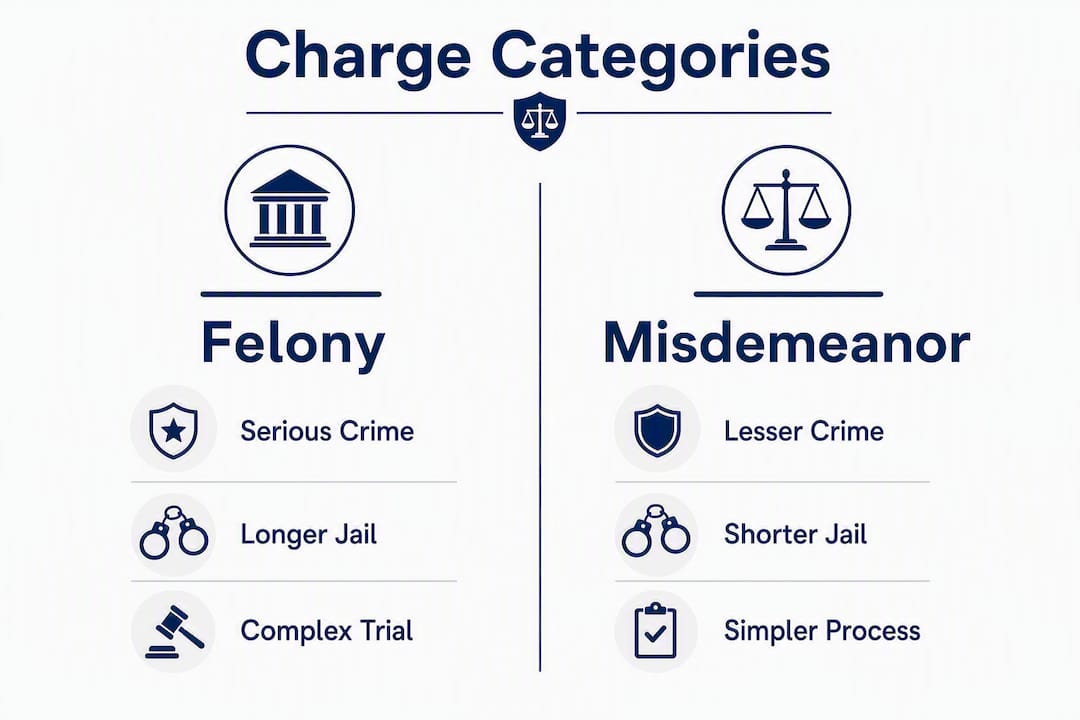
A single altercation can generate more than one charge, and the classification determines bail exposure, pretrial requirements, and collateral consequences like employment and immigration status.
- Disorderly conduct / disturbing the peace (Penal Code §415): Often charged as an infraction or misdemeanor. Prosecutors and defense attorneys frequently use PC §415 as a reduction target when more serious assault allegations lack strong evidence.
- Simple assault (PC §240): A misdemeanor carrying up to six months in county jail and fines. Bail is typically lower, and OR release is common for first-time defendants.
- Battery (PC §242): Requires actual physical contact, unlike assault. Also a misdemeanor in most fight scenarios, though it can elevate based on injury severity.
- Aggravated assault (PC §245): Felony potential when a weapon is involved or serious bodily injury results. Bail amounts climb sharply, pretrial supervision is stricter, and collateral consequences multiply.
The same incident can produce a felony complaint from the DA or a misdemeanor citation from the arresting officer — the prosecutor decides, not the police. County matters too: Los Angeles, San Bernardino, and Orange County prosecutors apply different charging thresholds for the same conduct.
What to do first while you're still free
Time-sensitive steps, in priority order:
- Confirm your release conditions in writing. Get a copy of your release order. Know every restriction before you leave the courthouse or jail.
- Photograph your injuries immediately. Bruising and marks fade within days. Take photos with timestamps from multiple angles.
- Preserve surveillance footage. Contact businesses near the scene within hours, not days. Security footage is routinely overwritten on 24–72 hour loops. Your attorney can send a preservation letter; you can also ask the business manager directly to hold the footage.
- Collect witness contact information. Full names, phone numbers, and a brief note on what each person saw. Do this before people scatter.
- Document your timeline. Write down everything you remember about the incident — location, sequence of events, who said what — while it is fresh. Give this only to your attorney.
- Stop posting about the incident. Delete nothing (that can look like obstruction), but post nothing new. Screenshots of your posts can and will be used against you.
- Avoid all contact with the alleged victim. This is not optional. Even a text saying "I'm sorry" can be charged as witness intimidation under California Penal Code §136.1.
- Call a criminal defense attorney. Many offer free consultations. Get one before your arraignment, not after.
- Contact a bail bondsman if bail was set. If you are not yet out, or if bail conditions change, Jakehernandezbailbonds can post bond fast and walk you through the logistics.
Pro Tip: The only safe channel for discussing the incident is through your attorney. Do not call, text, or message the alleged victim or any witness directly — not to apologize, not to explain, not to ask what they told police. Under PC §136.1, that contact can become a separate criminal charge.

How a California criminal case unfolds after a fight
The sequence below applies to most assault and public-fighting cases in California:
- Arrest or citation: Police may arrest on the spot or issue a citation requiring a future court appearance. Some cases are filed days or weeks after the incident following a DA review.
- Charges filed: The prosecutor reviews the police report and decides what to file — or whether to file at all. This is the first real decision point where early evidence can matter.
- Arraignment: The judge reads the charges, you enter a plea (almost always "not guilty" at this stage), and the court addresses bail or OR release. At arraignment, if you cannot afford a lawyer, the court appoints one.
- Discovery and motions: Your attorney requests police reports, bodycam footage, and witness statements. Motions to suppress unlawfully obtained evidence are filed here.
- Pretrial negotiations: Most cases resolve here through plea deals, diversion programs, or dismissals. Early evidence collection directly affects the strength of your negotiating position.
- Preliminary hearing (felonies only): The prosecution must show probable cause to proceed to trial. This is a critical checkpoint where charges can be reduced or dismissed.
- Trial: The minority of cases that do not resolve pretrial proceed to a jury or bench trial.
Under California Penal Code §977, once an initial plea is entered, your attorney can appear at many routine procedural hearings without you. That matters practically: fewer missed workdays, less scheduling pressure, and more time to focus on building your defense.
How to stay free while your case proceeds
Release comes in two main forms. Own recognizance (OR) means the court releases you on your promise to appear, with no money posted. Bail requires a cash deposit or a bond through a licensed bondsman. OR is a discretionary privilege — courts can revoke it) if you violate conditions, and there is no automatic right to OR even for misdemeanors.
Common conditions attached to release:
- No contact with the alleged victim or witnesses
- Travel restrictions (county or state limits)
- Regular check-ins with pretrial services
- Prohibition on possessing weapons
- Drug or alcohol testing
- Mandatory appearance at all scheduled hearings
Violating any of these conditions can trigger immediate re-arrest, bail revocation, and a new charge for contempt or violation of a court order. The practical steps to stay free are straightforward: read your release order carefully, set calendar reminders for every court date, keep your attorney's contact information accessible at all times, and if you used a bondsman, keep them updated on any address or phone changes.
Staying free while your case proceeds is not passive — it requires active compliance with every condition the court sets. One missed check-in or one text to the alleged victim can undo a bond that took hours to arrange and weeks of work to maintain.
Common legal defenses in fight and assault cases
Your attorney will evaluate the facts against several defensible legal theories. The right defense shapes everything: which motions get filed, whether a plea makes sense, and what diversion programs you may qualify for.
| Defense | What it requires | Key evidence |
|---|---|---|
| Self-defense | Reasonable belief of imminent harm; force proportional to threat | Witness statements, your injuries, call sequence |
| Defense of others | Same standard as self-defense, applied to protecting a third party | Witness accounts, video showing the protected person |
| Mutual combat | Both parties willingly engaged; no clear aggressor | Surveillance video, bilateral injuries, witness testimony |
| Mistaken identity | You were not the person who committed the act | Alibi witnesses, phone location data, surveillance showing someone else |
| Insufficient evidence | Prosecution cannot meet its burden of proof | Gaps in police report, inconsistent witness statements |
| Procedural violations | Evidence obtained unlawfully | Lack of probable cause for arrest, improper search |
Self-defense is the most commonly raised theory in fight cases, but it requires more than saying you felt threatened. Contemporaneous injuries, a credible sequence of events supported by witnesses, and video showing who escalated first all strengthen the argument. Mutual combat, by contrast, can reduce a felony assault to a PC §415 disturbing-the-peace charge — a significant reduction with far lower penalties.
When can charges be filed and how long do cases take?
Charges can be filed at the time of arrest or weeks later after a DA review. For misdemeanor assault, California's statute of limitations is generally one year from the date of the offense. Felony assault carries a three-year window, longer if serious bodily injury is alleged.
- Arraignment timing: For someone in custody, arraignment must occur within 48 hours of arrest (excluding weekends and holidays). For someone cited and released, the arraignment date is set on the citation.
- Misdemeanor timelines: Many misdemeanor fight cases resolve within 3–6 months, often at the first or second pretrial conference.
- Felony timelines: Felony cases move slower. A preliminary hearing must typically be held within 10 court days of arraignment if you are in custody, or 60 calendar days if you are out.
- Pretrial resolution: The majority of assault and fight cases in California resolve before trial through plea agreements, diversion, or dismissal. Early evidence gathering and a strong pretrial posture are what drive favorable outcomes at that stage.
A practical evidence preservation checklist
Evidence degrades on a schedule. Here is what to do and when:
- Within 24 hours: Photograph all visible injuries on your body. Screenshot any relevant social media posts (yours and others'). Write your timeline and give it only to your attorney.
- Within 24–48 hours: Visit or call businesses near the scene and ask them to preserve surveillance footage. Your attorney should follow up with a formal preservation letter the same day.
- Within 48–72 hours: Collect full contact information from every witness you can identify. Note what each person saw and from where.
- Within the first week: Request copies of your own medical records if you sought treatment. Export and back up relevant text messages and call logs. Do not delete anything.
- Within the first two weeks: Your attorney should submit formal discovery requests and, where needed, subpoenas for bodycam footage, dashcam recordings, and business surveillance records.
Attorneys use preservation letters and early subpoenas to freeze evidence before routine overwriting or deletion occurs. This is not something to handle yourself — the legal weight of a formal letter from counsel is different from a personal request.
Pro Tip: Phone location data can place you (or the alleged victim) at the scene and establish who approached whom. Ask your attorney early whether a subpoena for cell-tower records or app location history is worth pursuing in your case.
What happens if your release is revoked
If you violate a release condition or pick up a new arrest while the case is pending, the consequences move fast.
- Return to custody: The court can issue a bench warrant or remand you at your next hearing.
- Bail re-set or denied: The judge may set a higher bail amount or deny release entirely, citing the violation as evidence you are a flight risk or danger to the community.
- Additional charges: Violating a no-contact order or missing a court date can generate separate criminal charges on top of the original case.
If revocation happens, your immediate steps are:
- Call your defense attorney first. Do not wait.
- Contact your bondsman. If your bond is at risk of being forfeited, your bondsman needs to know immediately to take protective steps.
- Gather documentation showing compliance with other conditions (check-in records, travel logs, employer verification of your whereabouts).
- Request an expedited hearing to address the violation and argue for reinstatement of release.
A revocation hearing moves quickly. Having documentation of your compliance with every other condition — and a bondsman who can speak to your reliability — gives your attorney real material to work with at that hearing.
Common triggers for revocation: texting the alleged victim, a new arrest for any offense, missing a scheduled court date, and traveling outside permitted boundaries without prior court approval. All of these are avoidable.
How prior criminal history affects your case
A prior record changes the calculus on release conditions, bail amounts, and defense strategy in concrete ways.
Judges weigh criminal history heavily at arraignment when setting bail or deciding OR eligibility. Under California's pretrial framework, three or more failures to appear within three years — with warrants issued — can disqualify a defendant from OR release entirely, per PC §1319.5. A prior conviction for assault or battery signals a pattern to prosecutors, which typically results in higher bail, stricter conditions, and less flexibility in plea negotiations.
On the defense side, a prior record limits some options. Diversion programs like PC 1001.80 (military diversion) or informal diversion for first-time offenders are generally unavailable to defendants with prior convictions for similar offenses. Prosecutors use prior history to argue against reduced charges. Your attorney needs to know your full record from the first conversation — not because it automatically hurts you, but because the strategy has to account for it honestly.
One area where prior history sometimes helps: if the alleged victim also has a relevant record, that can support cross-examination and credibility arguments at trial or in pretrial negotiations.
Emotional and psychological support during the legal process
Facing criminal charges while managing work, family, and daily life is genuinely stressful. That stress is not a weakness — it is a predictable response to an unpredictable situation, and ignoring it tends to make legal decision-making worse.
Practical resources worth knowing:
- California's court self-help centers: — Many courthouses have on-site or online self-help resources that can reduce the anxiety of not knowing what to expect procedurally.
One practical note: vent to your therapist or counselor, not to friends via text. Anything you say to a non-privileged third party can potentially be subpoenaed. Attorney-client privilege and therapist-patient confidentiality are real protections. Group chats are not.
Key Takeaways
Fighting charges while free comes down to two non-negotiable priorities: preserve evidence in the first 72 hours and comply with every release condition without exception.
| Point | Details |
|---|---|
| Preserve evidence immediately | Surveillance footage overwrites in 24–72 hours; collect witness contacts and photograph injuries the same day. |
| Contact a defense attorney fast | Early discovery requests and pretrial negotiation determine whether most cases resolve favorably before trial. |
| Follow every release condition | OR and bail are both revocable; one violation can return you to custody and raise your bail amount. |
| Know your charges and their weight | PC §415 (misdemeanor) to PC §245 (felony) carry very different bail, pretrial, and collateral consequences. |
| Jakehernandezbailbonds for fast release | Available 24/7 across all 58 California counties with 0% down options to get you home while your attorney works. |
What working with counsel and bail support actually looks like
The first call to a defense attorney is shorter than most people expect. You describe the incident, the attorney asks about your release status, your prior record, and any conditions already imposed. That conversation sets the direction for everything else.
Within the first day or two, your attorney sends preservation letters to businesses near the scene and submits an initial discovery request to the DA's office. You sign releases for medical records and provide the witness contact information you collected. The attorney handles the subpoenas and formal communications; your job is to stay compliant and available.
At arraignment, your attorney enters a not-guilty plea and argues for OR or reasonable bail. Under California Penal Code §977, once that initial plea is entered, counsel can appear at many subsequent procedural hearings without you — a real practical benefit for someone managing work and family while the case proceeds.
If bail was set and you used Jakehernandezbailbonds, the bondsman coordinates with you on court-date reminders and any changes to your release status. That logistics support frees your attorney to focus on evidence and negotiations rather than emergency courthouse issues. Most pretrial posture-setting — whether the case is heading toward a plea, diversion, or trial — becomes clear within the first 60–90 days.
Jakehernandezbailbonds gets you home fast so your defense can start
When bail is set after a fight arrest, every hour in custody is an hour you are not gathering evidence, meeting with your attorney, or managing your life. Jakehernandezbailbonds covers all 58 California counties with 24/7 availability, no middleman, and a direct line to a licensed agent who handles the posting logistics fast.
For qualified co-signers, 0% down options and flexible payment plans are available — bonds range from $1,000 to $1,000,000, and the consultation is always free. Bilingual support in Spanish, Hindi, and Arabic means the process does not stall over a language barrier. If the case involves a complex hold like a PC 1275 bail source hearing, the team has direct experience navigating those scenarios statewide.
Call Jakehernandezbailbonds now for a free consultation, or use the bail bond cost calculator to understand your options before you call.
This article is general information, not legal advice. Consult a licensed California criminal defense attorney and verify current rules with the California Courts for guidance specific to your situation.
Useful sources and where to verify the details
| Resource | What it covers |
|---|---|
| California Courts — Criminal Court Overview | How charges are filed, arraignment process, and court stages |
| California Courts — The Arraignment | What happens at arraignment, right to counsel, bail decisions |
| California Penal Code §136.1 | Witness intimidation and tampering — why contact with the victim is legally dangerous |
| California Penal Code §977 | Attorney appearance on behalf of defendant at procedural hearings |
| Cornell LII — Own Recognizance) | OR release definition, conditions, and revocation |
| Jakehernandezbailbonds — Felony Bail Bonds | Statewide felony bond logistics and co-signer responsibilities |
| Disability Attorney Settlement Negotiation Guide | Pretrial negotiation strategy context for legal proceedings |