
Weekend arrest bail options in California include posting cash bail, using a property bond, or securing a bail bond through a licensed bondsman, with legal timing and ability-to-pay rules shaping every decision. California Penal Code § 825 mandates arraignment within 48 hours, but Sundays and court holidays are excluded from that count. The 2021 In re Humphrey ruling further changed the process by requiring judges to weigh a defendant's ability to pay before setting bail. Understanding these rules is the fastest way to get someone home.
What legal rules govern weekend arrest bail options?
The 48-hour arraignment rule is the single most important timeline you need to know. California Penal Code § 825 requires that a defendant appear before a judge within 48 hours of arrest. Sundays and official court holidays do not count toward that window.
That exclusion has real consequences. A person arrested on a Friday evening may not see a judge until Monday morning or, if a holiday falls on Monday, until Tuesday. Many families interpret this as a legal violation or intentional delay. It is neither. It is the law operating exactly as written.
The In re Humphrey ruling adds a second layer to understand. This 2021 ruling prohibits courts from setting bail at an amount a defendant cannot afford without first considering non-monetary release conditions. Courts must justify any detention without bail using clear and convincing evidence. That standard gives defendants and their attorneys real leverage at arraignment.
Key timing facts for weekend arrests:
- A Friday arrest typically leads to a Monday arraignment.
- A Friday arrest before a three-day holiday weekend can push arraignment to Tuesday.
- Booking procedures, including fingerprinting and data entry, add hours before bail can even be posted.
- Bail can often be posted before arraignment using a bail schedule, which lists preset amounts by charge.
Pro Tip: Check the California bail schedule for the county where the arrest occurred. Posting bail before arraignment using the schedule can cut custody time by a full day or more.
What bail options are available after a weekend arrest?
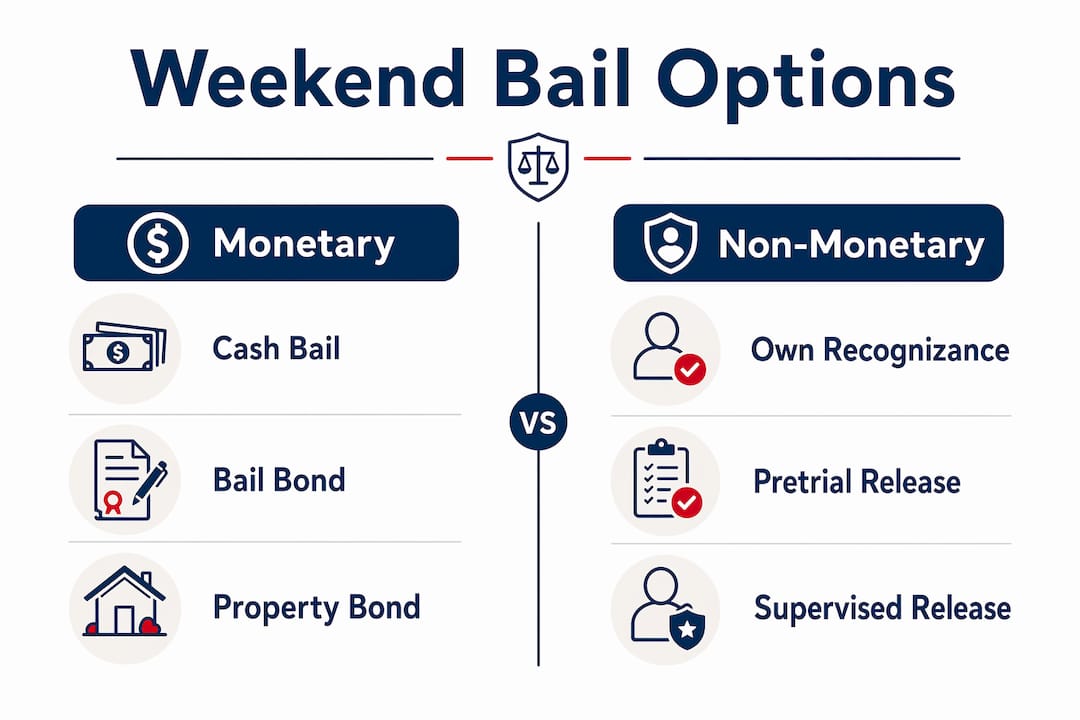
Four main release paths exist after a weekend arrest in California. Each has different costs, timelines, and eligibility requirements.
-
Cash bail. You pay the full bail amount directly to the jail or court. The money is returned after the case ends, minus any court fees, provided the defendant appears at all hearings. The downside is that full amounts often run into tens of thousands of dollars, which most families cannot produce on short notice over a weekend.
-
Property bond. A property owner pledges real estate equity equal to the bail amount. Courts require documentation proving ownership and equity, which takes time to process. Property bonds are rarely the fastest option for weekend releases because county assessors and courts are closed.
-
Bail bond through a licensed bondsman. A bail bondsman typically charges a non-refundable premium of around 10% of the total bail amount. That fee is the cost of the service, not a deposit. Jakehernandezbailbonds, for example, offers bonds from $1,000 to $1,000,000 with 0% down options and payment plans for qualified co-signers. Licensed bondsmen operate 24/7, making this the most practical path for weekend arrests.
-
Release on own recognizance (OR). A judge releases the defendant without any payment, based on the promise to appear. The Humphrey ruling made OR release more accessible by requiring courts to consider it before setting monetary bail. OR release is decided at arraignment, so it is not available before the defendant sees a judge.
Pro Tip: If cash is limited, contact a licensed bondsman first. They can often begin the paperwork and post bond within hours of a call, even at 2:00 AM on a Saturday.
Some courts also use pre-arraignment release protocols that allow release based on a risk assessment before the formal hearing. These programs reduce reliance on monetary bail and can speed up release for eligible defendants significantly.
How to navigate posting bail after a weekend arrest
The process moves faster when you know exactly what to do and in what order.
-
Step 1: Get the booking information. Once arrested, the defendant goes through booking. Fingerprinting and data entry cause standard delays that have nothing to do with bail. The booking number and facility name are what you need to start the release process.
-
Step 2: Find the bail amount. Call the jail directly or check the county's online inmate locator. Many California counties post bail schedule amounts online by charge type. The bail schedule amount applies before a judge sets a different figure at arraignment.
-
Step 3: Contact a licensed bail bondsman. Jakehernandezbailbonds operates 24/7 across all 58 California counties. A bondsman can confirm the bail amount, explain payment options, and begin posting bond immediately. You do not need to wait until Monday.
-
Step 4: Request an attorney. Exercising the right to remain silent and requesting an attorney immediately after arrest protects the defendant's rights during initial proceedings. An attorney can argue for OR release or reduced bail at arraignment, which directly affects how much you pay.
-
Step 5: Prepare for arraignment. Even after bail is posted, the defendant must appear at arraignment. Missing that date forfeits the bail and triggers a warrant.
Pro Tip: Write down the jail's direct phone number and the defendant's booking number before anything else. Every call to a bondsman starts with those two pieces of information.
What challenges come with securing bail on weekends?
Weekend arrests create specific bottlenecks that weekday arrests do not. Knowing them in advance prevents panic and wasted time.
Sundays and court holidays are excluded from the 48-hour arraignment window, which legally extends custody. Families who expect a Saturday morning court appearance are often blindsided when they learn the defendant will not see a judge until Monday. That frustration is understandable, but the timeline is fixed by statute.
Court closures also limit who can set bail. On weekends, only on-call commissioners or duty judges handle emergency bail hearings. Their availability varies by county. In smaller counties, getting a judge to set bail outside the bail schedule on a weekend is rare.
Financial barriers are the most common reason people stay in custody longer than necessary. The Humphrey ruling exists precisely to address this. If a defendant cannot afford bail, their attorney can argue at arraignment that OR release or supervised release is the appropriate alternative. Courts cannot legally ignore that argument.
Other common obstacles include:
- Booking delays that push bail posting back by several hours.
- Families calling the wrong facility because the defendant was transferred after arrest.
- Co-signers who are unavailable or unaware of what signing a bail bond agreement means.
- Misunderstanding the difference between bail being set and bail being posted.
The practical fix for most of these is a single phone call to a licensed bondsman. They know which facility holds the defendant, what the bail schedule says, and how to move the paperwork fast.
Non-monetary release options and pretrial programs in California
California's pretrial system has shifted meaningfully since the Humphrey ruling. Non-monetary release is no longer a rare exception. It is a required consideration at every bail hearing.
Pretrial services programs use risk assessment tools to evaluate a defendant's likelihood of appearing at future hearings and their risk to public safety. These assessments inform whether a judge grants OR release, supervised release, or monetary bail. The goal is to base release decisions on individual risk, not on how much money someone has.
Supervised release conditions can include electronic monitoring, GPS tracking, regular check-ins with a pretrial officer, or participation in treatment programs. Judicial officers can require any combination of these conditions as an alternative to cash bail. These conditions are not punitive. They are designed to keep defendants connected to the court while they remain in the community.
| Release type | Monetary requirement | Typical conditions | Weekend availability |
|---|---|---|---|
| Cash bail | Full bail amount upfront | Appear at all hearings | Available if jail accepts payment |
| Bail bond | 10% non-refundable premium | Appear at all hearings | Available 24/7 through bondsmen |
| Own recognizance | None | Appear at all hearings | Set at arraignment only |
| Supervised release | None | Monitoring, check-ins | Set at arraignment only |
| Pre-arraignment protocol | Varies | Risk-based conditions | Available in select counties |
Most California criminal cases resolve before trial, which means pretrial release decisions have an outsized impact on how many days someone spends in custody. A defendant released pretrial can work, support their family, and prepare a defense. One who stays in custody because of a financial barrier they cannot clear faces compounding disadvantages.
Key Takeaways
Securing release after a weekend arrest requires knowing your legal rights, the applicable timelines, and which release option fits your situation fastest.
| Point | Details |
|---|---|
| 48-hour rule with exclusions | Sundays and holidays extend the arraignment window, so weekend arrests often mean custody through Monday. |
| Bail bond is the fastest option | A licensed bondsman can post bail 24/7, making it the most practical path when courts are closed. |
| Humphrey ruling protects defendants | Courts must consider ability to pay and non-monetary conditions before setting bail. |
| OR release requires arraignment | Own recognizance release is only granted by a judge, so it cannot happen before the court date. |
| Legal counsel speeds everything | Requesting an attorney immediately after arrest protects rights and improves bail outcomes at arraignment. |
What I've learned from years of weekend bail calls
Weekend arrests are the hardest calls to receive. The person on the other end of the phone is scared, often confused, and working with incomplete information. After years of handling these situations across California, a few things stand out clearly.
The families who move fastest are the ones who call a bondsman before they call anyone else. Not because bondsmen are more important than attorneys, but because a bondsman can tell you exactly where the defendant is, what the bail amount is, and what it will cost to get them out tonight. That information then shapes every other conversation.
The second thing I've learned is that the Humphrey ruling is underused. Defendants and families often accept whatever bail amount is set without pushing back. An attorney who knows to argue for OR release or a reduced amount at arraignment can save a family thousands of dollars. That argument is legally required to be heard. Use it.
The third thing is patience with the timeline. A Friday night arrest with a Monday arraignment feels like an eternity. It is not a mistake or a rights violation. It is the system working within its legal boundaries. Understanding that does not make it easier emotionally, but it prevents families from taking steps that waste time or money.
Prepare before you need to. Know which California jails are in your area. Know that a bondsman is available at any hour. Know that you have legal rights from the moment of arrest.
— Jake
Jakehernandezbailbonds is available right now, all weekend
When a family member is arrested on a Friday night or a holiday weekend, waiting until Monday is not the only option.
Jakehernandezbailbonds provides 24/7 bail bond services across all 58 California counties, including weekends and holidays. Bonds range from $1,000 to $1,000,000, with 0% down options and payment plans for qualified co-signers. Free consultations are available in English and Spanish. If you need emergency bail posted fast, the team is ready to move the moment you call. No call centers, no middlemen. Just direct, experienced help when the timing matters most.
FAQ
What is weekend arrest bail in California?
Weekend arrest bail refers to the process of securing a defendant's release after an arrest that occurs on a Saturday, Sunday, or holiday. Because courts are closed, bail is typically posted using a bail schedule amount through a licensed bondsman or by paying cash directly to the jail.
How long can someone be held after a weekend arrest?
Under California Penal Code § 825, a defendant must be arraigned within 48 hours, but Sundays and court holidays are excluded. A Friday arrest can legally result in custody through Monday or Tuesday if a holiday falls on Monday.
Can a bail bondsman post bail on weekends?
Yes. Licensed bail bondsmen operate 24 hours a day, seven days a week, including holidays. Jakehernandezbailbonds covers all 58 California counties and can begin the release process immediately after a call, regardless of the day or time.
What does the In re Humphrey ruling mean for bail?
The Humphrey ruling requires California judges to consider a defendant's ability to pay before setting bail and to evaluate non-monetary release conditions first. Courts cannot detain someone solely because they cannot afford bail without clear and convincing evidence of necessity.
What is own recognizance release and can I get it on a weekend?
Own recognizance (OR) release means a judge releases the defendant without requiring any payment, based on a promise to appear at future hearings. OR release is only granted at arraignment, so it is not available before the defendant sees a judge, which typically happens on the next court business day after a weekend arrest.