Bail for gun charges in California typically runs from $20,000 for basic possession offenses to $250,000 or more for shooting at an inhabited dwelling, with felony gun enhancements pushing amounts even higher. Posting a cash bail or hiring a licensed bail bond agent are the two fastest routes to release, though certain violent-felony charges and court holds require a hearing before anyone gets out. County bail schedules set these numbers, and Penal Code sections spell out when a judge must intervene before bail can move.
TL;DR:
- Bail for firearm charges varies widely depending on the offense, with low-end charges around $20,000 and higher charges, like shooting at a dwelling, exceeding $250,000.
- The final bail amount depends on the base schedule, enhancements, multiple charges stacking, and whether a judge must hold a hearing before adjusting it downward.
- Serious felony gun charges or cases with a 1275.1 hold often require a court review before bail can be posted, delaying release regardless of payment capacity.
- Most families waste time seeking a single bail figure when they should first confirm eligibility for release, then negotiate bail bonds or legal strategies accordingly.
- Contacting a licensed bail agent and an attorney simultaneously within the first hours of arrest significantly improves chances of quick release and ensures proper legal handling.
Table of Contents
- Gun Charge Bail in California: How County Schedules Set the Number
- What Gun Charge Bail Actually Looks Like by Offense
- How Judges Decide Whether to Move Bail From the Schedule
- Posting Bail: Cash, Bonds, and What It Costs You
- When Bail Isn't Simply Available on the Schedule
- Your First Moves After a Gun Charge Arrest
- Inside a Statewide Gun-Charge Bail Case
- The Real Problem With How People Search for Bail Numbers
- Get Someone Out of Jail Today
- Sources
- FAQ
Gun Charge Bail in California: How County Schedules Set the Number
Every California county adopts its own bail schedule under Penal Code section 1269b, which sets a presumptive bail amount for each offense so jails can process warrantless arrests without waiting for a judge. That number on the schedule is your starting point, not necessarily your final bail.
Some charges don't work that way. Penal Code section 1270.1 requires a hearing before bail can be set below the schedule amount for specified serious and violent felonies, which includes several firearm offenses. A judge, not the jail, makes that call.
Multiple charges from the same arrest can also stack. Depending on the county's stacking rules, separate counts sometimes add to the total bail rather than the highest single charge controlling, according to San Diego County's bail schedule.
What actually drives the final figure:
- The base schedule amount tied to the specific Penal Code section charged
- Sentencing enhancements attached to the arrest, like use of a firearm during a separate felony
- Whether the charge falls on the list requiring a 1270.1 hearing
- How the county in question handles multiple simultaneous charges
What Gun Charge Bail Actually Looks Like by Offense
Bail figures vary by county, but the pattern across California's schedules is consistent enough to give you a real number to work from. Santa Clara County's 2026 criminal bail schedule and comparable documents from other counties show firearm bail climbing sharply with the severity of the charge and who was targeted.
Carrying a concealed weapon or possessing a loaded firearm under PC 25400 or 25850 usually sits near the low end. Assault with a firearm under PC 245 variants runs considerably higher, and shooting at an inhabited dwelling under PC 246 tops most county lists with bail amounts among the highest set in county schedules. Cases involving a peace officer or firefighter victim, or a semiautomatic weapon, get bumped into a separate, higher tier entirely.
| Offense | Penal Code | Typical Bail Range |
|---|---|---|
| Carrying a concealed firearm | 25400 | Around $20,000 |
| Possession of a loaded firearm | 25850 | Around $20,000 |
| Assault with a firearm | 245(a)(2) | Typically set at tens of thousands of dollars |
| Assault on a peace officer/firefighter with a firearm | 245(d) | Higher tier, county-specific |
| Shooting at an inhabited dwelling | 246 | Usually set at a very high bail amount |
These figures come from schedule lines reported across Stanislaus County's schedule and echoed in Orange County's felony bail schedule. Add a firearm-use enhancement under sections like 12022.5, and the base number can jump substantially before a judge even weighs in.
How Judges Decide Whether to Move Bail From the Schedule
The schedule gives you a starting figure. What happens next depends on the person, not just the charge. Judges reviewing gun cases weigh:
- Danger to the community — a firearm charge automatically raises this concern more than most other offenses
- Flight risk — ties to the area, employment, and family all factor in
- Criminal history — prior firearm or violent offenses push bail up, sometimes sharply
- Circumstances of the arrest — whether the weapon was loaded, concealed, or used against a person
There's also a source-of-funds wrinkle unique to bail that catches families off guard. Under Penal Code section 1275.1, if there's reason to believe bail money was obtained illegally, the court can place a hold and require proof of legitimate funds. That review has to happen within 24 hours, but it still delays release.
Pro Tip: Pretrial services interviews carry more weight than most families realize. Have accurate employment, housing, and family contact information ready before that interview happens. It often influences whether a judge grants a lower bail or an own-recognizance release.
Posting Bail: Cash, Bonds, and What It Costs You
You have three real options once bail is set: pay the full amount in cash, post a property bond, or work with a licensed bail bond agent. Cash bail gets refunded after the case resolves, minus any court fees, but tying up $50,000 or $250,000 for months isn't realistic for most families.
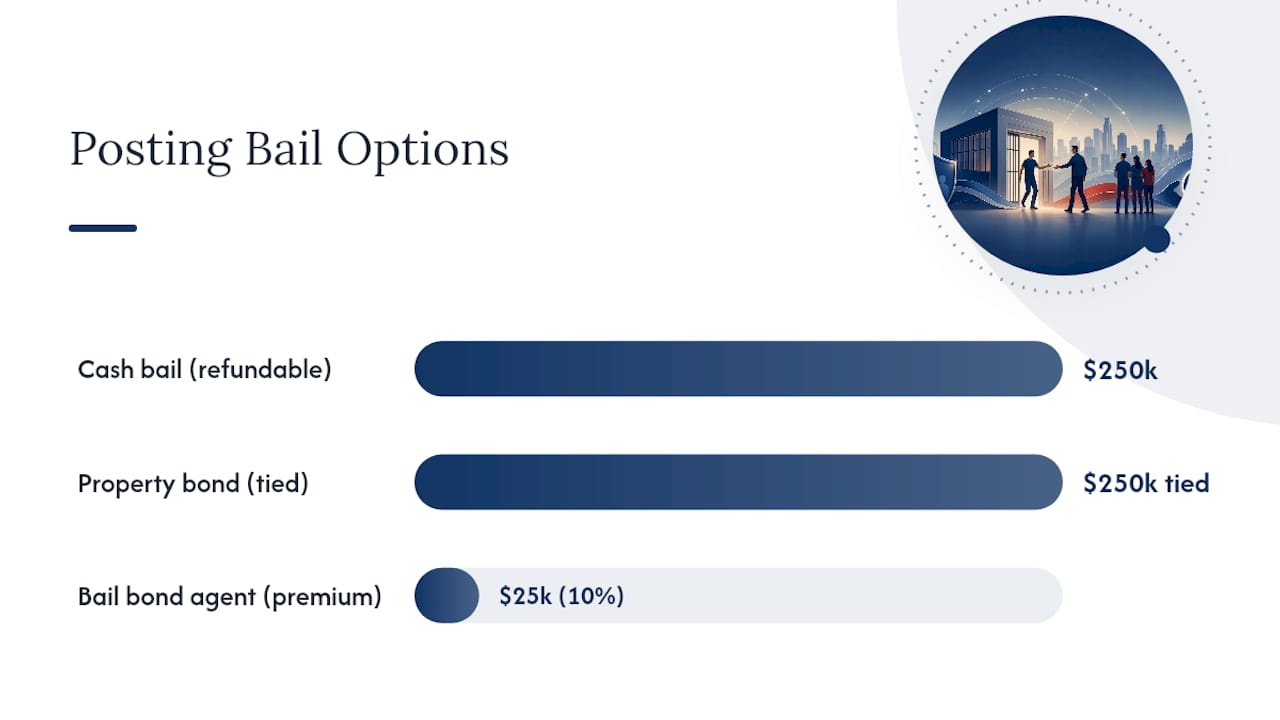
A surety bail bond solves that cash problem. Instead of paying the full amount, you pay a percentage, known as the premium, and the bonding company posts the full bail with the court. Jake Hernandez Bail Bonds structures this at a standard 10% premium, with an 8% rate available for cases where an attorney is already retained. That premium isn't refundable, but it's the difference between coming up with $250,000 and coming up with $25,000.
Getting the bond moving usually takes these steps:
- Call a licensed bail agent and give them the person's full name, booking number, and county jail location.
- Confirm the exact bail amount listed on the county schedule or set by the judge.
- Provide co-signer identification and basic financial information for the paperwork.
- Sign the bond agreement, which some agents handle entirely online for faster processing.
- Wait for the jail to process release, typically a few hours after paperwork clears.
Pro Tip: Have the booking number ready before you call. It's the single detail that speeds up every step that follows, since agents use it to confirm the exact charge and bail figure directly with the jail.
When Bail Isn't Simply Available on the Schedule
Certain gun charges don't let you post bail and walk out the same day, no matter how much cash you have. Serious and violent felonies on the state's list, along with any case flagged under a 1275.1 hold, require a judge to review the matter first.
Here's what typically triggers that delay:
- The charge falls under Penal Code section 1270.1's list of serious or violent felonies
- The court has reason to question where bail money came from
- Multiple firearm charges stack into a combined bail figure requiring judicial confirmation
- The arrest involves a domestic violence element alongside the firearm charge
If a hold is in place, ask the jail directly for the hearing date and notify a defense attorney immediately. A bail agent familiar with 1275 holds can also start preparing documentation of legitimate fund sources while you wait, which shortens the delay once the hearing happens.
Your First Moves After a Gun Charge Arrest
Speed matters most in the first few hours. Here's the order that actually gets someone released fastest:
- Call the jail or check its inmate locator to confirm the booking and the exact bail figure.
- Note the arraignment date. Missing it creates a separate legal problem on top of the original charge.
- Contact a licensed bail agent and a criminal defense attorney at the same time. Don't wait to line up one before calling the other.
- Gather co-signer ID, proof of address, and any documentation the bond company requests.
- Ask about payment plans, $500 down options, or attorney discounts if cash is tight.
Pro Tip: Bail agents work around the clock for exactly this reason. A 3 a.m. arrest doesn't need to mean waiting until Monday morning to start the process.
Inside a Statewide Gun-Charge Bail Case
Firearm cases move through jails and courts differently county by county, and that inconsistency is exactly what trips families up when they're searching for a number online instead of calling someone who works the local schedule daily.
Every county we work handles gun charges a little differently, from how fast the jail processes paperwork to whether a 1275 hold gets flagged automatically. Our job is knowing which schedule applies, what a 1270.1 hearing actually requires, and how to move a bond through cleanly across all 58 counties, day or night, in English or Spanish.
Certain bail bond services offer free consultations and round-the-clock support, but a bond only covers release. Once someone's out, a criminal defense attorney handles the actual charge, and pairing both early gives a case its best shot.
The Real Problem With How People Search for Bail Numbers
Most people typing "gun charge bail California" into a search bar want a single dollar figure. That instinct makes sense, but it's also where families waste hours. The schedule number for PC 245(a)(2) or PC 246 is only the opening bid. Judges adjust it up for priors, enhancements, and victim type, and adjust it down for someone with deep community ties and no record. Treating the schedule as gospel leads to sticker shock in one direction or false confidence in the other.
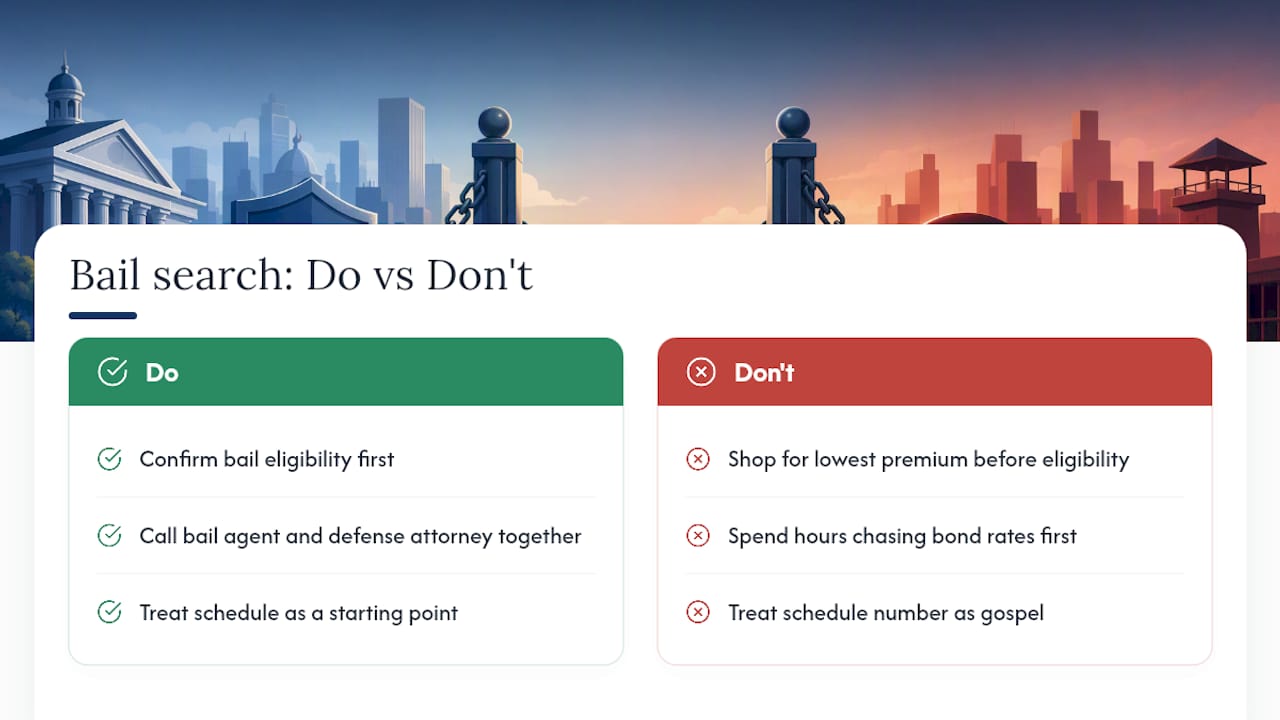
The bigger blind spot is timing. Families often spend the first critical hours calling around for the "best deal" on a bond premium instead of confirming whether a 1270.1 hearing or a 1275.1 hold even allows bail to move yet. That's backwards. Confirm eligibility for release first, then shop the premium, because a lower rate on a bond that can't post yet doesn't get anyone out faster.
If there's one piece of advice worth taking seriously, it's this: call a bail agent and a defense attorney in the same hour, not in sequence. The schedule tells you where bail starts. What happens next depends on who's advocating for the file while you're still figuring out the paperwork.
— Jake
Get Someone Out of Jail Today
Some bail bond services connect clients directly with licensed agents familiar with how gun-charge cases move through California's county jails and courts, avoiding call-center delays.
Whether the charge is carrying a concealed weapon or something as serious as PC 246, the process starts with one call. Bring the booking number and county jail location, and an agent walks you through the bond premium and attorney discount options before you sign anything. Cases with a source-of-funds concern or a 1275 hold get handled the same way, with documentation prepared ahead of the hearing instead of after it.
Visit Jake Hernandez Bail Bonds or call now to start the paperwork, day or night, in English or Spanish.
This article is general information, not a substitute for advice from a qualified lawyer. Consult a qualified legal professional about your own circumstances before acting on anything here.
Sources
- 2026 criminal bail schedule — Santa Clara County Superior Court
- San Diego County felony, misdemeanor and infraction bail schedule
- Stanislaus County bail schedule (effective Jan 1, 2026)
- California Penal Code §1275.1 — Bail chapter
FAQ
How much jail time comes with a gun charge in California?
It depends entirely on the specific charge. Misdemeanor firearm offenses can carry up to a year in county jail, while felony charges like shooting at an inhabited dwelling under PC 246 carry state prison time measured in years, not months. An attorney needs to review the exact charge and any enhancements to give a real estimate.
How long after a domestic violence charge can I own a gun in California?
A domestic violence conviction typically triggers a firearm ban lasting 10 years under state law, separate from any federal restrictions that may also apply. The exact start date and any exceptions depend on the specific conviction, so confirming the timeline with an attorney is essential.
What is the 10-year gun ban in California?
California imposes a 10-year prohibition on firearm ownership for people convicted of certain misdemeanors, including specific domestic violence and weapons offenses. The clock generally starts at conviction, and violating the ban during that window is itself a separate crime.
Can a felon own a gun in California after 20 years?
Most felony convictions carry a lifetime firearm ban in California with no automatic restoration after any set number of years. Restoring firearm rights generally requires a formal process like expungement combined with a certificate of rehabilitation, and even then, restoration isn't guaranteed. Anyone in this situation should consult a defense attorney before assuming rights have returned.
What's the fastest way to post bail on a gun charge?
Contacting a licensed bail bond agent immediately after confirming the exact bail amount is usually the fastest path, since agents can process paperwork and coordinate with the jail around the clock. Some bail bond services provide around-the-clock support and online bond options to reduce wait times.