Bail for assault charges in California typically ranges from several thousands of dollars for a basic misdemeanor battery to much higher amounts for aggravated assault involving a weapon or serious injury, with county bail schedules setting the exact starting number. Magistrates can raise or lower that figure based on the facts of the arrest. If someone you love was just booked, the fastest move is to call the jail clerk or a licensed California bail bondsman with the booking number and charge code in hand, since that call determines how quickly release actually happens.
TL;DR:
- Most assault bail amounts in California are based on county schedules, with misdemeanor battery starting at a basic, predefined amount, and more serious charges like firearm or injury-related assaults reaching higher or no-bail statuses.
- Judge review at arraignment can alter initial bail, especially when a credible reason such as medical emergency or error justifies lowering the amount, but violent felonies face strict limits on bail reduction.
- A PC 1275 hold can delay release after bail is posted if there's probable cause the funds were obtained illegally, requiring documented proof to lift the hold before bond release.
- Families should gather the defendant’s full name, booking number, exact charge code, arresting agency, and jail location immediately for faster bail processing.
- Using a licensed bail bondsman usually offers the quickest release option, with standard premiums around 10% of the bail amount and available 24/7 multilingual support across California.
Table of Contents
- What Bail Amounts Look Like for Common Assault Charges
- How Bail Amounts Are Set in California
- Where to Find Your County's Bail Schedule
- What a PC 1275 Hold Means for Posting Bail
- Cash, Bail Bonds, Own Recognizance, or Property: Which Release Option Fits
- How to Ask the Court to Lower Bail
- What to Do First: A Family Checklist After an Assault Arrest
- Juvenile vs. Adult Assault Cases: Key Differences
- Protective Orders and No-Contact Conditions in Assault Cases
- How Bail Forfeiture Works if the Defendant Skips Court
- What Families Should Expect Working With a Bail Bondsman
- Get Someone Released Fast With Jake Hernandez Bail Bonds
- Sources
- FAQ
What Bail Amounts Look Like for Common Assault Charges
Every county in California runs its own bail schedule, but the pattern across them is consistent enough that you can predict a rough range before you even see the paperwork. Simple battery under Penal Code 243(e) or 243(d), the kind that doesn't involve a weapon or serious injury, tends to land around the amount listed in the county schedule in sample county schedules. Battery causing bodily injury pushes that number up. Assault likely to cause great bodily injury, charged under the 245 family of statutes, commonly runs the amount listed in the county schedule to the amount listed in the county schedule depending on how the county schedule reads and what enhancements apply.
Assault with a firearm or an assault on a police officer sits at the higher end almost everywhere, frequently the amount listed in the county schedule to the amount listed in the county schedule or more. Domestic violence assault charges follow a similar curve to general assault but often carry additional no-contact conditions layered on top of the dollar figure, which we'll get to in a later section.
Here's a rough breakdown based on charge severity:
- Misdemeanor battery (PC 243(e)): often set at a baseline amount noted in county schedules
- Battery with bodily injury (PC 243(d)): commonly set higher than the misdemeanor battery amount
- Assault likely to produce great bodily injury (PC 245 variants): typically higher amounts varying by county and circumstances
- Assault with a firearm or on a peace officer: frequently among the highest bail amounts set in county schedules
- Certain aggravated or repeat-offense scenarios: can be marked "no bail" pending a judge's review
Statistic Callout: The 2026 Santa Clara County criminal bail schedule lists the amount listed in the county schedule for certain battery charges, the amount listed in the county schedule for battery causing bodily injury, and figures up to the amount listed in the county schedule for aggravated assault variants involving a firearm or deadly weapon.
Some of the most serious assault charges get flagged as "no bail" at booking. That doesn't mean bail is impossible. It means a judge has to personally review the case before setting an amount, which usually happens at arraignment rather than at the jail counter. County differences matter here more than people expect. The same charge filed in Los Angeles and filed in Marin can carry a different presumptive number, because each county board of judges adopts its own schedule.
How Bail Amounts Are Set in California
California law requires every county to maintain a bail schedule, and that schedule is the default starting point the moment someone is booked. The California Penal Code's bail chapter directs judges to weigh public safety, the seriousness of the offense, the defendant's prior criminal record, and the likelihood the person will show up for court dates. That's the legal skeleton behind every number you'll see posted at a county jail.
In practice, this plays out in two stages. At booking, jail staff apply the county schedule mechanically. There's no judgment call at that point. The amount listed for the charged Penal Code section is the amount, unless a hold or special flag changes that (more on holds shortly). The second stage happens at arraignment, when a judge or magistrate reviews the case and can adjust bail up or down based on facts the schedule alone doesn't capture.
Factors a judge typically weighs at arraignment include:
- Whether a weapon was used and what kind
- The severity of any injury to the alleged victim
- The defendant's criminal history, especially prior violent offenses
- Ties to the community, such as employment, family, and length of residency
- Flight risk, including any history of missed court appearances
- Whether sentencing enhancements apply, which can add years to potential exposure and weight to the bail decision
For serious or violent felonies, California law limits how far a judge can go in reducing bail below the schedule amount. A judge generally can't drop bail on a violent felony without finding "unusual circumstances," and that finding has to be specific and on the record. A vague claim of financial hardship usually doesn't meet that bar. What tends to work is something concrete: a documented medical emergency, an error in how the charge was coded, or clear, verifiable proof that the person poses no realistic flight risk. Courts.ca.gov's public guidance on bail confirms that schedules are the first authority applied, and that judges retain discretion to depart from them once a case reaches a hearing.
Where to Find Your County's Bail Schedule
You don't have to guess at what bail will cost. Every county publishes its own schedule as a public PDF, and reading the right line for your charge takes about five minutes once you know what to look for.
- Identify the county where the arrest happened. Bail is set by county, not statewide, so a Los Angeles arrest uses the Los Angeles Superior Court felony bail schedule, while a Santa Clara arrest uses that county's own document.
- Search for the exact Penal Code section on the arrest report or booking sheet. Assault and battery charges get cited by number (243(e), 245(a)(1), and so on), and the schedule is organized by that same numbering.
- Match the code section to its dollar amount in the schedule. Look for footnotes or asterisks, since those usually flag enhancements or special conditions that raise the base figure.
- Check for a "no bail" or "NB" notation. That means the charge requires a judge to personally set bail, typically at arraignment, rather than allowing automatic posting at the jail.
- Confirm the amount with the jail clerk or a bail agent before assuming it's final, since holds and enhancements can change the number after booking.
Reading these schedules gets easier once you know the shorthand. Felony charges are typically listed separately from misdemeanors, with felony amounts running much higher. "No bail" notations show up next to charges carrying life sentences or certain violent felony enhancements. Enhancement markers, sometimes a plus sign or a reference to a separate enhancement table, signal that the base amount doesn't reflect the final number and a judge needs to add to it.
The Marin County felony bail schedule follows this same structural pattern, which is worth knowing if you're comparing figures across counties. Once you've found the right row, write down the exact Penal Code section and dollar figure and bring that information when you call a bail agent or the jail clerk. It saves time and prevents confusion, especially if the charge sheet lists more than one code section.
What a PC 1275 Hold Means for Posting Bail
A PC 1275 hold stops release even after bail has technically been set, and it catches a lot of families off guard because nobody warns them it's coming. Under Penal Code section 1275.1, a peace officer, prosecutor, or judge can file a declaration asserting there's probable cause that the money intended to pay bail was obtained through criminal activity. Once that declaration is filed, release is suspended until a hearing happens.
The burden then shifts to the defendant. To get the hold lifted, the defense has to prove, by a preponderance of the evidence, that the funds being used for bail were legitimately obtained. That's a lower bar than "beyond a reasonable doubt," but it still requires real documentation, not just a verbal assurance.
Documents commonly used to clear a 1275 hold include:
- Recent pay stubs or employer verification letters
- Bank statements showing a consistent, traceable source of funds
- Loan agreements or gift letters from a family member, ideally notarized
- Tax returns from the past one to two years
- Records showing the sale of a car, property, or other asset if that's the funding source
According to Shouse Law's practitioner breakdown, these holds show up most often in cases tied to suspected drug trafficking, money laundering, extortion, or embezzlement, though they can technically attach to other charges too. There's also a built-in deadline: if the declaration isn't acted on within 24 hours, the defendant is entitled to release upon posting the standard schedule amount.
At the hearing itself, the court has the option to close proceedings if a third party, say, a parent or spouse who provided the bail money, needs privacy protection.
Pro Tip: If a 1275 hold shows up on your case, request a closed hearing right away and bring every financial document you can organize into one folder. Judges move faster when the paper trail is already assembled instead of promised for later.
Cash, Bail Bonds, Own Recognizance, or Property: Which Release Option Fits
Once bail is set, you've got more than one way to actually get someone released, and the choice usually comes down to how much cash you have on hand versus how much time you have to raise it.
Cash bail means paying the full amount directly to the court or jail. It's the fastest option when you have the entire sum available, and it's fully refundable at the end of the case (minus any court-ordered fines or restitution) as long as the defendant makes every required court appearance.
A bail bond, sometimes called a surety bond, works differently. A licensed bail agent posts the full amount on the defendant's behalf, and the family or co-signer pays a percentage of that total as a nonrefundable premium. California caps that premium by statute, and the standard rate charged by bail agents is 10% of the total bail amount. So an amount listed in the county schedule bail typically means a $5,000 premium rather than coming up with the full amount listed in the county schedule in cash.
Own recognizance (OR) release doesn't require any money at all. A judge releases the defendant based on a promise to appear, usually reserved for lower-level charges, strong community ties, and no significant flight risk. It's rare in serious assault cases, particularly anything involving a weapon or injury.
Property bonds let a defendant or family member use real estate equity as collateral instead of cash. These take longer to process because the court has to verify the property's value and clear title, which makes them a poor fit when speed matters.
Quick cost and speed comparison:
- Cash: fastest if funds are available, fully refundable, but ties up the entire bail amount
- Bail bond: lower upfront cost (10% premium), but nonrefundable and typically requires a co-signer
- Own recognizance: no cost, but only available for qualifying, lower-risk cases
- Property bond: no cash needed upfront, but slow to process and requires clear property title
Most families dealing with a serious assault charge end up choosing a bail bond simply because the full cash amount, especially anything above the amount listed in the county schedule, isn't sitting in a checking account. A bail bond cost calculator can give you a fast estimate of the premium before you make any calls.
How to Ask the Court to Lower Bail
Requesting a bail reduction is a formal process, and doing it right the first time matters because judges don't love repeat requests on the same set of facts.
- File the motion through defense counsel, typically before or at arraignment, though it can also be requested later if circumstances change.
- Gather supporting evidence in advance, including proof of steady employment, letters from family or employers attesting to character, evidence of community ties like homeownership or long-term residency, and documentation of any enrollment in counseling or rehabilitation programs if relevant.
- Attend the hearing prepared to counter the prosecution's arguments, since prosecutors typically oppose reduction by pointing to the severity of the alleged injury, any weapon involved, or a defendant's prior record.
- For serious or violent felonies, be ready to show "unusual circumstances" rather than general hardship, since that's the standard courts apply before departing from the schedule on those charge types.
- Expect one of three outcomes: the judge grants a reduction, denies the request outright, or sets modified release conditions such as electronic monitoring or a no-contact order in place of a lower dollar amount.
Realistic expectations matter here. A first-time request with strong documentation and no prior record has a real shot, especially on charges below the most serious felony tier. A repeat offender facing an aggravated assault charge with a documented weapon and injury is unlikely to see much movement, regardless of how the motion is framed.
What to Do First: A Family Checklist After an Assault Arrest
The first hour after learning about an arrest is chaotic, and most families waste time because they don't know what information to gather before making calls. Here's what actually speeds things up.
Collect this information immediately:
- The defendant's full legal name and date of birth
- The booking number, which the jail assigns once processing is complete
- The exact charge code (the Penal Code section, not just "assault")
- The arresting agency (city police, county sheriff, CHP, etc.)
- The specific jail or detention facility where the person is held
Once you have that, call the jail clerk to confirm the bail amount, then call a licensed bail agent to start the release process. Doing both in parallel, rather than one after the other, cuts real time off the process.
If a 1275 hold has been placed on the case, ask for a copy of the declaration itself, not just a verbal confirmation that one exists. Start pulling together proof-of-funds paperwork right away, and get an attorney involved before the hearing if at all possible, since the burden of proof falls on the defense.
Pro Tip: Never discuss the details of the alleged assault on a recorded jail call. Those calls are almost always monitored and can be used later in the criminal case. Stick to logistics: bail amounts, who's coming to visit, and what documents are needed.
Communication with jail staff and bail agents works best when it's specific and calm. Have the booking number ready every time you call. Vague descriptions ("my son got arrested last night") slow everything down compared to leading with the exact facility and booking number.
Juvenile vs. Adult Assault Cases: Key Differences
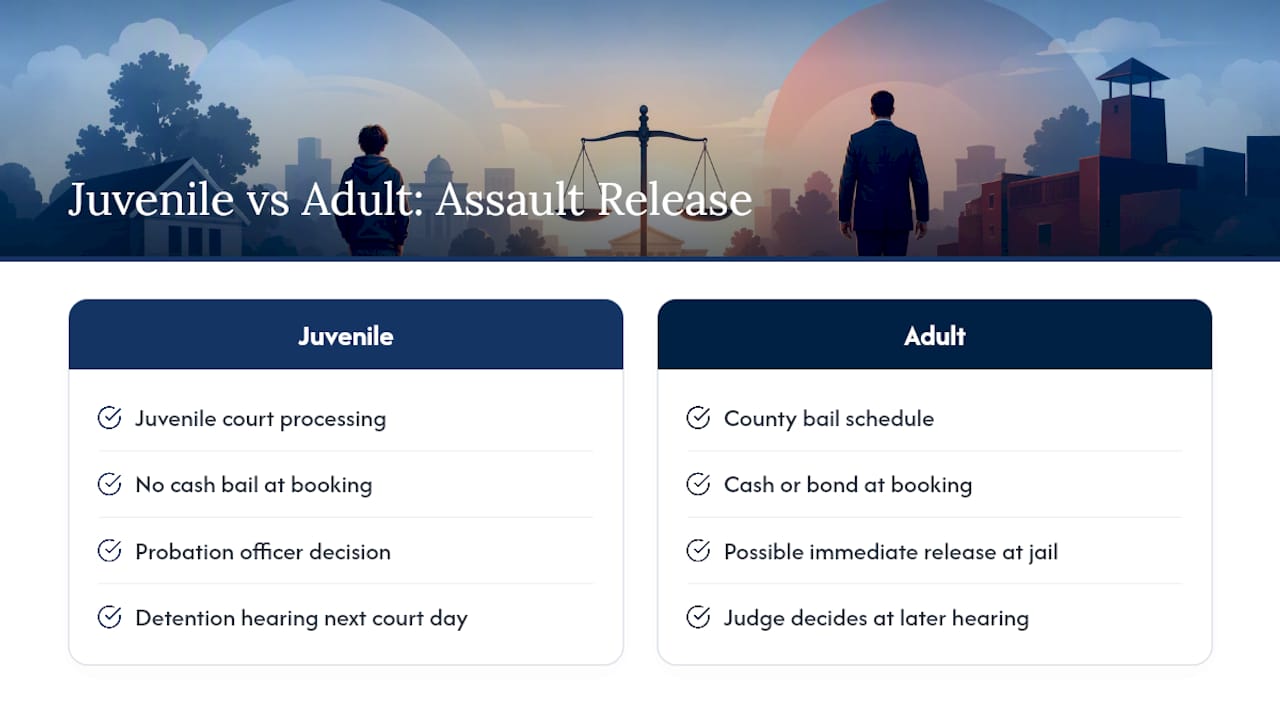
Juvenile assault cases in California don't run through the same bail system as adult cases at all. Minors are processed through juvenile court, and the concept of posting cash bail generally doesn't apply the way it does for adults.
Instead of a bail schedule, a probation officer typically makes an initial detention decision shortly after a minor is taken into custody, and a detention hearing follows within a short statutory window, generally the next court day. The judge at that hearing decides whether to release the minor to a parent or guardian, place conditions on release, or continue detention pending further proceedings.
Adult assault cases, by contrast, run through the county bail schedule from the moment of booking, with the possibility of immediate cash or bond posting before any judge gets involved. That's the core distinction: adults can often buy their way out at the jail counter, while juveniles wait for a judicial decision regardless of family resources.
Family involvement looks different too. Parents of a juvenile defendant are typically required to appear at the detention hearing, and the court weighs home environment and parental supervision heavily in the release decision, factors that don't come into play at all in adult bail proceedings.
Protective Orders and No-Contact Conditions in Assault Cases
Assault charges, especially those involving domestic violence or a known victim, almost always come with a protective order request attached, and that order can shape bail conditions even when it doesn't change the dollar amount.
A judge can set bail at the schedule amount while still imposing a no-contact order as a release condition. That means posting bail gets the defendant out of custody, but violating the no-contact order, even accidentally, such as showing up at a shared residence, can trigger immediate rearrest and a new bail determination, often at a much higher amount.
In domestic violence assault cases specifically, courts frequently require the defendant to vacate a shared home immediately upon release, arrange for a third party to collect personal belongings, and avoid all contact with the protected party, including through social media or mutual friends. Families should treat these conditions as seriously as the bail amount itself, since a no-contact violation can undo a release faster than almost anything else in the process.
How Bail Forfeiture Works if the Defendant Skips Court
Missing a required court appearance triggers bail forfeiture, and the consequences move fast once that happens.
The court typically declares the bail forfeited if the defendant doesn't appear as ordered. For a bail bond, California law gives the surety company (the bail agent) a statutory window, generally 180 days, to locate the defendant and return them to custody before the forfeiture becomes final and the bail agent has to pay the full bond amount to the court. That's why bail agents move quickly and use bounty recovery agents when a client disappears.
For the co-signer, forfeiture can mean losing any collateral pledged to secure the bond, on top of the original premium already paid, which is never refunded regardless of outcome. For the defendant, skipping bail adds a separate criminal charge, failure to appear, on top of the original assault charge, and it virtually eliminates any chance of a bail reduction or OR release on future cases.
What Families Should Expect Working With a Bail Bondsman
Every family calling about an assault arrest is scared and moving fast, and that's exactly why availability matters more than almost anything else in this business. Round-the-clock access means the difference between someone spending one night in custody or three, and bilingual support removes a barrier that shouldn't exist for families already under enough stress.
What families deserve is a real person picking up the phone, not a call center routing them through scripts before connecting them to someone who can actually help. That distinction shapes how a case moves from the first phone call to release. Turnaround depends heavily on the county, the time of day, and whether a hold complicates things, but having documentation ready (ID, proof of income, collateral information) consistently shortens the wait.
One thing worth being upfront about: posting bail resolves custody, not the underlying case. A bail bond gets someone out of jail. It doesn't make an assault charge disappear, and anyone telling a family otherwise isn't being straight with them. What a licensed bondsman can promise is transparency on fees, a clear premium structure, and no surprise costs buried in fine print.
— Jake
Get Someone Released Fast With Jake Hernandez Bail Bonds
Reading a county bail schedule and calling around at 2 a.m. after an arrest are two very different things, and Jakehernandezbailbonds exists for the second one. Jake Hernandez Bail Bonds posts bail statewide across all 58 California counties, handles assault charges from misdemeanor battery through aggravated felony cases, and offers 0% down and payment plans for qualified co-signers, so the full premium doesn't have to come out of one paycheck.
Before calling, have three things ready: the booking number, the exact Penal Code charge, and the county where the arrest happened. That information lets an agent confirm the bail amount and start paperwork immediately instead of tracking down details over multiple calls. Support runs 24/7 with bilingual service in Spanish, Hindi, and Arabic, and every consultation is free, whether you're dealing with a straightforward battery charge or a case complicated by a PC 1275 hold.
Keep in mind that posting bail resolves custody, not the underlying criminal case. Most families still need a defense attorney once release is handled. If an assault arrest just happened, start the bail process now or use the bail bond cost calculator to see what the premium looks like before you call.
Sources
Bail figures and statutory language shift by county and by legislative session, so it's worth checking primary sources directly rather than relying on secondhand summaries.
- 2026 criminal bail schedule (Santa Clara County)
- FELONY BAIL SCHEDULE (Los Angeles Superior Court)
- California Penal Code section 1275.1 (FindLaw)
- California Penal Code — Bail chapter
This article is general information, not a substitute for advice from a qualified lawyer. Consult a qualified legal professional about your own circumstances before acting on anything here.
FAQ
How much is bail for assault in California?
Bail for assault charges typically ranges from around the amount listed in the county schedule for misdemeanor battery to the amount listed in the county schedule or more for aggravated assault involving a firearm or serious injury, with the exact figure set by the county's bail schedule.
How much jail time can you get for assault in California?
Sentencing depends heavily on the specific charge and any enhancements, ranging from up to a year in county jail for misdemeanor assault to several years in state prison for felony assault with a deadly weapon or great bodily injury, so anyone facing charges should consult an attorney about their exact exposure.
What are California's current bail laws?
California continues to use county bail schedules and judicial discretion under the Penal Code's bail chapter, with cash bail remaining the standard practice while judges retain authority to adjust amounts based on public safety and flight risk factors.
How long do you have to press charges for assault in California?
Prosecutors, not victims, decide whether to file charges, and the applicable statute of limitations depends on whether the offense is charged as a misdemeanor or felony, generally one year for most misdemeanor assault charges and longer for felony variants.
What is a PC 1275 hold and does it affect assault bail?
A PC 1275 hold suspends release when there's probable cause that bail funds came from illegal activity, and while it applies to any charge type, it appears most often in cases connected to drug trafficking or money laundering rather than assault alone.