
After-hours bail services are defined as licensed bail bond options available outside standard court hours, including nights, weekends, and holidays, to secure emergency inmate release. Seven primary types exist in the U.S.: cash bonds, surety bonds, property bonds, personal recognizance, citation release, federal bonds, and immigration bonds. Each type carries different costs, timelines, and eligibility requirements. Knowing which option fits your situation before you call an agent saves critical time when every hour matters.
1. What are the types of after-hours bail services?
The industry term for what most families search for is "24-hour bail bond service," and it covers every bond type a licensed agent can post outside regular business hours. The seven bond categories each serve a distinct legal situation. Understanding them before an arrest happens puts you ahead of the process when it counts most.
- Surety bonds: A licensed agent posts bail on the defendant's behalf for a non-refundable fee.
- Cash bonds: The full bail amount paid directly to the court or jail, refundable after case resolution.
- Property bonds: Real estate used as collateral in place of cash.
- Personal recognizance (PR) bonds: Release based on a written promise to appear, no money required.
- Citation release: Law enforcement releases the defendant at the scene with a court date, no jail booking.
- Federal bonds: Used for federal charges, requiring specialized agents and higher complexity.
- Immigration bonds: Posted with ICE for non-citizen detainees, governed by federal immigration law.
Each type has a different path to release. Surety and cash bonds are the most common options families encounter during after-hours emergencies.
2. How surety bonds work after hours

Surety bonds are the most common type of bail bond handled after hours. A licensed bail agent guarantees the full bail amount to the court and charges the defendant's family a non-refundable premium of 10%–20% of the total bail. That fee is the cost of the service, not a deposit. You do not get it back when the case ends.
The agent handles all paperwork and submits the bond to the jail. After-hours submissions often use electronic filing, which cuts signing time significantly. The agent's job ends at submission. What happens next depends entirely on jail staff.
- Fee range: 10%–20% of bail amount, set by state regulation in California.
- Refundability: The premium is never refunded, regardless of case outcome.
- Paperwork: Agents collect co-signer information, ID, and employment details before posting.
- Timing: Bond can be submitted any hour, but jail processing runs on its own schedule.
Pro Tip: Contact a licensed agent the moment you learn of an arrest. Agents can begin collecting your information and monitoring the defendant's booking status before bail is even set, which cuts processing time once the amount is confirmed.
3. How cash bonds function for after-hours release
A cash bond requires paying the full bail amount directly to the court or jail. If the defendant appears at all required hearings, the full amount is refunded at case resolution, minus administrative fees. That refundability makes cash bonds appealing, but the upfront cost is the barrier.
Posting a cash bond after hours presents real logistical challenges. Most courts are closed at night, and jail cashier windows operate on limited schedules. Families need to confirm whether the facility accepts cash bond payments outside business hours before attempting this route.
- Cost: Equal to 100% of the bail amount set by the judge.
- Refund: Returned after case completion, typically minus a small court processing fee.
- Availability: Limited after hours due to court and jail cashier schedules.
- Best use: When bail is low and the family has liquid funds readily available.
Cash bonds also require that bail has already been set. Bail cannot be posted until a judge or magistrate sets the amount, which can take up to 48 hours on weekends. That wait makes surety bonds through a 24-hour agent the faster path in most overnight emergencies.
4. Personal recognizance and other non-monetary bonds
A personal recognizance (PR) bond releases a defendant on a written promise to appear in court, with no money exchanged. Judges grant PR bonds based on the defendant's ties to the community, criminal history, and the severity of the charge. Low-risk defendants with stable employment and local family connections are the most likely candidates.
PR bonds are not available on demand. A judge must approve them, which means they are subject to court hours and judicial discretion. After-hours PR releases are rare unless a duty judge is available.
- Conditions: Courts often attach reporting requirements, drug testing, or GPS monitoring.
- Eligibility: Restricted by charge type; violent or repeat offenders rarely qualify.
- Timing: Requires judicial approval, which may not happen until the next business day.
- Attorney bonds: In some jurisdictions, licensed attorneys can post bond directly, bypassing commercial agent fees and potentially speeding up release.
Pro Tip: If the defendant has no prior record and faces a minor charge, ask the booking officer whether a PR bond is possible. Some facilities process PR releases without requiring a court appearance, which can be faster than any paid bond option.
5. Specialized bonds: federal, immigration, and citation releases
Federal bonds apply when a defendant faces charges in federal court rather than state court. These bonds require agents with specific federal licensing and carry higher complexity in documentation and court requirements. Federal bond fees are typically higher than standard surety bonds, and the process involves federal pretrial services rather than local jail staff.
Immigration bonds cover individuals held by U.S. Immigration and Customs Enforcement (ICE). Two types exist: delivery bonds, which allow release pending an immigration hearing, and voluntary departure bonds, which guarantee the detainee will leave the country by a set date. Both require agents with federal immigration bond authorization.
- Federal bonds: Require federally licensed agents; involve U.S. Pretrial Services review.
- Delivery bonds: Allow ICE detainees to remain in the U.S. pending hearings.
- Voluntary departure bonds: Refundable only if the detainee departs as ordered.
- Citation release: Issued at the scene by law enforcement; no jail booking occurs, so no bond is needed.
Citation releases are the fastest outcome possible because the defendant never enters a jail facility. They are issued at officer discretion for minor offenses. Families dealing with federal or immigration holds should confirm agent credentials before signing any agreement, since not all bail agents carry the required federal authorization.
6. How jail processing times affect after-hours bail release
Release after bond posting ranges from 30 minutes in small facilities to 24 hours or more in large urban jails. That range has nothing to do with agent speed. It reflects jail intake volume, staffing levels, and facility-specific protocols that run independently of any bond submission.
Night shifts and weekends compound the problem. Jail staffing reductions during off-hours slow paperwork verification at every stage. Agents with established relationships with night shift staff can sometimes move the verification phase faster, but no agent can override a facility's internal queue.
Pro Tip: Ask your agent directly whether they have experience posting bonds at the specific jail holding your family member. Agents who regularly work a facility know which windows to use, which staff to contact, and what documentation that jail requires after hours.
| Facility type | Typical release time after bond posting |
|---|---|
| Small county jail | 30 minutes to 2 hours |
| Mid-size facility | 2 to 8 hours |
| Large urban jail | 8 to 24 hours |
| Weekend or holiday | Add 4 to 12 hours to any estimate |
Electronic bond filing reduces paperwork time substantially and is especially useful for remote co-signers who cannot appear in person. Even with digital submission, the jail's internal processing queue determines the actual release time. Contact a bail agent as early as possible to start the clock.
Key Takeaways
The fastest after-hours release comes from understanding your bond options before you need them and calling a licensed agent the moment an arrest occurs.
| Point | Details |
|---|---|
| Surety bonds are the most common | Agents post bail for a 10%–20% non-refundable fee, available 24/7. |
| Cash bonds require full payment upfront | Refundable after case resolution, but limited by court cashier hours after midnight. |
| PR bonds need judicial approval | Low-risk defendants may qualify, but approval often waits until the next court session. |
| Jail processing controls release timing | Release takes 30 minutes to 24 hours regardless of when the bond is submitted. |
| Early agent contact speeds everything | Families who call immediately allow agents to prepare documents before bail is even set. |
What I've learned after years of after-hours releases
The biggest misconception I hear from families is that calling a 24/7 bail agent means their loved one walks out within the hour. That is not how it works. Jail bureaucracy controls actual timing, not the bondsman. I can post a bond at 2:00 AM and have the paperwork confirmed by 2:30 AM. The jail may still not process the release until 10:00 AM because of a shift change, a backlog of bookings, or a staffing shortage on the overnight crew.
What I tell every family is this: call me the moment you know someone has been arrested. Do not wait until bail is set. I use that time to collect your co-signer information, verify the defendant's booking status, and prepare every document so we are ready to move the second a judge sets the amount. Early engagement is the single biggest factor families control in this process.
The other thing I want families to understand is that not every bond type is available at every hour. Federal and immigration bonds require specialized agents. PR bonds require a judge. Cash bonds require an open cashier window. Surety bonds through a licensed agent are almost always the fastest and most accessible path after midnight. That is not a sales pitch. It is the practical reality of how jails and courts operate at night.
Prepare your co-signer information in advance if you can. Know the defendant's full legal name, date of birth, and the jail they are booked into. Those four pieces of information let me start working immediately instead of spending the first 20 minutes tracking down basics.
— Jake
Jakehernandezbailbonds is available right now, any hour
When an arrest happens at midnight on a Saturday, you need a licensed agent who already knows the jail, not a call center reading from a script. Jakehernandezbailbonds operates 24/7 across all 58 California counties, handling surety bonds, federal bonds, and immigration bonds with no middleman and no delay from hand-offs between staff.
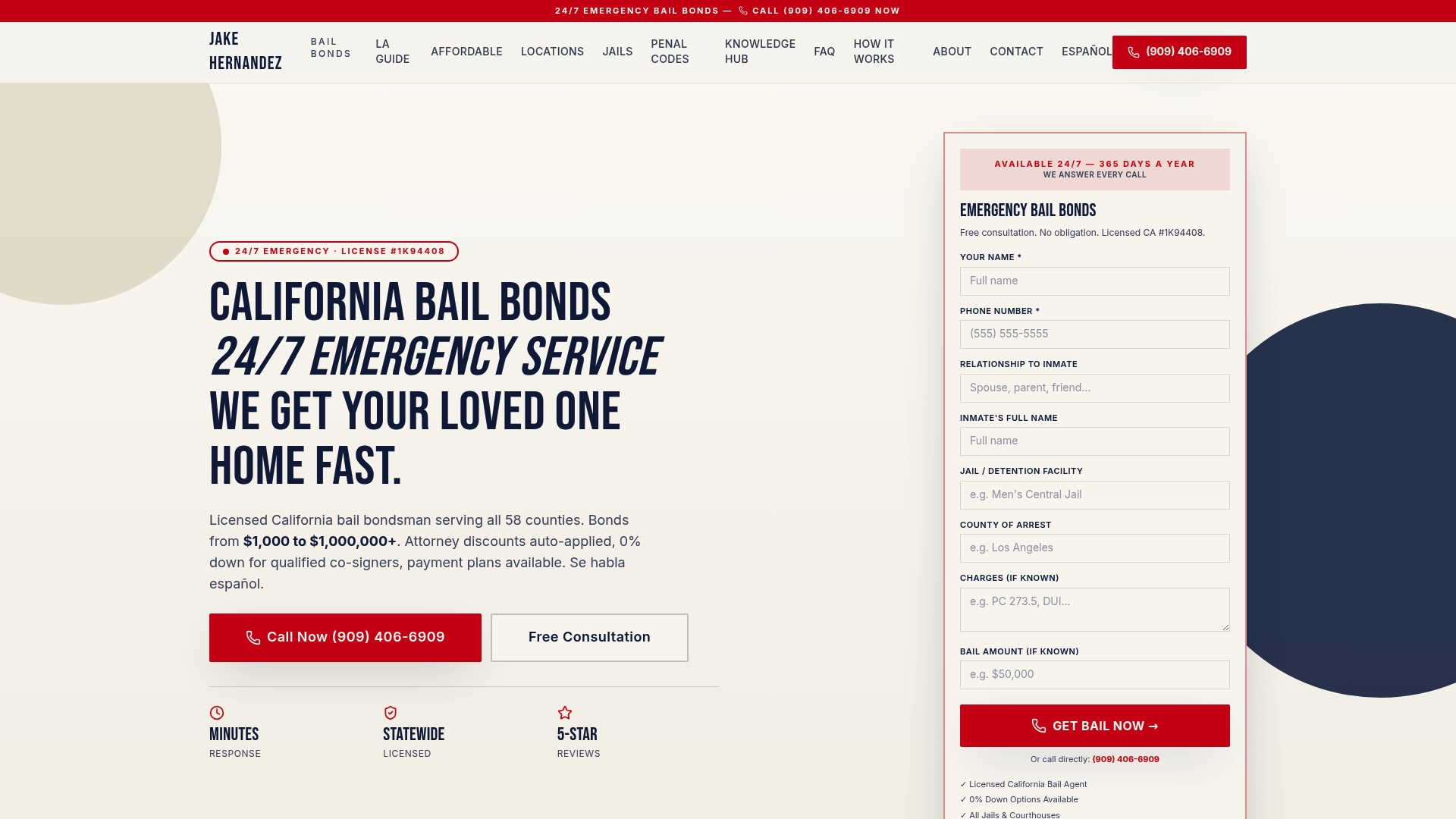
Bonds start at $1,000 and go up to $1,000,000, with 0% down options and payment plans available for qualified co-signers. Free consultations are available around the clock, and bilingual service means no family gets left behind because of a language barrier. Whether the arrest happened at a Los Angeles County jail or a facility hours away, Jakehernandezbailbonds can begin the process right now.
FAQ
What types of bail bonds are available after hours?
The seven types available after hours are surety bonds, cash bonds, property bonds, personal recognizance bonds, citation releases, federal bonds, and immigration bonds. Surety bonds through a licensed 24/7 agent are the most accessible option for overnight and weekend emergencies.
How long does after-hours bail release take?
Release after bond posting ranges from 30 minutes to 24 hours depending on facility size, booking volume, and staffing levels. Weekends and holidays typically add several hours to any estimate.
Can bail be posted before a judge sets the amount?
No. A judge or magistrate must set the bail amount before any bond can be posted. On weekends, that magistration process can take up to 48 hours, which is why contacting an agent immediately after arrest is critical.
What is the fee for a surety bond after hours?
Licensed agents charge a non-refundable premium of 10%–20% of the total bail amount. In California, the standard rate is 10% for most defendants, with variations for attorney-referred clients.
Does a 24/7 bail agent guarantee faster release?
A 24/7 agent guarantees faster bond submission, not faster jail processing. Jail staff operate on their own schedule regardless of when the bond is posted, so actual release time depends on the facility's internal workload and staffing.