
What is a bail premium and how is it calculated?
A bail premium is the non-refundable fee you pay a licensed bail bond agent to post bail on your behalf. It is not the bail amount itself. The court sets the total bail; the premium is simply the agent's charge for guaranteeing that amount.
The most common rate is 10% of the total bail. The fee you pay is calculated as this percentage of the bail amount set by the judge. For instance, if the court sets bail at $25,000, the premium is typically $2,500. That amount is not refunded regardless of how the case ends. Understanding how bail premium is determined starts with that single distinction: court-set bail amount versus the percentage fee you actually pay out of pocket.
Key facts at a glance:
- The premium is typically 10% of the total court-set bail amount
- The premium is non-refundable once the bond is posted
- Rates can vary by state, bond size, and qualifying discounts
- The bail amount and the premium are two separate figures
- Some states do not use commercial bail bonds at all, requiring cash deposits directly with courts instead
How legal regulations and bail schedules set premium rates
State law, not individual agents, controls how bail bond premiums are set. In California, the California Department of Insurance Rate Regulation Branch reviews all filed premium rates to confirm they are not excessive, inadequate, or unfairly discriminatory. Every surety company must file its rates with CDI, and every agent representing that surety must charge those exact filed rates.
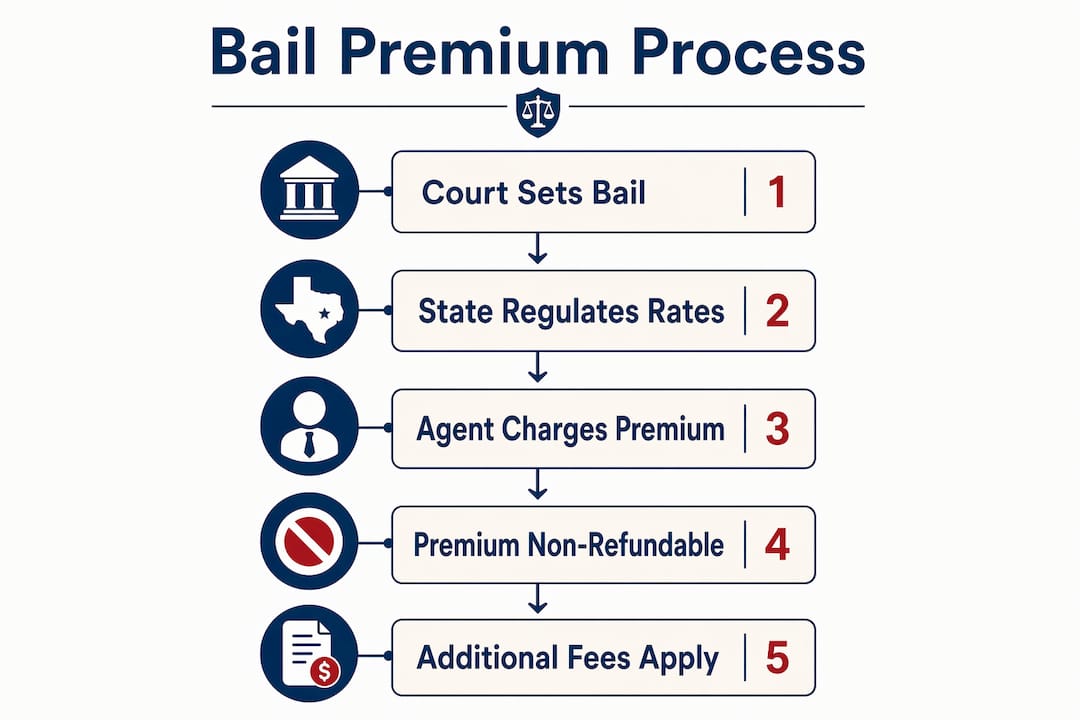
Bail schedules add another layer. Counties publish schedules that assign a default bail amount to specific charges, and judges use those schedules as a starting point. Because the premium is a percentage of the bail amount, a higher schedule amount directly produces a higher premium. Judges can adjust bail above or below the schedule based on case-specific factors, which shifts the premium accordingly.
New York uses a tiered structure that caps premiums as bond size grows. Under New York's bail fee regulations:
- Bonds of $200–$3,000: maximum premium of 10%
- Bonds of $3,001–$10,000: 10% on the first $3,000, then 8% on the remainder
- Bonds above $10,000: the above rates apply, plus 6% on any amount exceeding $10,000
California law also prohibits renewal premiums. Under AB 1347, effective January 1, 2022, no bail agent may charge a second premium during the life of a bond. One payment covers the entire period until the bond is exonerated.
Why this matters for your family: Legal caps exist precisely so agents cannot charge whatever the market will bear during a crisis. Knowing the statutory ceiling gives you the power to push back if a quote looks wrong.
Are bail premiums refundable, and what other fees apply?
The premium is earned the moment the bond is filed. The bail agent has taken on financial risk from that instant, and California law is explicit that premiums are non-refundable even if charges are dropped, the case is dismissed, or the defendant is found not guilty. The only narrow exception: if the defendant is surrendered before trial, a partial refund minus administrative costs may apply under CCR Title 10 §2090.
Beyond the premium itself, agents may pass on certain documented costs, but only under strict conditions. California Bulletin No. 137 allows reimbursement of out-of-pocket expenses such as third-party guard services or necessary long-distance calls, provided those charges are itemized in writing and represent the exact actual cost. General service fees disguised as add-ons are prohibited.
Common questions families ask about fees and collateral:
- Can the agent require collateral? Yes. For large bail amounts, agents often require a lien on real property or other assets to secure the bond.
- What counts as acceptable collateral? Real estate, vehicles, and other assets of sufficient value. New York guidance suggests collateral should be reasonable relative to the bond value.
- Is collateral returned? Collateral is released once the bond is exonerated, provided the defendant met all court obligations.
- Can I make payments? Some agents offer premium financing, where you pay a portion upfront and the rest over time, secured by collateral.
- Does a co-signer affect my premium? A co-signer, called an indemnitor, does not lower the filed premium rate, but their creditworthiness and assets can influence whether an agent accepts a payment plan.
Pro Tip: Ask for a written itemization of every charge before signing anything. Agents are legally required to disclose all fees in writing, and any charge not listed in that document is a red flag.
How bail bond agents operate within the rules
Bail agents are not free to price however they like. They operate as representatives of licensed surety insurers, and every rate they charge must match what that surety filed with the state insurance department. California's Bulletin No. 137 eliminated the old practice of splitting the payment into a "premium" and a separate "service charge." The full amount you pay is the premium, period.

Agents do have some flexibility within the law. Under California's Proposition 103, an agent may offer a rebated rate, effectively lowering the percentage charged. Clients with private attorneys, union membership, or substantial collateral sometimes qualify for reduced rates as low as 2%–8% instead of the standard 10%. Market competition drives much of this, particularly in counties with many active agents.
On the cost side, understanding how bail bondsmen make money clarifies why premiums are structured the way they are. A bail bond company typically pays around 20% of the premium to its surety insurer, with 10% of the total premium held in a buffer account to cover potential bond forfeiture losses. The remainder is the agent's gross income. On a typical premium, the agent retains the portion remaining after surety costs are paid.
Agent responsibilities under state law include:
- Filing uniform rates with the state insurance department
- Charging every client the same filed rate, with no individual variations unless a proper rebate basis exists
- Disclosing all charges in writing before the bond is executed
- Collecting collateral only in amounts reasonable to the bond value
- Offering payment plans only within the terms permitted by the filed rate structure
What Jakehernandezbailbonds offers families navigating bail costs
Jakehernandezbailbonds operates across all 58 California counties, 24 hours a day, seven days a week, with bilingual support for Spanish-speaking families. There is no call center, no middleman. You speak directly with a licensed agent who can explain exactly how your premium is calculated and what your options are.
For qualified co-signers, Jakehernandezbailbonds offers 0% down payment plans, which means you can secure a loved one's release without paying the full premium upfront. Bonds range from $1,000 to $1,000,000. Consultations are always free.
Every premium Jakehernandezbailbonds charges is filed with and approved by the California Department of Insurance. No hidden fees, no renewal premiums, no service charges beyond what the law permits.
Pro Tip: Use the bail bond cost calculator on the Jakehernandezbailbonds website to see your estimated premium before you call. It takes 30 seconds and removes the guesswork entirely.
Jakehernandezbailbonds covers jails across California, from Men's Central Jail in Los Angeles to facilities in San Bernardino, Banning, Castaic, and Santee. If someone you care about has been arrested, call now for a free consultation. Jakehernandezbailbonds is available around the clock.
Key Takeaways
Bail premiums are legally regulated, non-refundable fees calculated as a percentage of the court-set bail amount, most commonly 10%, and agents must charge the exact rates filed with state insurance regulators.
| Point | Details |
|---|---|
| Standard premium rate | The most common rate is 10% of the total court-set bail amount. |
| Non-refundable by law | Premiums are earned when the bond is filed and are not returned if charges are dropped. |
| Legal caps protect you | States like New York use tiered structures; California prohibits renewal premiums under AB 1347. |
| Discounts are possible | Clients with private attorneys or substantial collateral may qualify for rates as low as 2%–8%. |
| Agents follow filed rates | Every agent must charge the rate their surety company filed with the state insurance department. |