A PC 1275 hold is a bail hold under California Penal Code §1275.1 that pauses a defendant's release the moment a judge finds probable cause that the bail money came from a felony. Once filed, the jail will not accept bail until the person posting it, the surety, proves by a preponderance of the evidence that the funds are legitimate. Until that proof lands, the defendant stays in custody.
TL;DR:
- A 1275 hold is imposed when a judge finds probable cause that the bail money is linked to a felony, delaying release until proof of legitimacy is provided.
- The surety must prove within 24 hours, by a preponderance of evidence, that the funds are clean, or the defendant must be released on the original bail amount.
- Holds are most common in cases involving drug trafficking, money laundering, or large-scale theft, and are rarely used for low-level misdemeanors.
- The hearing to lift a 1275 hold is document-heavy, requiring bank statements, pay stubs, or loan documents showing the money’s lawful source.
- Transitioning to a court-approved bail bond can often resolve the hold faster, especially with the help of experienced bail agents and legal counsel.
Table of Contents
- What Does Penal Code §1275.1 Actually Say?
- Which Charges Typically Trigger a 1275 Hold?
- How Does the Court Actually Impose the Hold?
- What Happens at the 1275 Hearing?
- What If the Hold Stays In Place?
- How Bail Agents and Defense Counsel Actually Handle a 1275 Hold
- How Jake Hernandez Bail Bonds Handles 1275 Holds Fast
- Sources
What Does Penal Code §1275.1 Actually Say?
Penal Code §1275.1 gives courts the power to freeze a bail transaction whenever there's probable cause the money behind it was "feloniously obtained." That single phrase drives everything else in the statute, and reading the actual subdivisions clears up a lot of confusion families run into at the jail counter.
Subdivision (b) sets the trigger: a judge or magistrate can order a hold if evidence suggests the bail consideration traces back to a felony, not just a hunch or a rumor. Subdivision (c) shifts the burden. Once the hold is on, the defendant or surety must show, by a preponderance of the evidence, that the money is clean. That's a lower bar than "beyond a reasonable doubt," but it still means real documentation, not just a verbal assurance.
Two more subdivisions matter for timing and resolution:
- Subdivision (g): if the declaration triggering the hold isn't acted on by a judge within 24 hours, the defendant must be released on posting the bail amount already set.
- Subdivision (j): a court can vacate the hold once a licensed, court-approved surety issues the bond, provided the court approves the consideration used.
That 24-hour window is one of the most overlooked protections in the statute. Families often assume a hold means indefinite detention, but the law builds in a hard deadline for judicial action.
Statutory snapshot: the hold applies only when probable cause exists that bail funds are tied to a felony, and the burden then falls on the surety, not the prosecution, to prove otherwise.
Which Charges Typically Trigger a 1275 Hold?
Not every arrest carries this risk. A 1275 hold shows up almost exclusively in cases where large sums of cash and criminal proceeds plausibly overlap. Charges most commonly linked to a hold include:
- Drug trafficking or large-scale distribution
- Money laundering
- Embezzlement
- Grand theft
- Extortion
- Gang-related financial crimes
Law enforcement zeroes in on these charges because the alleged crime itself generates cash. Wallin & Klarich's guidance on 1275 holds notes that prosecutors and judges look at whether the bail money's source lines up with income a defendant could plausibly explain, and drug or fraud cases often don't pass that smell test on the surface.
Misdemeanors rarely draw a hold. A DUI, a simple assault charge, or a low-level theft case almost never triggers §1275.1 because there's no obvious felony-proceeds trail attached to the bail money. If you're facing a misdemeanor and a hold still gets placed, it's worth asking your attorney whether the filing was appropriate at all.
How Does the Court Actually Impose the Hold?
A 1275 hold doesn't appear out of nowhere. It follows a specific procedural sequence, and knowing the steps helps families understand where they are in the process and what happens next.
- A peace officer or prosecutor files a declaration under penalty of perjury. The declaration lays out the probable-cause basis for believing the bail funds are tied to a felony. Prosecutors carry civil immunity for filing this declaration in good faith, according to FindLaw's text of the statute.
- A judge can also initiate the hold independently if the court itself has reason to question the funds during a bail proceeding.
- The jail immediately stops accepting bail on that case the moment the hold is entered, which halts any bond posting already in motion.
- The clock starts on the 24-hour rule. If no judge acts on the declaration within that window, the law requires release on the originally set bail amount.
- The defense or surety requests a hearing to present evidence and lift the hold, typically through defense counsel or the bail agent coordinating with the court.
That sequence moves fast, which is exactly why families who wait a day or two to start gathering paperwork often lose valuable time they can't get back.
What Happens at the 1275 Hearing?
The hearing is where the surety actually gets to prove the money is legitimate, and it's a lot more document-driven than most people expect. A judge presides, the defense attorney or surety's counsel presents evidence, and the prosecution can cross-examine on the source of funds. Some courts will grant a closed hearing on request, keeping sensitive financial records out of the public docket, a detail confirmed by Wallin & Klarich's overview of the process.
The preponderance standard means the surety only has to make the legitimate-source explanation more likely than not. But "more likely than not" still requires real paper. Evidence that tends to persuade judges includes:
- Bank statements showing a consistent deposit history over months, not a single large recent transfer
- Pay stubs and W-2s tied to a known employer
- Tax returns matching the claimed income
- Loan agreements or signed promissory notes with a repayment schedule
- Sale or closing documents if the funds came from selling property
- Employer letters confirming income and length of employment
According to LegalClarity's breakdown of the hearing process, a promissory note paired with bank records showing actual repayments carries more weight than a note alone, because it ties the money to a documented, traceable transaction rather than a claim on paper. Judges consistently favor a slow, boring paper trail over a dramatic one-time deposit, even when the total dollar amount is identical.
Witness testimony and notarized affidavits can round out the picture, especially when a family member is loaning money and can explain the relationship and the terms in person.
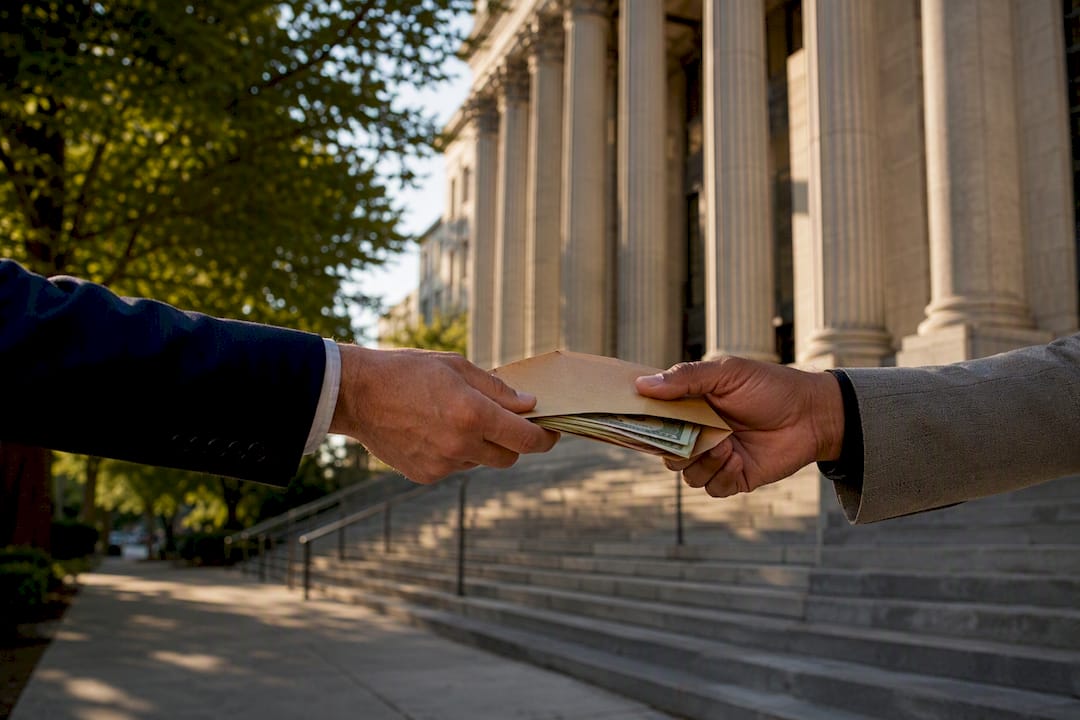
Pro Tip: Pull bank statements covering at least three to six months before the hearing, not just the days around the bail payment. Judges consistently find a longer, steady deposit history far more convincing than a single unexplained lump sum.
What If the Hold Stays In Place?
If the judge isn't convinced, the hold remains and the defendant stays in custody, sometimes with the disputed funds effectively frozen while the case continues. That delay can ripple into defense strategy too. Time spent fighting a bail hold is time not spent building the actual criminal defense.
The path forward doesn't have to end there. Under subdivision (j) of the statute, a judge can vacate the hold once a licensed, court-approved surety bail bond is issued and the court approves the consideration behind it. In plain terms: switching from disputed cash to a bond backed by a properly licensed bail agent often resolves the standoff faster than continuing to litigate the original funds.
Realistic next steps once a hold sticks include:
- Presenting a different, clearly verified source of funds instead of the original disputed money
- Working with an admitted surety insurer or approved bail agent to post a court-approved bond
- Requesting an expedited hearing rather than waiting for the next available court date
- Reviewing whether alternate bail posting methods make more sense than re-litigating the same contested cash
A licensed bail agent's role here matters more than people assume. Agents who regularly handle 1275 holds know exactly what documentation the court wants to see before it will approve the consideration behind a new bond, which shortens the back-and-forth considerably.
How Bail Agents and Defense Counsel Actually Handle a 1275 Hold
The families who move fastest through a 1275 hold treat it like a document project from hour one, not a legal mystery to wait out. A bonds agent who has handled these holds before will usually build a checklist immediately: bank statements, pay stubs, loan paperwork, whatever fits the actual source of funds, and get it moving toward defense counsel before the hearing date is even set.
Coordination between the bonds agent and the attorney is where most delays disappear. When both sides show up with employer letters and notarized affidavits already prepared, the hearing tends to move faster and the cross-examination gets a lot less adversarial.
If you're facing this right now, three things matter immediately: contact a bail agent who has actually worked 1275 holds before, pull your financial records together tonight rather than next week, and get your defense attorney looped in before the hearing, not after.
— Jake
How Jake Hernandez Bail Bonds Handles 1275 Holds Fast
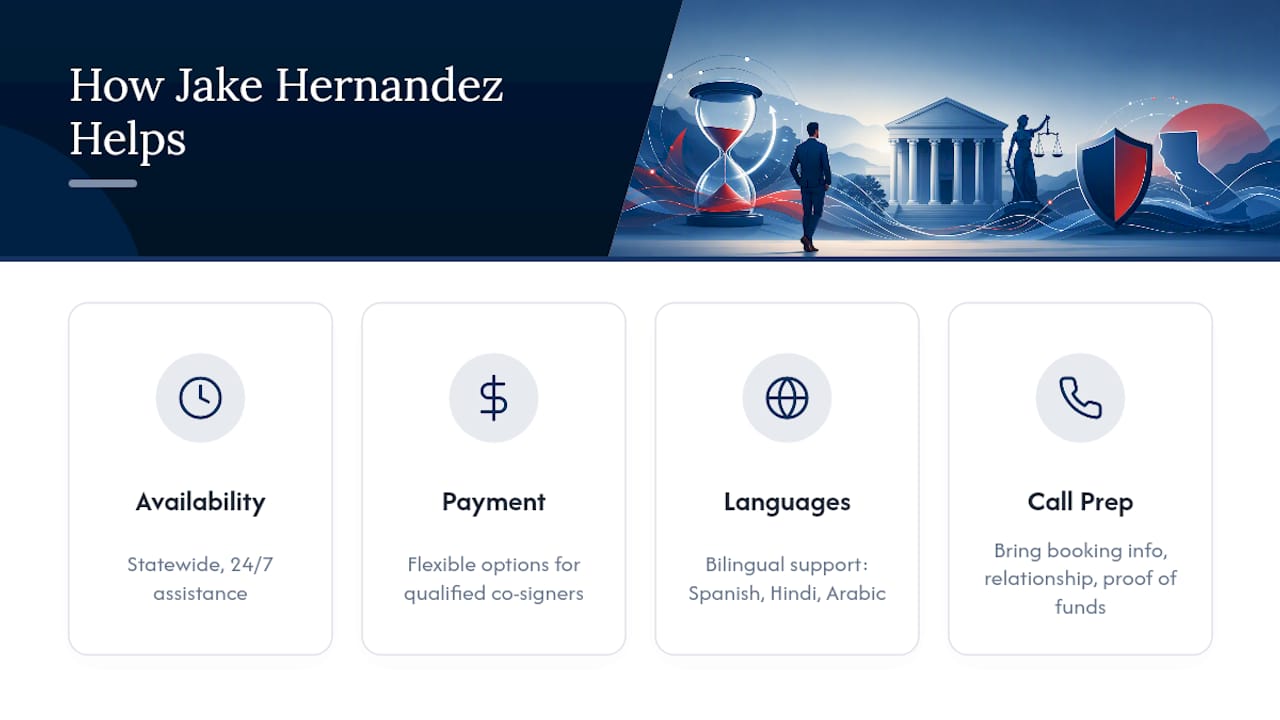
Jake Hernandez Bail Bonds gives families facing a 1275 hold something most agencies can't: a team that has actually walked clients through the document fight, not just the bond paperwork. We work statewide across California, 24/7, offering flexible payment options for qualified co-signers and bilingual support in Spanish, Hindi, and Arabic, so language never slows down a time-sensitive hearing.
When you call, have the defendant's booking information, your relationship to them, and whatever proof of funds you already have on hand: pay stubs, bank statements, anything showing where the bail money is really coming from. Your first consultation is free, and everything you share stays confidential. We'll walk you through what the court will want to see and how a court-approved bail bond can move the case toward a vacated hold instead of another week in custody.
Reach out through our California bail bonds line now, day or night, and let's get the release process moving while you gather the paperwork.
This article is general information, not a substitute for advice from a qualified lawyer. Consult a qualified legal professional about your own circumstances before acting on anything here.