Court dates are set by the court itself, typically through a combination of judicial authority, prosecutor or district attorney docketing, and clerk-managed calendars. In federal cases, the Speedy Trial Act) (18 U.S.C. § 3161) creates a default 70-day window from indictment or first appearance to trial. For state cases, the timeline depends on local rules, case complexity, and which office controls the docket in your jurisdiction.
Here is how to find or confirm your date right now:
- Check the court's online calendar. Most county and federal courts publish searchable case calendars on their official websites. Search by defendant name, case number, or booking number.
- Call the clerk of court. The clerk's office manages notices and can confirm scheduled hearings directly. Have your case number, the defendant's full legal name, and the county ready before you call.
- Contact your attorney or public defender. They receive formal notice of all scheduled dates and can explain what each hearing means.
Pro Tip: When calling the clerk, lead with the case number, not just the defendant's name. Many counties have dozens of defendants with similar names. A booking number or case number gets you to the right record in under a minute.
Key Takeaways
Court dates in the United States are set by judges, shaped by prosecutors and clerks, and governed by local rules and the federal Speedy Trial Act, which requires trial within 70 days in most federal cases.
| Point | Details |
|---|---|
| Who sets dates | Judges hold final authority; prosecutors and clerks often prepare the docket in practice. |
| Federal timing rule | The Speedy Trial Act requires trial within 70 days of indictment or first appearance, subject to statutory exclusions. |
| How to confirm your date | Check the court's online calendar, call the clerk with your case number, and verify with your attorney. |
| Missed date consequences | A missed date can trigger a bench warrant, bail forfeiture, and additional charges; act the same day. |
| Delays are common | Case complexity, discovery backlogs, and court volume all push timelines out; prompt counsel and early communication help. |
Table of Contents
- Who actually controls your court date?
- What the typical scheduling timeline looks like
- How to find your court date when you need it fast
- What happens if a date needs to change, or if you miss one
- What slows down or speeds up your court date
- What the federal Speedy Trial Act requires
- How courts manage calendars to keep dates from slipping
- A practical mindset for court dates, from Jake
- Need help with an urgent court date or bail situation?
- Sources
Who actually controls your court date?
The short answer: a judge has final authority, but in practice, prosecutors, defense counsel, and court staff often shape the calendar before a judge ever signs off.
In many superior courts, the district attorney's office prepares administrative dockets and proposes hearing dates. A judge retains the authority to accept, reject, or modify those dates, but the practical scheduling often originates with the prosecutor's office. As the UNC School of Government explains in its analysis of North Carolina's docketing system, scheduling is often an iterative negotiation among judge, prosecutor, and defense counsel, with informal staff communication determining practical dates even though judges hold legal authority.
Scheduling authority in practice: "Docketing plans and informal staff communication often determine practical dates even though judges have legal authority." The result is that the office you need to call depends on which model your jurisdiction uses — prosecutor-led, judge-led, or a hybrid managed by court staff.
North Carolina's G.S. 7A-49.4 is one of the clearest statutory examples of prosecutor-led docketing: it explicitly authorizes district attorneys to prepare criminal dockets in superior court. Most other states vest scheduling authority more directly in the court, with clerks managing the calendar under judicial supervision. Federal courts operate differently again, with scheduling orders issued by the judge at or near arraignment.
A calendar call is worth understanding here. It is an administrative hearing where a judge checks the readiness of multiple cases at once. For defendants, it is usually a check-in point where readiness for trial, a plea, or further scheduling is confirmed. Missing a calendar call carries the same consequences as missing any other court date.
What the typical scheduling timeline looks like
The sequence of court events follows a fairly predictable pattern in criminal cases, though timing varies significantly by jurisdiction, charge severity, and whether the case is federal or state.
Criminal case sequence:
| Stage | What happens | Typical timing |
|---|---|---|
| Arrest / first appearance | Charges read, bail set or denied | Within 24 hours of arrest |
| Arraignment | Formal plea entered | Days to a few weeks after arrest |
| Scheduling order / status conference | Trial date and deadlines set | 30 days after arraignment |
| Pretrial motions / discovery | Hearings on evidence and legal issues | Weeks to months before trial |
| Trial | Case heard by judge or jury | Varies widely by complexity |
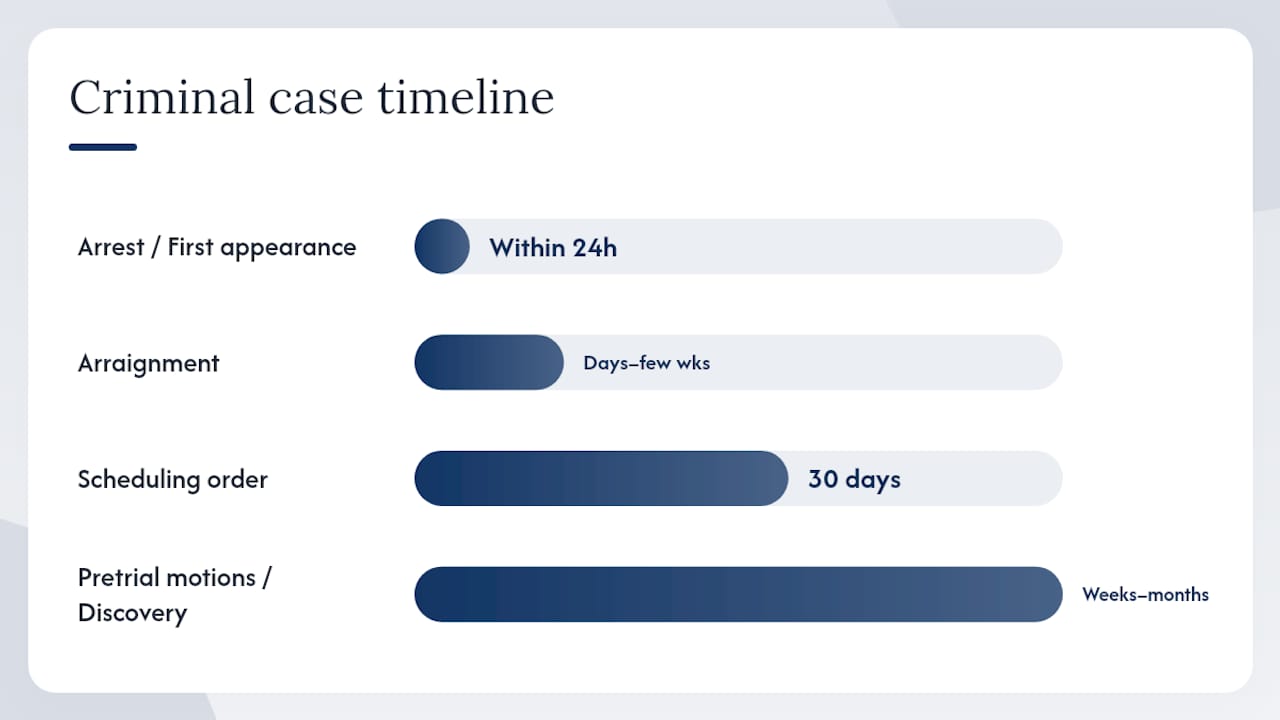
Federal cases follow a tighter statutory framework. Under 18 U.S.C. § 3161, trial must begin within 70 days of indictment or the defendant's first appearance, whichever is later. That clock can be paused for specific statutory exclusions, including continuances for good cause, complex cases, or pending pretrial motions.
Civil cases work differently. A judge typically issues an initial scheduling order after the parties file their first pleadings, setting deadlines for discovery, motions, and a trial date. Those timelines tend to run longer than criminal cases, often spanning six months to two years depending on complexity and court backlog.
Local rules and Criminal Scheduling Orders in federal districts often require that a scheduling order be entered at or near arraignment, locking in deadlines for discovery and motions consistent with the Speedy Trial Act unless the parties agree to an alternative timeline.
How to find your court date when you need it fast
Confirming a court date is not complicated, but you need the right identifiers and the right source. Online calendars can lag by a day or two after a rescheduling, so always cross-reference at least two sources for anything time-sensitive.
Step-by-step checklist:
- Court website case search. Go to the official website for the county or federal district where the case was filed. Look for a "case search," "court calendar," or "online docket" link. Enter the case number or defendant name.
- Clerk of court (phone or email). The clerk's office is the authoritative source. Call during business hours with the case number, defendant's full legal name, county, and booking number if the person is still detained.
- Your attorney or public defender. They receive formal notices and can clarify what each hearing type means. If you do not have an attorney, the public defender's office for the county can often point you to the right calendar.
- Jail or inmate lookup. If the defendant is still in custody, the jail's inmate search tool often lists upcoming court dates. For California cases, tools like the Calaveras County inmate search can surface detention status and scheduled hearings quickly.
What to have ready: case number, defendant's full legal name as it appears on booking documents, county of arrest, booking number, and the court where the case was filed (not always the same county as the arrest).
Pro Tip: Mailed court notices are official, but they can be delayed or sent to an old address. Always verify a mailed notice against the court's online calendar before assuming the date is current. If the two sources conflict, call the clerk that same day.
Most state courts, including those in North Carolina and California, publish online calendars and case lookup tools as standard practice. The Federal Judicial Center notes that court administrative systems vary by county, so the exact interface and data freshness differ from one jurisdiction to the next.
What happens if a date needs to change, or if you miss one
Requesting a continuance
A continuance is a formal postponement of a scheduled court date. To get one, a party typically files a written motion or submits a stipulation signed by both sides, showing good cause for the delay. "Good cause" covers things like a key witness being unavailable, incomplete discovery, or a scheduling conflict for counsel. The judge decides whether to grant it.
The process in practice:
- Consult your attorney immediately when a conflict arises.
- Your attorney files a motion for continuance or a joint stipulation with opposing counsel.
- The court reviews the request and issues an order granting or denying it.
- If granted, the clerk issues a new notice with the rescheduled date.
In federal cases, continuances must be formally documented to exclude time from the Speedy Trial Act clock. An oral agreement between counsel is not enough.
Missing a court date
Missing a scheduled court date triggers serious consequences, usually fast:
- Bench warrant. A judge can issue a bench warrant for the defendant's arrest the same day a date is missed.
- Bail forfeiture. If the defendant was released on bail, the court may order the bail bond forfeited. The bonding company is notified and has a limited window to return the defendant to custody before the full bond amount is owed.
- Additional charges. In some jurisdictions, failure to appear is a separate criminal offense.
If a date is missed, act the same day. Call your attorney, then call the clerk of court to confirm a warrant has not yet been issued. Your attorney can file a motion to recall or quash the bench warrant, which asks the court to withdraw it in exchange for a new appearance date. You can also check for an active warrant through a resource like the California warrant search tool to know exactly what you are dealing with before making contact.
A bail bonds provider can help with urgent logistics: locating the defendant if re-arrested, coordinating a new bond if bail was forfeited, and communicating with the court on timing.
What slows down or speeds up your court date
Several factors push scheduling timelines in one direction or the other, and understanding them helps you set realistic expectations.
Factors that delay scheduling:
- Case complexity. More charges, more defendants, or more serious felonies require more pretrial preparation and longer scheduling windows.
- Multiple defendants. When several people are charged together, every party's attorney schedule and readiness affects the shared trial date.
- Pending discovery. Lab results, forensic reports, or voluminous document production can hold up a trial date for months.
- Court backlog. High-volume courts in major urban counties often have dockets booked months out. A case filed today may not reach trial for a year or more.
- Local calendaring rules. Some courts use a master calendar system (cases assigned to any available judge); others use individual calendars (one judge per case from start to finish). Individual-calendar courts tend to move faster.
What you can do to avoid unnecessary delays:
- Retain or contact an attorney as early as possible after arrest. Unrepresented defendants create scheduling complications that slow the whole docket.
- Communicate scheduling conflicts to your attorney immediately. Last-minute continuance requests are more likely to be denied.
- Respond to discovery requests on time. Delays in producing documents or evidence push every subsequent deadline back.
Courts are also beginning to explore data-driven scheduling tools. Research published in 2024 examined machine-learning approaches to fair court scheduling that factor in defendants' preferences to reduce nonappearances and improve equity. These systems are not yet widespread, but they signal where court administration is heading.
Understanding factors judges consider when setting bail also matters here: the same case complexity that slows scheduling often affects bail decisions at the first appearance.
What the federal Speedy Trial Act requires
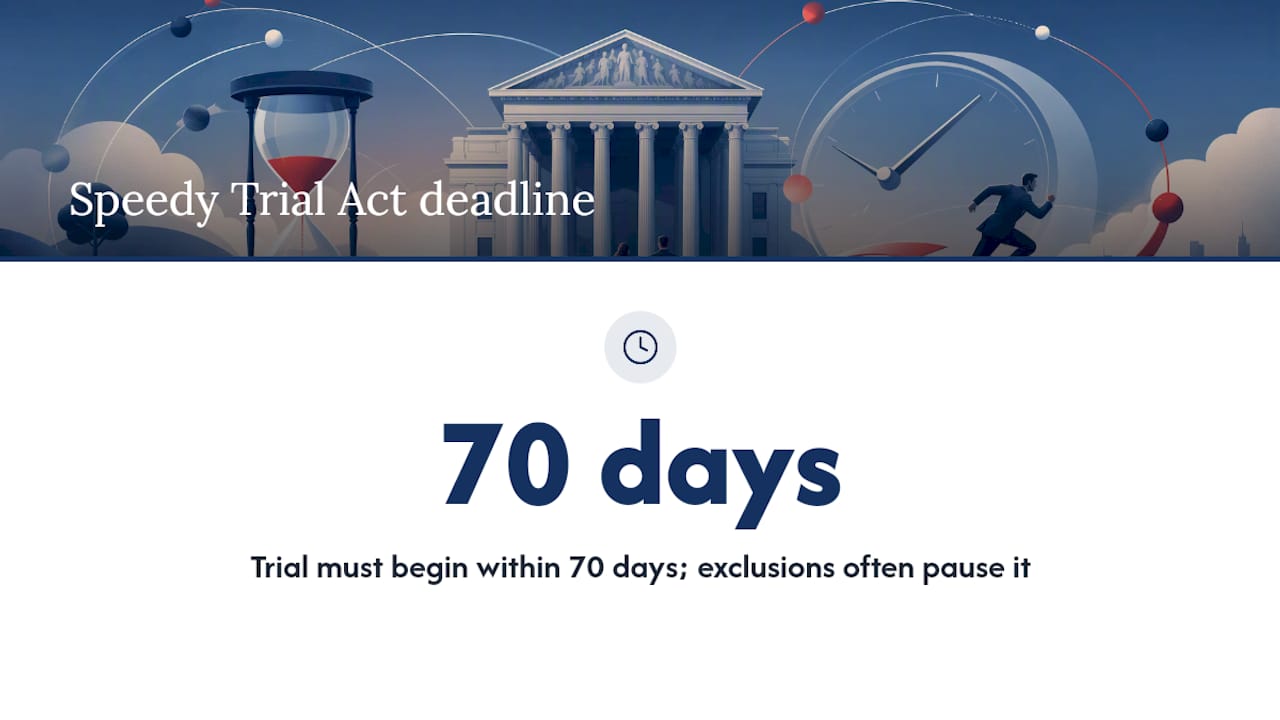
The Speedy Trial Act, codified at 18 U.S.C. § 3161, sets the clearest statutory deadline in American criminal procedure. Trial must begin within 70 days of the later of two events: the filing of an indictment or information, or the defendant's first appearance before a judicial officer.
The 70-day rule in plain terms: The Speedy Trial Act clock starts ticking at indictment or first appearance. If trial does not begin within 70 days, the defendant can move to dismiss the charges. But the clock is frequently paused. Continuances for good cause, pending pretrial motions, complex-case designations, and other statutory exclusions all stop the count. Practitioners must file motions or stipulations to formally exclude time; an informal agreement between attorneys does not pause the clock.
The practical effect is that federal cases rarely hit the raw 70-day deadline. Exclusions are common and often agreed to by both sides. What the Act does is create a ceiling that prevents indefinite delay, giving defendants a legal tool if the government drags its feet without justification.
Local federal rules add another layer. The U.S. District Court for Hawaii's Criminal Local Rules (CrimLR2.1) require a Criminal Scheduling Order to be entered at or near arraignment, setting trial dates and related deadlines consistent with the Speedy Trial Act or reflecting party-agreed alternative dates. Most federal districts have equivalent rules.
If you believe your speedy-trial rights are being improperly excluded, that is a conversation for your attorney immediately. A motion to dismiss for Speedy Trial Act violations is a serious remedy and requires careful documentation of the timeline.
How courts manage calendars to keep dates from slipping
Caseflow management is the set of practices courts use to keep cases moving on schedule. The goal is straightforward: set realistic dates early, enforce them, and grant continuances only when genuinely necessary.
Courts that do this well share a few consistent practices. They issue scheduling orders at or near arraignment rather than leaving dates open-ended. They track the time between each case event and flag cases that are falling behind. They require written, justified requests for continuances and keep count of how many have been granted in each case.
The data supports this approach. Research on timely justice in criminal cases shows that courts with strict continuance policies and active case-tracking schedule and move cases more quickly than courts without those practices. The U.S. District Court for Massachusetts best practices guidance recommends setting realistic, firm trial dates early, enforcing discovery deadlines, and granting continuances only for articulated good cause.
The National Center for State Courts frames it this way: effective courts create the expectation that events will occur as scheduled. When that expectation is consistent, attorneys prepare on time, witnesses show up, and the docket moves.
What this means for you: if your case is in a court with strong caseflow practices, expect dates to hold. If it is in a high-backlog court, build in extra time for verification before every hearing. Check the court's local rules page to see whether it publishes scheduling standards or continuance policies.
A practical mindset for court dates, from Jake
Most of the stress around court dates comes from uncertainty, not the dates themselves. You can eliminate most of that uncertainty with a short checklist run the week before any scheduled hearing.
Week-before checklist:
- Confirm the date and time against the court's online calendar and your attorney's notice.
- Print or screenshot the case number, courtroom number, and judge's name.
- Arrange transportation. Parking near courthouses is often limited; plan to arrive 30 minutes early.
- Arrange child care or work coverage for the full day, not just the hearing time. Court schedules shift.
- Verify the defendant's detention status if they are in custody. A last-minute transfer between facilities can affect whether they appear in person or by video.
- Let your attorney or bondsman know immediately if any conflict arises. A 48-hour heads-up is manageable. A same-day call is not.
The bail bond side of this matters more than most people realize. If someone was released on bond, the bonding company has a direct interest in making sure they appear. A good bondsman will remind clients of upcoming dates, help locate a defendant who has gone out of contact, and coordinate with the court on logistics when something unexpected happens. That is not a sales pitch; it is just how the relationship works when it is functioning properly.
For anyone navigating the period between arrest and first appearance, understanding why speed matters in the bail process can make the difference between a defendant sitting in custody through multiple hearings or being home and able to prepare their defense.
Need help with an urgent court date or bail situation?
When a court date is coming up fast and someone is still in custody, every hour counts. Jakehernandezbailbonds provides 24/7 licensed bail bond services across all 58 California counties, with 0% down options for qualified co-signers, free consultations, and bilingual support in Spanish, Hindi, and Arabic. Whether you need a bond posted tonight or help tracking down a court date for a detained family member, the team is available around the clock.
Sources
Use these authoritative resources to verify rules and search for your local court calendar:
- 18 U.S.C. § 3161 (Speedy Trial Act)
- Going to Court | North Carolina Judicial Branch
- USDC HID Criminal Local Rules (CrimLR2.1 Criminal Scheduling Order)
- Best Practices for Scheduling in Criminal Cases (U.S. District Court, Massachusetts)
This article provides general information about court scheduling procedures in the United States. It is not legal advice. Confirm current rules and deadlines with a licensed attorney or the clerk of court for your specific jurisdiction.
This article is general information, not a substitute for advice from a qualified lawyer. Consult a qualified legal professional about your own circumstances before acting on anything here.