
A citation release is a formal charge paired with a written promise to appear in court, issued in place of a physical arrest. It is not a warning, and it is not a slap on the wrist. Signing the citation creates a real criminal case with a real court date, though it doesn't mean you're guilty of anything.
The immediate legal effect matters more than most people realize. The officer isn't letting you go because the offense doesn't count. They're releasing you because the law generally allows citation instead of custody for qualifying offenses, and booking you would tie up jail resources without making anyone safer.
Pro Tip: Sign the citation. Refusing doesn't cancel the charge, it just converts your release into a custodial arrest because officers need that written promise before they can let you walk.
Key Takeaways
A citation release creates a formal criminal charge and a binding court date, and it demands the same follow-through as a full arrest, minus the jail time.
| Point | Details |
|---|---|
| Signing isn't guilt | A citation signature is a promise to appear, not an admission of wrongdoing. |
| Three release types exist | Field, stationhouse, and jail release differ only in where processing happens. |
| Eligibility has limits | Warrants, intoxication, no ID, or witness risk can turn a citation into an arrest. |
| Court dates are non-negotiable | Missing one typically triggers a bench warrant and further charges. |
| Citation isn't bail | Skipping custody now doesn't guarantee you'll avoid bail if the case escalates later. |
Table of Contents
- How the Citation Release Process Works
- Who Qualifies for a Citation Release?
- What Happens After You Sign the Citation?
- Citation Release vs. Arrest: What's Actually Different
- What to Do If You Just Got a Citation
- If You're Arrested Instead of Cited
- Frequently Asked Questions
- Sources
How the Citation Release Process Works
Officers follow a fairly consistent script before handing over a citation. They confirm your identity, run a warrant check, assess whether you're a danger to anyone at the scene, and decide whether releasing you would still guarantee you show up to court. If everything checks out, they walk you through the charge, note the court date, and have you sign a receipt copy. You keep one copy, they keep one for the file.
What varies is where this happens. Research from the Office of Justice Programs breaks the process into three distinct models used across agencies nationwide:
- Field release — you're cited and released right at the scene, no ride to the station required.
- Stationhouse release — you're transported to the station for processing, then cited and released from there.
- Jail release — you're booked first, then released on your promise to appear, sometimes with a later court order for fingerprinting.
San Antonio's police manual offers a concrete example of how this plays out: officers there typically set the court appearance 10 calendar days.pdf?ver=2021-06-22-163748-773) from the date of issuance, after verifying identity and warrant status.
An officer can still refuse to cite you even for a qualifying offense. Lack of verifiable ID, active warrants, intoxication, or a real risk you'd destroy evidence or intimidate a witness are the usual dealbreakers. Model policy guidance frames these as narrow exceptions, not broad discretion, precisely because citation programs are built to save time. One policy analysis found the practice can save officers a significant amount of time per incident compared to a full custodial booking.

Who Qualifies for a Citation Release?
Most citation-eligible cases involve nonviolent misdemeanors: low-level theft, minor drug possession, traffic offenses, and similar charges that don't put anyone at immediate risk. Some states cap eligibility by offense class, so a misdemeanor in one jurisdiction might not qualify in another.
Disqualifying factors show up consistently across policy documents, even when the language differs slightly. The Elk Grove Police Department policy lists several that echo statewide guidance:
- No verifiable identification or refusal to identify yourself
- Active warrants, especially for failure to appear on a prior case
- Visible intoxication or an unaddressed medical need
- Domestic violence charges or violations tied to a protective order
- Reasonable belief you'd destroy evidence or intimidate a witness
Officer discretion plays a bigger role than most people expect. The NCSL's review of state citation laws notes that a prior failure to appear is one of the most common triggers for a full arrest instead of a citation, even on charges that would otherwise qualify.
What Happens After You Sign the Citation?
Signing doesn't end anything. It starts a formal court proceeding, and what happens next depends on the judge, the charge, and your record. The court might dismiss the matter outright, schedule an arraignment, or set conditions you'll need to meet before the case moves forward. None of that is automatic, and none of it is guaranteed just because you were cited instead of booked.
Missing your court date is the one mistake that turns a manageable situation into a bigger problem. A no-show typically triggers a bench warrant, and from there you're looking at a possible arrest and sometimes additional charges layered on top of the original citation.
Your job in the meantime is straightforward:
- Keep your copy of the citation somewhere you won't lose it.
- Write down the exact date, time, and courthouse location.
- Confirm your address and contact information are correct on file.
- Talk to an attorney before your court date, not after.
Pro Tip: If something comes up and you genuinely can't make the court date, contact the clerk's office before the date passes, not after. Courts are far more forgiving of a heads-up than a no-show.
Citation Release vs. Arrest: What's Actually Different
A citation release means you walk away on a written promise to appear. A custodial arrest means you're booked, likely fingerprinted and photographed, and potentially held until you post bail or see a magistrate. That's the core distinction, and it's why citation release feels so different in the moment, even though both create the same kind of formal case.
A few things worth knowing before you assume you're in the clear:
- Some jurisdictions still order fingerprinting or formal booking later, even after a field citation.
- Citation release skips the immediate need to pay bail, but it doesn't erase the possibility of bail down the road if you're arrested again or the case escalates.
- If you're later taken into custody on the same matter, your bail eligibility will depend on the charge, not on the fact that you were cited the first time.
What to Do If You Just Got a Citation
Treat the paperwork like it matters, because it does. Here's the order of operations:
- Sign and keep your copy. Don't leave the scene without it.
- Write down the court date, time, and location somewhere you'll actually check it.
- Double-check your identity details on the citation for typos or errors.
- Confirm you have no other active warrants that could complicate the case later.
- Photograph the citation as a backup in case the paper copy gets lost.
- Set a calendar reminder well before the court date, not the night before.
- Reach out to a public defender or private attorney to understand your specific charge and options.
Pro Tip: If you're unsure whether you should sign, don't just refuse. Calmly ask to speak with an attorney first. Outright refusal is one of the fastest ways to turn a citation into a custodial arrest.
If You're Arrested Instead of Cited
Not every situation qualifies for a citation, and if an officer decides to arrest instead, you're looking at booking, fingerprinting, and either posting bail or appearing before a magistrate to get release conditions set.
That's where a licensed bail bond service earns its keep. A bondsman posts the bail amount on your behalf in exchange for a premium, usually with a co-signer involved, which gets you out faster than waiting on the court process alone. This is procedural information, not legal advice. Talk to an attorney about your specific case.
A quick word from experience
Most of the trouble people run into after a citation isn't the charge itself. It's missing the court date because the paperwork got tossed in a glove box and forgotten. Sign it, track the date, talk to a lawyer. That's most of the battle.
Frequently Asked Questions
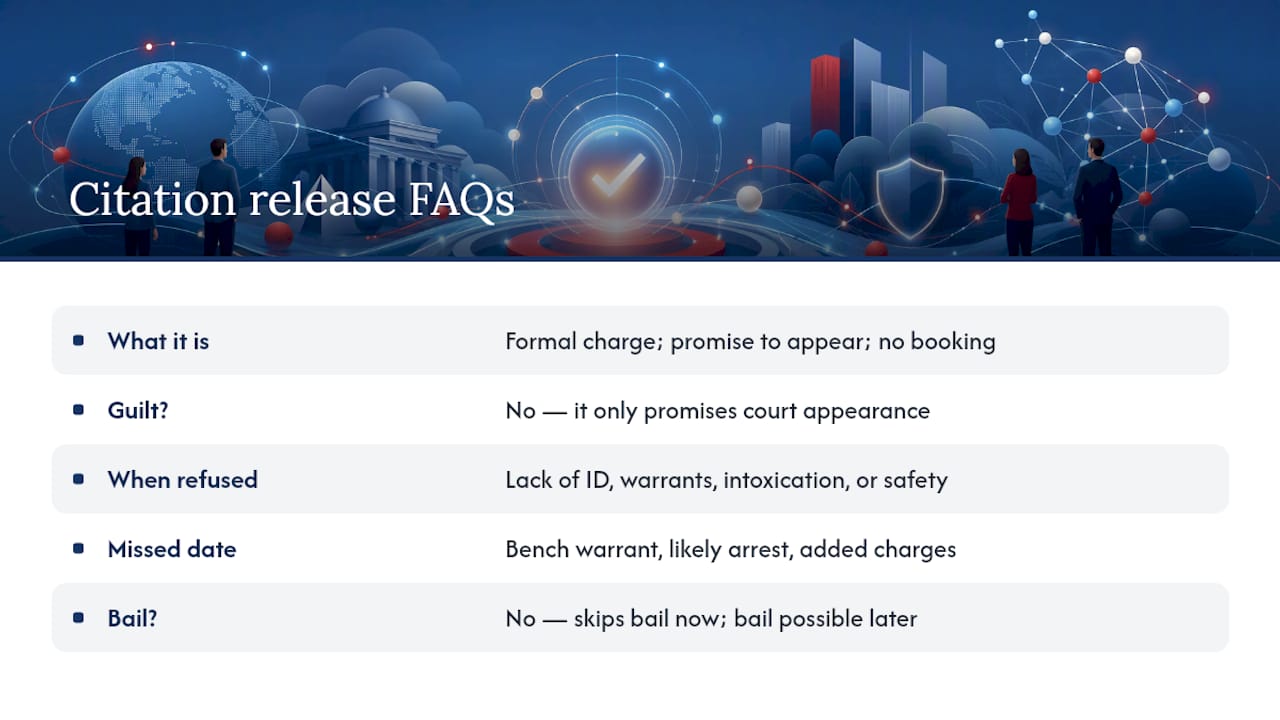
What is a citation release, exactly? It's a formal charge issued in place of a physical arrest. You sign a written promise to appear in court and are released without being booked.
Does a citation release mean I'm not guilty? No. Signing acknowledges the promise to appear, not guilt. The court still decides the outcome at your scheduled hearing.
Can police refuse to issue a citation even for a minor offense? Yes. Lack of ID, active warrants, intoxication, or safety concerns can all lead an officer to arrest instead, even for offenses that would normally qualify.
What happens if I miss my citation court date? Expect a bench warrant and possible arrest, sometimes with additional charges added to the original citation.
Is a citation release the same as posting bail? No. Citation release skips custody and bail entirely at that moment. If you're later arrested on the same or a related matter, bail becomes a separate question tied to that new situation.
This article is general information, not a substitute for advice from a qualified lawyer. Consult a qualified legal professional about your own circumstances before acting on anything here.
Sources
Don't take anyone's summary as the final word on your jurisdiction's rules. The San Antonio Police Department manual shows officer checklists and timelines in plain language, while county and municipal police policy PDFs, like Elk Grove's, spell out exceptions and release methods. Your local court or police department's website is the fastest way to confirm what applies to you specifically.
- Citation in Lieu of Arrest | NCSL
- Citation Release | Office of Justice Programs
- CITATION IN LIEU OF ARREST (Model policy) | North Carolina Department of Justice
- 420.3 Release by citation | Elk Grove Police Department policy