Cash bail is the money a court requires a defendant to deposit as a guarantee they will return for every scheduled hearing. If the defendant shows up, the court refunds the money when the case closes. If they skip a hearing, the court keeps it. That's the core of it.
The system is older than most people realize, rooted in English common law and carried into American courts long before the Eighth Amendment was written. The Eighth Amendment now prohibits excessive bail, but judges still hold wide discretion over the amount. Organizations like The Bail Project and the Brennan Center for Justice have spent years documenting how that discretion, combined with high dollar amounts, traps low-income defendants in jail before they've been convicted of anything.
Understanding how cash bail works, what it costs, and what alternatives exist is practical knowledge. Whether someone you love was just arrested or you're simply trying to understand the news, this guide gives you the full picture.

Table of Contents
- How cash bail works: from arrest to release
- Bail, cash bail, and bonds: what's actually different?
- Who sets bail and what factors judges consider
- What happens when someone can't afford bail
- What jurisdictions are doing instead of cash bail
- If someone you care about is arrested: what to do in the first 48 hours
- What bail actually costs: a real-world example
- Key Takeaways
- The part of cash bail nobody talks about enough
- Authoritative sources and further reading
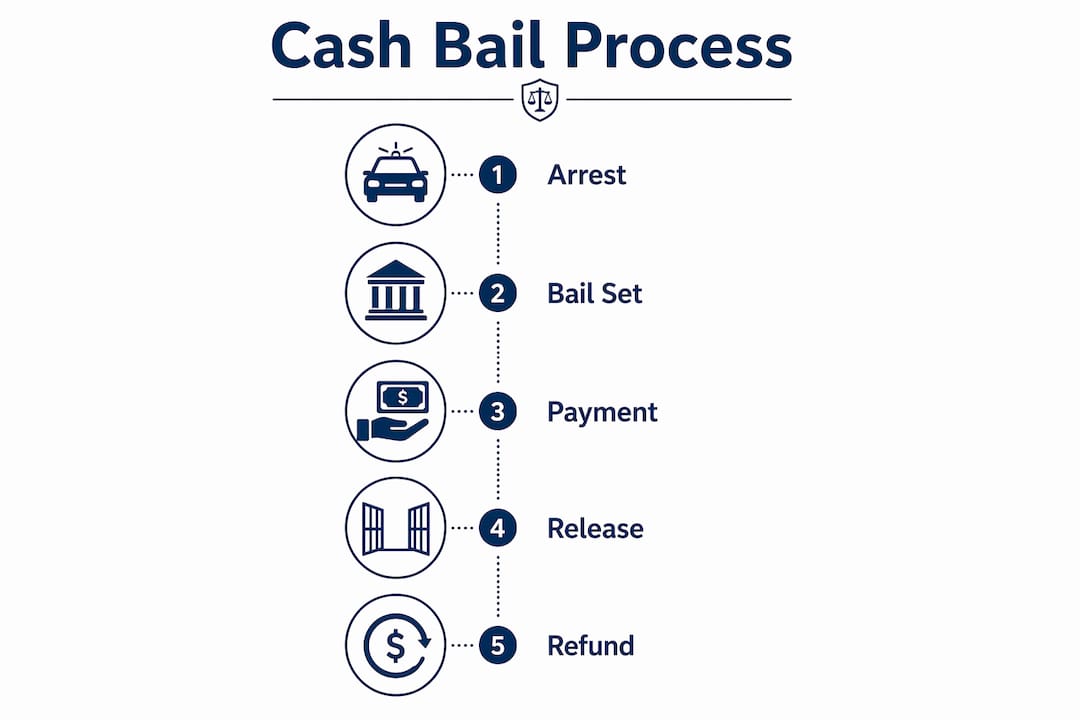
How cash bail works: from arrest to release
The process follows a predictable sequence, though timing and rules vary by state.
Step-by-step:
- Arrest. Police take the defendant into custody and book them at a jail facility.
- Bail hearing or arraignment. A judge or magistrate reviews the case, often within 24–72 hours. At this point, the judge sets bail, denies it, or releases the defendant without imposing financial conditions.
- Bail is set. The judge announces a dollar amount based on the alleged offense, the defendant's record, and other factors.
- Defendant or family posts bail. The full cash amount is paid directly to the court, or a bail bond agent is hired to post it on the defendant's behalf.
- Release. Once bail is posted and processed, the jail releases the defendant.
- Case proceeds. The defendant attends all required hearings.
- Case closes. The court returns the cash bail after the case resolves, minus any administrative fees or outstanding fines.
Key terms worth knowing:
- Arraignment: The first formal court appearance where charges are read and bail is addressed.
- Forfeiture: What happens when a defendant misses a court date. The court keeps the bail money and may issue a warrant.
- Surety: A third party (typically a bail bond company) that guarantees the defendant's appearance.
- Release on recognizance (ROR): The judge releases the defendant on their promise to appear, with no money required.
One thing families often don't expect: even when bail is fully refunded, courts can take months or years to return it after a case closes. Courts may also deduct administrative fees or fines before sending the balance back. Keep every receipt.
Bail, cash bail, and bonds: what's actually different?
These terms get used interchangeably, but they mean different things. Mixing them up leads to real confusion when you're trying to make fast decisions.
Bail is the court's financial condition for release. It's the number the judge announces.
Cash bail means the defendant (or someone on their behalf) pays that full amount directly to the court. If bail is set at $20,000, someone hands the court $20,000 in cash or a cashier's check. That money is fully refundable if the defendant meets all court obligations.
A surety bond (commonly called a bail bond) is what happens when the defendant can't pay the full amount. A licensed bail bond agent pays the court on the defendant's behalf, charging a non-refundable premium, typically 10–15% of the total bail. On a bail amount set by the court, the premium is a non-refundable fee paid regardless of the case outcome.
| Bond Type | Who Pays the Court | Up-Front Cost to Defendant | Refundable? |
|---|---|---|---|
| Cash bond | Defendant/family | the full bail amount | Yes, minus court fees |
| Surety bond | Bail bond agent | 10–15% premium (non-refundable) | No |
| Property bond | Defendant/family | Property pledged as collateral | Property returned if conditions met |
| ROR/unsecured bond | No payment required | $0 | N/A |
The Bail Project and the Brennan Center both note that the surety bond market exists almost entirely because most defendants cannot afford the full cash amount. The premium is the price of freedom for people who can't write a $20,000 check. For many families, that fee is the single largest financial consequence of an arrest, not the bail itself.
Who sets bail and what factors judges consider
Judges don't pick bail amounts randomly. Most courts work from a combination of a bail schedule (a preset list of amounts by charge type) and an individualized hearing where the judge weighs specific circumstances.
Standard factors judges consider:
- Seriousness of the alleged offense
- The defendant's prior criminal record
- Flight risk, including ties to the community (family, employment, length of residence)
- Whether the defendant poses a danger to the public
- History of appearing or failing to appear at past hearings
- Financial resources of the defendant
The Eighth Amendment prohibits "excessive bail," but courts have interpreted that narrowly. A high bail amount is not automatically unconstitutional. What matters legally is whether the amount is rationally tied to ensuring the defendant's appearance or protecting public safety.
In federal court, the Bail Reform Act of 1984 governs pretrial release. It requires judges to impose the least restrictive conditions necessary, and it explicitly prohibits setting a financial condition that results in detention solely because the defendant can't afford it. In practice, that line is difficult to enforce.
Bail schedules are common in California and many other states. They allow defendants to post bail immediately after booking, without waiting for a hearing. But scheduled amounts can be high, and a judge can deviate upward or downward at a hearing. If you want a deeper breakdown of how judges weigh each factor, that's worth reading before any bail hearing.
What happens when someone can't afford bail
This is where cash bail stops being an abstract legal concept and becomes a crisis.
When a defendant can't pay, they stay in jail. Not because they've been convicted. Not because a judge determined they're dangerous. Simply because they don't have the money.
The numbers are stark. The American Bar Association has documented that cash bail disproportionately harms low-income defendants, increasing the likelihood of pretrial detention and worse case outcomes for those who cannot pay.
Pretrial detention creates a cascade of problems. Defendants who sit in jail lose jobs, miss rent payments, and get separated from children and caregivers. They have less time to work with an attorney and less ability to gather evidence or witnesses in their own defense.
The pressure to plead guilty grows fast. A defendant offered a plea deal that means "time served" has a powerful incentive to take it, even if they're innocent, because the alternative is waiting months in a cell for a trial. The Brennan Center and ACLU have both documented this dynamic extensively.
The equity dimension is hard to ignore. Low-income defendants and communities of color bear a disproportionate share of pretrial detention. When bail amounts are set without accounting for a defendant's actual financial situation, wealth becomes the deciding factor in who goes home and who stays locked up before trial.
For families trying to help, understanding how bail reduces jail time is the first practical step.
What jurisdictions are doing instead of cash bail
The reform movement has produced real policy changes, and the results are instructive.
Common alternatives to cash bail:
- Release on recognizance (ROR): The defendant signs a written promise to appear. No money changes hands.
- Supervised release: The defendant checks in regularly with a pretrial services officer, similar to probation.
- Electronic monitoring: GPS ankle monitors track location as a condition of release.
- Court date reminders: Text and phone reminders have shown meaningful effects on appearance rates in multiple jurisdictions.
- Risk-assessment tools: Algorithms or structured assessments evaluate flight risk and public safety to guide (not replace) judicial decisions.
- Pretrial services programs: Court-connected programs that connect defendants with housing, employment, and substance-use support to reduce failure-to-appear.
Research supported by the MacArthur Foundation found that many jurisdictions can achieve high court-appearance rates using non-monetary tools, directly challenging the assumption that money is the only effective incentive for defendants to return to court.
Illinois enacted a sweeping reform eliminating cash bail statewide in 2023. New Jersey significantly reduced its use of cash bail in 2017, relying instead on a risk-assessment system. Both reforms remain contested, with law enforcement groups raising concerns about public safety and advocates pointing to data showing stable or improved appearance rates.
The honest picture is that no single alternative works perfectly in every context. Supervised release costs money to administer. Risk-assessment tools have faced criticism for encoding existing racial disparities. ROR works well for low-risk defendants but requires careful screening.
Pro Tip: At arraignment, you or your attorney can ask the judge to consider ROR or supervised release as an alternative to cash bail. Courts are not always required to offer it, but asking is free. Check your local court's pretrial services office before the hearing to understand what options are available in your jurisdiction.
For a detailed look at how cash bail alternative programs work, the mechanics vary significantly by county and state.
If someone you care about is arrested: what to do in the first 48 hours
Speed matters. Here's what to do, in order.
- Confirm where they're being held. Call the arresting agency or search the county jail's online inmate locator. You need the facility name, booking number, and the defendant's full legal name.
- Contact an attorney or request a public defender. Do this before the bail hearing if at all possible. An attorney can argue for lower bail or ROR at the hearing. Public defenders are appointed at no cost for defendants who qualify financially.
- Find out the bail amount. Once set, the amount is public record. Ask the jail directly or check the court's online docket.
- Attend the bail hearing. Family presence can matter. Judges sometimes consider community support when setting conditions.
- Explore ROR or reduced bail. Ask the attorney to request it. If the charge is nonviolent and the defendant has strong community ties, it's worth arguing.
- Contact a licensed bail bond agent if needed. Have the bail amount, booking number, jail facility, and the defendant's full name ready. Ask about the premium rate, collateral requirements, and payment plans.
- Document everything. Keep copies of all receipts, bond agreements, and court paperwork. You'll need them when the case closes and you're requesting a refund.
The 24-hour bail bond process is faster than most families expect when you have the right information ready. Knowing what to expect at a bail hearing removes a lot of the uncertainty.
What bail actually costs: a real-world example
Say bail is set at $50,000. Here's what the two main paths look like.
| Scenario | What You Pay | What You Get Back |
|---|---|---|
| Post full cash bail | $50,000 to the court | $50,000 minus court fees, after case closes |
| Use a bail bond agent (10% premium) | $5,000 to the bond company | Nothing — the premium is non-refundable |
| Use a bail bond agent (15% premium) | $7,500 to the bond company | Nothing — the premium is non-refundable |
The cash route costs more upfront but is recoverable. The bond route costs less immediately but that money is gone. For most families, the bond route is the only realistic option.
Bond companies often require collateral for larger bail amounts, particularly above $20,000. That might mean a car title, real estate equity, or a co-signer who pledges their own assets. If the defendant fails to appear, the bond company can pursue that collateral.
Premium rates vary by state and company. In California, the standard rate is set by state regulation. Jakehernandezbailbonds offers bonds from $1,000 to $1,000,000, with 0% down options for qualified co-signers and payment plans to reduce the immediate financial burden. Use the bail bond cost calculator to estimate what you'd actually pay before committing to anything.
When you're ready to talk through options, Jakehernandezbailbonds provides licensed, 24/7 bail bond services across all 58 California counties, with free consultations and bilingual support. No call centers, no runaround.
This article is general information, not legal advice. Bail rules vary by state and charge. Confirm current procedures with your local court or a qualified attorney for your specific situation.
Key Takeaways
Cash bail is a refundable court deposit that secures pretrial release, but the surety bond market means most families pay a non-refundable premium of 10–15% to a bail bond agent instead of posting the full amount themselves.
| Point | Details |
|---|---|
| Cash bail is refundable | The court returns the full amount after the case closes, minus any fees or fines. |
| Surety bond premiums are not | The 10–15% fee paid to a bail bond agent is gone regardless of the case outcome. |
| Judges have broad discretion | Bail amounts are shaped by offense type, flight risk, criminal history, and community ties. |
| Pretrial detention causes real harm | Defendants who can't pay bail risk job loss, plea pressure, and worse case outcomes. |
| Alternatives exist | ROR, supervised release, and appearance-support programs can replace cash bail in many cases. |
The part of cash bail nobody talks about enough
Most explainers on this topic treat cash bail as a binary: either the system is fair or it's broken. The reality is more complicated, and the families I talk to every day are living in that complexity.
What I see consistently is this: families make the most expensive mistakes in the first few hours after an arrest, usually because they're panicking and don't have information. They don't know they can ask for a bail hearing. They don't know the premium is non-refundable before they hand over money. They don't know that a co-signer's assets are genuinely at risk if the defendant disappears.
The reform debate is real and worth having. The Brennan Center's research on wealth-based detention is solid. The ACLU's equity arguments are grounded in documented disparities. At the same time, families who need someone out of jail tonight don't have the luxury of waiting for policy change. They need to know how the system actually works right now, what it costs, and how to protect themselves financially while navigating it.
The most useful thing you can do in the first hour is call an attorney, not a bail bond company. Get the legal picture first. Then, if a bond is the right move, work with a licensed agent who will explain every document before you sign it. Jakehernandezbailbonds operates 24/7 across California with that exact approach: no pressure, full transparency, and someone who picks up the phone.
Authoritative sources and further reading
- The Bail Project — What Is Cash Bail? — Plain-language policy explainer and equity research.
- Brennan Center for Justice — How Cash Bail Works — Research reports on pretrial detention and reform.
- ACLU of Pennsylvania — Smart Justice: Ending Cash Bail — Advocacy and reform case studies.
- American Bar Association — The Bail Bond System and Rule of Law — Legal analysis of bail's equity and structural effects.
- Legal Information Institute (Cornell Law) — Bail — Concise legal definition and constitutional context.
- Congress.gov — Bail: An Overview of Federal Criminal Law — Congressional Research Service overview of the Bail Reform Act.
- University of Washington School of Law — What Is Bail? — Academic explainer on bail bondsmen and collateral mechanics.
For state-specific procedures, contact your local court's pretrial services office or a public defender. Rules on bail schedules, premium rates, and alternative release conditions differ significantly from one jurisdiction to the next.