
A bail-bond forfeiture summary judgment is the court order that converts a forfeited bail bond into an enforceable money judgment for the full bond amount plus costs, entered against the surety and, through the indemnity agreement, against the co-signer. Under California Penal Code §§1305–1306, once the statutory exoneration window closes without the forfeiture being set aside, the court must enter that judgment. At that point it is collectible like any civil money judgment: levy, garnishment, lien. The clock starts the moment a defendant misses a required court date, and it moves fast.
Key Takeaways
A bail-bond forfeiture summary judgment is a fully enforceable money judgment for the full bond amount plus costs, entered under Penal Code §1306 once the §1305 exoneration window closes without relief.
| Point | Details |
|---|---|
| 180/185-day recovery window | Forfeiture must be resolved within 180 days (185 if notice mailed) or summary judgment follows. |
| 90-day judgment entry rule | Under §1306(c), the court's right to enter summary judgment expires 90 days after it first becomes available. |
| Co-signer exposure | The indemnity agreement makes co-signers liable for the full bond amount, not just the premium paid. |
| Cosigner notice defense | Missing Civil Code §1799.91 notice can block enforcement of the indemnity agreement against a co-signer. |
| Jakehernandezbailbonds | Provides 24/7 statewide surrender coordination, motion filing support, and free consultations to stop forfeiture from converting to judgment. |
Table of Contents
- What is a forfeiture summary judgment in California bail cases?
- Who actually owes the money when judgment is entered?
- How to avoid a summary judgment or vacate a forfeiture
- What happens after the court enters summary judgment?
- How bail companies recover losses and what defenses co-signers have
- Your first 7–14 days after forfeiture: what to do immediately
- How a licensed bondsman can help stop a forfeiture from becoming a judgment
- Jakehernandezbailbonds is available right now, 24/7
- Sources
What is a forfeiture summary judgment in California bail cases?
The 180-day exoneration period under Penal Code §1305 begins the day the court declares bail forfeited in open court. That declaration is the trigger. From that moment, the surety has a fixed window to bring the defendant back, file a motion to vacate, or otherwise stop the conversion of forfeiture into a money judgment.
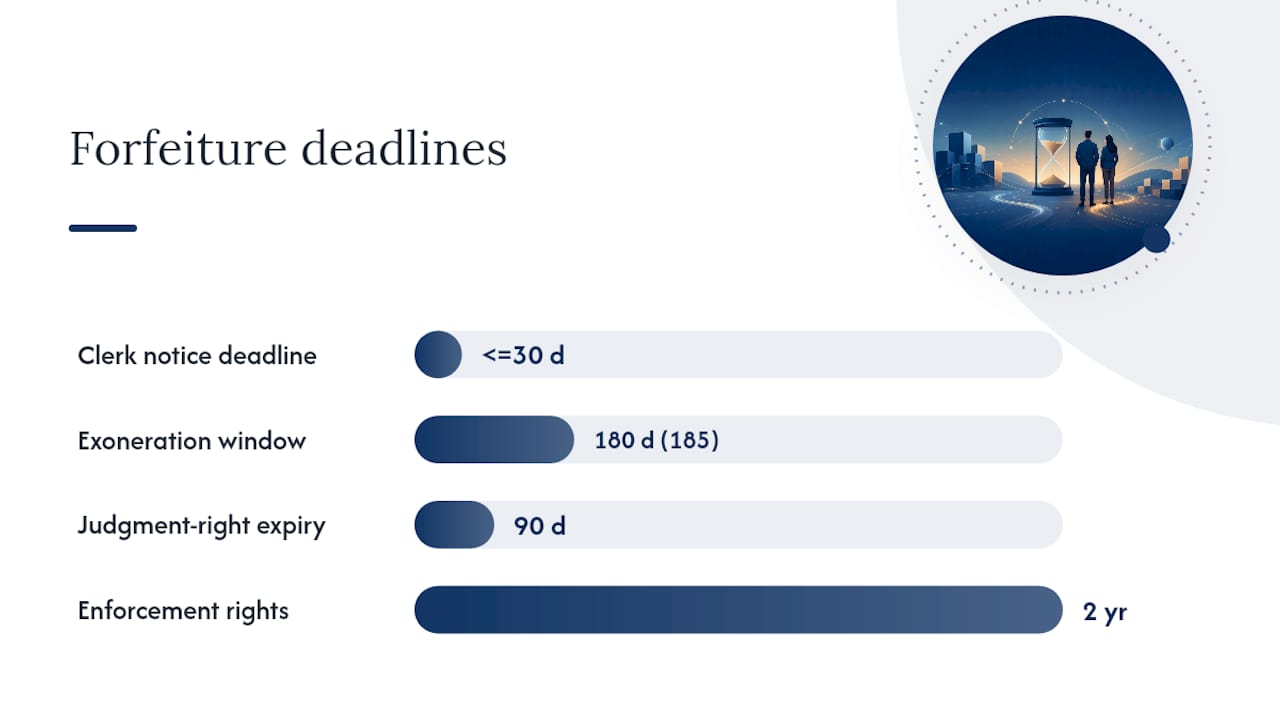
| Event | Statutory Trigger | Deadline |
|---|---|---|
| Forfeiture declared in open court | Defendant fails to appear | Day 0 |
| Clerk mails notice to surety | §1305 mailing rule | Within 30 days of forfeiture |
| Exoneration window closes | §1305 | Day 180 (Day 185 if notice mailed) |
| Summary judgment may first be entered | §1306 | Day after window closes |
| 90-day rule: judgment right expires | §1306(c) | 90 days after it may first be entered |
| Enforcement rights expire | §1306 | Two years after judgment entry |
If notice was mailed, the window extends by five days, giving the surety 185 days total. California Bail Forfeiture guidance describes this as the recovery window: the period during which bringing the defendant back to court stops the conversion to a money judgment.
§1305(i) motions matter here. If a motion to vacate forfeiture is timely filed within the exoneration period, People v. Granite State Insurance Co. holds that the court must decide that motion before §1306's summary-judgment timing is treated as ripe. A timely motion can pause the finality clock even when the hearing date slips past the window.
Who actually owes the money when judgment is entered?
The judgment is entered against the bondsman (surety) named on the bail bond. The co-signer, called the indemnitor, is not named in the court judgment itself but is bound by the separate indemnity agreement signed when the bond was posted. That agreement makes the indemnitor responsible for reimbursing the surety for any judgment paid.
- Surety/bondsman: Named judgment debtor in the court order; directly liable to the court for the bond amount plus costs.
- Indemnitor/co-signer: Contractually liable to the surety under the indemnity agreement; the surety can pursue collateral, wages, or a separate civil suit.
- Defendant: Not typically a named judgment debtor in the forfeiture action, though the indemnity agreement may also name them.
What the judgment covers: the full face amount of the bond plus court-ordered costs. Penalty assessments cannot be added under §1306. A $50,000 bond produces a $50,000 judgment plus costs, nothing more.
One distinction families often miss: if cash bail was posted directly to the court, the court simply keeps the cash on forfeiture. With a surety bond, the bondsman may be forced to pay the judgment and then pursue the indemnitor for reimbursement through collateral seizure or collection. Co-signers often assume their exposure is limited to the premium paid. It is not. Under the indemnity agreement, full bond exposure is possible unless statutory notice protections apply.
How to avoid a summary judgment or vacate a forfeiture
The most direct path is surrendering the defendant within the 180-day window. If the defendant appears in the county where the case is pending, the court typically vacates the forfeiture and exonerates the bond. Out-of-county arrest requires coordination with local authorities and transport, but it still counts.
| Option | Deadline | What It Does |
|---|---|---|
| Surrender defendant in-county | Within 180/185 days | Court vacates forfeiture, bond exonerated |
| Surrender defendant out-of-county | Within 180/185 days | Court may vacate; transport required |
| File §1305 motion to vacate | Within 180/185 days | Pauses §1306 clock per Granite State |
| §1305(i) extension for good cause | Before exoneration period ends | Extends hearing date past window |
| Appeal + undertaking (CCP §917.1) | After judgment entered | Stays enforcement; different surety may be required |
Filing a motion to vacate forfeiture under §1305 is the procedural lever that preserves options. The motion must be filed within the exoneration period, even if the hearing happens later. Miss that filing deadline and the §1306 clock runs without interruption.
Pro Tip: Get the clerk's certificate of mailing the day you learn of the forfeiture. That document fixes the exact date the 180-day or 185-day window started. Practitioners consistently identify it as the single most useful piece of paper in a forfeiture case, because every other deadline flows from it.
What happens after the court enters summary judgment?
Once the judgment is entered, the surety has 30 days to receive a demand for payment. If the judgment remains unpaid 20 days after that demand, enforcement proceeds like any civil money judgment: bank levy, wage garnishment, real property lien, or writ of execution.
| Post-Judgment Step | Timing |
|---|---|
| Demand for payment issued | Within 30 days of final judgment |
| Enforcement begins if unpaid | 20 days after demand |
| Enforcement rights expire | Two years after judgment entry |
The 90-day rule under §1306(c) cuts the other direction: if the court fails to enter summary judgment within 90 days after it may first be entered, the right to enter judgment expires and the bail is exonerated. Courts do not always catch this. Tracking that 90-day window is as important as tracking the 180-day window.
Appeals can stay enforcement, but only if the appellant posts an undertaking under CCP §917.1. In some cases, a different surety must provide that undertaking. Waiting to appeal without posting the undertaking does not stop collection.
How bail companies recover losses and what defenses co-signers have
When a surety pays a forfeiture judgment, it turns immediately to the indemnity agreement. Recovery tools include seizing pledged collateral (vehicles, real property), wage garnishment, and civil collection suits. This process can move quickly once judgment is final.
Co-signers do have real defenses, and the most powerful one is procedural: failure to provide the statutory cosigner notice under Civil Code §1799.91. California courts have held that when a co-signer was not given this required financial-impact notice, the premium-financing contract can be unenforceable against that co-signer. Check whether you received this notice before assuming the indemnity agreement is airtight.
Humphrey-based arguments (inability to pay) rarely succeed after summary judgment is entered. People v. Financial Casualty & Surety, Inc. confirms that appellate courts treat such claims as procedural, not jurisdictional. They must be raised before judgment, not after.
- Original bail bond and bond number
- Signed indemnity agreement and any premium-financing paperwork
- Cosigner notice (or documentation that it was never provided)
- Court minute order showing the forfeiture date
- Clerk's certificate of mailing
- Any proof of surrender, appearance, or transport coordination
Pro Tip: If you cannot locate the cosigner notice in your paperwork, request a copy of the complete file from the bail company in writing. That request creates a paper trail and may surface the missing notice as a defense.
Your first 7–14 days after forfeiture: what to do immediately
Speed is the only resource that matters in the first two weeks. Every day of delay narrows the options.
- Call the bail bondsman immediately. If the bondsman is still in business and the bond is active, they have the strongest incentive and the tools to locate and surrender the defendant.
- Contact a California criminal defense attorney, especially if the bond amount is large or judgment has already been entered.
- Get the court minute order showing the exact forfeiture date. This is the document that fixes every deadline.
- Confirm whether the clerk mailed notice and on what date. The 180-day or 185-day window depends on this.
- Calculate your deadlines: 180 or 185 days from forfeiture for the exoneration window; 90 days after that window closes for the summary-judgment entry deadline.
- Gather the bond, indemnity agreement, cosigner notice, receipts, and any premium-financing paperwork.
- If the defendant is located out of county or out of state, coordinate with the bondsman on transport. Time spent on logistics still counts against the clock.
How a licensed bondsman can help stop a forfeiture from becoming a judgment
A licensed bondsman does more than post bail. After a forfeiture declaration, the bondsman's job is to locate the defendant, coordinate surrender, and file the right paperwork before the window closes. That sequence, done correctly, stops summary judgment before it starts.
- Locate and surrender the defendant: Bondsmen have skip-tracing resources and established relationships with local jails. A fast surrender within the 180-day window is the cleanest resolution.
- Coordinate out-of-county transport: If the defendant is in another county or state, the bondsman manages extradition logistics and ensures the court receives the right documentation.
- File timely motions: A bondsman working with counsel can file a §1305 motion to vacate and request §1305(i) extensions, preserving the clock while the hearing is scheduled.
- Post new bonds or undertakings: When an appeal is the right path, the bondsman can arrange the undertaking required to stay enforcement.
- Provide 24/7 support: Forfeiture declarations happen on court days; the response window starts immediately. Bondsmen available around the clock can begin the recovery process the same day.
Jakehernandezbailbonds handles forfeiture proceedings across all 58 California counties, with bilingual staff and free consultations for families navigating these deadlines.
What licensed bondsmen see most often
The families who lose the most money in forfeiture cases are not the ones who acted and failed. They are the ones who waited three weeks assuming the problem would resolve itself, then called when the 180-day window had already closed. By that point, the only options left are expensive and uncertain.
The other common mistake: assuming the indemnity agreement is just paperwork. It is a contract with real teeth. The full bond amount, not just the premium, is the exposure. That distinction changes everything about how urgently a co-signer should act.
One rule that holds across every case: get the stamped minute order showing the forfeiture date on day one. Not day five. Not after you've talked to three people. Day one. That single document controls the recovery clock, and without it, you are calculating deadlines from memory.
Jakehernandezbailbonds is available right now, 24/7
When forfeiture is declared, the recovery window starts immediately. Jakehernandezbailbonds covers every county in California with 24/7 bail bond services, free consultations, and bilingual staff ready to coordinate surrender, file timely motions, and stop a forfeiture from converting to a judgment.
Payment plans and 0% down options are available for qualified co-signers. The team handles complex holds including PC 1275, federal bonds, and immigration bonds. Whether the defendant is in a local county jail or across state lines, Jakehernandezbailbonds can begin the recovery process today. Call now for a free consultation and get your deadlines confirmed before the clock runs out.
Sources
The statutes and cases below are the primary authorities cited throughout this article. Share them with your attorney.
- ARTICLE 7. Forfeiture of the Undertaking of Bail or of the Deposit of Money
- California Bail Forfeiture: Rules, Deadlines, and Relief - LegalClarity
- California Court Rules Bail Bond Companies Must Give Cosigners Financial Impact Notice | Prison Legal News
- People v. Financial Casualty & Surety, Inc.
- People v. Granite State Insurance Co.
- ARTICLE 7. Forfeiture of the Undertaking of Bail or of the Deposit of Money (Penal Code §1306)
This article provides general legal information about California bail-bond forfeiture procedures, not legal advice. Confirm current statutes and deadlines with a licensed California attorney or your bail bondsman.
This article is general information, not a substitute for advice from a qualified lawyer. Consult a qualified legal professional about your own circumstances before acting on anything here.