What is a bail bond execution?
"Bail bond execution" carries two distinct legal meanings, and mixing them up causes real confusion. Understanding both is the starting point for everything else in this article.
The first meaning is contractual: execution of a bail bond refers to the act of signing the written undertaking by which a defendant or surety guarantees the defendant's appearance in court. Under New York's Criminal Procedure Law, a bail bond is formally defined as "a written undertaking, executed by one or more obligors," promising the defendant will appear as required and that the obligors will pay a specified sum if the defendant fails to do so. This is the bail bond contract, sometimes called a bail bond undertaking, and it creates the three-party relationship at the heart of every commercial bail bond.
The second meaning is enforcement: execution on a judgment is the post-forfeiture legal process where a court directs law enforcement to seize a debtor's non-exempt assets to satisfy an unpaid bond debt. This happens only after a defendant skips court, the bond is forfeited, and a final judgment is entered against the surety.
Key elements of a bail bond execution include:
- The defendant's written promise to appear at every required court date
- The surety's financial guarantee to pay the full bond amount if the defendant fails to appear
- A three-party structure linking the defendant (principal), the surety (bail bond agent), and the court (obligee)
- Financial consequences for the surety if the defendant absconds, including asset seizure under a writ of execution
- The non-refundable premium paid to the bail bond agent, which is a percentage of the bail amount
How does the legal process unfold after bail bond forfeiture?
The path from a missed court date to actual asset seizure follows a defined sequence. Courts do not immediately seize property the moment a defendant fails to appear. There is a procedural chain, and each step has its own timeline and legal requirements.
- Failure to appear triggers a bench warrant. The court issues an arrest warrant and begins the forfeiture process. Under Michigan court rules, the court must notify the surety within 7 days of the defendant's failure to appear. Missing that deadline can bar forfeiture entirely.
- Judgment nisi is entered. The Texas District & County Attorneys Association describes this as an interlocutory, conditional judgment declaring the bond forfeited unless the defendant shows good cause for the absence. It is not yet a final, enforceable debt.
- Show-cause hearing is scheduled. The surety receives notice and has the right to appear before the court to contest the forfeiture. This hearing is the surety's primary opportunity to avoid a final judgment.
- Final judgment is entered if no good cause is shown. At this point, the forfeited bond becomes a civil debt. Bond forfeiture proceedings combine criminal and civil law, and the final judgment is enforceable under civil procedure rules.
- Writ of execution is issued. If the judgment remains unpaid, generally within 31 days of the final judgment, the court issues a writ directing a sheriff or constable to seize and sell the surety's non-exempt property to satisfy the debt. Texas Rules of Civil Procedure 621 through 656 govern this process.
- Asset seizure and sale. The sheriff levies on non-exempt assets, which may include real estate, vehicles, bank accounts, or other property. Exempt property, such as a homestead in Texas, cannot be touched.
- Supersedeas bond or motion for new trial can pause execution. A defendant or surety who files a proper supersedeas bond can suspend the writ of execution while an appeal or motion is pending.
Pro Tip: If you are a co-signer on a bail bond and the defendant misses court, contact the bail bond agent immediately. Acting fast before the show-cause hearing closes is your best chance to avoid a final judgment.
Who is responsible for what during bail bond execution?
Every party in a bail bond carries specific obligations, and the consequences of failing those obligations differ sharply depending on your role.
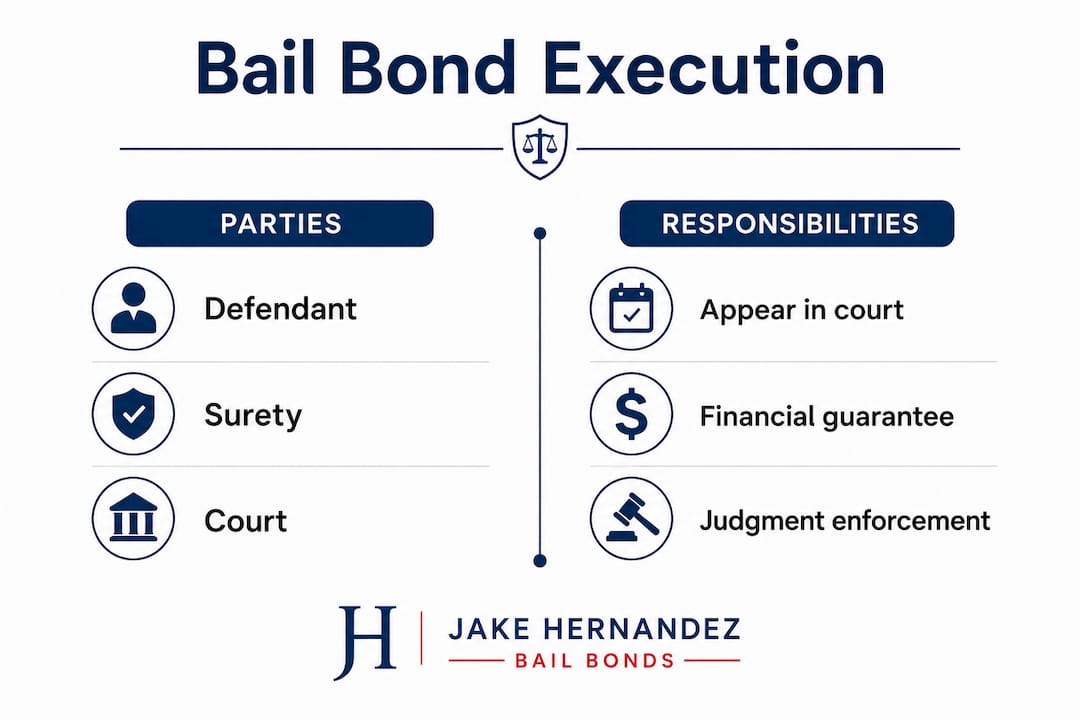
The defendant is the principal. The bail bond contract is fundamentally a promise by the defendant to appear at every scheduled court proceeding. If the defendant honors that promise, the bond is eventually discharged and any collateral is returned. Fail to appear, and the defendant becomes personally liable for the full bond amount, on top of any criminal penalties for the underlying charge.
The surety is the financial guarantor. A surety bond is a three-party guarantee linking the defendant, the bonding company, and the court. The bail bond agent collects a non-refundable premium, typically 10% to 20% of the total bail amount, in exchange for posting the full bond. If the defendant skips, the surety owes the court the entire bond amount. The show-cause hearing is the surety's legal tool to contest that liability before it becomes final.
The court holds the authority to bind all parties, enter judgments, and direct enforcement. Once a final forfeiture judgment is entered, the court treats it like any other civil judgment, subject to the same collection tools, including writs of execution, motions for turnover, and abstracts of judgment.
Collateral posted by the defendant or a co-signer can be recovered if the defendant is eventually apprehended and the conditions of the bond are satisfied. The premium, however, stays with the bail bond agent regardless. That distinction matters practically: a family member who pledges a car as collateral may get it back; the cash fee paid upfront will not be returned.
For a deeper look at how surety bail bonds work in practice, including the specific obligations that attach at each stage, the structure is consistent across most U.S. states even when the procedural timelines differ.
Common questions about bail bonds and execution
What does a bail bond actually cost? Bail bond agents charge a non-refundable fee, typically 10%–20% of the bail amount, though some states may cap the rate lower. That fee compensates the agent for the financial risk of guaranteeing the full amount. You do not get it back even if the case is dismissed.
What happens if the defendant fails to appear? The court declares a forfeiture, issues a judgment nisi, and schedules a show-cause hearing. If the surety cannot demonstrate good cause for the absence, a final judgment is entered and the bond becomes collectible as a civil debt. The surety may then pursue the defendant or co-signers to recover the loss.
Can a bail bond forfeiture judgment be set aside? Yes. Courts have discretion to set aside a forfeiture if justice requires it, particularly if the defendant is later apprehended. Under Michigan law, a court must set aside the forfeiture and discharge the bond within one year of the forfeiture judgment if the defendant has been apprehended and the county's costs have been repaid.
Is there a time limit on collecting a forfeited bond? Enforcement actions are subject to statutes of limitations. States vary, but the principle is consistent: sureties are not exposed to indefinite collection liability. Property exemptions also apply, meaning a sheriff cannot seize assets that state law protects.
What is a bail bond discharge? A bail bond discharge releases the surety from all obligations under the bond. This typically occurs when the defendant has satisfied all court requirements, the case concludes, or a court orders the bond exonerated. Once discharged, the surety's financial exposure ends.
For families navigating the bail bond process for the first time, understanding these distinctions before signing anything is worth the time.
What legal experts say about bail bond execution and enforcement
Legal practitioners draw a clear line between two uses of the word "execution" in bail bond law, and that distinction shapes how courts handle enforcement.
- Bond forfeiture proceedings are a hybrid criminal-civil proceeding, governed by civil procedure rules once a final judgment is entered. Sureties who treat forfeiture as purely a criminal matter often miss the civil deadlines that protect them.
- The show-cause hearing is described by courts as a procedural safeguard, not a formality. Sureties who appear with evidence of the defendant's whereabouts, medical emergency, or other compelling reason have a genuine path to avoiding judgment.
- Writs of execution in bail bond cases work identically to those in standard civil debt collection. A sheriff levies on non-exempt property, sells it, and applies the proceeds to the judgment. The Texas District & County Attorneys Association notes that a writ of execution is often a faster collection tool than an abstract of judgment.
- Statute-of-limitations protections prevent indefinite enforcement. Once the limitations period expires, the judgment cannot be collected, which gives sureties a defined window of exposure rather than open-ended liability.
- The judgment nisi stage is the most underutilized protection available to sureties. Because it is conditional and interlocutory, it can be challenged before it ripens into a final, enforceable judgment. Waiting until after final judgment dramatically narrows the available defenses.
For anyone dealing with an Ohio bail bond situation, the procedural sequence follows the same general framework, though state-specific timelines and exemption rules apply.
Key Takeaways
A bail bond execution is both the act of signing the bond contract and the court-ordered enforcement process that follows forfeiture when a defendant fails to appear.
| Point | Details |
|---|---|
| Dual meaning of execution | "Execution" means signing the bail bond undertaking and, separately, enforcing a forfeiture judgment through asset seizure. |
| Procedural sequence | The process runs from judgment nisi to show-cause hearing to final judgment, then writ of execution if unpaid within 31 days. |
| Surety's financial exposure | The surety owes the full bond amount after final judgment; the 10%–20% premium paid upfront is never refunded. |
| Show-cause hearing protection | Sureties can contest enforcement before final judgment by demonstrating good cause at the show-cause hearing. |
| Enforcement time limits | Statutes of limitations cap how long a forfeiture judgment can be collected, protecting sureties from indefinite liability. |
Facing an arrest in California and need to act fast? Jakehernandezbailbonds covers all 58 California counties, with bonds from $1,000 to $1,000,000, 0% down options, and free consultations available 24/7. Call or visit Jakehernandezbailbonds now for immediate help from a licensed agent who handles your case directly, no call center, no runaround.