
Bail forfeiture is defined as the court's legal declaration that a defendant has surrendered their right to bail money by violating the terms of their release. Understanding how bail forfeiture proceedings work is critical for defendants, co-signers, and family members, because the financial and legal consequences fall on everyone connected to the bond. The court declares forfeiture in open session, typically the moment a defendant fails to appear as required. A grace period of 30 to 180 days then follows, during which the forfeiture can be reversed if the defendant returns to custody. Missing that window triggers permanent financial liability for everyone who signed the bond.
How bail forfeiture proceedings work: triggers and court declaration
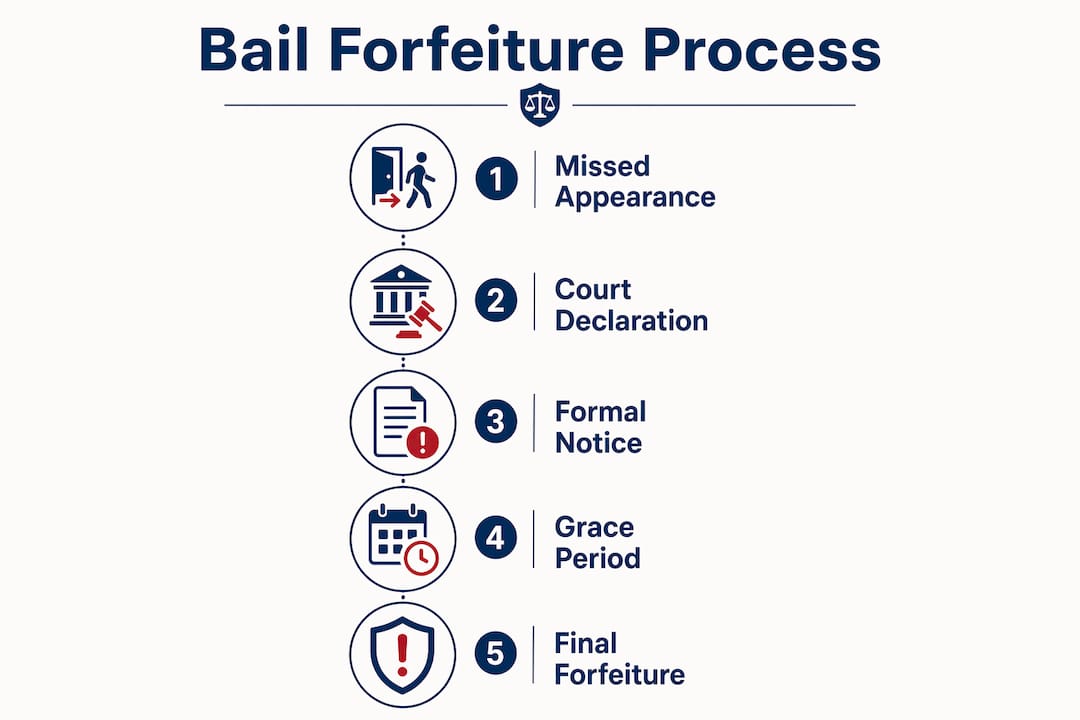
Bail forfeiture proceedings begin with a single event: the defendant does not appear in court as ordered. The court does not wait for an explanation. A judge declares the bail forfeited in open session, and the clerk enters it into the official docket immediately.
The most common reasons forfeiture is declared include:
- Failure to appear at a scheduled hearing, arraignment, or trial date
- Violation of release conditions, such as leaving the state without permission or contacting a protected party
- Re-arrest on a new charge while out on bail
- Failure to comply with mandatory check-ins, drug testing, or electronic monitoring requirements
After the declaration, the court sends formal written notice to the bail agent and all co-signers. This notice starts the clock on the grace period. Grace periods vary by jurisdiction, typically running 30 to 180 days. California, for example, grants 185 days from the date of mailing the notice. That window is the only opportunity to reverse the forfeiture without paying the full bond amount.
Pro Tip: Read the forfeiture notice the day it arrives. The grace period deadline is printed on it, and missing that date by even one day can cost you the entire bond amount.
Understanding what judges weigh when setting bail helps explain why courts treat missed appearances so seriously. Bail exists as a financial guarantee of appearance. When that guarantee fails, the court moves to collect.
What is the bail bond forfeiture process from start to finish?
Once forfeiture is declared, the bail agency activates its recovery process. The steps below reflect the standard sequence across most jurisdictions.
- Forfeiture declared in court. The judge notes the absence, declares the bond forfeited, and the clerk records it. The bail agent receives official notice within days.
- Bail agency notifies co-signers. Co-signers receive written notice of the forfeiture and the deadline to resolve it. This is not optional communication. It is a contractual and legal obligation.
- Recovery agents are assigned. The bail agency dispatches licensed recovery agents, also called fugitive recovery agents or bail enforcement agents, to locate the defendant. Their job is to return the defendant to custody before the grace period expires.
- Defendant is located and surrendered. If recovery agents find the defendant and return them to custody within the grace period, the bail agency can file a motion to set aside the forfeiture. The court reviews the motion and, if approved, exonerates the bond.
- Grace period expires without resolution. If the defendant is not returned in time, the forfeiture becomes final. The court issues a judgment against the bail agency for the full bond amount.
- Bond amount is paid to the court. The bail agency pays the court and then pursues co-signers to recover that loss under the indemnity agreement signed at the time of the bond.
Pro Tip: If you are a co-signer and you know where the defendant is, contact your bail agent immediately. Providing that information during the grace period can prevent the forfeiture from becoming final and save you from paying the full bond.
Speed matters enormously at every stage of this process. Delays in communication between co-signers and the bail agency reduce the time available for recovery and increase the likelihood of a final forfeiture judgment.

What are the financial and legal consequences for co-signers?
Co-signers bear the heaviest financial burden when forfeiture becomes final. The consequences extend well beyond the premium already paid.
Joint and several liability
Joint and several liability means the court or bail agency can pursue any one co-signer for the entire forfeiture amount, regardless of how many people signed the bond. If three people co-signed a $50,000 bond, the agency can demand the full $50,000 from just one of them. That person must then seek reimbursement from the others independently. Many co-signers do not realize this until they receive a collection demand.
Costs beyond the premium
The financial exposure for co-signers includes:
- Full bond amount, which can range from $1,000 to $1,000,000 depending on the original bail set by the court
- Recovery agent fees, which typically start at $500 to $1,000 plus travel expenses, all contractually owed by co-signers under the indemnity agreement
- Court costs and administrative fees added to the final judgment
- Attorney fees if the bail agency pursues legal action to collect
Long-term financial impact
Collateral liquidation takes months and sometimes years. If you pledged a vehicle or real estate as collateral, the bail agency can initiate foreclosure or asset sale proceedings to recover the debt. Beyond collateral, bail agencies hold creditor tools including wage garnishment and bank levies. These collection actions can continue for years after the original case closes.
One critical nuance: each bail bond is a separate legal obligation. If a defendant has multiple open cases with separate bonds, resolving one case does not exonerate the others. Each bond requires its own explicit court order of exoneration. Co-signers who assume otherwise often discover additional liability they did not anticipate.
You can review bail bond cost structures to understand how premiums, collateral, and payment plans interact before signing any bond agreement.
How do you file a motion to set aside a bail forfeiture?
A motion to set aside, also called a motion to vacate, is the formal legal request asking the court to reverse the forfeiture declaration. Courts grant these motions under specific circumstances, and the process requires precise documentation.
Grounds the court accepts
- Incarceration elsewhere: the defendant was in custody in another jurisdiction and physically could not appear
- Medical emergency or incapacitation: documented illness or injury prevented appearance
- Death of the defendant: a death certificate filed with the motion ends the bond obligation
- Procedural error: the court or clerk failed to properly notify the defendant of the hearing date
What you need to file
Filing a motion to vacate requires assembling specific documents: the case number, bond number, the date of forfeiture, and the evidence supporting your grounds. Jail records, medical records, or death certificates must accompany the motion. Incomplete filings cause delays and can push you past the jurisdictional deadline.
Deadlines are absolute. A late filing results in automatic denial regardless of the merit of your argument. Once denied, the only remaining option is an appeal, which is more expensive and less likely to succeed.
At the hearing, the government must establish a prima facie case that the forfeiture was properly declared. Defense success at this stage often depends on identifying procedural errors in the declaration or demonstrating that no actual harm occurred. An attorney experienced in bail law gives you the best chance of a favorable outcome.
Key Takeaways
Bail forfeiture becomes final when a defendant fails to appear and the grace period expires without resolution, leaving co-signers liable for the full bond amount, recovery costs, and potential long-term collection actions.
| Point | Details |
|---|---|
| Forfeiture trigger | A missed court appearance causes the judge to declare bail forfeited in open session immediately. |
| Grace period window | Courts allow 30–180 days to return the defendant to custody and reverse the forfeiture. |
| Co-signer liability | Joint and several liability means one co-signer can owe the entire bond amount regardless of others. |
| Recovery costs | Recovery agent fees start at $500–$1,000 plus expenses, all owed by co-signers under the indemnity agreement. |
| Motion to vacate | Filing before the jurisdictional deadline with proper documentation is the only way to reverse a final forfeiture. |
What I have learned from watching families navigate forfeiture
Working in bail bonds across California, I have seen the same mistake repeated more than any other: co-signers wait. They receive the forfeiture notice, they feel overwhelmed, and they assume someone else is handling it. Nobody is. The bail agency is working the case, but co-signers who stay silent lose the ability to provide information that could locate the defendant faster.
The second mistake is signing a bond without reading the indemnity agreement. Joint and several liability is not buried in fine print. It is the core of the agreement. I have spoken with co-signers who genuinely believed their financial exposure was limited to the premium they paid. That misunderstanding costs families tens of thousands of dollars.
The third thing I want you to understand is that the motion to vacate process is not a long shot. Courts grant these motions regularly when the paperwork is correct and filed on time. The problem is that most people do not know the deadline exists until it has passed. Get an attorney involved within the first week after forfeiture is declared. That single decision changes the outcome more than anything else you can do.
Forfeiture proceedings feel like a wall closing in, but they have defined steps and defined deadlines. Knowing those steps is the difference between recovering the situation and absorbing a financial loss that follows you for years.
— Jake
Jakehernandezbailbonds is available when forfeiture threatens your family
Bail forfeiture moves fast, and the decisions made in the first few days determine whether the situation is recoverable. Jakehernandezbailbonds operates 24/7 across all 58 California counties, providing licensed bail bond services and direct guidance for co-signers and families facing forfeiture scenarios.
Whether you need to post a new bond, understand your obligations as a co-signer, or get clarity on what happens next, Jakehernandezbailbonds connects you directly with a licensed agent. No call centers, no runaround. Consultations are free, bilingual support is available, and bonds start at $1,000 with 0% down options for qualified co-signers. Reach the team anytime through California bail bond services and get answers before the clock runs out.
FAQ
What is bail forfeiture?
Bail forfeiture is the court's declaration that a defendant has lost their bail by failing to comply with release conditions, most commonly by missing a scheduled court appearance. The court enters the forfeiture into the official record in open session.
How long is the grace period after bail is forfeited?
Grace periods run 30 to 180 days depending on the jurisdiction. California provides 185 days from the date the forfeiture notice is mailed to the bail agent.
Can a bail forfeiture be reversed?
Yes. A motion to set aside the forfeiture can succeed if filed before the jurisdictional deadline and supported by evidence such as incarceration records, medical documentation, or proof of a procedural error in the original declaration.
What does a co-signer owe after forfeiture becomes final?
A co-signer owes the full bond amount plus recovery agent fees and any court costs added to the judgment. Joint and several liability means the bail agency can collect the entire amount from any single co-signer.
Does resolving one case cancel bonds on other cases?
No. Each bail bond requires its own explicit court order of exoneration. Closing one case does not automatically release obligations on any other open bond.