
An OR (own recognizance) release, sometimes called an ROR or R.O.R. release, is a judge's decision to free a defendant from custody without requiring any money bail. The defendant signs a written promise to appear at all future court dates, and that promise is the only security the court holds. If you or a family member just got arrested, the most useful thing you can do right now is contact a defense attorney and start gathering two things: government-issued ID and proof of community ties such as an employment letter, a lease, or a utility bill in the defendant's name.
An OR-release motion is the formal written request a defense attorney files asking the judge to grant that release. According to the Legal Information Institute, OR release is based solely on the defendant's promise to appear, with no financial deposit required. The motion puts that argument in front of the judge with supporting evidence attached.
Key Takeaways
An OR release motion is a formal request asking a judge to free a defendant without money bail, based on a written promise to appear and evidence of community ties.
| Point | Details |
|---|---|
| OR release defined | A defendant is freed on a signed promise to appear, with no money bail required. |
| California statutory basis | Penal Code §1270 authorizes OR release; §1275 sets public safety as the primary factor judges weigh. |
| Best time to request OR | At arraignment — bring ID, an employment letter, and proof of local address to support the request. |
| If OR is denied | Request on-the-record findings, file a motion for reconsideration, and explore a bail bond immediately. |
| Jakehernandezbailbonds | Licensed 24/7 California bail bond service with 0% down options and bilingual support. |
Table of Contents
- What is an OR release motion and how does it work legally?
- Who do judges typically release on OR?
- How to request OR release at arraignment or by motion
- How OR release differs from bail, citation release, and pretrial supervision
- What happens if you violate OR conditions or miss court?
- Which charges commonly get OR release and which usually don't?
- Why OR rules differ by state, and what California's statutes say
- What to do when OR is denied: next steps for families
- What families actually face when OR is denied
- When OR is denied, Jakehernandezbailbonds can help you act fast
- Sources
What is an OR release motion and how does it work legally?
The authority to grant OR release comes from state statutes and court rules, not judicial whim. In California, Penal Code §1270 establishes that a defendant charged with a noncapital offense may be released on their own recognizance, subject to on-the-record findings about public safety and a reasonable assurance of appearance. That language matters: the judge must state the reasons for the decision in the record, which gives defense counsel something to challenge if the ruling goes the wrong way.
The basic procedural flow looks like this:
- Arrest and booking — the defendant is taken into custody, fingerprinted, and assigned a booking number.
- Arraignment — the first court appearance, typically within a few days of arrest for a felony (sooner for misdemeanors). The California Courts self-help guide confirms this is when a judge typically decides custody status: OR, bail, or continued detention.
- OR decision or bail set — the judge weighs the factors below and either grants OR, sets a bail amount, or orders detention.
- Motion for OR release — if OR is denied at arraignment, defense counsel can file a formal written motion asking the court to reconsider. The U.S. Department of Justice explains that pretrial motions are applications to the court asking a judge to decide an issue before trial, and OR motions fall squarely in that category.
Courts may also attach conditions to OR release. California Supreme Court precedent in In re York confirms that judges have authority to impose reasonable conditions on OR release, including requirements that may touch constitutional interests, so long as those conditions are proportionate to the circumstances of the case.
Who do judges typically release on OR?
Judges grant OR most often for low-level misdemeanors, minor traffic-related offenses, and first-time defendants with no prior record and strong local ties. Serious violent felonies, domestic violence charges with statutory holds, and cases involving victim-safety concerns are far less likely to result in OR. That said, the decision is always fact-specific.
Factors judges weigh when deciding OR:
- Flight risk — does the defendant have reason to leave the jurisdiction? Prior failures to appear weigh heavily here.
- Community ties — how long has the defendant lived locally? Do they have family, a job, or a lease in the area?
- Employment — steady employment signals stability and a reason to stay.
- Criminal history — prior convictions, especially for similar offenses, reduce the odds of OR.
- Seriousness of the charge — a DUI first offense reads very differently from an armed robbery.
- Danger to the public — under California Penal Code §1275, public safety is the primary consideration when setting or denying bail, and the same standard applies to OR.
- Victim and witness concerns — if granting release could endanger a victim or witness, judges factor that in.
- Prosecutor's recommendation — prosecutors often oppose OR on public-safety grounds; a strong defense presentation can shift that dynamic.
Pro Tip: Bring three documents to the arraignment that most judges find persuasive: a current pay stub or employer letter on company letterhead, a lease or mortgage statement showing the defendant's local address, and a government-issued photo ID. These three items directly address the two biggest concerns: flight risk and community ties.
How to request OR release at arraignment or by motion
Timing is everything. The arraignment is the first and best opportunity to ask for OR. If the judge denies it there, a written motion for reconsideration or a formal OR-release motion is the next move.
Step-by-step process:
- Hire a defense attorney before arraignment if at all possible. An attorney can contact the jail, review the charges, and prepare a short presentation for the judge before the hearing starts.
- At arraignment, the attorney orally requests OR and briefly states the factual basis: ties to community, employment, no prior record, willingness to comply with conditions.
- If denied, request on-the-record findings. The judge must state why OR was denied; those findings become the roadmap for the written motion.
- File a written OR-release motion that includes: a factual statement of the defendant's ties to the community, employment verification, identity documents, a reference to the applicable bail schedule, and a proposed set of conditions (check-ins, travel restrictions) that address the judge's stated concerns.
- Prepare for the prosecutor's opposition. Prosecutors typically argue public safety or flight risk. Counter with specific documentation: a letter from an employer confirming the defendant is expected at work, a family member's declaration, or evidence that the defendant has no prior failures to appear.
- Attend the motion hearing with supporting witnesses if the judge allows testimony.
Families: what to do right now. Get the booking number from the jail's online inmate locator or by calling the facility directly. Write down the arresting agency, the charges listed, and the scheduled arraignment time. That information is what an attorney needs to start working immediately.
Justia's overview of OR release confirms that presenting specific evidence of ties and proposing concrete conditions is more persuasive than a general argument that the defendant is trustworthy.
How OR release differs from bail, citation release, and pretrial supervision
Understanding the differences helps families choose the right next step quickly.
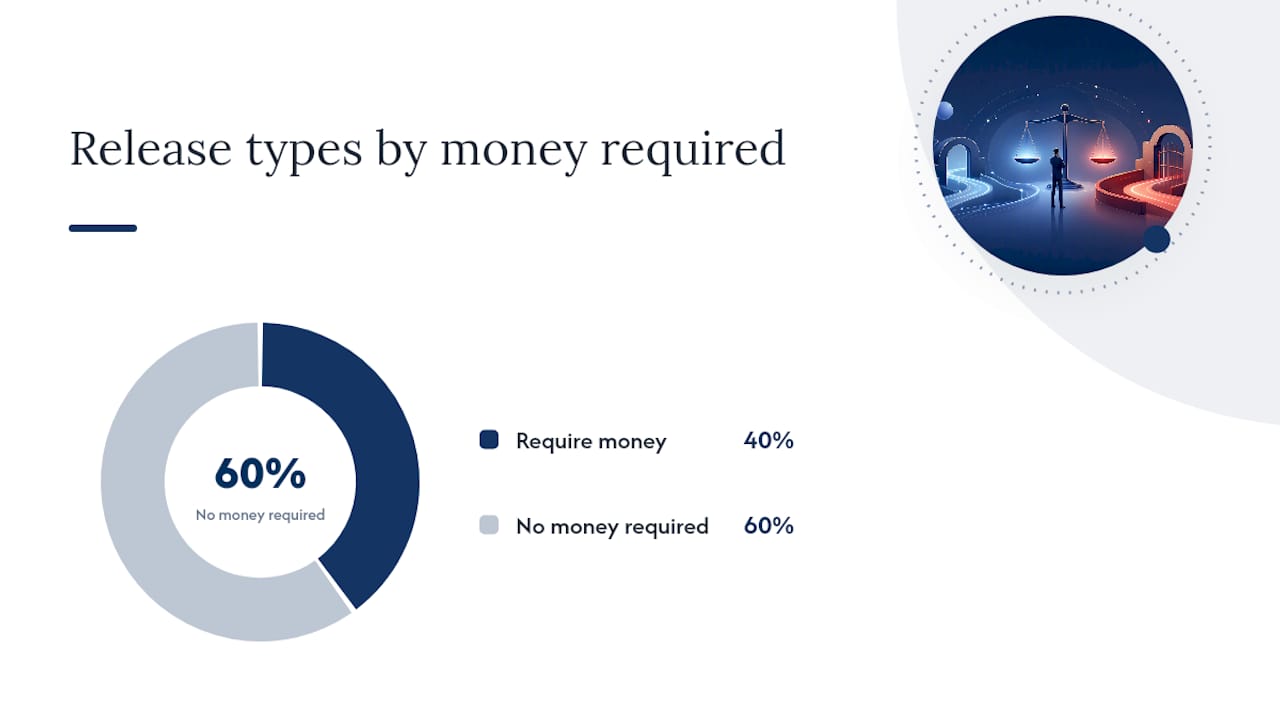
| Release type | Money required? | Who guarantees appearance? | Typical speed | Common conditions |
|---|---|---|---|---|
| OR release | No | Defendant's signed promise | Fast (same hearing) | Check-ins, travel limits, no-contact orders |
| Bail (cash) | Yes — full amount | Defendant/family pays court | After payment clears | Standard court-date obligations |
| Bail bond | Yes — premium (typically 10% in CA) | Licensed bondsman guarantees full bail | Hours after bond posted | Cosigner obligations, bondsman check-ins |
| Citation release | No | Officer issues citation at scene | Immediate | Appear on date listed on citation |
| Pretrial supervision | No | Pretrial services agency monitors | After assessment | Regular reporting, drug testing, GPS |
The cosigner guarantees that the defendant will appear; if the defendant skips, the bondsman can pursue recovery. The Legal Information Institute's bail entry describes bail as a security payment to guarantee appearance, which is the core distinction from OR: one costs money, the other costs only a promise. For a fuller look at pretrial release alternatives, including supervised release and citation programs, the differences in obligations and monitoring intensity vary considerably by county.
Citation release happens before custody even begins: an officer issues a citation at the scene and releases the person on the spot. No judge, no hearing, no bail. Pretrial supervision sits between OR and bail: the defendant is released but monitored by a county agency through regular check-ins, drug testing, or electronic monitoring.
What happens if you violate OR conditions or miss court?
Missing a court date while on OR release triggers a chain of events that moves fast.
A bench warrant is typically issued the same day a defendant fails to appear. Once that warrant is active, law enforcement can arrest the defendant anywhere in the state, and in many cases across state lines. The court will also likely revoke OR status, set a new and higher bail amount, and the defendant may face an additional charge for failure to appear — a separate criminal offense in most states.
Courts document violations through the court's own records: the clerk notes the absence, the judge issues the warrant from the bench, and the order is entered into the statewide warrant database. At that point, the defendant's release status changes immediately.
If a family member misses a court date, the steps are: contact the defense attorney within hours, not days; check for outstanding warrants so you know the current status; do not advise the defendant to avoid law enforcement (that makes things worse); and arrange a bond or self-surrender plan with counsel as quickly as possible. The longer the warrant sits active, the harder it becomes to negotiate favorable terms on the new bail amount.
Under California Penal Code §1275, public safety is the primary consideration when the court revisits bail after a violation, which means a missed appearance almost always results in a higher bail or no bail at all.
Which charges commonly get OR release and which usually don't?
Charges that frequently result in OR:
- Minor misdemeanors (petty theft, simple possession of small amounts, minor in possession)
- First-time nonviolent offenses with no prior record
- Low-level traffic offenses that result in custody
- Infractions that escalate to arrest due to a warrant
Charges that rarely result in OR:
- Serious violent felonies (murder, rape, robbery with a weapon)
- Domestic violence offenses, particularly those with statutory holds or victim-safety concerns
- Cases where the defendant has prior failures to appear
- Offenses involving firearms where the defendant is prohibited from possessing them
- Federal charges and cases with immigration detainers, which operate under separate federal rules
County practice matters as much as the charge itself. Local bail schedules set presumptive bail amounts by offense, and some counties have more liberal OR practices than others. A misdemeanor DUI in one county might routinely result in OR; in a neighboring county, the same charge might carry a standard bail amount. Always check the local bail schedule and ask a local attorney about county-specific norms. For a detailed breakdown of how charges affect eligibility, the criminal charges and bail eligibility guide covers the full spectrum.
Why OR rules differ by state, and what California's statutes say
OR release is governed by state law, not federal law, which means the rules, procedures, and eligibility standards vary significantly across jurisdictions. Some states have statutory presumptions in favor of OR for certain offenses; others leave it almost entirely to judicial discretion.
California's framework:
- Penal Code §1270 authorizes OR release for defendants charged with noncapital offenses, subject to on-the-record findings about public safety and assurance of appearance.
- Penal Code §1275 sets out the factors judges must weigh: protection of the public, seriousness of the offense, prior criminal record, and probability of appearing at trial.
- Penal Code §1270.1 requires an open-court hearing before OR or bail can be set for defendants charged with certain serious offenses, including domestic violence and offenses involving great bodily injury. That hearing requirement exists specifically to give prosecutors and victims a chance to be heard.
- A PC 1275 hold is a separate mechanism that can block release even after bail is set, requiring a bail source hearing to verify that the funds used to post bail were not obtained illegally.
Federal and immigration holds operate entirely outside the state OR framework. If a federal detainer or immigration hold is lodged against a defendant, state OR release does not override it. The defendant may be released from state custody only to be transferred to federal or immigration custody immediately. Families dealing with a detainer need both a criminal defense attorney and, in immigration cases, an immigration attorney working in parallel.
What to do when OR is denied: next steps for families
OR denial is not the end of the road. Here is the practical sequence:
- Ask for the on-the-record findings immediately after the judge denies OR. The judge's stated reasons are the foundation of any motion for reconsideration.
- Request a bail reduction at the same hearing if OR is off the table. Even a modest reduction in bail can make the difference between a bond being affordable and not.
- File a motion for reconsideration with specific evidence addressing the judge's stated concerns. If the judge cited flight risk, attach an employer letter and a lease. If the judge cited criminal history, address it directly with context.
- Explore a bail bond if the bail amount is set but unaffordable. A licensed bondsman posts the full bail for a non-refundable premium. In California, that premium is typically 10% of the bail amount. Payment plans and 0% down options exist for qualified cosigners.
- Gather documents that speed the process: booking number, name of the arresting agency, the bail amount as set by the court, a government-issued ID for the cosigner, and proof of the cosigner's income or assets.
- Contact the jail directly to confirm the defendant's housing location, since large counties often move defendants between facilities during the booking process.
Pro Tip: The booking number is the single most important piece of information for a bail bondsman. Get it from the jail's online inmate locator or by calling the facility's booking desk. Without it, the process stalls.
For felony defendants specifically, felony bail bond services operate under the same premium structure but often involve larger bail amounts and more complex cosigner requirements. The step-by-step walkthrough at how to bail someone out of jail in California covers the full logistics from booking to release.
What families actually face when OR is denied
Statewide California coverage across all 58 counties means seeing the same pattern repeat: a family gets the call, they don't know the booking number, they don't know the bail amount, and they spend the first two hours calling the wrong facility. That delay costs real time in custody.
The families who move fastest are the ones who call an attorney and a bondsman at the same time, not sequentially. The attorney handles the legal strategy — the motion, the reconsideration, the hearing. The bondsman handles the financial logistics the moment bail is set. Bilingual support in Spanish, Hindi, and Arabic makes a real difference when the family member making calls is not a native English speaker and needs to understand cosigner obligations clearly before signing anything.
OR release is always the better outcome when a judge grants it. When a judge doesn't, speed and preparation are what determine how long someone stays in custody.
When OR is denied, Jakehernandezbailbonds can help you act fast
Getting OR denied at arraignment is stressful, but it does not mean the defendant stays in custody while the case moves forward. Jakehernandezbailbonds is a licensed California bail bond service covering all 58 counties, available 24 hours a day, seven days a week. Free consultations are available immediately, and bilingual agents (Spanish, Hindi, Arabic) are on call to walk cosigners through obligations clearly before anything is signed.
This is not legal advice; consult a criminal defense attorney for legal strategy specific to your case. For the financial side of securing release after OR denial, contact Jakehernandezbailbonds now for a free consultation and rapid assistance across every California county and jail facility.
Sources
- release on one's own recognizance | Legal Information Institute
- California Code, PEN 1270.
- The arraignment | California Courts | Self Help Guide
- In re York - California Supreme Court Resources
This article is general information, not a substitute for advice from a qualified lawyer. Consult a qualified legal professional about your own circumstances before acting on anything here.