
Material change in bail is defined as a significant new fact or circumstance that was unavailable at the original bail hearing and that directly affects a court's assessment of flight risk or community danger. This is the legal threshold courts apply when deciding whether to revisit bail terms. The concept goes by several names across jurisdictions, including "changed circumstances" or "bail redetermination," but the standard is consistent: the new information must be genuinely new, not a rehash of what the judge already weighed. Understanding what is material change in bail gives you a real foundation for deciding whether to file a modification request or wait until you have stronger evidence. Jakehernandezbailbonds works with families across all 58 California counties who face exactly this question every day.
What is material change in bail, and what qualifies?
Material change in bail requires new information that was unavailable at the initial hearing and that materially affects the original bail reasoning. Minor improvements or vague claims do not meet the threshold. The change must shift the court's analysis on flight risk or the defendant's danger to the community.
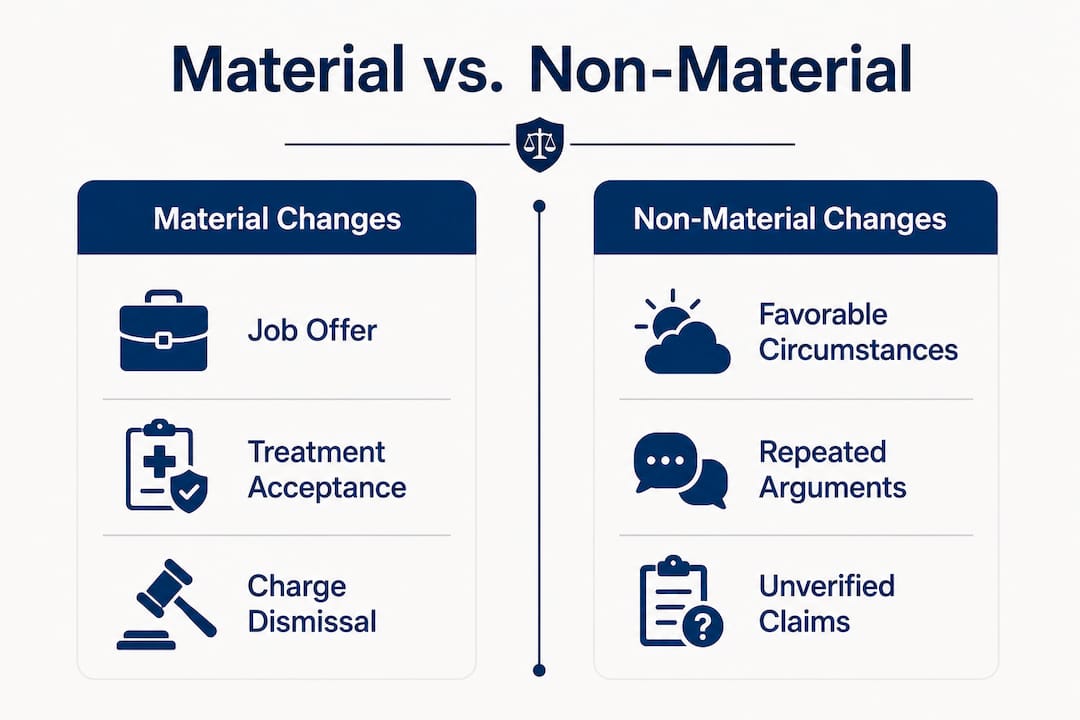
Courts draw a clear line between changes that are material and those that are merely favorable. A defendant who was unemployed at the time of arrest and has since received a verified job offer presents material new evidence. A defendant who simply says "things are better now" does not.

Common examples courts recognize
The following categories of new facts consistently qualify as material changes:
- New employment or a verified job offer with a start date and employer contact
- Acceptance into a licensed treatment program for substance abuse or mental health
- A significant shift in case posture, such as a key charge being dropped or new exculpatory evidence surfacing
- Documented family circumstances, such as becoming the sole caregiver for a dependent
- Verified compliance with existing bail conditions over a sustained period
Documentary proof carries far more weight than verbal claims alone. Courts want letters on official letterhead, program enrollment confirmations, and signed employer statements.
Material vs. non-material changes
| Change | Material? | Reason |
|---|---|---|
| Verified job offer with start date | Yes | Reduces flight risk with concrete ties to the community |
| "I feel more stable now" | No | Vague, unverifiable, and not new |
| Acceptance into a residential treatment program | Yes | Addresses community safety and supervision concerns |
| Defendant's family wants them home | No | Emotional appeal without new factual basis |
| Key charge dismissed by prosecution | Yes | Directly alters the risk calculus the judge originally applied |
| Defendant has been in custody for a long time | No | Duration alone does not constitute new evidence |
Pro Tip: Document every qualifying change the moment it happens. A job offer letter dated before you file is far stronger than one you scramble to obtain the week of the hearing.
How do courts evaluate bail modification requests?
Courts apply a structured review when a bail modification motion arrives. The judge's first question is always whether the new information was genuinely unavailable before. Procedural rules under frameworks like Florida Rule 3.131(e) require written motions, formal notice to prosecutors, and in many felony cases, the defendant's physical presence at the hearing.
The judicial analysis then turns to the § 3142(g) factor framework, which guides courts in weighing new evidence against flight risk and community danger. Effective motions tie each new fact to one of these specific factors rather than presenting evidence in a general way. A judge who originally set high bail because of flight risk needs to see exactly how the new fact reduces that specific concern.
Typical procedural steps in a bail modification hearing
- File a written motion that identifies the new evidence and explains why it was unavailable at the original hearing
- Provide formal notice to the prosecution, with minimum notice periods varying by jurisdiction (Arizona Rule 7.2, for example, requires timely notice and a hearing within a specified window)
- Arrange the defendant's presence at the hearing, which is required in most felony cases
- Present documentary evidence rather than relying on attorney argument alone
- Directly address the original bail factors the judge cited when setting the initial amount or conditions
One common and costly mistake is recycling arguments from the original bail hearing. Reusing old arguments without new information leads to immediate denial. Courts require genuine new facts, and repeated filings with stale evidence damage the defendant's credibility for future motions.
What evidence best supports a bail modification claim?
Strong bail modification motions are built on documents, not declarations. The court needs to verify every claim independently, so the evidence package must be court-ready before the motion is filed.
The most effective evidence packages include:
- Employer letters on company letterhead confirming a job offer, salary, start date, and the employer's willingness to vouch for the defendant
- Treatment program enrollment confirmations from licensed facilities, including the program's address, duration, and supervision structure
- Court records or prosecution filings showing a charge reduction, dismissal, or new development in the case posture
- Medical or social service documentation supporting a caregiver claim or health-related circumstance
- Compliance records from pretrial services showing the defendant has met every existing condition without violation
Most rejected motions fail because the new evidence does not clearly address the judge's main concerns about flight risk or community safety. Emotional hardship pleas rarely succeed on their own.
Effective defense strategies often prioritize modifying bail conditions such as electronic monitoring or no-contact orders over simply seeking a lower dollar amount. A well-planned supervision proposal can be more persuasive than asking the court to cut the bail figure in half. You can review how bail reduction hearings work in California to understand what judges typically look for.
Pro Tip: Read the judge's original bail ruling carefully before drafting your motion. Align every piece of new evidence directly with the specific concerns the judge stated. Judges respond to motions that answer their own prior reasoning.
What are the limits and implications of bail modification requests?
Bail modification requests carry real strategic risk. Filing too soon, filing without strong new evidence, or filing repeatedly with recycled facts can all backfire. Courts require clear justification explaining why the prior bail decision is no longer correct. Mechanical, repetitive requests are denied without hesitation.
The practical implications break down into four key areas:
-
Timing matters more than most people realize. Filing too quickly after a denial without substantial new developments is counterproductive. The best approach is to wait until you have a comprehensive, verified evidence package before returning to court.
-
Credibility is cumulative. Each failed motion that recycles old arguments makes the next motion harder to win. Judges track the history of filings, and a pattern of weak motions signals that the defense is not taking the standard seriously.
-
Jurisdiction shapes the rules. Procedural requirements vary significantly across states. California, Arizona, and Florida each have distinct rules about who may file, which judge may hear the motion, and what notice is required. Understanding the factors judges consider in your specific jurisdiction is not optional.
-
Not every change in circumstances reaches the legal threshold. A defendant who feels more settled, whose family is struggling financially, or who has simply been in custody for a long time has not necessarily experienced a material change. The standard is strict, and courts enforce it consistently.
The most successful modification requests combine genuinely new facts, a direct connection to the original bail factors, and a realistic proposal for supervision or conditions that addresses the court's concerns.
Key Takeaways
A successful bail modification requires genuinely new evidence tied directly to the court's original flight risk or community safety concerns, not a restatement of facts the judge already weighed.
| Point | Details |
|---|---|
| Material change definition | New, previously unavailable facts that directly affect flight risk or community danger assessments. |
| Qualifying evidence types | Job offers, treatment program enrollment, case posture changes, and caregiver documentation all qualify. |
| Court evaluation process | Judges apply the § 3142(g) framework and require written motions with formal notice to prosecutors. |
| Common failure reason | Motions fail most often when new evidence does not address the judge's original stated concerns. |
| Strategic approach | Modifying conditions like monitoring is often more effective than requesting a lower bail amount. |
What I've learned from watching families navigate this process
The biggest mistake I see is treating a bail modification motion like a second chance to make the same argument. Families come to me frustrated after a denial, and when I ask what was new in the motion, the answer is often "nothing, really." That is the problem.
Courts are not looking for persistence. They are looking for proof that something genuinely changed. A job offer letter, a treatment program acceptance, a charge that got dropped. These are the facts that move judges. Emotional appeals about hardship are understandable, but they do not meet the legal standard, and filing them wastes time and credibility.
My advice is always the same: wait until you have something real, document it thoroughly, and connect it explicitly to what the judge said when bail was originally set. Patience here is not passive. It is strategic. The bail hearing process rewards preparation far more than urgency.
— Jake
How Jakehernandezbailbonds can help when bail terms change
When bail conditions shift or a modification hearing is on the horizon, having a licensed bondsman who understands the process makes a real difference. Jakehernandezbailbonds is available 24/7 across all 58 California counties, with no call center and no middleman. You speak directly with someone who knows the system.
Whether you need help understanding current bail terms, figuring out your payment options, or getting a loved one released quickly, Jakehernandezbailbonds offers free consultations and 0% down payment plans for qualified co-signers. Bonds range from $1,000 to $1,000,000. Bilingual support is available. If you are ready to move forward, contact Jakehernandezbailbonds now for immediate assistance.
FAQ
What is material change in bail?
Material change in bail is a significant new fact, unavailable at the original hearing, that directly affects the court's assessment of flight risk or community danger. Minor improvements or emotional appeals do not meet this legal threshold.
What are common examples of material changes in bail?
Courts recognize verified job offers, acceptance into licensed treatment programs, charge dismissals, and documented caregiver responsibilities as qualifying material changes. Each must be supported by documentary proof.
How do courts decide if a change is truly material?
Judges apply the § 3142(g) factor framework and ask whether the new information was genuinely unavailable before and whether it changes the original bail reasoning. Evidence must be tied directly to flight risk or public safety concerns.
Can you file for bail modification more than once?
Yes, but repeated filings with recycled arguments damage credibility and are routinely denied. Courts require genuine new developments each time a modification is requested.
Does a lower bail amount always require a material change?
Yes. Any request to reduce bail or alter conditions must be grounded in new facts that meet the material change standard. Courts do not revisit bail decisions based on the passage of time or general hardship alone.