
The Eighth Amendment to the U.S. Constitution states plainly: "Excessive bail shall not be required, nor excessive fines imposed, nor cruel and unusual punishments inflicted." That single clause is the constitutional foundation governing how courts set bail across the United States. Its role is specific and often misunderstood. The Amendment does not guarantee every defendant a right to bail; it prohibits bail set at an unreasonably high amount relative to the government's legitimate interest, whether that is ensuring a defendant appears at trial or protecting public safety.
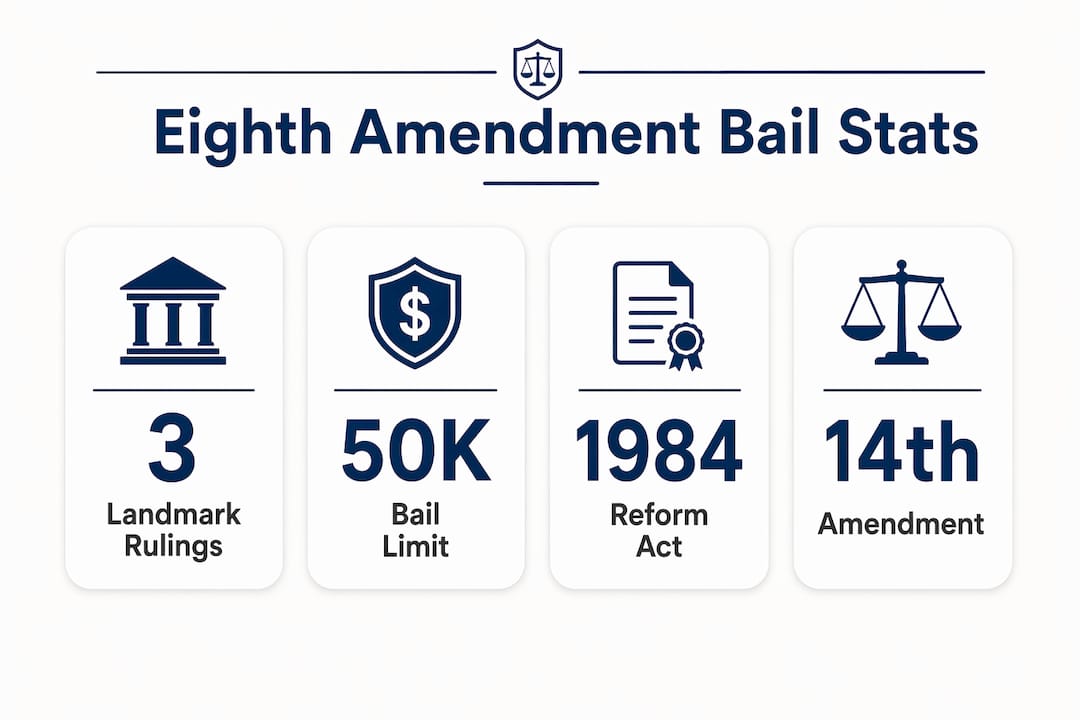
Two Supreme Court decisions define the modern framework. In Stack v. Boyle (1951), the Court held that bail is excessive when set higher than reasonably necessary to ensure the defendant's court appearance. In United States v. Salerno (1987), the Court went further, upholding the Bail Reform Act's pretrial detention provisions and confirming that the Eighth Amendment limits bail amounts but does not require release in every case.
The Amendment's core bail protections and limitations, as courts have interpreted them:
- Bail cannot be set at a figure higher than what is reasonably calculated to serve the government's stated interest
- The Amendment does not guarantee bail in all cases, including capital offenses
- Courts may deny bail entirely when a defendant poses a threat that no release condition can address
- Procedural safeguards apply: defendants may move to reduce bail and appeal through the Court of Appeals
- The Eighth Amendment's protections apply to state courts through the Fourteenth Amendment
How the Eighth Amendment's bail clause traces back to English law
The excessive bail clause did not originate with the American founders. It was lifted from the English Bill of Rights Act of 1689, nearly verbatim, after centuries of English legal struggle over pretrial detention.
The story starts with the Statute of Westminster of 1275, which catalogued bailable and non-bailable offenses. For roughly five and a half centuries, that statute served as the primary authority on who could be released before trial. The system broke down repeatedly. In Darnel's Case (1627), judges allowed indefinite imprisonment on the King's order alone, which prompted Parliament to pass the Petition of Right in 1628. Then judges found a new workaround: they set bail so high that defendants could never pay it. Parliament closed that loophole with the Bill of Rights of 1689.

That history matters because it explains the clause's limited scope. English law never read the provision as a universal right to bail. The U.S. founders imported the language without expanding its meaning.
What courts have decided about excessive bail under the Eighth Amendment
Judicial interpretation of the Eighth Amendment's bail clause has developed through a handful of landmark rulings. The table below captures the key cases and their holdings.
| Case | Year | Core holding |
|---|---|---|
| Stack v. Boyle | 1951 | Bail is excessive if set higher than necessary to ensure court appearance |
| Carlson v. Landon | 1952 | No absolute right to bail; detention permitted for public interest |
| United States v. Salerno | 1987 | Bail Reform Act upheld; Amendment limits amounts, not detention authority |
| Schilb v. Kuebel | — | Court assumed Eighth Amendment applies to states via Fourteenth Amendment |
The procedural path for challenging excessive bail follows a specific sequence:
- File a motion to reduce bail in the trial court
- If denied, appeal to the Court of Appeals for the circuit
- If still unsuccessful, appeal to the Supreme Court Justice sitting for that circuit
In Stack v. Boyle, the Court struck down a $50,000 bail as excessive because the government offered no evidence of flight risk and ignored the defendants' financial circumstances. The ruling established that bail must be individualized, not set by offense category alone.
United States v. Salerno shifted the analysis. The Court held that the Bail Reform Act of 1984 did not violate the Eighth Amendment by allowing pretrial detention for defendants charged with serious felonies who posed a danger no release condition could eliminate. The Eighth Amendment's text, the Court noted, "says nothing about whether bail shall be available at all." The Amendment's only substantive limit is that the government's response must not be excessive relative to the interest it is protecting. When Congress mandates detention for a compelling interest beyond flight prevention, the Amendment does not require release.
The Eighth Amendment applies to state courts through the Fourteenth Amendment, though the Supreme Court has described this as an "assumption" rather than an explicit holding. In practice, state bail proceedings are governed by both the federal constitutional floor and individual state statutes.
Pro Tip: If you believe bail has been set unconstitutionally high, act quickly. Courts review bail only when formally challenged. A motion to reduce bail is the required first step, and delay can mean weeks of unnecessary pretrial detention. Learn more about what happens at a bail hearing before you appear.
What the Eighth Amendment actually permits and prohibits in bail decisions
The Amendment's scope is narrower than most people assume. Here is what it does and does not cover:
- Prohibits: Bail set at a figure higher than reasonably necessary to serve the government's stated interest
- Prohibits: Using bail as a punitive tool before conviction
- Does not prohibit: Denying bail entirely when a defendant poses a documented public safety threat
- Does not prohibit: Considering factors beyond flight risk, including danger to the community
- Does not cover: The speed of bail processing; courts may impose holding periods without violating the Amendment
- Does not apply: To post-conviction release pending appeal, though courts generally grant such releases
The distinction between bail amount and bail denial is critical. A court that sets bail at $500,000 for a defendant charged with a minor offense may violate the Eighth Amendment. A court that denies bail entirely for a defendant charged with a serious felony who poses a genuine safety threat, after an adversary hearing, likely does not. The Bail Reform Act of 1984 codified this distinction at the federal level, and Salerno confirmed its constitutionality.
Release on recognizance, where a defendant is released without posting money, sits outside the Amendment's financial prohibition entirely. Bail conditions such as electronic monitoring or travel restrictions are evaluated under a reasonableness standard, not the excessive bail clause specifically. For a closer look at bail eligibility distinctions by charge type, the underlying statutory framework matters as much as the constitutional floor.
Balancing public safety and the presumption of innocence in bail decisions
The central tension in bail law is real and unresolved. The presumption of innocence demands that defendants remain free before trial. Public safety concerns push in the opposite direction. The Eighth Amendment does not resolve this tension cleanly; it sets a floor, not a ceiling.
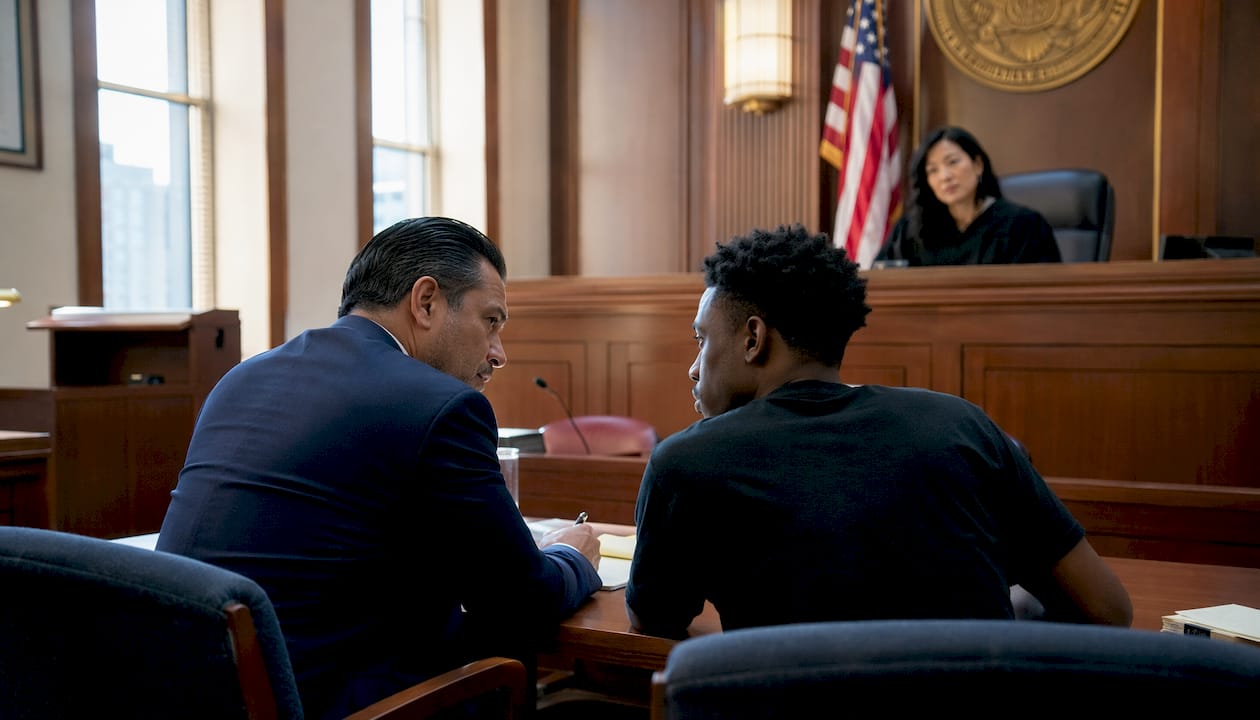
Legal practitioners note that the Amendment compels courts to justify bail amounts but does not prevent judges from denying bail entirely when the defendant's risk profile warrants it. The Salerno Court was explicit: detention for public safety is regulatory, not punitive, and the distinction matters legally. Pretrial detention under the Bail Reform Act requires an adversary hearing, applies only to serious felonies, limits detention length, and requires that detainees be housed separately from convicted prisoners.
Contemporary bail reform debates often focus on whether the Eighth Amendment does enough. Critics argue that cash bail systems effectively punish poverty, since a $10,000 bail is manageable for one defendant and impossible for another. The Amendment's text addresses only whether bail is excessive relative to the government's interest, not whether a defendant can actually afford it. That gap is where much of the current reform conversation lives. Understanding why bail conditions matter for defendants is part of a broader national conversation about whether the constitutional floor is high enough.
How bail practices affect marginalized communities under the Eighth Amendment
The Eighth Amendment's prohibition on excessive bail operates in theory as a universal protection. In practice, its impact falls unevenly. A bail amount that is constitutionally permissible because it is proportionate to the government's interest may still be practically unaffordable for a low-income defendant. The Amendment asks whether bail is excessive relative to the government's purpose, not whether it is excessive relative to a defendant's means.
This gap produces a well-documented disparity. Defendants who cannot afford bail remain incarcerated pretrial, losing jobs, housing, and the ability to assist in their own defense. Wealthier defendants charged with identical offenses go home. The constitutional standard, as interpreted through Stack and Salerno, does not directly address this asymmetry. Bail reform advocates argue that the Eighth Amendment should be read to prohibit bail amounts that are functionally punitive because of a defendant's financial circumstances, not just amounts that are facially disproportionate to the government's interest. Courts have not broadly adopted that reading, leaving the gap to be addressed through legislation rather than constitutional interpretation.
Need help navigating bail in California?
When a family member is arrested, understanding constitutional rights is one thing. Getting them home fast is another. Jakehernandezbailbonds serves all 58 California counties, 24 hours a day, with no call center and no middleman. Bonds start at $1,000, with 0% down options for qualified co-signers. Get bail help now or call for a free consultation any time.
Key Takeaways
The Eighth Amendment limits excessive bail amounts but does not guarantee bail in every case, and courts may deny bail entirely when public safety requires it under the Bail Reform Act of 1984.
| Point | Details |
|---|---|
| Amendment limits amounts, not access | The Eighth Amendment prohibits excessive bail but does not require courts to offer bail in all cases. |
| Stack v. Boyle standard | Bail is excessive when set higher than necessary to ensure the defendant's court appearance. |
| Salerno expanded the framework | Courts may detain defendants for public safety, not just flight risk, without violating the Eighth Amendment. |
| State courts are covered | The Eighth Amendment's bail protections apply to states through the Fourteenth Amendment. |
| Reform gaps remain | The Amendment does not address whether a defendant can afford bail, only whether the amount is proportionate to the government's interest. |