To avoid jail pretrial steps and get someone released before trial, contact a licensed bail bondsman right now and have them post a surety bond on the defendant's behalf. That single call sets the entire release process in motion, and it usually costs far less time than waiting on a court date to sort itself out.
Before you dial, gather three things: the inmate's full legal name exactly as booked, the booking number, and the bail amount if it's already been set. A bondsman can start working even without the bail figure, but having it speeds everything up. Verify the company's state license and ask directly whether they cover the facility where your family member or client is being held. Jake Hernandez Bail Bonds covers all 58 counties in California and works with every major jail in the state, so coverage gaps rarely become the bottleneck they are with smaller local operators.
Key Takeaways
Avoiding extended pretrial detention comes down to speed, accuracy, and choosing a licensed bondsman who can verify coverage before you sign anything.
| Point | Details |
|---|---|
| Call immediately | Contact a licensed bail bondsman with the inmate's full name, booking number, and bail amount ready. |
| Expect a nonrefundable premium | Typical bail bond premiums run around 10%, with some states capping the rate lower. |
| Understand co-signer liability | Signing an indemnity agreement means covering the full bond if the defendant fails to appear. |
| Verify before you commit | Confirm the bondsman's state license and jail coverage before handing over payment or collateral. |
| Jake Hernandez Bail Bonds covers all 58 CA counties | Offers 0% down, payment plans, bilingual support, and 24/7 rapid release statewide. |
Table of Contents
- What To Gather in the First Minutes After an Arrest
- How Does a Bail Bondsman Actually Get Someone Released?
- What Does It Cost to Bail Someone Out?
- What Are You Actually Signing When You Co-Sign a Bond?
- How Can You Tell a Bondsman Is Legitimate?
- How Do You Choose the Right Bail Bondsman?
- How Long Does Release Actually Take?
- What Happens If the Defendant Misses Court?
- A Provider's Note on What Families Actually Need in the First Hour
- Get Someone Out Now: How Jake Hernandez Bail Bonds Works
- Sources
What To Gather in the First Minutes After an Arrest
Speed depends almost entirely on accuracy. A bondsman can't post a bond for someone the jail's system can't match, so precision here beats urgency.
Have this ready before you call:
- Inmate's full name, spelled exactly as it appears on the booking sheet
- Date of birth
- Booking number (find it via the jail's inmate locator, the facility's public information line, or the arresting officer)
- Name of the arresting facility or jail
- Bail amount, if the court or bail schedule has already set one
- Any known holds, especially immigration or federal holds, which change the process significantly
You'll also need a co-signer, sometimes called an indemnitor, who is ready to sign paperwork. That person should have a government-issued photo ID and, ideally, proof of income or residence on hand, since some bondsmen ask for it during underwriting.
Pro Tip: Call the jail's public information line before you call anyone else. A booking number takes thirty seconds to get there, and it eliminates the single biggest cause of release delays: misspelled names or transposed digits on the paperwork.
How Does a Bail Bondsman Actually Get Someone Released?
The process runs in a predictable sequence, and knowing it in advance keeps you from panicking when there's a lull.
- Verification. The bondsman confirms the inmate's identity, booking number, and the exact bail amount with the jail.
- Underwriting. The bondsman evaluates risk. This is a quick version of what any surety business does. Bail bond agents act as private financial guarantors who assume real liability if the defendant skips court, so they check the co-signer's ability to pay and sometimes the defendant's ties to the community.
- Indemnity agreement. The co-signer signs a contract agreeing to cover the full bond amount if the defendant fails to appear.
- Posting the bond. The bondsman submits the surety bond to the court or jail, backed by a licensed underwriting company.
- Jail processing. The facility verifies the bond, clears any holds, and begins release procedures.
Posting the bond is not the finish line. Jail intake systems still have to run their own checks, and that final stretch is often where families feel the most friction.
Release timing after a bond is posted commonly falls somewhere between two and twenty-four hours, driven mostly by how backed up the facility's intake staff is at that moment, not by anything the bondsman controls once the paperwork is filed.
Pro Tip: Accurate identifiers and electronic signatures cut real time off this process. If your bondsman offers remote e-signing, use it. It removes the step where someone has to physically drive documents to be signed.
What Does It Cost to Bail Someone Out?
Expect to pay a premium, which is a nonrefundable fee for the bondsman's service, not a deposit you get back.
- The industry standard premium is roughly 10% of the total bail amount, though some states cap the rate lower, closer to 8%.
- Payment options usually include cash, credit card, and structured payment plans.
- Some agencies, including Jake Hernandez Bail Bonds, offer 0% down for qualified co-signers, which shifts more of the underwriting weight onto the co-signer's ability to keep up with payments later.
- Collateral can include a car title, jewelry, or a lien against real property, and it secures the bondsman's risk rather than replacing the premium.
If the defendant fails to appear, pledged collateral can be seized to cover the forfeited bond and any recovery costs. Because bail rules and bond definitions vary by state, the exact cap on premiums where you live may differ from what a friend in another state paid.
Pro Tip: Ask every bondsman you call for a written fee disclosure before you agree to anything. If they hesitate or can't cite the statute or cap that applies in your state, that hesitation tells you something.
What Are You Actually Signing When You Co-Sign a Bond?
The indemnity agreement is the document that makes a co-signer legally responsible, and it deserves a slower read than most people give it.
Signing it means you're personally guaranteeing that the defendant will show up for every court date. If they don't, you can be held liable for the full bond amount, not just the premium you already paid.
Indemnity agreements are not a formality. Co-signers take on real financial exposure, including potential costs tied to recovery efforts if the defendant disappears before trial.
Your obligations don't end once release happens:
- Keep the bondsman updated on any change in your address or phone number, and the defendant's, too.
- Be available for calls or check-ins the bondsman requests.
- Help locate the defendant if they miss a court date and the bondsman needs assistance.
- Understand that collection actions, civil suits, or seizure of collateral are all real possibilities if the bond is forfeited.
Pro Tip: If you're considering pledging a home or business equity as collateral, talk to an attorney first. That conversation costs a fraction of what a forfeited high-value bond does.
How Can You Tell a Bondsman Is Legitimate?
Most bail bond transactions go smoothly, but the industry has enough bad actors that a quick verification step is worth the extra five minutes.
Watch for these red flags:
- Pressure to sign paperwork immediately, before you've read it
- Requests to sign blank forms "to save time"
- Refusal or reluctance to give you a license number
- Demands for full payment in cash only, with no receipt
Protect yourself with a few fast checks: look up the bondsman on your state's Department of Insurance licensing portal, ask for a written receipt for every payment, and confirm they genuinely operate 24/7 and cover the facility in question. Never hand over collateral, a title, jewelry, anything, without a signed contract specifying how and when it gets released.
How Do You Choose the Right Bail Bondsman?
A good bondsman answers direct questions without dodging them. Ask these on your first call:
- Are you licensed, and can you give me the license number now?
- Do you cover the jail where my family member is being held?
- What's your premium rate, and does my state cap it?
- Do you offer payment plans or 0% down for qualified co-signers?
- How and when do I get collateral back?
Look for a firm with a transparent fee schedule, direct experience with the specific facility involved, and a clear written process for surrendering the defendant if that ever becomes necessary.
Pro Tip: Screenshot every written fee disclosure and save the license number in your phone. If a dispute ever comes up, that record is worth more than a memory of what someone told you on the phone.
How Long Does Release Actually Take?
The fastest cases release within two to four hours of the bond being posted. Realistically, plan for six to twenty-four hours, since most delays happen inside the jail, not at the bondsman's desk.
Common slowdowns include mismatched identifiers on the paperwork, an outstanding warrant surfacing during the records check, an immigration or federal hold, or simply a shift change hitting right as your paperwork lands on someone's desk.
While you wait, use the time productively:
- Arrange transportation, since most releases happen with little warning
- Gather a change of clothes and any medication information the defendant may need
- Stay near your phone in case the bondsman needs a signature or additional information
What Happens If the Defendant Misses Court?
This is the scenario every co-signer needs to understand before signing anything, not after.
If the defendant fails to appear, the court issues a bench warrant, and the bond is subject to forfeiture. The bondsman may hire a recovery agent to locate the defendant, and those costs often get passed to the co-signer under the indemnity agreement. Civil collection against pledged collateral or personal assets can follow.
If you find yourself in this position, act fast:
- Notify the bondsman the moment you know a court date was missed.
- Help locate the defendant if you have any information at all.
- Ask the bondsman about surrendering the defendant, sometimes called "going off the bond," which can limit further liability.
- Consult an attorney about your options, including repayment arrangements.
Surrendering the defendant ends the bondsman's liability on the bond, and depending on the case, it can also reduce or discharge what the co-signer owes once the case reaches disposition or the defendant is confirmed in custody elsewhere.
A Provider's Note on What Families Actually Need in the First Hour
Most people calling a bondsman have never done this before, and they're doing it while scared, exhausted, or both. That combination is exactly when clear communication matters most, and it's exactly when a lot of companies fail families the hardest, usually by routing them through a call center that has no idea which jail they're even asking about.
Rapid release only works when the paperwork is right the first time and someone picks up the phone at 2 a.m. the same way they would at 2 p.m. That's the standard we hold ourselves to, and it's why bilingual support and 24/7 availability aren't marketing lines, they're operational requirements for this job.
If you call for a free consultation, expect two things immediately: confirmation of our license status and a straight answer about whether we cover the facility your family member is in. No pressure, no runaround, just a clear next step while you're already dealing with enough.
Get Someone Out Now: How Jake Hernandez Bail Bonds Works
Jake Hernandez Bail Bonds handles rapid release for co-signers across all 58 California counties, with the kind of direct, no-middleman service that a call-center operation simply can't offer when you need a real person answering fast decisions at 3 a.m.
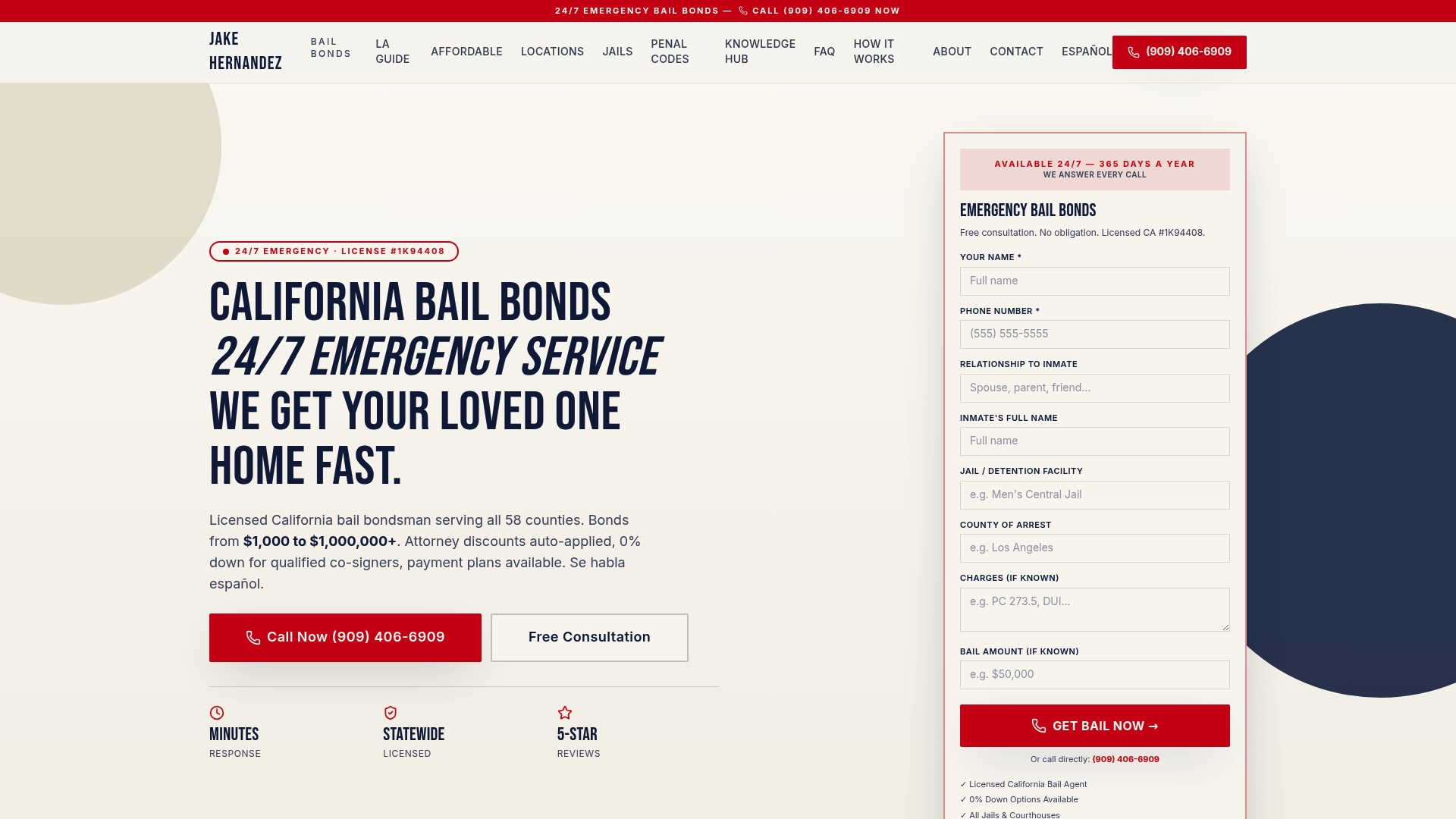
If immigration or federal holds are part of the case, we handle those directly instead of referring you elsewhere, and bilingual support in Spanish, Hindi, and Arabic means language never slows down a release. You can check our license status and confirm coverage of the facility holding your family member the moment you call.
Start with a free consultation or use our bail bond cost calculator to see premium estimates and payment options before you even pick up the phone. If you're not sure where to begin, our team is available 24/7 to walk you through the next step.
Sources
A few sources back the core claims in this guide, and each one covers a different piece of the puzzle worth double-checking on your own.
For more on the mechanics of bail itself, our guides on how bail reduces pretrial jail time and what factors judges weigh when setting bail go deeper into the decisions that shape the number you're working with in the first place.
This article is general information, not a substitute for advice from a qualified lawyer. Consult a qualified legal professional about your own circumstances before acting on anything here.