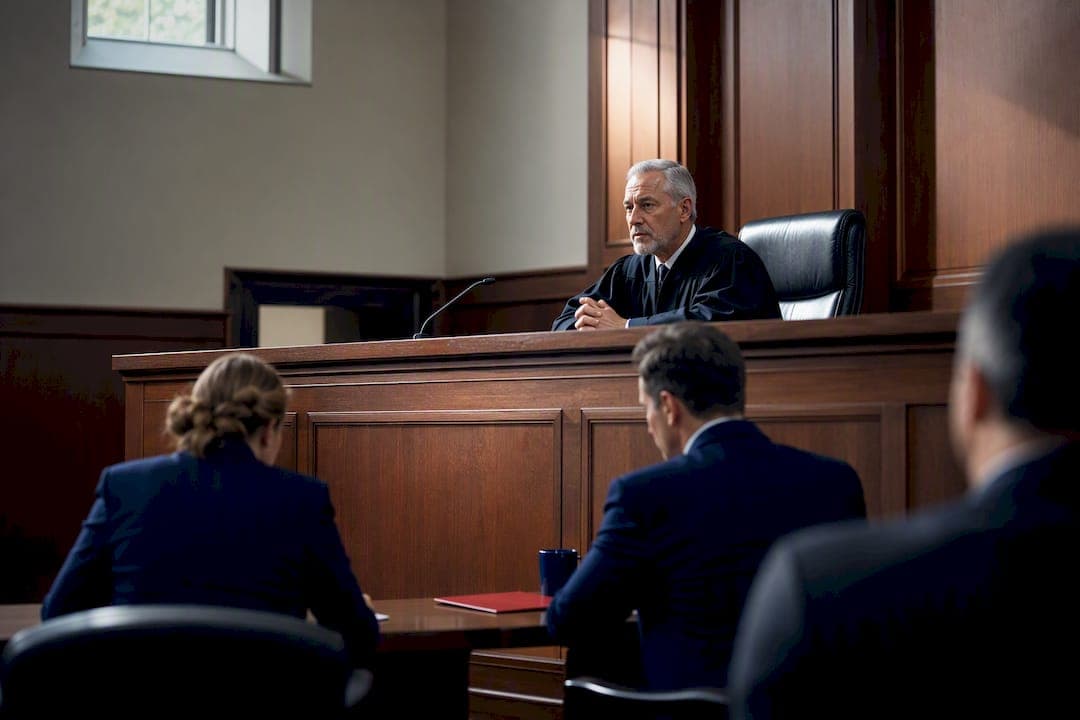
For burglary charges in California, presumptive felony bail often runs in the tens of thousands, with $50,000 common for residential burglary under county schedules. Judges can set that number higher or lower based on the facts of the case. The fastest path to release is usually posting cash, working with a licensed bail bond company for the standard 10% premium, or qualifying for release on your own recognizance. If a PC 1275 hold gets attached to the case, expect a delay until a judge clears the funds at a separate hearing.
TL;DR:
- Most California counties list $50,000 as the typical bail for residential first-degree burglary, but this can be adjusted higher or lower at arraignment based on case specifics.
- Enhancements like weapon use, prior strikes, multiple counts, or concurrent charges can raise bail above the printed schedule; court factors include flight risk, community ties, and ability to pay.
- Post-arrest bail options include cash payment, a bail bond with a premium, or release on own recognizance, with timelines from hours to days depending on circumstances.
- A PC 1275 hold for suspicious funds can delay release until the defendant proves the money's legal source in a separate hearing.
- Bail amounts vary widely between counties, and missed court dates immediately trigger warrants and forfeitures, making early action critical.
Table of Contents
- Typical Bail Amounts and County Bail Schedules for Burglary
- How Judges Actually Set or Change Bail in California
- How to Post Bail After a Burglary Arrest
- PC 1275 Holds: Why They Delay Release and How to Clear One
- Preparing for a Bail Hearing and Requesting a Reduction
- County-by-County Differences in Burglary Bail
- What Happens if Someone Skips a Court Date After Posting Bail
- Prior Convictions and Multiple Charges Push Bail Higher
- The Bail Hearing Process for Burglary Charges Step by Step
- Requesting a Bail Reduction or Modification After Arraignment
- What to Do Right Now if Someone You Know Was Arrested for Burglary
- What a Licensed Bail Bondsman Actually Does for Burglary Cases
- Get Fast Help With Burglary Bail Through Jake Hernandez Bail Bonds
- Sources
- FAQ
Typical Bail Amounts and County Bail Schedules for Burglary
Every California county runs its own felony bail schedule, a published list of presumptive bail amounts tied to specific Penal Code violations. Superior courts adopt these schedules under Penal Code §1269b, and every county sets its own numbers, so the same charge can carry a different price tag depending on where the arrest happened.
Burglary splits into two degrees under state law, and the schedule reflects that split. First-degree burglary, which covers entering an occupied residence, sits at the higher end. Second-degree burglary, covering commercial or unoccupied structures, usually comes in lower. Los Angeles County's schedule lists $50,000 for residential burglary under PC 459/460(a), while other burglary classifications on the same Los Angeles felony bail schedule run closer to $15,000. Those are baseline figures, not guarantees. A judge can move them up or down at arraignment.
Several things push a burglary bail number above the printed schedule amount:
- Sentencing enhancements. Weapon use, targeting an occupied home, or causing property damage during the break-in can add fixed dollar amounts on top of the base figure.
- Prior strikes. Some county schedules list separate add-ons for defendants with strike priors. Marin County's felony bail schedule, for example, spells out additional bail tied to second and third strike exposure.
- Multiple counts. Facing several burglary counts from separate incidents, rather than one continuous event, typically stacks bail rather than folding it into a single number.
- Concurrent charges. A burglary arrest that comes bundled with other felony charges (weapons possession, resisting arrest) adds bail for each count.
Finding your county's actual number takes a few minutes. Most superior courts post their felony bail schedule as a PDF on the court's own website, searchable by county name and "felony bail schedule." County jail booking or inmate lookup systems, like the one Los Angeles County Sheriff's Department maintains, will often show the exact bail amount set for a specific person once booking is complete. Bail bond agents pull from the same source, so calling one is often faster than digging through a court website on your phone in a parking lot at 2 a.m.
How Judges Actually Set or Change Bail in California
The written schedule is a starting point, not the final word. Penal Code §1269b requires every county to adopt a uniform bail schedule, but it also preserves a judge's authority to set bail at arraignment based on the specific person standing in front of them, not just the charge on the sheet.
Court guidance from California's judiciary makes public safety the top statutory priority when a judge decides on a burglary bail amount. Beyond that, the judge is weighing several other things at once:
- Flight risk. Ties to the area, job stability, and family in the county all cut against the assumption someone might skip town.
- Criminal history. A first arrest reads very differently than a rap sheet with prior burglary or theft convictions.
- Prior failures to appear. Missing even one earlier court date makes a judge far less willing to release someone on a lower amount.
- Community ties. Homeownership, long-term employment, and local family connections all work in a defendant's favor.
- Ability to pay. Courts are supposed to consider whether a bail amount is functionally impossible for the defendant to meet, though this factor gets applied unevenly county to county.
Here's something most people researching bail don't know: a large majority of California's counties layer a pretrial risk assessment tool on top of the bail schedule, according to the Public Policy Institute of California. These tools score a defendant's likelihood of reoffending or missing court, and that score can push a judge toward a lower bail or an O.R. release even when the schedule suggests a much higher number. It can also cut the other way. The tools have drawn real scrutiny over accuracy and fairness, so treat a risk-assessment score as one input among several, not a guarantee of a specific outcome.
Weapon use during the burglary, entry into an occupied home, or exposure to a third-strike sentence all give a judge legal grounds to set bail well above the county's printed figure. On the flip side, a defendant with deep community roots and no prior record sometimes walks out of arraignment with bail set below the schedule, or with an O.R. release entirely. The factors judges weigh at arraignment are worth understanding before that hearing happens, not after.
How to Post Bail After a Burglary Arrest
Once bail is set, three realistic paths get someone out of custody. Each comes with its own cost, paperwork, and timeline.
- Cash bail. Pay the full bail amount directly to the jail or court clerk, in cash or sometimes cashier's check. The upside: it's refundable at the end of the case (minus court fees) if the defendant makes every court appearance. The downside is obvious. Coming up with $50,000 in cash on short notice is out of reach for most families.
- Surety bond through a bail bondsman. A licensed bail agent posts the full bail amount on the defendant's behalf in exchange for a premium, capped by law at 10% of the total bail. On a $50,000 residential burglary bail, that's a $5,000 fee rather than $50,000 in cash out the door. The premium is non-refundable since it's the fee for the service, but most bond companies offer payment plans, and some advertise 0% down options for qualified co-signers. A co-signer typically needs to show steady income and provide ID, and the bondsman handles the paperwork with the jail directly.
- Own recognizance (O.R.) or supervised release. In some cases, a judge releases the defendant without requiring any bail at all, based on low flight risk and no danger to public safety. This is more common for first-time offenders facing lower-level burglary counts than for anyone with a violent enhancement or prior strike attached to the case.
Timelines vary by option and by jail. Cash bail posted directly at the jail can process in a couple of hours once the amount is confirmed. A bail bond typically moves at a similar pace once paperwork and payment are in place, sometimes faster, since a bondsman who works with a specific jail daily already knows the release process cold. O.R. release depends entirely on when arraignment happens, which can take anywhere from a few hours to a couple of days depending on the county and how backed up the court calendar is.
Pro Tip: Call a bail bond company before you drive to the jail, not after. A bondsman can confirm the exact bail amount, check whether a 1275 hold is attached, and tell you what documents to bring, which saves a wasted trip.
For a full walkthrough of the paperwork involved, see this step-by-step guide to bailing someone out in California.
PC 1275 Holds: Why They Delay Release and How to Clear One
A PC 1275 hold stops a bail payment cold, even when the family has the money in hand. Under Penal Code §1275.1, a judge, prosecutor, or peace officer can place this hold when there's probable cause to believe the money being used to post bail was feloniously obtained, meaning it traces back to the crime itself or another illegal source.
Once a 1275 hold is in place, the burden shifts to the defendant. At a 1275 hearing, the defendant has to prove the bail funds came from a legitimate source before a judge will release the hold and let the bond go through.
That proof usually comes down to paperwork:
- Pay stubs or W2s showing steady income over time
- Bank statements showing a consistent balance history, not a sudden deposit
- A signed affidavit from a family member or friend explaining a loan or gift
- Documentation of a settlement, inheritance, or asset sale if that's the source
A bail bond agent who has handled 1275 holds before often knows exactly what a specific court wants to see and can flag gaps in the paperwork before the hearing, rather than after a judge sends the family back to gather more documents. An attorney familiar with 1275 hold hearings can also push to get the hearing scheduled faster, since delays here often cost more time than the underlying bail hearing itself.
The immediate move if you suspect a 1275 hold: start pulling bank records and pay stubs the same day, don't wait for the court date to figure out what's missing.
Preparing for a Bail Hearing and Requesting a Reduction
Arraignment is the moment bail either gets confirmed, raised, or lowered, and preparation before that hearing matters more than most families realize. A defense attorney asking for a lower bail or an O.R. release needs concrete proof the defendant isn't a flight risk, not just a verbal promise.
Useful documentation to gather beforehand:
- Pay stubs or an employer letter confirming steady work
- A signed lease or mortgage statement showing local residency
- Letters from family members confirming ties to the area
- Any documentation of medical needs, caretaking responsibilities, or school enrollment
Defense counsel typically frames a bail reduction request around the same factors judges already weigh: minimal or no criminal history, strong community ties, and a charge that doesn't involve violence or a weapon. When the schedule amount looks disconnected from the defendant's actual risk level, an attorney can ask for a formal bail reduction hearing, sometimes on the same day as arraignment, sometimes requiring a continuance to gather the right paperwork.
Realistic expectations matter here. A prior failure to appear, a pending case in another county, or a burglary charge involving an occupied home all make a reduction request a much harder sell.
Pro Tip: Bring documentation to arraignment even if your attorney hasn't asked for it yet. Judges move fast at these hearings, and having proof of employment or residency ready can turn a five-minute exchange into an actual bail reduction.
County-by-County Differences in Burglary Bail
Bail for the identical burglary charge can differ by tens of thousands of dollars depending purely on which county files the case. A residential burglary that draws $50,000 in Los Angeles County might carry a different figure in a smaller county with its own schedule, since each superior court sets its numbers independently under Penal Code §1269b.
Procedure varies too, not just dollar figures. Some counties hold arraignment within hours of booking for lower-level felonies; others run on a slower calendar, especially over weekends and holidays. Counties also differ in how aggressively they apply pretrial risk assessment tools, which, as noted earlier, 49 of California's 58 counties now use alongside the printed schedule. A county leaning heavily on risk scores may release a low-risk defendant on O.R. even when a neighboring county sticks closer to the printed schedule amount.
For families dealing with an arrest outside their home county, or unsure which schedule applies, checking that specific county's current felony bail schedule PDF, or calling a bail agent who works statewide, avoids guessing based on numbers from the wrong jurisdiction.
What Happens if Someone Skips a Court Date After Posting Bail
Missing a court date after bail has been posted triggers consequences that hit fast and hard. The court issues a bench warrant for arrest, usually within the same day.
Cash bail gets forfeited to the court. A surety bond triggers a separate problem: the bail bond company remains on the hook for the full bail amount to the court, so the co-signer who backed that bond becomes financially responsible for either producing the defendant or covering the forfeited amount. Bond companies typically have a window, often around 180 days, to locate the defendant and return them to custody before the forfeiture becomes final, which is part of why bondsmen work so hard to track down a client who misses a date.
Beyond the financial fallout, failure to appear is its own separate criminal charge under California law, layered on top of the original burglary case. A new bail amount gets set, almost always higher than the original, since a missed court date is one of the strongest signals a judge can point to when deciding someone is a flight risk. Any future bail request in that case, or in any future case, gets harder once a failure to appear is on record.
Prior Convictions and Multiple Charges Push Bail Higher
A clean record and a burglary charge with a prior strike or an existing felony conviction lead to very different bail numbers. County schedules build this in directly. Some, like Marin County's, list specific dollar additions tied to strike priors on top of the base burglary amount.
Concurrent charges compound the effect further. A burglary arrest that comes with a separate weapons charge, a probation violation, or resisting arrest typically means bail gets calculated and often stacked for each count rather than absorbed into one number. A defendant already out on bail or probation for an unrelated case when a new burglary arrest happens faces an uphill climb toward any kind of reduction, since a judge is now looking at someone who allegedly reoffended while already under court supervision.
None of this is automatic in every case. A judge still has discretion to weigh the full picture, including how much time has passed since a prior conviction and whether the new charge is genuinely comparable to the old one. But families should walk into arraignment expecting prior record and concurrent charges to be the first thing the judge and prosecutor bring up.
The Bail Hearing Process for Burglary Charges Step by Step
Arraignment is the actual bail hearing for most burglary cases, and it typically happens within 48 hours of arrest, not counting weekends and holidays. The judge first confirms the charge, then reviews the county's presumptive bail schedule amount for that specific burglary classification.
From there, the prosecutor and defense attorney each get a chance to argue for a different number. The prosecutor may push for bail above the schedule if there's a prior record, an enhancement, or safety concerns. The defense may ask for the schedule amount, a lower figure, or O.R. release, backed by whatever documentation counsel has managed to pull together in the short window before the hearing.
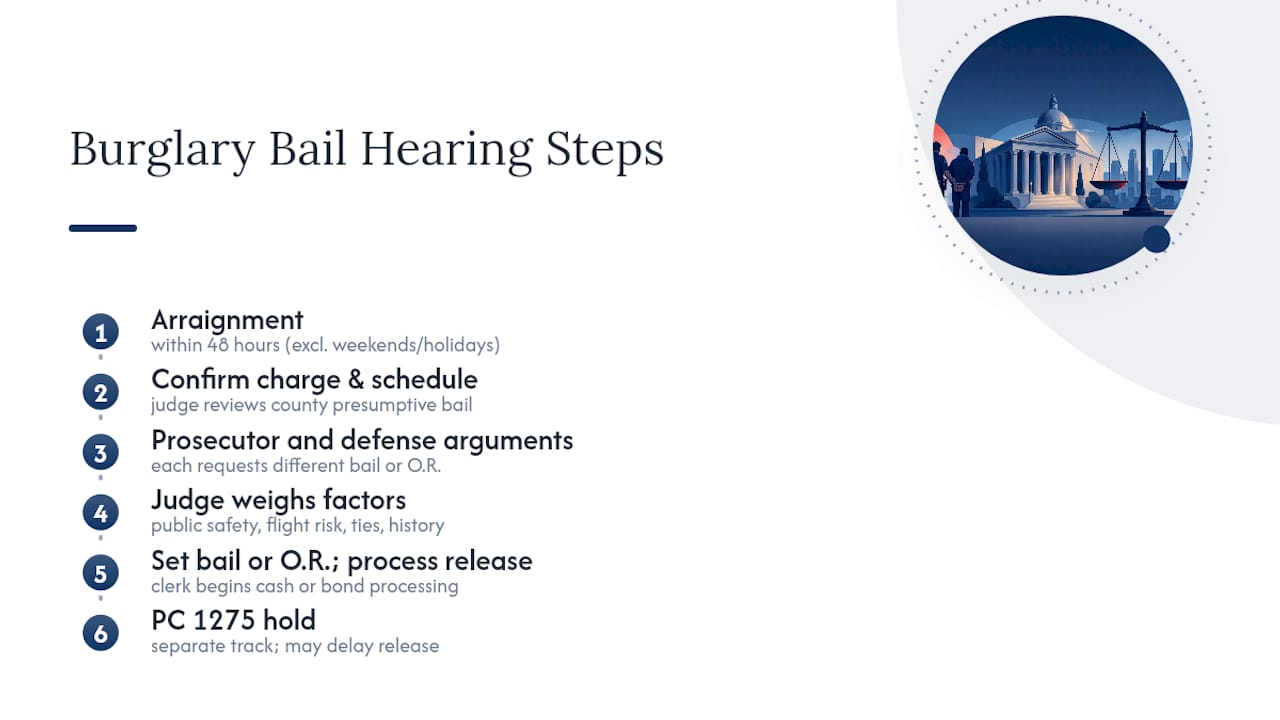
The judge then rules, often within minutes, factoring in public safety first, then flight risk, community ties, and criminal history. If a pretrial risk assessment score is available, some counties introduce it at this stage too. Once bail is set, the clerk or jail staff can begin processing a cash payment or a bail bond immediately. If a 1275 hold gets flagged during this same hearing, that process runs on a separate track and can delay actual release even after bail is technically "set."
Requesting a Bail Reduction or Modification After Arraignment
Bail doesn't have to stay fixed at whatever number gets set at arraignment. A defense attorney can file a motion for bail reduction at any point in the case, usually by requesting a separate bail review hearing before the same judge or a different one if the case gets reassigned.
The motion typically lays out what's changed or what wasn't fully presented the first time: new employment, a signed lease, a family member willing to supervise the defendant, or evidence undercutting the prosecutor's flight-risk argument. Judges are more receptive to a reduction request backed by concrete new documentation than to a request that simply repeats the original argument in different words.
Timing matters. A reduction motion filed quickly, while the original circumstances are still fresh, tends to move faster than one filed weeks into the case. Families working with a bail bondsman experienced with California courts often get a clearer sense of which judges in a given county are realistically open to a reduction request, since that varies more than people expect from courtroom to courtroom.
What to Do Right Now if Someone You Know Was Arrested for Burglary
The first call after a burglary arrest should go to whoever can confirm the exact bail amount fastest, which is often the jail's booking line or a licensed bail bond company that already has a relationship with that facility. Have the defendant's full legal name, date of birth, and the county of arrest ready before you call. That information lets a bondsman pull up the booking record and confirm the bail number in minutes rather than hours.
Once the amount is confirmed, a bondsman will walk you through what's needed to move forward: government-issued ID for the co-signer, proof of income or employment, and in some cases a small down payment depending on the bail amount and the company's payment plan options. None of this requires a lawyer to be involved yet, though contacting a defense attorney early is worth doing in parallel, especially if there's any chance a 1275 hold gets attached.
From confirmed bail amount to actual release, a straightforward case with no hold can move in as little as a few hours once payment and paperwork are in place. A case with a 1275 hold, enhancements, or a backed-up jail on a weekend can stretch to a day or more. Calling early, with the right information in hand, is the single biggest thing a family can do to shrink that window.
What a Licensed Bail Bondsman Actually Does for Burglary Cases
A licensed bail bond agent's job on a burglary case starts the moment a family calls, not after paperwork is already a mess. That means confirming the exact bail amount with the jail, checking whether a 1275 hold is attached before anyone shows up expecting a same-day release, and walking a co-signer through exactly what documentation the bond requires.
Licensed bail bond services are available statewide across all California counties, with 24/7 availability and bilingual support in multiple languages for families who need to move fast without a language barrier slowing anything down. That statewide reach matters specifically because burglary bail schedules and procedures differ so much county to county, as covered above. A bondsman who only knows one county's court calendar is at a real disadvantage the moment a case crosses jurisdiction lines.
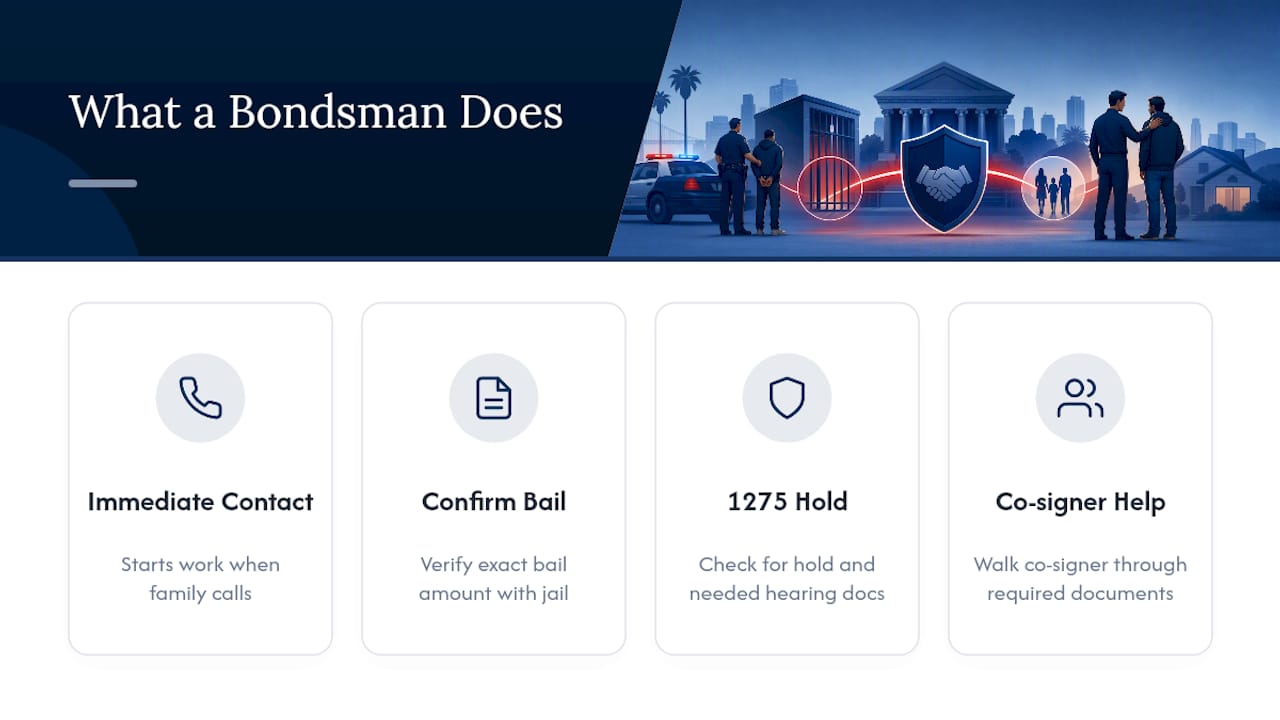
When a family calls about a burglary arrest, the right questions to ask a bondsman include: What's the confirmed bail amount for this specific charge? Is there a 1275 hold, and if so, what documentation will the hearing need? What are the payment plan options, and is there a qualified co-signer discount? A bondsman experienced with 1275 issues will also flag early whether an attorney needs to get involved on the funds-source question, since that hearing runs on its own track separate from the underlying criminal case.
None of this replaces a defense attorney's role in the actual criminal case. A bondsman's job is release logistics and speed. A good one treats those two things as equally serious.
— Jake
Get Fast Help With Burglary Bail Through Jake Hernandez Bail Bonds
You can talk directly to a licensed bail agent rather than a call-center operator, and that person can confirm your exact bail amount and start paperwork on the same call.
For a burglary arrest, that means access to felony bail bonds covering the higher presumptive amounts tied to residential burglary, along with $500 down bail bond options for families who can't front a full 10% premium up front. The standard premium is 10% of the total bail amount, with an 8% discount available for cases already retaining an attorney, and payment plans available for qualified co-signers. Bilingual support in Spanish, Hindi, and Arabic means language never becomes the reason a release gets delayed.
Free consultations run 24/7, whether the arrest happened at 3 p.m. on a Tuesday or 3 a.m. on a Sunday. Call to confirm the bail amount on your case, ask about a 1275 hold if you suspect one, and find out what a payment plan looks like for your situation. Start at Jakehernandezbailbonds or reach out directly to get a bond moving today.
This article is general information, not a substitute for advice from a qualified lawyer. Consult a qualified legal professional about your own circumstances before acting on anything here.
Sources
- FindLaw — California Penal Code §1275.1
- California Legislative Information — Penal Code (Bail provisions)
- Los Angeles Superior Court — Felony bail schedule (PDF)
- PPIC — Pretrial risk assessment in California
FAQ
What Is the Typical Bail Amount for Burglary in California?
Bail for residential, first-degree burglary commonly lands around $50,000 under sample county felony schedules like Los Angeles County's, while other burglary classifications often run lower. The exact number depends on the county, any enhancements, and whether the judge adjusts the schedule amount at arraignment.
What Is the Sentence for Burglary in California?
First-degree (residential) burglary is a felony that can carry a state prison sentence of two, four, or six years. Second-degree burglary can be charged as either a felony or misdemeanor, with sentencing that varies based on the specific facts and the defendant's prior record.
How Long Does Someone Stay in Jail for Burglary Before Release?
With no 1275 hold and bail set at arraignment, release can happen within hours once bail is posted through cash or a bond. A 1275 hold, enhancements, or a backed-up jail calendar over a weekend can push that timeline out to a day or longer.
How Bad Is a Burglary Charge Compared to Other Property Crimes?
Burglary is treated more seriously than simple theft because it involves unauthorized entry with intent to commit a crime inside, which is why bail amounts for residential burglary sit well above many other property offenses. Enhancements for weapons or an occupied home push both bail and potential sentencing higher still.
Can a Bail Amount for Burglary Be Reduced After Arraignment?
Yes. A defense attorney can request a bail reduction hearing at any point in the case by presenting new documentation, such as proof of employment or community ties, that supports a lower amount or O.R. release. Jake Hernandez Bail Bonds can also help families understand realistic bail options while that request moves through the court.