
Bail bond collateral requirements are the specific assets a bail agent accepts as security to guarantee a defendant's court appearances. Agents commonly accept cash, vehicle titles, real estate liens, jewelry, and stocks or bonds. The nonrefundable premium you pay the agent (typically around 10% of the bail amount) is separate from collateral and never comes back to you, regardless of the case outcome.
Three things to do before handing over anything:
- Confirm the agent is licensed through your state's Department of Insurance (California residents can verify at Insurance.ca.gov)
- Demand a written, numbered collateral receipt listing every item, its estimated value, the owner's name, and the return conditions.
- For cash above your state's threshold, require it be deposited into a trust account, not the agent's personal account.
- For real estate, insist on a lien filing, not a title transfer
Pro Tip: Never hand over any asset without a signed security agreement and a numbered receipt in hand. That document is your legal proof of ownership and your primary tool for recovering collateral after the bond is exonerated.
Table of Contents
- What types of collateral do bail agents accept?
- How do agents value and accept your collateral?
- How do state rules change what agents can accept?
- What is the step-by-step process for posting and recovering collateral?
- What will agents refuse, and what are the red flags?
- What are your options if you cannot pledge collateral?
- What are your legal rights when an agent holds your collateral?
- Key Takeaways
- What most people get wrong about collateral
- Fast, licensed bail bond help across California
- Useful sources to bookmark
What types of collateral do bail agents accept?
Collateral is any asset of value pledged to a bail agent to ensure the defendant appears in court. If the defendant skips, the agent can liquidate that asset to cover the forfeited bond. Here is what agents typically accept and what each requires.
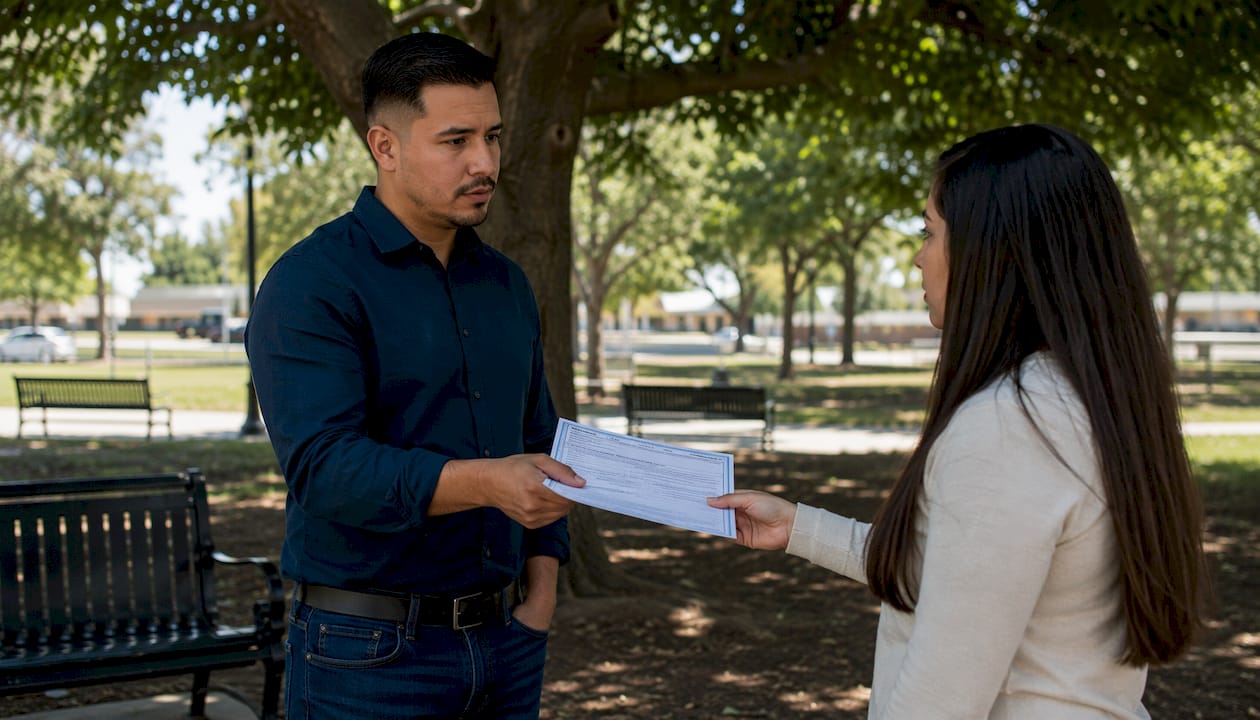
Cash and certified checks are the fastest and cleanest option. No appraisal needed, no title search. The tradeoff is liquidity risk: your money is tied up until the case resolves. For large amounts, funds are often required to go directly to the insurer via cashier's check or wire, then held in a segregated trust account.

Credit card authorizations work for smaller bonds. Many agents will run a charge or hold on a card to cover the premium and, in some cases, a portion of the bond exposure. Expect this option to disappear for bonds above roughly $10,000.
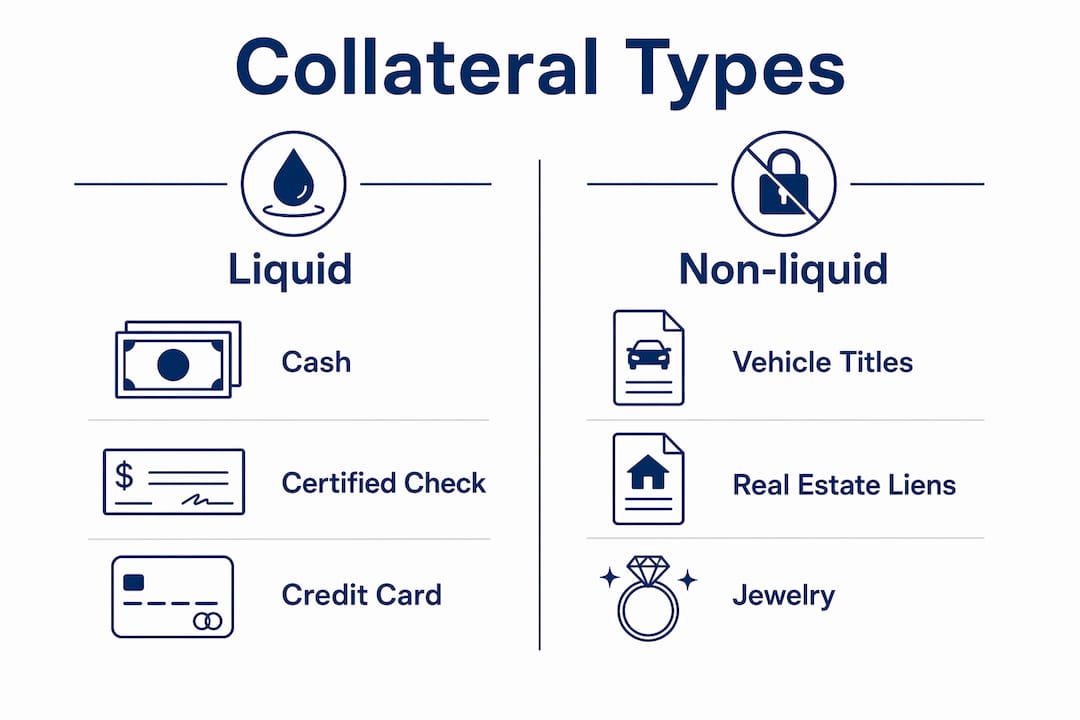
Vehicle titles are widely accepted. The agent holds the title as security while you keep driving the car. Valuation is typically based on Kelley Blue Book or a dealer quote, and you will need the title, current registration, and proof of insurance. A vehicle with a lien already on it may be rejected outright or accepted only if the unencumbered equity covers the bond.
Real estate is common for high-value bonds. Agents typically file a lien rather than demand a deed transfer, which protects your ownership while securing the insurer's interest. You will need a recent appraisal, a mortgage statement showing remaining balance, and a clear title search. The unencumbered equity must cover the bond amount after the agent's fee.
Jewelry and precious metals require a certified appraisal from a licensed appraiser. Agents will not accept your word on value, and most will discount the appraised figure to account for liquidation costs.
Stocks and bonds are accepted by some agents, typically with a current brokerage statement. Volatility is a concern, so agents often require a cushion above the bond amount.
| Asset class | Liquidity | Paperwork complexity | Key risk |
|---|---|---|---|
| Cash / certified check | High | Low | Funds tied up during case |
| Credit card authorization | High | Low | Charge-back exposure; limited to smaller bonds |
| Vehicle title | Medium | Medium | Lien or equity gap disqualifies it |
| Real estate | Low | High | Appraisal delays; encumbrance issues |
| Jewelry / precious metals | Low | Medium | Discount on appraised value |
| Stocks / securities | Medium | Medium | Market value fluctuation |
For bonds under roughly $10,000, many agents will only accept cash or a credit card charge. The paperwork overhead for a vehicle title or real estate lien simply does not make economic sense at that scale.
How do agents value and accept your collateral?
The process is more structured than most people expect. Agents are not just eyeballing your assets; they are running a checklist that protects both the insurer and, when done correctly, you.
Step-by-step, here is what happens:
- Ownership verification. The agent confirms you actually own the asset. For vehicles, that means the title matches your ID. For real estate, a title search or deed review. For securities, a brokerage statement in your name.
- Lien and encumbrance search. Any existing lien reduces usable equity. An agent will pull a lien search on real estate and check the vehicle title for outstanding loans.
- Valuation. Vehicles get a Kelley Blue Book or dealer quote. Jewelry and real estate require a certified appraisal. Stocks use the current brokerage statement value, often with a discount applied.
- Equity calculation. The agent subtracts existing liens from the appraised value. The remaining equity must cover the bond amount, sometimes with a buffer.
- Identity verification. You will show government-issued ID, and the agent may run a background check on the collateral source, particularly for large cash amounts. Under 18 U.S.C. §3142, courts can also inquire into the source of assets offered as collateral.
- Security agreement and receipt. Once accepted, the agent issues a written security agreement and a numbered receipt. The receipt must describe each item, state its value, name the owner, and spell out the return conditions.
When multiple assets are pledged together, agents treat them in aggregate. The combined unencumbered value of all pledged assets must meet or exceed the bond amount.
Pro Tip: Bring your own valuation evidence. A KBB printout, a recent appraisal, or a current brokerage statement speeds up the process and prevents the agent from undervaluing your asset. An independent figure gives you a baseline to push back on.
A good walkthrough of the paperwork side of this process is available in how bail paperwork gets completed, which covers the full documentation chain from agreement to court filing.
How do state rules change what agents can accept?
State law governs almost every detail of how collateral is accepted, held, and returned. The variation is significant enough that what works in one state may be refused or even illegal in another.
Key state-level rules to know:
- Montana caps collateral at 250% of the bond amount unless no other collateral is available. Cash must be deposited into an FDIC-insured trust account within five banking days. Collateral must be returned within five business days after exoneration. Before liquidation, the agent must give 30 days' written notice.
- New York guidance from the Department of Financial Services frames collateral as needing to be "commercially reasonable" relative to the bond amount.
- North Carolina caps aggregate collateral at the bond amount itself, meaning agents cannot stack collateral worth more than the bond.
- California residents should consult Insurance.ca.gov for state-specific guidance on licensed agents, permissible collateral, and complaint procedures.
| State | Collateral cap | Trust account required | Return timeline |
|---|---|---|---|
| Montana | 250% of bond | Yes (5 banking days) | 5 business days post-exoneration |
| North Carolina | — | Yes | Immediately after obligation discharged |
| New York | Commercially reasonable | Guidance-based | Per agreement |
| California | Per DOI guidance | Yes | Per DOI guidance |
How to look up your state's rules:
Search your state's Department of Insurance website using terms like "bail bond collateral regulations" or "surety bail agent rules." You can also search your state's administrative code directly. Most state DOI sites have a license verification tool so you can confirm an agent's standing before signing anything.
What is the step-by-step process for posting and recovering collateral?
Posting collateral follows a clear sequence. Knowing each step in advance prevents surprises and protects your assets.
Posting collateral:
- Sign the bail bond agreement and pay the nonrefundable premium.
- Submit collateral documents (title, appraisal, deed, brokerage statement) and sign the security agreement.
- Agent files the bond with the court and arranges the defendant's release.
- Collateral is held: cash in a trust account, real estate via a lien filing, jewelry or vehicle titles in the agent's custody.
How collateral is held:
- Cash goes into a segregated trust account, never commingled with the agent's operating funds.
- Real estate liens are filed with the county recorder; you keep possession of the property.
- Vehicle titles and jewelry are held physically by the agent or insurer.
Getting collateral back:
Once the court exonerates the bond (typically at case disposition), the agent's obligation ends. Under Montana's rules, return must happen within five business days of written exoneration notice. Ohio's statute similarly requires return within a set period after exoneration, per Ohio Revised Code §3905.92. Always request written confirmation of exoneration from the court and deliver it to the agent in writing to start that clock.
Warning: If the defendant fails to appear, the court issues a forfeiture order. The agent cannot begin liquidation immediately. Montana rules, for example, require 90 days after the forfeiture order before the agent can even send a liquidation notice, and then 30 more days' written notice to you before any sale. Many states impose similar windows. Know your state's timeline before you pledge high-value assets.
Understanding how bail forfeiture proceedings work is worth reading before you commit any significant asset.
What will agents refuse, and what are the red flags?
Some assets are disqualified from the start. Others look fine but carry hidden problems that surface during the lien search or appraisal.
Agents will typically refuse:
- Property with a contested or unclear title
- Assets already pledged as collateral elsewhere
- Real estate with insufficient unencumbered equity after existing mortgages
- Property in probate or subject to a court freeze
- Stolen property (and pledging it exposes you to criminal liability)
- Vehicles with outstanding loans that exceed their market value
Red flags in agent behavior:
- Asking you to deposit cash into a personal bank account rather than a trust account. State consumer protection guidance is explicit: collateral must be held in trust, not commingled with personal funds.
- Refusing to issue a numbered receipt or a written security agreement.
- Pressuring you to transfer a real estate deed rather than file a lien. Outright title transfer is prohibited or highly restricted in many states.
- No verifiable license number or refusal to provide insurer information.
If the defendant skips bail:
The court issues a forfeiture order. The agent then has a statutory window to locate the defendant and have the bond reinstated before liquidation begins. If that window closes, the agent follows the state's liquidation procedure: written notice to you, an opportunity to pay outstanding costs, and then a commercially reasonable sale. Any proceeds above the bond amount and allowable costs must be returned to you.
Pro Tip: Before signing anything, look up the agent's license on your state DOI website. In California, that is Insurance.ca.gov. A license number takes 30 seconds to verify and is the single fastest way to confirm you are dealing with a legitimate operation.
What are your options if you cannot pledge collateral?
Not everyone has a free-and-clear vehicle title or real estate equity sitting around. There are real alternatives, each with different cost and risk profiles.
- Pay the full cash bail directly to the court. No agent involved, no premium lost. The court returns the full amount at case disposition. The catch is you need the entire bail amount in cash, which for serious charges can be hundreds of thousands of dollars.
- Pay a licensed bail agent's premium only. You pay roughly 10% of the bail amount (some states cap it at 8%), the agent posts the bond, and no collateral is required if the agent is comfortable with the risk. The premium is nonrefundable. Use the bail bond cost calculator to estimate what this looks like for your bond amount.
- Use a cosigner with stronger credit or assets. If your own assets are insufficient, a creditworthy cosigner can pledge their collateral instead. The cosigner takes on the financial risk if the defendant fails to appear.
- Payment plans or 0% down promotions. Some licensed agents offer payment plans or low-down options for qualified cosigners, which reduces the upfront asset exposure. Jakehernandezbailbonds offers 0% down options for qualified applicants.
- Unsecured or signature bonds. In some cases, courts grant release on a defendant's own recognizance or on an unsecured appearance bond, requiring no cash or collateral at all. Eligibility depends on the charge, the defendant's history, and the judge's assessment of flight risk. Factors that influence this are covered in detail in what judges consider when setting bail.
Avoid informal "private bond" arrangements outside the licensed surety system. They offer no regulatory protections and no recourse if something goes wrong.
What are your legal rights when an agent holds your collateral?
The law treats bail agents as fiduciaries when they hold your assets. That is not just a courtesy; it creates enforceable legal duties.
What agents are legally required to do:
- Issue a written, numbered receipt for every item received, per Ohio Revised Code §3905.92 and similar statutes in most states.
- Hold cash collateral in a segregated trust account, never in operating or personal funds, as required by NAIC Chapter 19 guidance and state-level rules.
- Return collateral promptly after exoneration, in the same condition it was received.
- Follow commercially reasonable liquidation procedures with proper notice before selling any asset.
- Maintain records open to inspection by the state insurance commissioner.
Penalties for violations:
Montana's rules illustrate what enforcement looks like: an agent who wrongfully fails to return collateral or violates liquidation rules faces a penalty of up to three times the value of the collateral, or $1,000, whichever is greater. Other states impose license suspension, fines, or civil liability.
Your rights in plain terms: You are entitled to a numbered receipt before the agent takes custody of anything. You are entitled to collateral return after exoneration, within the timeline your state sets. You are entitled to written notice before any liquidation begins. If an agent violates any of these, file a complaint with your state's Department of Insurance.
Actionable checklist:
- Verify the agent's license number on your state DOI website before signing.
- Request and keep the signed security agreement and numbered receipt.
- After the case resolves, get written court confirmation of exoneration and deliver it to the agent in writing.
- If collateral is not returned within your state's statutory window, file a complaint with the state insurance commissioner.
Federal law also plays a role: under 18 U.S.C. §3142, courts can require collateral sufficient to assure appearance and may inquire into the source of any pledged property.
Key Takeaways
Bail bond collateral must cover the bond amount, be clearly documented with a numbered receipt and security agreement, and is returned after exoneration within a state-mandated timeline.
| Point | Details |
|---|---|
| Accepted collateral types | Cash, vehicle titles, real estate liens, jewelry, and securities are the most common options agents accept. |
| Valuation standards | Vehicles use Kelley Blue Book; jewelry and real estate require certified appraisals; securities use current brokerage statements. |
| State rules vary significantly | Montana caps collateral at 250% of the bond; North Carolina caps aggregate collateral at 100%; California guidance is at Insurance.ca.gov. |
| Collateral return timeline | Return is triggered by bond exoneration; Montana requires return within 5 business days; Ohio sets a similar fixed period under §3905.92. |
| Jakehernandezbailbonds | Licensed across all 58 California counties, with 0% down options and 24/7 support for families navigating collateral and bail. |
What most people get wrong about collateral
The biggest misconception I see is that collateral and the bail premium are the same thing. They are not. The premium is the agent's fee for taking on the risk. Collateral is the security that sits behind the bond. You lose the premium no matter what. You get the collateral back when the case ends, provided the defendant showed up.
The second thing people underestimate is how much leverage a written receipt gives them. Agents who resist issuing one are not cutting paperwork; they are removing your ability to enforce return. That receipt is the document you hand to a state insurance commissioner if the agent goes dark after exoneration. Without it, you are in a dispute with no paper trail.
The third thing worth saying plainly: a lien on real estate is not a loss of your home. It is a recorded security interest. You keep living there, keep paying the mortgage, and the lien is released when the bond is exonerated. The agents who push for a full deed transfer instead of a lien are the ones to walk away from.
Fast, licensed bail bond help across California
When a family member is in custody and the bond amount is significant, the last thing you need is a call center reading from a script. Jakehernandezbailbonds handles collateral-backed bonds from $1,000 to $1,000,000 across all 58 California counties, with a direct line to a licensed agent, not a middleman.
Payment plans and 0% down options are available for qualified cosigners, so pledging a vehicle title or real estate is not always necessary. The bail bond cost calculator shows you the premium versus collateral tradeoff in under a minute. Support is available 24/7, consultations are free, and bilingual service means nothing gets lost in translation when the stakes are high. Call or visit Jakehernandezbailbonds now to speak with a licensed agent and get the defendant home faster.
This article is general information, not legal advice. Bail bond rules vary by state and change over time. Confirm current requirements with your state's Department of Insurance or a licensed attorney before pledging assets.
Useful sources to bookmark
- Insurance.ca.gov — Bail Bonds: California's Department of Insurance page for verifying agent licenses, understanding state rules, and filing complaints.
- 18 U.S.C. §3142: The federal statute governing release conditions and collateral requirements in federal cases.
- NAIC Chapter 19 — Bail Bond Agents: Model regulatory guidance on fiduciary duties, trust accounts, and disclosure standards for bail agents.
- Montana Admin. r. 6.6.6003: One of the most detailed state rules on collateral caps, trust accounts, return timelines, and liquidation procedures. Useful as a benchmark even if you are not in Montana.
- Ohio Revised Code §3905.92: Ohio's statute on written receipts and collateral return timelines, a good example of statutory consumer protections.
- Kelley Blue Book (KBB): The standard reference for vehicle valuations when pledging a car title as collateral.
- Your state's Department of Insurance: Search "[your state] Department of Insurance bail bond" to find the license verification tool and complaint portal for your jurisdiction.