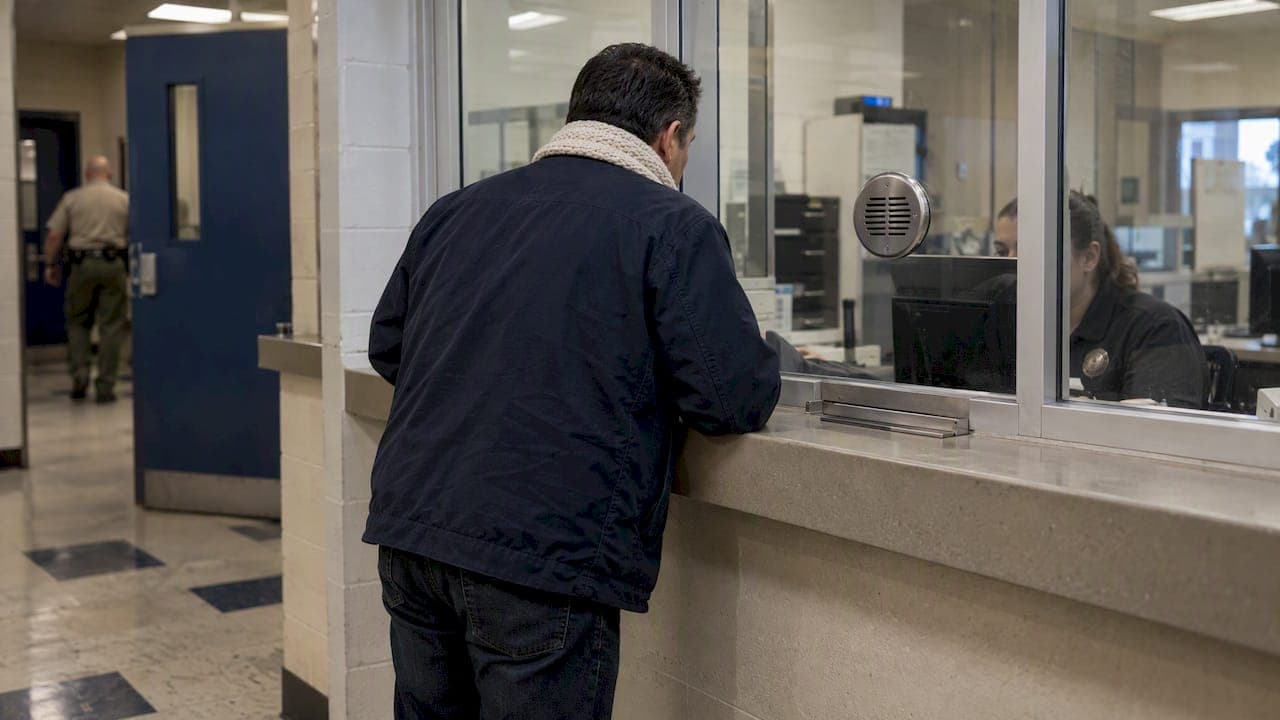
Bail for an evading charge in California depends on which section of the Vehicle Code the arrest falls under. A basic evading charge (VC 2800.1) is a misdemeanor. Reckless evading (VC 2800.2) can be charged as a felony, and the county bail schedule usually sets a much higher number. A bail bond lets a family post that bail for a fee of 10% of the amount. This guide covers how the charges differ, what bail looks like, what the bond costs, and what happens if the defendant later misses court or runs.
If someone you love is in custody right now, you can call us any time for a free consultation. Our line is open 24/7 across all 58 counties.
TL;DR
- Simple evading (VC 2800.1) is a misdemeanor. Reckless evading (VC 2800.2) is a "wobbler" that can be charged as a felony, so bail can differ by tens of thousands of dollars.
- Bail is set from the county's bail schedule, and a judge can later raise, lower or reduce it at a hearing. Ask about that before you pay a full amount.
- A bond premium is 10% of the bail amount. Attorneys get 8%, and the discount is applied automatically.
- Missing court after release can mean a forfeiture, a possible new felony charge and a bondsman legally allowed to arrest the defendant. Reaching out early gives you the most options.
- If the court issues a 1275 hold, the co-signer must prove the money is legitimate. Gather pay stubs and bank statements right away.
Table of Contents
- Which evading charge are we talking about?
- How bail is set for an evading arrest
- What a bond costs for an evading charge
- Steps to get someone out
- Perspective: what we see after an evading arrest
- What if the defendant misses court or runs again?
- When the court puts a 1275 hold on bail
- Other release routes to ask about
- Getting started with us
- FAQ
- Sources
Which evading charge are we talking about?
Three things get called "evading police" in California, and the difference drives the bail.
Misdemeanor evading, VC 2800.1. This is willfully fleeing or trying to elude a pursuing officer in a vehicle with lights and siren. According to the Vehicle Code summary in our research, the misdemeanor carries up to one year in county jail.
Reckless evading, VC 2800.2. If the driving shows willful or wanton disregard for the safety of people or property, the charge is a wobbler. Section 2800.2 lets prosecutors file it as a felony or a misdemeanor, with a fine between $1,000 and $10,000 and either state prison or county jail time.
Evading with injury or death, VC 2800.3. When the flight causes serious bodily injury, the prison term goes to 3, 5 or 7 years. When it causes death, it is 4, 6 or 10 years.
There is also a separate rule for driving the wrong way on a highway while fleeing. VC 2800.4 covers it, and prosecutors treat it seriously.
Running on foot is different again. Pedestrian cases are often charged under other sections, such as Penal Code 148 for resisting or delaying an officer. Ask the jail or the booking sheet which exact code sections are listed. The bond price follows the charge, so this is the first fact to pin down.

How bail is set for an evading arrest
Every county has a bail schedule. Booking staff look up the charge and the schedule gives a dollar figure. The schedule is the starting point, not the final word.
One example: a defense firm reports that the scheduled bail for reckless evading was $100,000 in San Bernardino County in 2023. Schedules change every year and vary by county. Los Angeles Superior Court publishes its 2026 felony bail schedule, effective January 1, 2026, so check the current version for the county where the arrest happened. Don't rely on a figure from an older article.
When a judge sets or reviews bail, the San Francisco Superior Court's bail fact sheet explains the factors. The court looks at public safety, the criminal record and the risk that the person will not return. After the In re Humphrey decision in 2021, a court generally cannot keep someone locked up only because they cannot afford bail. It must consider less restrictive options, such as electronic monitoring or supervised release, unless it makes specific findings that nothing else will work.
For families, that means two things:
- Ask whether the person qualifies for release on their own recognizance. Penal Code 1270 allows it for offenses other than capital ones. A prior pursuit or a past missed court date makes this less likely.
- If bail is high, a lawyer can ask for a reduction. Our guide to bail reduction hearing best practices in California explains what a judge wants to see.
A bail amount is not a fine. It is a guarantee that the defendant comes back to court. If they appear at every date, the court releases the bond, though the premium you paid to a bondsman is not refunded.
What a bond costs for an evading charge
The statutory premium is 10% of the bail amount, and we publish that on our bail bond cost page. Attorneys receive an 8% rate, applied automatically.
Here is the arithmetic on that San Bernardino example of $100,000 in scheduled bail:
| Bail amount | Standard premium (10%) | Attorney rate (8%) |
|---|---|---|
| $10,000 | $1,000 | $800 |
| $25,000 | $2,500 | $2,000 |
| $50,000 | $5,000 | $4,000 |
| $100,000 | $10,000 | $8,000 |
Those are calculations from the rates above, not a quote for your case. The real number depends on the county's schedule and any order from the judge.
We write bonds from $1,000 to $1,000,000. For qualified co-signers we offer 0% down options and payment plans, so a $10,000 premium doesn't have to come out of one paycheck. Our $500 down bail bonds page explains how a small first payment can work. Approval depends on the co-signer, so ask us about your situation.
Misdemeanor versus felony paperwork
The process is the same, but the amounts differ and felony cases often draw more questions from the court. We have separate pages for misdemeanor bail bonds and felony bail bonds. For a wobbler like VC 2800.2, tell us whether the booking sheet lists it as a felony or misdemeanor, because that changes the bail.
Steps to get someone out
- Find the booking details. You need the full name, date of birth, the jail holding the person, and the booking number if you have it.
- Confirm the charges and bail. Ask for the code sections, such as VC 2800.1 or 2800.2, and the bail amount. Some sheets list more than one charge, and bail adds up.
- Call a bondsman. We run a free consultation, and you can start the paperwork online if you can't get to an office.
- Sign as co-signer. The co-signer is responsible for making sure the defendant goes to every court date and for paying the agreed premium.
- Wait for release. Timing depends on the jail's processing. It can take several hours, sometimes longer.
- Write down every court date. Put them in a phone calendar and tell the defendant to confirm them with the court clerk.
Perspective: what we see after an evading arrest
We've written bail for families who thought a chase was the whole story, only to learn that the booking sheet had three or four charges attached. We tell people to slow down for ten minutes and read the sheet. A VC 2800.1 misdemeanor and a VC 2800.2 felony can be a world apart in bail and in how a judge will view the case.
The second thing we stress is that a co-signer's real job begins after release. The person who signs is promising the court appearance. If the defendant stops answering the phone, call us the same day, not after the court date. We would rather solve a problem in week one than in month five.
Third, we answer our own phone. You talk to the person who writes your bond, not a call center, and we speak Spanish, Hindi and Arabic. When a family is scared, they shouldn't have to translate.
— Jake
What if the defendant misses court or runs again?
This is the heart of the question for many readers: what happens when someone released on bail on an evading case does not show up?
Forfeiture is not automatic
Under Penal Code 1305, the court declares the bond forfeited if the defendant fails to appear without sufficient excuse. The court can choose not to declare a forfeiture if it has reason to believe an excuse exists, such as a hospitalization. If a forfeiture is declared, there is a 180-day window (plus 5 days if notice was mailed) in which the bail agent can find the defendant and return them to court. If that happens, the bond can be exonerated and the forfeiture vacated.
The statute also allows a motion to extend that period. Penal Code 1305.4 permits an order extending the 180 days when there is good cause.
A new criminal charge is possible
Separately from the bond, Penal Code 1320.5 makes it a felony to willfully fail to appear after release on bail with the intent to evade the court. The maximum fine is $10,000, and there may be jail or prison time. The law presumes intent to evade if the defendant doesn't appear within 14 days of the required date. That 14-day mark matters: a defendant who walks in quickly is in a very different position from one who disappears.
Our article on what happens if you miss a court date in California covers the practical steps. A defense attorney should be in the loop immediately.
Bondsmen can bring a defendant in
According to Penal Code 1301, a bail agent, or anyone who deposited money for the release, may arrest the defendant anywhere and at any time before the bond is discharged, in order to surrender them. The person arrested must be delivered to a jail or court within 48 hours. If that period ends on a weekend or holiday, the deadline moves to noon on the next business day. For how recovery works in practice, see our piece on fugitive recovery in California.
A voluntary surrender is almost always better. It protects the co-signer, can help the judge's view of the defendant, and ends the manhunt.
When the court puts a 1275 hold on bail
Some evading cases come with a complication: the court wants to know where the bail money came from. Under Penal Code 1275.1, bail can't be accepted unless a judge finds that none of the money used was feloniously obtained. If a judge or prosecutor has probable cause to believe it was, a 1275 hold blocks release until the source is shown, and the burden is on the defendant. If the court doesn't act on a filed declaration within 24 hours, the defendant must be released on posting the set bail.
The practical advice for co-signers is simple. Bring proof before anyone asks: recent pay stubs, bank statements, or loan documents. A slow response can cost days in custody. We handle these holds as a specialty. See our guides on how to clear a PC 1275 hold and the PC 1275 hold hearing, plus the no-bail hold steps for the first 24 hours.

Other release routes to ask about
A surety bond isn't the only option. A judge may allow release on one's own recognizance, supervised release or electronic monitoring, particularly after Humphrey. Our overview of how cash bail alternative programs work in 2026 describes what's out there. If a family has property, a property bond versus a surety bond is another route, though it is slower.
If the arrest happened in California but you live elsewhere, you can still arrange release. Read how to bail someone out of a California jail from another state.
Getting started with us
We're a licensed bail bond company covering all 58 California counties, with free consultations around the clock. If you have the booking details and the charges, we can walk you through the cost, co-signer requirements and payment plan options. Start at our main page, or look at felony bail bonds in Los Angeles County if the arrest was there. Attorneys and military families can ask about the discounts we offer.
We are not a law firm. We can explain the bond, but a criminal defense lawyer should advise on the evading charge itself.
FAQ
How much jail time can felony evading carry in California?
Reckless evading under VC 2800.2 is a wobbler, with state prison or county jail time and a fine from $1,000 to $10,000, according to the statute. If someone is seriously injured, VC 2800.3 raises the prison term to 3, 5 or 7 years. Only a defense attorney can tell you what a prosecutor is likely to file.
How long will someone stay in jail if bail isn't paid?
There is no fixed number. They can remain in custody until arraignment and any bail hearing, or until the case ends. After Humphrey, a court generally can't detain someone solely because they can't afford bail, so a lawyer should ask about reduction or release conditions.
Can the police still prove it was me if I got away?
That is a question for a criminal defense attorney, and it's best asked before speaking to police. Evidence can include video, plates and witness reports. Don't flee again or ignore a warrant: a failure to appear creates a separate problem.
Does the bail premium get refunded when the case ends?
No. The 10% premium is the fee for the bond service, and it is not returned even if the charges are dropped. Any collateral you pledged is a different matter and is handled according to your agreement.
Sources
- California Vehicle Code, Division 2, Chapter 4 (VC 2800 series)
- California Vehicle Code 2800.2
- California Vehicle Code 2800.4
- Evading Police: Law, Penalty & Defense (San Bernardino bail example)
- Superior Court of California, Los Angeles: 2026 Felony Bail Schedule
- San Francisco Superior Court bail fact sheet
- California Penal Code 1270
- California Penal Code 1305
- California Penal Code 1305.4
- California Penal Code 1320.5 (Article 10, Violations)
- California Penal Code 1301
- California Penal Code 1275.1