Call a licensed California bail agent right now. A licensed bail bondsman can operate statewide and often start paperwork immediately upon contact. Have the arrestee's full name, booking number, jail location, and bail amount ready, and be prepared to sign as co-signer. If a PC 1275 hold applies, expect one extra legal step before release, covered below.
TL;DR:
- Most bail bonds in California are posted within a few hours after payment and paperwork, but release times can vary depending on county and jail workload.
- Co-signers are responsible for guaranteeing the defendant's court appearances, potentially pledging collateral, and reimbursing costs if the defendant skips bail.
- A PC 1275 hold delays release until proof is provided that bail funds were obtained legally, with hearings scheduled within 24 hours and requiring documented evidence.
- The standard bail premium is a fixed percentage regulated by California law, with no hidden or unwarranted fees; always confirm the total cost before signing.
- Prompt communication and proper documentation are critical if a defendant misses court, leaves the state, or if a forfeiture is initiated, to mitigate financial and legal risks.
Table of Contents
- What Are the First Steps to Post Bail in California?
- How Does a California Bail Bond Actually Work?
- What Is a PC 1275 Hold and How Do You Challenge It?
- What Does a California Bail Bond Actually Cost?
- How Do You Pick a Licensed Bail Agent Under Pressure?
- What Happens After the Bond Is Posted?
- Legal Requirements and Licensing for Fugitive Recovery Agents in California
- What Are the Risks If a Defendant Fails to Appear?
- What Is the Typical Timeline If Someone Misses a Court Date?
- What Happens When a Defendant Crosses State Lines?
- What If the Defendant Can't Be Located?
- A Direct Word to Families Acting Right Now
- How Jake Hernandez Bail Bonds Gets You Through This Faster
- Sources
- FAQ
What Are the First Steps to Post Bail in California?
Getting someone out of a California jail fast comes down to sequence. Skip a step and you add hours, sometimes days, to a process that should move quickly.
- Call a licensed bail agent first, then a defense attorney if one is already retained. The agent handles the financial mechanics; the attorney handles the legal ones.
- Give the agent exact details: the arrestee's full legal name, date of birth, booking number, the jail facility, the arresting agency, and the bail amount set on the booking sheet.
- Bring your documentation: a government-issued ID, proof of your relationship to the arrestee (if requested), and information about income or collateral if the bond requires it.
- Settle payment terms: discuss the premium, any down payment option, and how soon the agent can post the bond once paperwork and payment are complete.
Most straightforward bonds move from phone call to jail release within a few hours once payment and paperwork clear, though release times shift by county and by how busy the jail is that day.
Pro Tip: Write down the booking number the moment you get it from the jail or arresting officer. Agents can't start the paperwork without it, and re-calling the jail for it later burns time you don't have.
How Does a California Bail Bond Actually Work?
A bail bond is a surety contract, not a loan. The bail agent posts a bond with the court guaranteeing the full bail amount, and in exchange, you (the indemnitor, or co-signer) sign a contract agreeing to specific obligations. The bail bond contract is the mechanism most families use instead of paying the full cash amount directly to the court.
The premium, generally a percentage of the total bail, is what you pay the agent for taking on that risk. Once the bond is posted and accepted by the court, this premium is typically treated as earned and is not refundable, even if the case resolves quickly or charges get dropped.
Signing as co-signer carries real weight. You're agreeing to:
- Guarantee the defendant shows up for every court date
- Potentially pledge collateral, such as a vehicle title or property, if the agent requires it for a larger bond
- Reimburse the bail company for costs if the defendant skips and the company has to locate them
- Stay reachable and cooperative with the agent throughout the case
Before signing anything, verify the agent's license number. California's bail industry runs under state oversight, and a legitimate agent will not hesitate to share that number or explain how premium rates and disclosures are supposed to work. Reading more about co-signer responsibilities before you sign gives you a clearer picture of what you're taking on.
What Is a PC 1275 Hold and How Do You Challenge It?
A PC 1275 hold freezes the release process because the court suspects the bail money came from illegal activity. Under Penal Code Section 1275.1, a judge can require proof that bail funds were legally obtained whenever there's probable cause to believe otherwise.
A peace officer, prosecutor, or judge can file the declaration that triggers the hold. Once filed, the court generally has to act within 24 hours, either scheduling a hearing or resolving the issue, rather than letting the defendant sit indefinitely.
At the hearing, the burden falls on the defendant (or whoever posted the funds) to show, by a preponderance of the evidence, that the money is clean. That's a lower bar than "beyond a reasonable doubt," but it still requires real documentation.
- Pay stubs or W2s showing legitimate income
- Bank statements showing a consistent, explainable balance history
- Loan documents or gift letters if the funds came from a loan or a relative
- Sworn affidavits explaining the source of funds when paper records are thin
If you're facing a hold, demand a copy of the declaration immediately, request a hearing date, and loop in both your attorney and your bail agent. Agents who have handled 1275 holds before often know exactly what documentation a particular courtroom expects, which can shave real time off the process.
What Does a California Bail Bond Actually Cost?
California regulates how bail premiums work, so the number you're quoted shouldn't be a guess. The standard premium is set by filed rates, and California Code of Regulations Title 10, Section 2081 spells out what agents can charge on top of that premium and under what circumstances.
- The premium itself, generally a percentage of the total bail amount
- Limited out-of-pocket expenses the regulation allows, such as travel costs in unusual cases
- No arbitrary "extra fees" tacked on without disclosure
The California Department of Insurance expects agents to disclose premium terms clearly on the bail undertaking itself. If an agent won't put the total cost in writing before you sign, that's a red flag worth walking away from.
Full premium and discount details vary by agent, so confirm the final number before you sign anything.
Pro Tip: If an agent quotes you a number well under the standard rate with no explanation, ask why. Rates are filed with the state for a reason, and a price that looks too good on paper sometimes hides fees elsewhere in the contract.
How Do You Pick a Licensed Bail Agent Under Pressure?
You don't have time for a long vetting process at 2 a.m., but a few fast questions protect you from a bad decision.
- Ask for the license number and confirm the agent is registered for oversight by the California Department of Insurance.
- Ask if they cover the specific jail and county where your family member is being held. Not every agent works every facility.
- Ask about experience with 1275 holds specifically, since not every agent handles that situation smoothly or quickly.
- Confirm availability, meaning true 24/7 response, not a voicemail that gets returned in the morning.
- Get every fee in writing, including the premium, any down payment structure, payment plan terms, and whether bilingual support is available if that matters for your family.
An agent who answers all five without hesitation is generally one you can trust to move fast without surprises later.
What Happens After the Bond Is Posted?
Release from custody usually follows within a few hours of the bond being posted and processed by the jail, though larger facilities can take longer during busy periods.
Once your family member is out, the obligations don't end. The court sets the calendar, and the bail agent has a direct financial interest in making sure every court date gets met, since a missed appearance puts the full bond amount at risk.
- Missing a court date can trigger bail forfeiture, meaning the court claims the full bail amount from the bond
- If forfeiture happens, the bail company may pursue recovery efforts, and any collateral pledged at signing can come into play
- Forfeiture can sometimes be set aside if there's a valid reason for the missed date, but that requires prompt legal action, not a wait-and-see approach
If a court date gets missed for any reason, illness, transportation failure, confusion about the date, contact your attorney and the bail agent immediately. The faster you communicate, the more options remain on the table.
Legal Requirements and Licensing for Fugitive Recovery Agents in California
Bail enforcement work in California sits under state-level licensing requirements administered through the California Department of Insurance, which oversees the bail industry more broadly. Agents who post bonds and, when necessary, coordinate on locating a defendant who fails to appear operate within a regulated framework rather than as freelance operators.
Licensing exists because bail work touches people's liberty and money at the same time. A bail agent needs a valid license to write bonds, and that license carries real consequences, fines, suspension, or revocation, if an agent violates state rules on disclosures, charges, or conduct.
For families and co-signers, the practical takeaway is simple: verify licensing before you sign anything. A licensed agent operates under a system of accountability. An unlicensed operator, or someone cutting corners on paperwork, does not, and that gap becomes your problem the moment something goes wrong with the bond or the case.
This is also why the co-signer contract matters so much. You're not just hiring a service, you're entering a regulated financial arrangement with a company the state has already agreed to hold to specific standards. That regulatory backing is part of what protects you if a dispute arises over fees, collateral, or contract terms down the line.
What Are the Risks If a Defendant Fails to Appear?
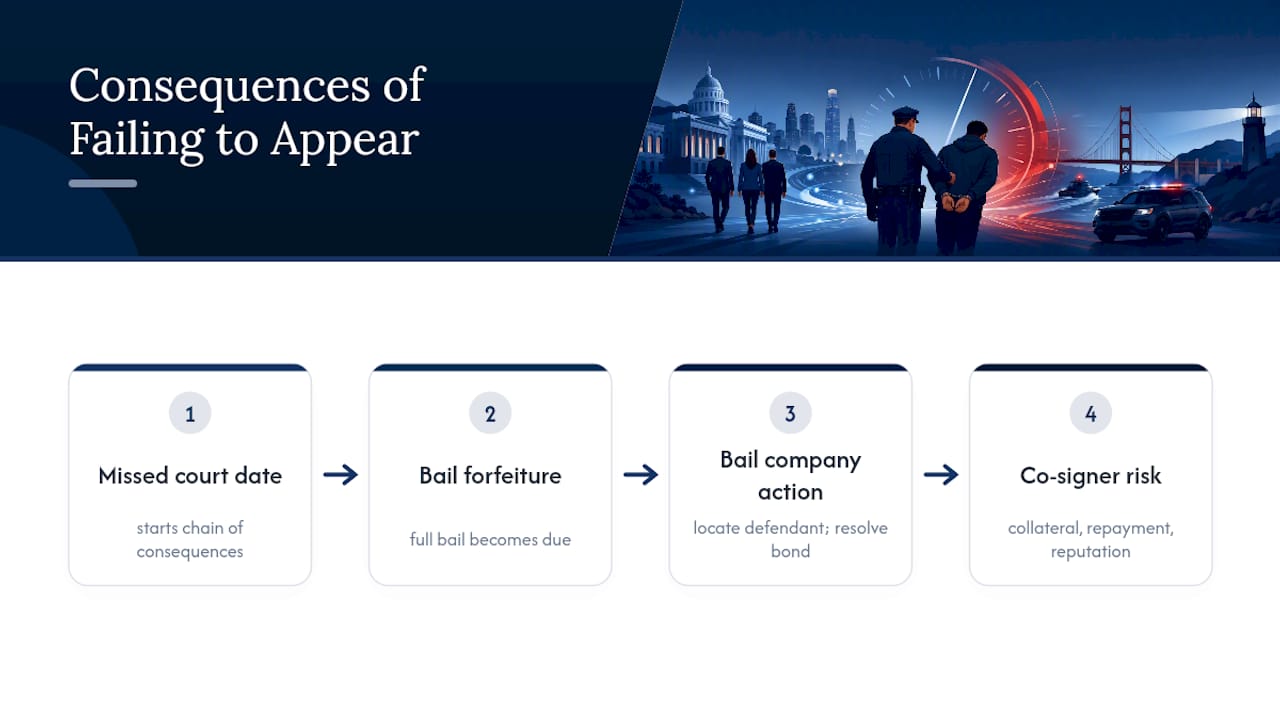
The single biggest risk in any bail bond situation is a missed court date. Once a defendant fails to appear, the clock starts on a chain of consequences that affects everyone connected to the bond, not just the person who skipped.
The court can order bail forfeiture, meaning the full bail amount becomes due. The bail company, which fronted that guarantee to the court, now has a financial stake in resolving the situation, and that often means locating the defendant and getting them back in front of a judge within a set window before the forfeiture becomes final.
For the co-signer, this is where the contract signed at the start becomes real. If collateral was pledged, a car, a piece of property, that collateral can be at risk. If reimbursement obligations were part of the agreement, the co-signer may owe money to cover costs the bail company incurs. This is exactly why the earlier point about reading the contract carefully, not just signing under pressure, matters so much.
There's also reputational and relationship risk that doesn't show up in any contract. Co-signing for a friend or family member means trusting them to show up, every time, for the life of the case. That's a real ask, and it's worth an honest conversation before you sign, not after a missed date puts everyone in a difficult position.
What Is the Typical Timeline If Someone Misses a Court Date?
The timeline from a missed appearance to a resolved case varies, but it generally follows a predictable shape. Understanding it helps a co-signer know what to expect and when to act.
Immediately after a missed date, the court issues a bench warrant and the bail company is notified. Most bail contracts include a grace period, often measured in days, during which the company and any recovery efforts work to locate the defendant and get them back into custody voluntarily before forfeiture becomes permanent.
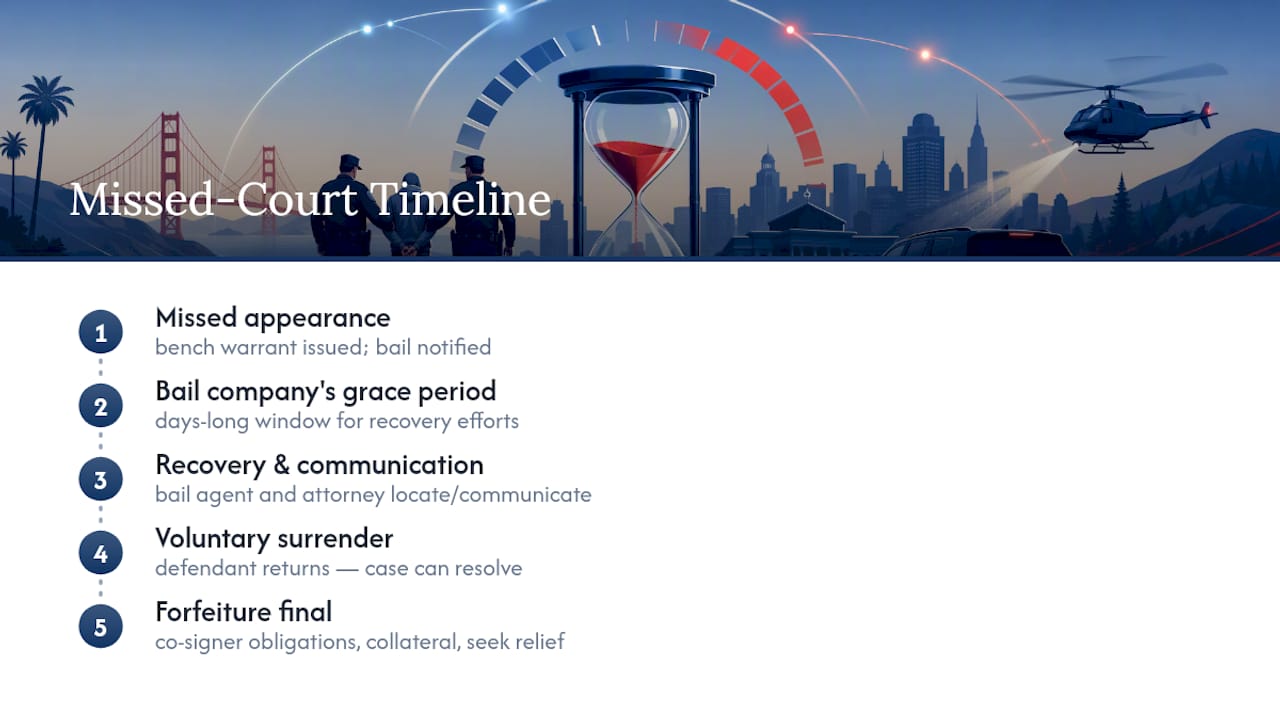
During that window, communication is everything. If you know where the person is, or have any information about why they missed the date, get it to your attorney and the bail agent immediately. A defendant who turns themselves in voluntarily during this window is in a far better position than one who has to be located and brought in.
If the window closes without resolution, the forfeiture can become final, and the bail company's financial exposure becomes real. At that point, the co-signer's contractual obligations, reimbursement, collateral, come into sharper focus. This is also when legal counsel becomes essential, since there may be grounds to petition the court for relief from forfeiture depending on the circumstances of the missed date.
What Happens When a Defendant Crosses State Lines?
A missed court date gets more complicated when the defendant leaves California. Bail bonds and bench warrants don't stop working at the state border, but the practical mechanics of coordination change.
Extradition becomes part of the conversation once a defendant is located out of state. California can request the return of a defendant through formal extradition processes, though the specifics depend on the severity of the charges and the cooperation of the other state's authorities. This process takes time, sometimes significant time, which extends how long a case stays unresolved.
For a co-signer, the interstate wrinkle doesn't change your underlying obligations under the bond contract, but it does mean patience matters more. A defendant who fled to a neighboring state is a different situation than one who fled the country, and the bail company's ability to act quickly depends heavily on where the person ends up and how much information is available about their location.
This is one more reason to be candid with your bail agent from day one about any concerns you have about the defendant's ties to other states, family elsewhere, or reasons they might leave. That information doesn't prevent someone from making a bad choice, but it helps the agent and attorney respond faster if it happens.
What If the Defendant Can't Be Located?
Sometimes a defendant simply isn't found within the standard grace period, and the case moves toward permanent forfeiture. This is the outcome nobody wants, but it's worth understanding what comes next.
Once forfeiture becomes final, the co-signer's financial exposure under the bond contract activates fully. Any collateral pledged at signing may be used to satisfy the obligation, and reimbursement terms in the contract become enforceable. This is the scenario the earlier warnings about reading your contract carefully were built around.
Legal counsel becomes critical at this stage. An attorney can evaluate whether there are grounds to petition the court for relief from forfeiture, particularly if there's a reasonable explanation for the defendant's absence or new information about their location surfaces later.
Staying in contact with your bail agent throughout this period matters too. Even after a grace period closes, communication with the company handling the bond can affect how aggressively they pursue remaining options, and it keeps you informed about your own financial exposure rather than finding out after the fact.
A Direct Word to Families Acting Right Now
If you're reading this at midnight trying to figure out what happens next, here's the honest version: speed and documentation are what move a bail case forward, not panic. A licensed agent who answers the phone directly, without routing you through a call center, and who can work in Spanish, Hindi, or Arabic if that's what your family needs, removes friction at the exact moment you can least afford it.
Gather the booking number, contact a licensed agent and an attorney in parallel, and keep every receipt and signed document. Those papers are your protection if any question comes up later about payment or contract terms.
— Jake
How Jake Hernandez Bail Bonds Gets You Through This Faster
Some bail bond services work with families directly across multiple California counties without call center intermediaries. That direct-line approach matters most in the hours right after an arrest, when every extra transfer or hold-time is time your family member spends sitting in a cell.
Coverage extends across felony and misdemeanor charges, plus federal and immigration bonds for cases outside standard county jurisdiction. Bilingual support in Spanish, Hindi, and Arabic means language never becomes another obstacle on top of everything else.
If you need to start the process right now, use the online bail bonds intake or call for a free consultation, available 24/7, to get the paperwork moving toward release today.
This article is general information, not a substitute for advice from a qualified lawyer. Consult a qualified legal professional about your own circumstances before acting on anything here.
Sources
- California Code, Penal Code - PEN § 1275.1 | FindLaw
- California Code of Regulations, Title 10, §2081 — Allowable charges (Cornell Law)
- Department of Insurance bulletin: 'Premium on undertaking of bail' (Bulletin No. 137)
- How Does Bail Work - Posting Bail in California - WK Law
- 1275 Hold - When The Court Seizes Your Bail Money (Shouse Law Group)
FAQ
How Fast Can Someone Get Out of Jail on Bail in California?
Release typically happens within a few hours of the bond being posted and processed, though timing varies by county and how busy the jail is at the time.
Is the Bail Premium Refundable If the Case Gets Dropped?
No. Once a bail bond is posted and accepted by the court, the premium is generally considered earned and is not refundable, regardless of how the case resolves.
What Should I Do If a PC 1275 Hold Is Placed on My Bond?
Request a copy of the declaration immediately, ask for a hearing date, and gather documentation like pay stubs or bank statements showing the funds were legally obtained.
Does Jake Hernandez Bail Bonds Handle 1275 Holds?
Yes. Jake Hernandez Bail Bonds has direct experience navigating PC 1275 holds and can coordinate with your attorney to request a prompt hearing.
What Does a California Bail Bond Cost?
Current pricing, including premium rates and available attorney discounts, is listed on the bail bond cost page.