
Cash bail alternative programs are systems that allow defendants to be released before trial without paying upfront cash, using validated risk assessments and tailored supervision conditions to ensure court appearance and community safety. These programs exist because the traditional cash bail system creates a two-tiered justice system where wealth determines freedom. More than 400,000 people sit in pretrial detention across the U.S. at any given time, the majority held not because they are dangerous, but because they cannot afford bail. Understanding how cash bail alternative programs work gives you a clearer picture of your rights and options before, during, and after a bail hearing.
How does the pretrial release process work with cash bail alternatives?
The process begins within hours of arrest. A Pretrial Services officer conducts an interview and gathers background information on the defendant, including employment history, community ties, prior criminal record, and any history of failing to appear in court. That information feeds directly into the release recommendation presented to the judge.
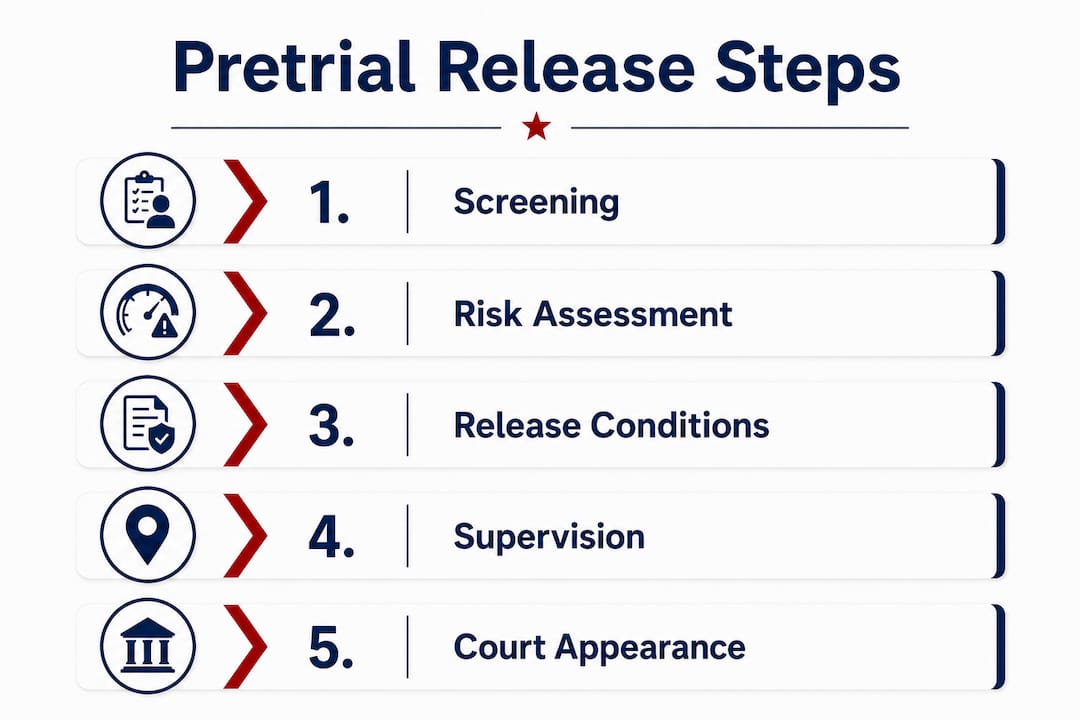
The procedural steps follow a consistent sequence in both federal and most state courts:
- Arrest and booking. The defendant enters the system and is assigned to a Pretrial Services officer.
- Pretrial Services interview. The officer collects personal and background data. This interview is voluntary, and statements made during it cannot be used to prove guilt at trial.
- Risk assessment. The officer runs the defendant's information through a validated risk tool to score flight risk and public safety risk.
- Detention hearing. A judge reviews the Pretrial Services report, hears arguments from both sides, and decides on release or detention. Under the Bail Reform Act, federal judges must focus on the least restrictive conditions that still protect community safety and assure court appearance. No preset bail amounts are used.
- Release plan presentation. Defense counsel presents an individualized plan that may include a custodian, verified employment, housing, and proposed supervision conditions.
- Release with conditions. If approved, the defendant is released under a specific set of requirements tailored to their risk level.
Pro Tip: Treat the pretrial hearing as an evidentiary opportunity. Defense attorneys who arrive with a documented release plan, including a named custodian and proof of employment, consistently achieve better outcomes than those who argue risk scores alone.
The judge's decision is not automatic. Factors like the nature of the charge, the defendant's history, and the quality of the proposed release plan all carry weight. Knowing what judges consider at this stage can meaningfully change the outcome.

What conditions and supervision do these programs involve?
Cash bail alternative programs replace a cash payment with a set of behavioral conditions. The range of possible conditions is wide, and courts are required to impose only what is necessary to manage identified risks.
Common release conditions include:
- Electronic monitoring. GPS ankle monitors track location in real time. Costs run $2 to $20 per day, and defendants often pay those fees themselves, which creates a real financial burden for low-income individuals.
- Travel restrictions. Defendants may be confined to a specific county, state, or region.
- Curfews. Set hours during which the defendant must remain at home.
- Regular check-ins. In-person or phone reporting to a Pretrial Services officer on a weekly or biweekly schedule.
- Drug and alcohol testing. Mandatory screening, often tied to treatment program enrollment.
- Mental health services. Referrals to counseling or psychiatric care when relevant to the case.
- Transportation assistance. Some community-based bail programs provide rides to court dates and service appointments to remove logistical barriers.
The principle guiding all of these conditions is "least restrictive." Courts are not supposed to pile on requirements beyond what the risk level justifies. Conditions can be modified over time as a defendant demonstrates compliance or as the case progresses, which reflects the flexibility built into non-monetary bail systems.
Pro Tip: If you or a family member is placed on electronic monitoring, document every check-in and keep receipts for monitoring fees. That paper trail supports a future motion to reduce restrictions.
The most consistently effective tool in any supervision program is also the simplest. Court date reminders, whether by phone, text, or mail, produce higher appearance rates than most electronic monitoring programs. That finding matters because it shifts the focus from surveillance to support.
How do risk assessment tools influence release decisions?
Risk assessment instruments are scoring tools that evaluate two primary questions: how likely is this defendant to miss a court date, and how likely are they to be arrested for a new offense before trial? Officers feed verified data into the tool and generate a score that accompanies the Pretrial Services report to the judge.
| Assessment Factor | What It Measures | Who Uses It |
|---|---|---|
| Flight risk score | Likelihood of failing to appear | Pretrial Services officers, judges |
| Public safety score | Risk of new arrest before trial | Judges, prosecutors |
| Criminal history data | Prior convictions, FTAs, open cases | All parties |
| Community ties | Employment, housing, family stability | Defense counsel, Pretrial Services |
Risk scores guide but do not bind judges. A judge can release a high-scoring defendant with strong community ties or detain a low-scoring defendant if specific evidence warrants it. That discretion is intentional and legally protected.
The accuracy of the data matters enormously. Errors in criminal history records, outdated information, or missing context can inflate a risk score and lead to unnecessary detention or harsher conditions. Defense counsel reviewing the Pretrial Services report before the hearing can catch those errors and correct them. The NAPSA Standards for pretrial justice emphasize evidence-based, fair decisions grounded in constitutional rights, and correcting factual errors in risk reports is central to that standard.
Bias is a documented concern with risk tools. Instruments built on historical arrest data can reflect systemic disparities in policing, which means defendants from over-policed communities may score higher not because they pose greater risk, but because they have had more contact with law enforcement. Courts and reform advocates continue to debate how to address this limitation.
What are the benefits and challenges of bail alternatives vs. traditional cash bail?
The core benefit of cashless bail options is straightforward. They remove wealth as the deciding factor in pretrial freedom. Under traditional cash bail, a defendant with $500 in savings and a $10,000 bail amount stays in jail. A defendant with the same charge and a wealthy family goes home. That disparity has no relationship to actual risk.
| Factor | Traditional cash bail | Cash bail alternatives |
|---|---|---|
| Release criteria | Ability to pay | Risk score and release plan |
| Pretrial detention driver | Financial capacity | Evidence-based risk evaluation |
| Court appearance support | None built in | Reminders, supervision, services |
| Supervision cost burden | Paid to bondsman | May fall on defendant (monitoring fees) |
| Flexibility | Fixed amount | Conditions can be modified over time |
Bail alternatives also produce measurable benefits for court systems. Defendants who receive support services, including reminders, transportation, and case management, show up to court at higher rates than those left to navigate the process alone. The third wave of bail reform research confirms that outcomes depend heavily on implementation quality and the availability of real support services, not just the removal of cash bail.
The challenges are real, though. Electronic monitoring fees can accumulate quickly, and a defendant paying $20 per day for months faces a significant financial strain. Some supervision requirements, like daily check-ins or strict curfews, can cost defendants their jobs. The goal of reducing burden while managing risk requires careful calibration that not every jurisdiction gets right. Understanding your bail hearing options before you walk into court gives you a real advantage.
Key Takeaways
Cash bail alternative programs replace upfront payments with evidence-based supervision conditions, and their success depends on accurate risk data, individualized release plans, and genuine support services rather than surveillance alone.
| Point | Details |
|---|---|
| Risk scores guide, not decide | Judges retain full discretion and can override any risk assessment score with sufficient reasoning. |
| Interview statements are protected | Pretrial Services interview statements cannot be used to prove guilt at trial, so informed participation benefits defendants. |
| Conditions are modifiable | Courts can reduce or eliminate supervision requirements as defendants demonstrate compliance over time. |
| Reminders outperform monitoring | Court date reminders produce more consistent appearance rates than electronic monitoring in most studied programs. |
| Data accuracy is critical | Errors in pretrial reports can inflate risk scores; defense review before the hearing is the primary safeguard. |
What I've learned watching bail reform play out in real cases
The debate over bail alternatives often gets framed as a binary: cash bail versus no bail. That framing misses the actual complexity. What I've seen, working with families across California, is that the quality of the pretrial hearing matters far more than the system type. A defendant who walks into a hearing with a documented release plan, a named custodian, and verified employment has a fundamentally different experience than one who doesn't.
The supervision conditions piece is where I see the most variation. Some programs genuinely support defendants with transportation, reminders, and case management. Others layer on electronic monitoring and daily check-ins that cost people their jobs within weeks. The difference between those two approaches is not philosophical. It is practical and it shows up in court appearance rates and case outcomes.
My honest concern with the current direction of reform is that removing cash bail without investing in support infrastructure just shifts the burden. A defendant on a GPS monitor paying $15 per day for eight months has paid $3,600 by the time their case resolves. That is not freedom. That is a different kind of financial pressure.
The best outcomes I've observed come when defense counsel treats the pretrial hearing as a full evidentiary proceeding, not a formality. Presenting a real release plan, correcting errors in the Pretrial Services report, and advocating for the least restrictive conditions that actually fit the risk level. That approach works regardless of whether the jurisdiction uses cash bail, alternatives, or a hybrid. If you want to understand how bail reduces jail time in practical terms, the answer almost always comes back to preparation.
— Jake
Jakehernandezbailbonds: California bail support when you need it most
When a family member is arrested in California, the window between booking and the bail hearing moves fast. Jakehernandezbailbonds operates 24/7 across all 58 California counties, with direct access to agents who know the local detention system and can explain your options without putting you on hold with a call center.

Whether the court sets traditional cash bail or the case involves a pretrial release program, Jakehernandezbailbonds provides free consultations, bilingual support, and bail bonds from $1,000 with 0% down options for qualified co-signers. If your loved one is held near a major facility, agents near Men's Central Jail and other detention centers are available around the clock for walk-in assistance. Call now for a free, no-pressure consultation.
FAQ
What is a cash bail alternative program?
A cash bail alternative program is a pretrial release system that replaces upfront cash payments with supervised conditions such as check-ins, electronic monitoring, or court date reminders, based on an individualized risk assessment.
Are pretrial Services interviews mandatory?
Pretrial Services interviews are voluntary. Defendants may decline without penalty, and statements made during the interview are generally inadmissible to prove guilt at trial.
Can release conditions be changed after they are set?
Yes. Courts can modify release conditions at any point during the pretrial period. Defendants who demonstrate compliance regularly file motions to reduce restrictions, and judges frequently grant them.
Do cash bail alternatives guarantee lower costs for defendants?
Not always. Electronic monitoring fees of $2 to $20 per day can accumulate into thousands of dollars over a long case, creating financial pressure comparable to traditional bail costs.
How does a risk assessment score affect a judge's decision?
Risk scores inform but do not control judicial decisions. A judge may release a high-scoring defendant or detain a low-scoring one based on the full record, the quality of the proposed release plan, and statutory factors under the Bail Reform Act.