
Robert Durst's bail hit $3 billion in 2004, the highest figure ever set in the United States, and an appeals court knocked it down to $450,000 within months. That pattern repeats across nearly every case on this list: a judge sets an eye-popping number, then a hearing, an appeal, or a collateral arrangement brings it back to earth.
Here are the headline figures worth knowing:
- Robert Durst — bail famously set extremely high initially, then reduced significantly on appeal
- Antonio Willis — $4 billion set by a Texas justice of the peace (2017), reduced to $150,000
- Sam Bankman-Fried — $250 million personal recognizance bond secured by his parents' home, later revoked
- Raj Rajaratnam — a large bond amount set due to flight risk concerns
- Michael Milken — $250 million, reduced after collateral was posted against his home
- Kim Freeman — reported $1 billion figure with limited public court documentation
- Donald Trump — high figures reported in civil proceedings, distinct from criminal bail amounts
- Bernie Madoff — $10 million bond secured by his Manhattan penthouse before eventual detention
- Marcus Schrenker — bail related to fraud and flight risk concerns following a staged incident
The takeaway across all of them: courts rarely let record-setting numbers stand. Most get challenged, reduced, or replaced by a collateral arrangement within weeks.
Key Takeaways
Extreme bail figures almost always get challenged, reduced, or restructured through collateral, which means the opening number rarely predicts the final cost of release.
| Point | Details |
|---|---|
| Record bail gets reduced | Durst's $3 billion fell to $450,000 on appeal, the widest swing in U.S. bail history. |
| Symbolic bonds don't hold | Willis's $4 billion dropped to $150,000, showing local magistrates sometimes set unrealistic figures. |
| Nebbia hearings matter | Courts can reject bail funds unless a defendant proves legitimate source through bank and tax records. |
| Premiums scale predictably | State bonds run around 10%, federal bonds around 15%, regardless of the total bail amount. |
| Local help exists | Jakehernandezbailbonds offers 0% down options and 24/7 bilingual consultations for bonds statewide in California. |
Table of Contents
- Examples of High-Value Bail Bond Cases That Made Legal History
- What makes a judge set bail in the millions or billions?
- How families actually post bond on a massive bail figure
- What a licensed bondsman does when the bail number is enormous
- Why the "biggest bail ever" headlines miss the real story
- Getting Help When Bail Feels Impossible to Manage
- Sources
Examples of High-Value Bail Bond Cases That Made Legal History
These profiles trace what actually happened after the gavel came down, not just the headline number.
-
Robert Durst (2003–2004). Charged with murder in the killing of his neighbor, Durst faced $1 billion per count across three felony counts, a figure the trial court justified almost entirely on flight risk. Durst had already fled Texas and lived under an assumed identity before his arrest, which gave the judge unusual grounds to go extreme. The 14th Court of Appeals disagreed with the magnitude, cutting the total to $450,000. It remains the largest bail amount in American history, even after the reduction.
-
Antonio Willis (2016–2017, Texas). A justice of the peace set Willis's bond at $4 billion in a murder case, a figure so far outside normal bail schedules that legal commentators called it symbolic rather than functional. No defendant could realistically post that amount, which is exactly the point local magistrates sometimes make: the number signals the severity of the charge more than a genuine flight-risk calculation. It was reduced to $150,000 after Willis's attorney challenged it.
-
Sam Bankman-Fried (2022). The FTX founder was released on a $250 million personal recognizance bond secured by his parents' Palo Alto home rather than cash. No money changed hands upfront. That structure works when a defendant's family has substantial home equity and a court trusts the arrangement, but it comes with strings: after allegations of witness tampering surfaced, the court tightened his conditions and eventually revoked the bond entirely, sending him into pretrial detention.
-
Donald Trump. Reporting around certain civil matters has cited large security or bond figures in the hundreds of millions, but those numbers stem from civil judgment appeal bonds, not criminal bail. The distinction matters. Criminal bail addresses flight risk pending trial. A civil appeal bond guarantees payment of a judgment while an appeal proceeds. Conflating the two produces some of the more misleading "biggest bail" claims circulating online.
-
Raj Rajaratnam. The Galleon Group founder faced a $100 million bond in his insider-trading case. Prosecutors argued that his wealth and international business ties made him a genuine flight risk, a common argument in white-collar prosecutions where the defendant has assets and connections outside the country. The bond was posted and Rajaratnam remained free pending trial, then began serving an 11-year sentence after conviction.
-
Michael Milken. The junk-bond financier's bail was initially set at $250 million, later reduced after his legal team arranged collateral tied to his home and other assets. Milken's case became a template for how wealthy white-collar defendants secure release: not with cash, but with real property pledged against the bond.
-
Kim Freeman. Media reports cite a $1 billion bail figure, but public court records for the case are sparse compared to Durst or Willis. That gap is worth noting on its own: extremely high bail for nonviolent offenses is rare, and when documentation is thin, it is worth treating the figure with more caution than the Durst or Willis numbers, which are backed by appellate records.
-
Bernie Madoff. Rather than an astronomical bond figure, Madoff's release involved a $10 million bond secured by his penthouse, with electronic monitoring and travel restrictions. He was later denied bail pending sentencing after prosecutors argued the scale of his fraud made flight a serious concern.
-
Marcus Schrenker. After staging a plane crash to fake his own death and evade fraud charges, Schrenker's bail proceedings reflected how a demonstrated flight attempt, not just the dollar value of alleged fraud, can override standard bail calculations entirely.
What makes a judge set bail in the millions or billions?
Judges weigh a short list of factors, and courts have repeatedly explained their reasoning in these high-profile rulings.
- Flight risk. A defendant with resources, foreign contacts, or a demonstrated history of fleeing (like Durst) gets treated differently than a first-time defendant with local ties.
- Access to assets. Courts assume that wealthy defendants can post almost any bond, so some judges scale the number to match net worth rather than typical bail schedules.
- International connections. Passports, dual citizenship, and offshore accounts push bail upward because they widen the defendant's options for disappearing.
- Severity of the alleged offense. Murder and large-scale fraud cases draw higher bail than lesser felonies, independent of flight risk.
- Prior record and history of compliance. A defendant who has skipped court before faces a steeper number almost automatically.
The Eighth Amendment bars "excessive" bail, and that single word has generated decades of litigation. Defense attorneys can request a bail-reduction hearing at almost any point after arraignment, and appellate courts frequently step in when a number looks punitive rather than protective. Legal experts note that bail is meant to secure appearance in court, not to punish a defendant before conviction, which is the core argument behind most successful reduction motions.
Very large cash or asset postings also trigger Nebbia hearings, where the court examines whether the money offered as bail actually came from a legitimate source. If a defendant tries to post bail with funds a prosecutor believes are proceeds of the alleged crime, the judge can reject them outright, regardless of the amount. Judges look at what factors drive a bail decision well beyond the headline number.

Pro Tip: Before a Nebbia hearing, gather bank statements, tax returns, and pay stubs covering at least the past two years, along with a written explanation for any large or irregular deposits. Judges who see organized documentation up front tend to move faster than judges left to guess.
How families actually post bond on a massive bail figure
Nobody pays $250 million in cash. Real postings on cases like these rely on three structures: surety bonds (a bondsman guarantees the full amount for a percentage fee), property bonds (real estate pledged as collateral, typically requiring equity worth 1.5 to 2 times the bail amount), and percentage or deposit bonds accepted directly by some courts.
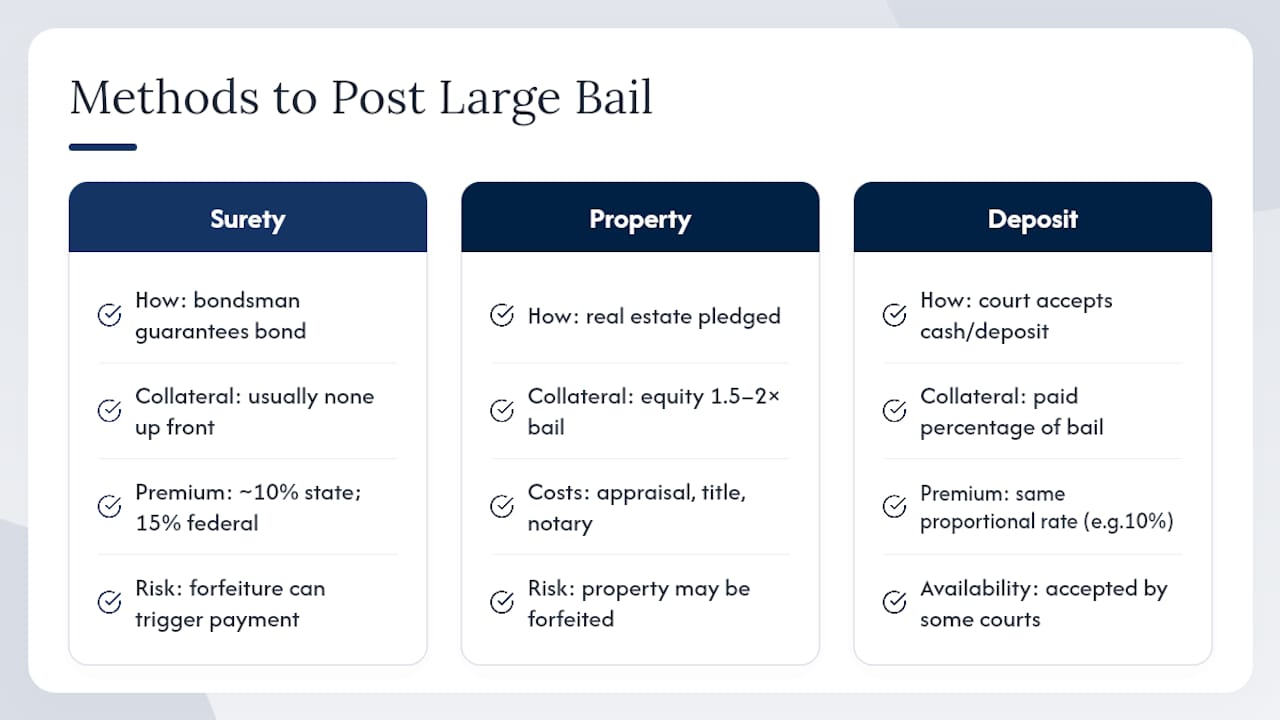
Premium rates differ by jurisdiction. Most state cases run around a 10% premium, while federal bonds commonly carry a 15% premium because sureties take on more exposure and stricter underwriting. On a $25,000 bail, that translates to a $2,500 premium, a number that scales the same way, proportionally, even at nine-figure levels.
Posting bond on a large figure also means budgeting for appraisals, title searches, and notarization on any property offered as collateral, plus the time those steps add to an already stressful process. Co-signers should understand the risk clearly: if the defendant skips a court date, the forfeiture process can put pledged property or the full bond amount on the line, not just the premium already paid.
What a licensed bondsman does when the bail number is enormous
When a family calls about a bail figure in the six or seven figures, the first move is a free consultation to confirm what type of bond the court will actually accept. From there, the priority shifts to Nebbia preparation: pulling bank records, tax filings, and proof of income before the hearing, not after.
A defendant with a legitimate, well-documented source of funds moves through a Nebbia hearing in days. A defendant who shows up with no paperwork can lose weeks waiting on a judge who wants proof the money is clean.
Collateral options get identified early, whether that's a vehicle title, home equity, or a co-signer's assets, and a bond cost calculator helps families see the real premium before committing to anything.
Why the "biggest bail ever" headlines miss the real story
The number that makes headlines is almost never the number anyone pays. Durst's $3 billion, Willis's $4 billion, these figures existed for weeks, sometimes days, before appeals or reduction hearings brought them back into the range of something a real person or family could conceivably arrange. Treating the headline figure as the defining fact of the case misses what actually determines the outcome: whether the defense moved fast on a reduction motion, whether the funds offered passed Nebbia scrutiny, and whether the underlying flight-risk argument held up under review.
The conventional advice, "just wait and see what the judge decides," undersells how much a defense team can influence the number through documentation and timing. Families who show up to a bail hearing with financial records already organized get better outcomes than those who scramble afterward. That single habit, preparation before the hearing rather than after, separates cases that resolve in days from ones that drag on for weeks.
If there's one lesson from Durst, Willis, and Milken, it's that an extreme opening number is a starting position, not a final one. Treat it that way.
Getting Help When Bail Feels Impossible to Manage
Most of the cases above involved legal teams, appellate motions, and enormous personal wealth. Most families never deal with a billion-dollar figure, but they face the same core problem on a smaller scale: a bail number that feels impossible to raise fast enough to matter. That's where a licensed bondsman earns their keep, not by making headlines, but by getting someone out of custody before a job, a family, or a court date gets derailed.
Jakehernandezbailbonds handles bonds from $1,000 up to $1,000,000 across all 58 California counties, with 0% down options and payment plans for qualified co-signers. Free consultations run 24/7, in English, Spanish, Hindi, and Arabic, and the team handles federal and immigration bonds along with complex 1275 holds where a Nebbia hearing might apply. There's no call center standing between you and a licensed agent who actually answers the phone. If you're staring at a bail amount that seems unmanageable, start with the bail bond cost calculator to see real numbers, or call for a free consultation through Jake Hernandez Bail Bonds to find out what release actually looks like in your case.
Sources
- What is the highest bail ever set in U.S. history? — LegalClarity
- Bigger in Texas: $4 billion bond set in murder case — USA Today
- How Sam Bankman-Fried's $250 million bail compares to huge bonds — Business Insider