When a minor gets transferred to adult criminal court in California, the fastest way to secure release is calling a licensed bail bondsman who works statewide, like Jake Hernandez Bail Bonds. That transfer order is the legal switch that flips a juvenile case into adult-style bail eligibility. Skip to the next section for the exact calls to make in the first hour.
TL;DR:
- The transfer to adult court triggers the ability to post bail on the same terms as an adult, but this only applies after the transfer order is issued and verified.
- Contact should be made by the arrestee, their attorney, or an adult family member or friend, as agents are prohibited from soliciting directly.
- Having the minor’s full name, booking number, arresting agency, facility, charges, and bail amount ready cuts down processing time significantly.
- Bail can be posted within hours once the bond is approved and paperwork is processed, but delays often occur from facility backlogs or transfer-related issues.
- Using a licensed bondsman with statewide coverage and flexible payment options accelerates release, especially when working with families in unfamiliar counties.
Table of Contents
- What Do You Do First for Juvenile Bail in California?
- How Does Transfer to Adult Court Change Bail Eligibility?
- How Do Bail Bonds Work in California?
- How Jake Hernandez Bail Bonds Can Help Right Now
- What to Have Ready Before You Call
- How Do You Hire a Licensed Bondsman?
- What Complicates Bail for a Juvenile Charged as an Adult?
- Are There Alternatives to Posting Cash Bail?
- Why Families Miss the Real Turning Point in These Cases
- Get Help From a Licensed California Bail Agent Now
- Sources
- FAQ
What Do You Do First for Juvenile Bail in California?
The clock matters. Every hour a juvenile sits in an adult holding facility is an hour a licensed bondsman could be working the case instead.
Who can legally make the call. Under California's bail bond regulations, only the arrestee, the arrestee's attorney, or an adult friend or family member can reach out to a licensed bail agent — agents themselves are barred from soliciting business. That means a parent, aunt, older sibling, or the family attorney can start the process. A stranger cannot.
Information to gather before you dial anyone:
- Full legal name and date of birth of the minor
- Booking number (the jail assigns this on intake)
- Arresting agency (LAPD, a sheriff's department, a specific police department)
- Name and county of the holding facility
- Known charges, and the bail amount if one has already been set
Then work the sequence in this order:
- Call the attorney first, if one is already retained. They may know the transfer status and any bail figure a judge already entered.
- Call a bail bondsman next, even before the attorney call finishes. Bondsmen can start paperwork while you're still gathering facts.
- Confirm details directly with the jail or the court clerk handling the case, since county-adopted bail schedules determine the exact figure and only the court can verify it.
- Arrange payment and cosigner details once the amount is confirmed.
Once a bond is posted, release can happen within a few hours, though processing time varies by facility depending on paperwork backlog, shift changes, or transfers between holding locations.
Pro Tip: Call the jail's booking desk directly and ask which specific unit "processes" bail paperwork — some facilities separate booking from release processing, and asking for the wrong desk can cost you 30 minutes you don't have.
How Does Transfer to Adult Court Change Bail Eligibility?
A transfer order is the legal event that unlocks adult bail. Once a juvenile court judge transfers a minor to a court of criminal jurisdiction, that minor becomes entitled to release on bail under the same terms as an adult charged with the identical offense, per Welfare and Institutions Code Section 707.1. Before that order, standard adult bail bonds generally don't apply. After it, they do.
Three things to confirm the moment you learn a transfer has happened:
- Which court now holds the case. The file moves from juvenile court to a criminal division, and the case number often changes.
- Whether a judge already set a bail amount. Some transfer hearings include a bail-setting decision on the spot; others leave it for a separate hearing.
- The exact case number. A bondsman can't quote or process anything without it, so get it in writing from the clerk if possible.
If counsel hasn't already raised it, ask directly whether an own-recognizance release or a bail reduction motion makes sense given the minor's ties to the community and the specific charge. That's a conversation for the attorney, but it costs nothing to ask early.
How Do Bail Bonds Work in California?
A bail bond is a surety bond. A licensed agent, backed by an insurance company, guarantees the full bail amount to the court so the family doesn't have to pay it in cash. The California Department of Insurance regulates every agent who does this work, and agents operate under Insurance Code and Title 10 regulations that govern licensing and conduct.
Here's what families typically encounter:
- Premium. Bondsmen commonly charge a nonrefundable premium around 10% of the bail amount, though some offer a reduced rate near 8% when a referring attorney is involved. Treat these as figures to confirm directly with the agent, not fixed guarantees.
- Collateral. Higher bail amounts or higher flight-risk assessments sometimes require collateral, like property or a vehicle title. If the defendant skips court, collateral can be seized to cover the forfeited bond.
- Cosigner liability. Whoever signs as indemnitor is financially responsible for the full bond amount if the defendant fails to appear. That's a real legal and financial exposure, not a formality.
- County bail schedules. Bail amounts differ by county and by charge because each county's judges adopt their own bail schedule. A robbery charge in one county may carry a different scheduled amount than the same charge two counties over. Check what a bail schedule means before assuming a figure from another case applies to yours.
Once the bondsman submits the bond, jail clerks and court officers are authorized to accept it and must transmit it to the court, and the defendant is discharged as to that offense once it's processed.
How Jake Hernandez Bail Bonds Can Help Right Now
Licensed bail bondsmen with broad coverage matter when a transfer hearing happens in an unfamiliar county and you need someone who already knows the local jail's procedures.
A few practical advantages for a family in this exact situation:
- Bonds range across a wide spectrum to cover varying amounts, from smaller juvenile-related charges to higher bail amounts tied to serious adult-court transfers.
- Some agents may offer low or no upfront down payment options and payment plans for qualified cosigners, which can help families facing unexpected legal emergencies with limited cash on hand.
- Bilingual support in multiple languages can help families navigating a stressful process in a second language.
- Working directly with an agent, rather than routing through a call center, tends to cut down on the back-and-forth that slows other bail companies down.
Before calling, check the full list of California jails covered to confirm the facility is in network, and use the bail bond cost calculator to get a rough premium estimate before you're on the phone. Free consultations mean there's no cost to just asking questions first.
What to Have Ready Before You Call
Have this ready before you dial the bondsman or the jail. It saves real time.
- Minor's full name, date of birth, and booking number
- Arresting agency and the name of the holding facility
- Known charges and case number, if the transfer hearing already assigned one
- Cosigner's government ID, proof of employment or residence
- Property deed or vehicle title, if collateral becomes necessary
- A payment method: cash, debit or credit card, or a request for a payment plan
Pro Tip: Take a photo of the booking slip if the jail gives the family one at intake — it usually has the booking number and facility name printed exactly as the bondsman needs it, which avoids spelling errors that can delay processing.
If collateral looks likely, review what collateral actually involves so there are no surprises about what happens if a court date gets missed.
How Do You Hire a Licensed Bondsman?
Start by confirming the license. California requires bail agents to carry state licensing through the Department of Insurance, and any legitimate agent will give you a license number without hesitation. Ask for it before you share any personal details.
Next, ask specific questions: What's the premium rate, and does it change based on the referral source? Is collateral required for this specific bail amount? What's the estimated release timeline once the bond is submitted? A bondsman who can't answer these clearly is a red flag.
Required documents typically include:
- Cosigner's photo ID and proof of address
- Cosigner's proof of income or employment
- Case details: booking number, charges, court, and case number
- Collateral paperwork, if the bail amount requires it
The approval process moves fast once documents are in hand. Most agents run a quick background and financial check on the cosigner, confirm the bail amount with the court, prepare the bond paperwork, and submit it to the jail or court clerk for processing. Attorney involvement early in the case can sometimes help on the premium side and can also support a parallel request for bail reduction or own-recognizance release, which is worth raising with counsel even while the bond process moves forward.
Expect the whole hiring conversation, from first call to signed paperwork, to take well under an hour if all the documents are ready.
What Complicates Bail for a Juvenile Charged as an Adult?
Bail approval for a transferred juvenile isn't always as straightforward as a standard adult case. A few things tend to slow it down or complicate it.
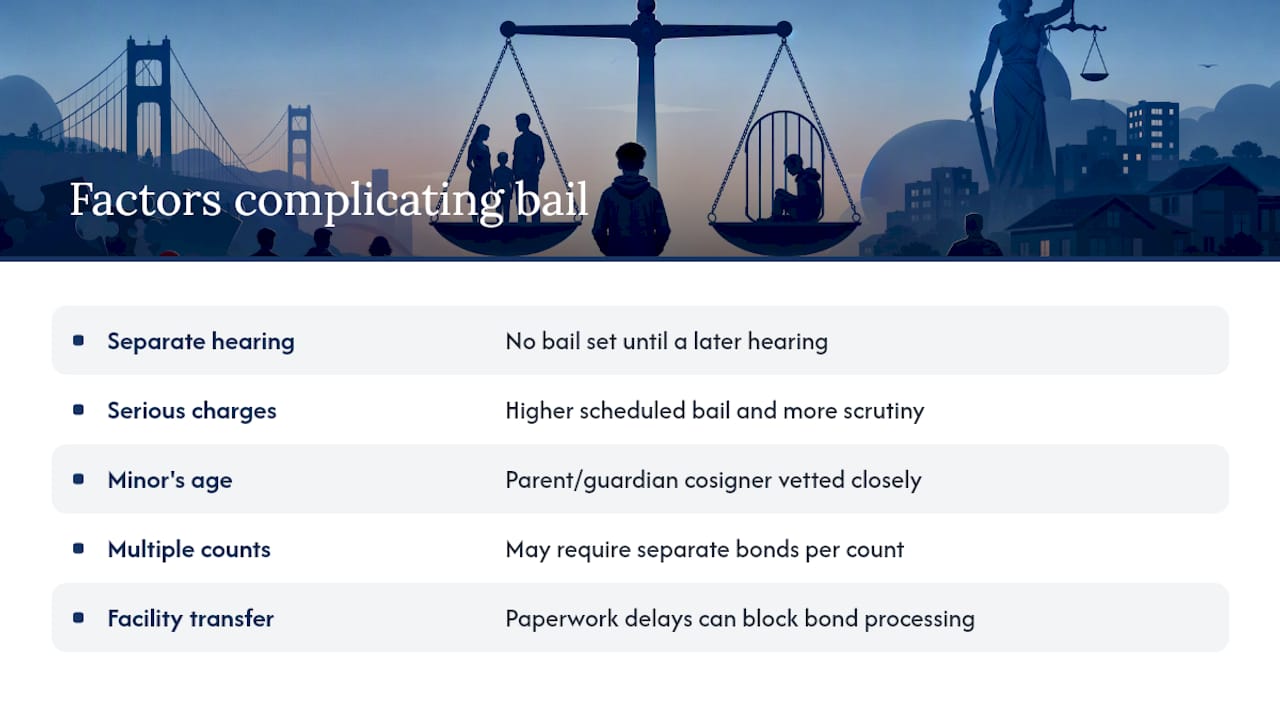
Bail may not be set immediately at the transfer hearing. Some courts schedule a separate bail hearing after the transfer order, which means there's a gap where no bail amount exists yet and a bondsman literally cannot quote a bond.
Serious charges can mean higher scrutiny. Charges serious enough to trigger a transfer to adult court, often under Welfare and Institutions Code Section 707, tend to carry higher scheduled bail amounts and more collateral scrutiny from underwriters assessing flight risk.
Age can affect cosigner requirements. Since the defendant is a minor, the cosigner is almost always a parent or guardian, and that person's financial standing gets weighed carefully given the higher stakes typically involved in transferred cases.
Multiple charges create multiple bond questions. If the transfer involves several counts, ask explicitly whether one bond covers everything or whether each count needs its own bond. This is a detail that catches families off guard.
Facility transfers cause delays. A minor moved from juvenile hall to an adult facility as part of the transfer process may sit in transit status for a window of time where no bond can be processed at all, simply because the paperwork hasn't caught up with the physical transfer.
None of these are reasons to wait. They're reasons to ask direct questions early.
Are There Alternatives to Posting Cash Bail?
Cash bail isn't the only route once adult bail eligibility kicks in for a transferred juvenile. A surety bond through a licensed agent remains the most common path because it requires only a fraction of the total bail amount upfront rather than the full sum in cash.
Beyond the bond itself, defense attorneys can request own-recognizance release, arguing the minor poses low flight risk given school enrollment, family ties, or lack of prior record. Courts sometimes grant this even in transferred cases, particularly when the underlying offense isn't the most serious category.
A bail reduction motion is another option worth raising with counsel. If the county's bail schedule sets an amount that seems disproportionate to the specific facts, an attorney can ask a judge to lower it, which reduces both the cash burden and the bond premium.
Property bonds exist too, where real estate secures the bond instead of cash or a percentage premium, though these tend to take longer to process because they involve appraisals and lien paperwork. For a family racing against the clock, that's usually the slower path compared to a straightforward surety bond arrangement.
Whichever route a family pursues, the decision usually comes down to a simple tradeoff: speed versus upfront cost, and most families in an urgent situation lean toward speed.
Why Families Miss the Real Turning Point in These Cases
The biggest mistake I see in how people approach juvenile bail in California is treating the arrest itself as the moment that matters most. It isn't. The transfer order is the real turning point, and too many families spend their energy calling around before that order even exists, when bail literally cannot be set yet.
Conventional advice tends to focus heavily on "know your rights" messaging without addressing the operational reality: a bondsman needs a case number and a bail figure to do anything. Rights matter, but they don't post bail.
What I'd prioritize differently is treating the hours right after a transfer decision as the real emergency window, not the hours right after arrest. That's when a licensed agent can actually move, when collateral conversations become real, and when a cosigner's paperwork starts mattering. Families who understand that sequence tend to move faster and with less wasted panic than families chasing information before there's anything actionable to chase.
— Jake
Get Help From a Licensed California Bail Agent Now
A licensed bail bond service built for families who just learned a minor's case moved to adult court can help move as fast as the paperwork allows. Unlike call-center operations juggling scripts and hold times, working directly with an agent can mean fewer handoffs and faster answers when every hour counts.
Coverage spans all 58 California counties, with 24/7 availability and bilingual support in Spanish, Hindi, and Arabic. Bonds range from $1,000 to $1,000,000, and qualified cosigners can access 0% down options along with flexible payment plans, so cash on hand doesn't have to be the deciding factor in how fast a family can act. Free consultations mean there's no risk in simply asking questions first.
Start with a free consultation at Jake Hernandez Bail Bonds to get a bail agent working the case within minutes, not hours.
This article is general information, not a substitute for advice from a qualified lawyer. Consult a qualified legal professional about your own circumstances before acting on anything here.
Sources
- California Department of Insurance — Bail Bonds
- California Department of Insurance — Bail Bonds (consumer info)
- California Penal Code — Section 1269b
- Welfare & Institutions Code §707.1 — Transfer to criminal jurisdiction
FAQ
What Is Juvenile Bail in California?
It refers to the bail process that becomes available once a minor is transferred to adult criminal court, at which point the case is treated like a standard adult bail matter under Welfare and Institutions Code Section 707.1.
How Fast Can a Bail Bondsman Get a Juvenile Released?
Release can happen within a few hours of posting the bond, though actual timing depends on jail processing speed, paperwork verification, and whether the facility is handling a backlog that day.
Who Is Allowed to Contact a Bail Bondsman?
Only the arrestee, the arrestee's attorney, or an adult friend or family member may legally contact a licensed bail agent, since agents themselves are prohibited from soliciting business.
What Does a Bail Bond Premium Typically Cost?
Bondsmen commonly charge a nonrefundable premium of around 10% of the bail amount, with some offering a reduced rate near 8% for attorney-referred cases, though exact terms should always be confirmed directly with the agent.
Does Jake Hernandez Bail Bonds Handle Cases Statewide?
Yes, Jake Hernandez Bail Bonds covers all 58 California counties with 24/7 support, bilingual service, and bonds ranging from $1,000 to $1,000,000, including 0% down options for qualified cosigners.