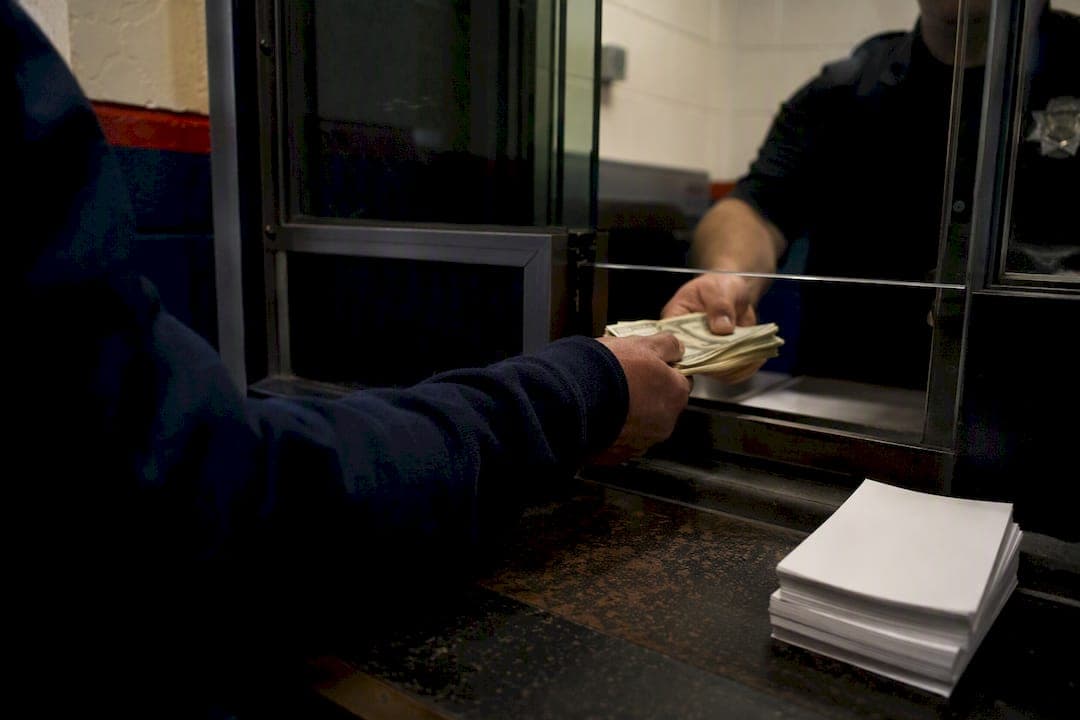
If you need to pay the bail right now, you have three real options: pay cash at the jail's cashier window, use the county or court's official online portal, or call a licensed bail bondsman if you can't cover the full amount. Cash at the jail is usually fastest when you have the full sum on hand. An online portal works if your county offers one, but you'll need the exact booking number and case details to avoid a rejected payment. If the full amount isn't realistic, a bondsman gets someone out with a fraction of the cost upfront.
Here's the priority order to follow:
- Full cash available? Go straight to the jail's cashier window. It's open in most facilities around the clock.
- Prefer to pay from home? Check the county sheriff or court website for an official portal, but expect card fees.
- Can't afford the full amount? Contact a licensed bondsman like Jake Hernandez Bail Bonds, which covers all 58 California counties with 0% down options and 24/7 bilingual support.
Pro Tip: Call the jail before you drive anywhere. Bail amounts and accepted payment methods sometimes change between arraignment and booking, and a five-minute call saves you a wasted trip.
Key Takeaways
Paying bail successfully depends on matching the correct payment channel to the exact booking record, understanding that only cash bail is refundable, and knowing that record checks, not payment method, cause most release delays.
| Point | Details |
|---|---|
| Confirm details first | Verify the exact bail amount and booking number before attempting any payment. |
| Cash is refundable, premiums aren't | Cash bail returns after the case closes; a bondsman's 10% to 15% premium never does. |
| Watch for card fees | Card convenience fees on county portals are nonrefundable even if bail itself comes back. |
| Delays usually aren't about payment | Records checks and inter-jurisdictional holds cause most delays after payment clears. |
| Jake Hernandez Bail Bonds offers a fast path | Provides 24/7 bilingual, statewide California bail bond service with 0% down options for qualified co-signers. |
Table of Contents
- Where Can You Legally Pay Bail?
- How Do You Actually Pay Bail Step by Step?
- What Payment Methods Do Jails Accept?
- How Long Does Release Take After Bail Is Paid?
- How Do You Get Cash Bail Back After the Case Ends?
- Cash Bail or a Bail Bond: Which Costs Less?
- What If You Can't Afford Bail At All?
- How Jake Hernandez Bail Bonds Gets Clients Out Fast
- What Most Families Get Wrong About Paying Bail
- Get Help Posting Bail Today
- Verify Local Rules Before You Pay
- Sources
Where Can You Legally Pay Bail?
Three types of locations handle bail payments, and each one behaves a little differently. The jail's cashier window is the most direct option and often the fastest, since staff process the release the moment the payment clears. Court clerk offices sometimes accept bail too, particularly for lower-level charges where a judge has already set the amount at arraignment. Online portals, when a county offers one, let you pay from anywhere, but they run on a slower administrative track because someone still has to manually confirm the payment matches the booking record before release starts.
Finding the legitimate payment channel matters more than people expect. Scam sites mimicking county bail portals have popped up in several states, usually appearing high in search results for "pay bail online" searches. Before entering any payment information, confirm three things:
- The domain matches the actual sheriff's department or superior court (look for ".gov" or the county's verified domain, not a generic ".com" copy).
- The connection is secured with HTTPS, shown by the lock icon in your browser.
- The portal asks for the booking or case number, not just a name and dollar amount. Legitimate systems always require exact case matching.
Counties that do offer digital payment often route it through a third-party processor rather than handling it in-house. That's normal and not a red flag by itself. What matters is that the link to the processor comes from the official county or court page, not from a sponsored ad or a random search result. Not every jurisdiction accepts online bail payments at all, and where portals exist, they vary by county in what they accept and how they charge for it.
If your search turns up nothing official, call the jail directly and ask. A thirty-second phone call beats twenty minutes second-guessing a website that might be fake.
How Do You Actually Pay Bail Step by Step?
Getting bail paid correctly on the first attempt saves hours. Here's the sequence that avoids the most common mistakes.
- Confirm the exact bail amount and the jail's location. Amounts can be set at arraignment, adjusted by a judge, or tied to a bail schedule that varies by charge. Don't assume the number a family member texted you is current.
- Get the booking number and the defendant's full legal name as it appears in the system. Facilities process payments by booking ID, not by nickname or informal spelling. A mismatched name is one of the most common reasons a payment gets rejected or delayed.
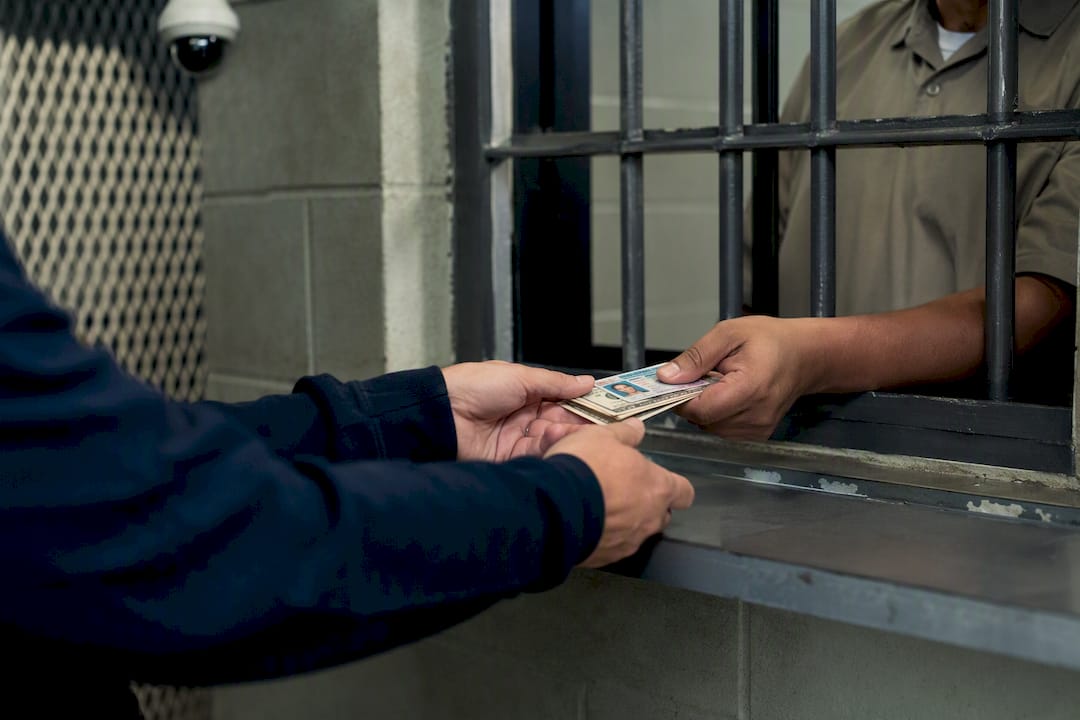
- Bring valid government-issued ID. Every jail requires the payer to show identification, and some also record the payer's relationship to the defendant.
- Decide your payment instrument before you arrive. Cash, cashier's checks, and money orders are standard. Personal checks are rarely accepted anywhere, and it's worth confirming card acceptance ahead of time since not every facility takes debit or credit at the window.
- If using money orders, check the per-order limit. Most money orders cap out around $1,000, so a $5,000 bail could mean five separate orders. Call ahead to confirm the facility will accept multiple instruments for one bail amount.
- Get an official receipt before you leave, whether you paid in person or online. This receipt is your proof of payment and the document you'll need later for a refund if the bail was cash rather than a bond premium.
Pro Tip: Take a photo of the receipt immediately and text it to whoever else in the family is involved. Receipts get misplaced during stressful moments, and a photo backup has saved more than one family from a refund headache months later.
If you're posting bail for the first time, walking through what happens at the jail window itself beforehand removes a lot of the guesswork on the day.
What Payment Methods Do Jails Accept?
Cash remains the most universally accepted form of payment, but it's not always the most practical choice, and it comes with a federal wrinkle worth knowing about.
- Cash works everywhere but carries risk if you're transporting a large sum, and it can trigger reporting requirements at high amounts.
- Cashier's checks and money orders are widely accepted and safer to carry than cash, though they take a few extra minutes to verify.
- Credit and debit cards are convenient on county portals but almost always carry a processing fee, typically a flat charge or a percentage of the transaction.
- ACH bank transfers show up on some online portals and tend to have lower fees than card payments, though they can take longer to clear.
- Personal checks are rejected at nearly every facility because they're too easy to reverse after release.
Here's the detail that catches people off guard: card convenience fees are never refunded, even when the underlying bail amount comes back to you in full after the case closes. A $10,000 bail paid by card might carry a $200 to $300 fee that's gone for good, regardless of the outcome.
There's also a federal reporting rule worth knowing if you're posting a large cash bail. Under IRS Form 8300 requirements, any business or court receiving more than $10,000 in cash from one person in a single transaction has to report it to the IRS within 15 days. This isn't a penalty against you, but it does mean your identity and payment amount get formally documented, which matters if you'd rather keep a large cash transaction more discreet.
How Long Does Release Take After Bail Is Paid?
Paying bail doesn't mean instant release. Most jails process release somewhere between 30 minutes and several hours after payment clears, though busy urban facilities and weekend or holiday bookings routinely push that timeline longer.
The payment itself is rarely the bottleneck. Administrative verification and inter-jurisdictional holds are the most frequent causes of delay, not the payment method or amount. A few specific things slow release down:
- Records checks that confirm the defendant has no outstanding warrants in other counties or states.
- Detainers from other jurisdictions, including immigration holds or warrants from a different county, which override an otherwise completed bail payment.
- Facility staffing and shift changes, which matter more at large county jails processing dozens of releases per day.
If release hasn't happened within a few hours of a completed payment, call the jail's booking desk directly and have your receipt, the booking number, and the exact payment time ready. That information lets staff track down exactly where the release paperwork is stuck.
How Do You Get Cash Bail Back After the Case Ends?
Cash bail is refundable once the defendant completes the required court appearances and the case reaches its conclusion, unlike a bondsman's premium, which is gone the moment the bond is posted. Here's how the refund actually plays out.
- The court issues an exoneration order once the case closes and the defendant has met every appearance obligation. This order is what officially releases the bail money back to whoever posted it.
- Processing takes time, often several weeks and sometimes a few months depending on the court's backlog. Refunds are rarely instant in any jurisdiction.
- Administrative fees may reduce the total. Courts sometimes deduct processing fees, outstanding fines, or restitution directly from the returned bail before issuing the balance.
- Keep every receipt and case number from day one. If a refund is late or short of the expected amount, the clerk's office will ask for exactly this documentation before investigating.
If a refund seems delayed well beyond your court's normal window, call the clerk's office with your case number in hand rather than the jail. Refunds route through the court, not the facility where bail was originally posted.
Cash Bail or a Bail Bond: Which Costs Less?
Cash bail is cheaper if you can afford the full amount, because it comes back to you when the case closes. A bail bond costs less upfront but the premium, typically 10% of the total bail, is gone the moment the bond is posted regardless of the case outcome. That single distinction should drive most of the decision.
- Cash bail: full amount required now, refundable later, no ongoing obligation once paid.
- Bail bond: roughly 10% to 15% paid now, nonrefundable, sometimes requiring collateral or a co-signer.
- Payment plans: some bondsmen, including Jake Hernandez Bail Bonds, offer 0% down and structured plans for qualified co-signers, which changes the math for families without cash reserves.
Bondsmen make sense when speed matters more than long-term savings, or when the full cash amount simply isn't available on short notice. Before signing anything, verify the bondsman is licensed in the state, ask for the exact fee schedule in writing, and understand what collateral (a car title, home equity, or other asset) you're putting up if you co-sign.
Pro Tip: Ask the bondsman directly whether the fee is a flat 10% or scales with bail amount. Some agencies use a sliding scale on very high bail amounts, and knowing that upfront prevents a surprise on the final invoice.
Co-signers carry real legal exposure. If the defendant skips a court date, the co-signer can be liable for the full bail amount, not just the original premium. Anyone considering that role, or wondering whether the bail amount itself can be challenged, should talk to defense counsel about a bail reduction motion before signing anything.
What If You Can't Afford Bail At All?
Not being able to cover bail in cash or through a bondsman doesn't mean release is off the table. A few lawful paths exist.
- Ask about a bail reduction hearing. A judge can lower the amount, especially if the defendant has strong community ties, no flight history, or a public defender arguing the original amount was excessive.
- Explore release on recognizance (ROR). Some charges qualify for release without any bail payment at all, based on the defendant's history and the nature of the charge.
- Contact a bondsman about payment plans. Licensed agencies offering 0% down financing exist specifically for families without immediate cash, and some extend discounts for military families or when a private attorney is already involved.
- Reach out to local legal aid organizations. Many counties have nonprofit bail funds or legal aid clinics that assist with emergency situations, particularly for lower-level charges.
Speed matters here too. The longer someone sits in custody waiting on a bail decision, the more likely they are to lose a job or miss family obligations, so working every one of these angles at once beats waiting on a single option to pan out.
How Jake Hernandez Bail Bonds Gets Clients Out Fast
Families calling during a crisis need a bondsman who answers immediately and explains costs without pressure. Jake Hernandez Bail Bonds operates across all 58 California counties, with bilingual support in Spanish, Hindi, and Arabic, and phones staffed 24/7 including holidays.
- 0% down options and structured payment plans for qualified co-signers, so cash on hand isn't a barrier to getting someone released today.
- Free consultations before any commitment, including a walkthrough of the exact fee for the specific bail amount involved.
- Direct service without call-center middlemen, meaning the person you talk to is handling your case, not routing it to someone else.
- Handles complex holds, including federal and immigration bonds and 1275 holds that require additional court review.
To speed things up when you call, have the defendant's full legal name, the jail location, and the booking number ready if you already have it. The bail bond cost calculator gives a fast estimate of the premium before you even pick up the phone, and the jails coverage page confirms whether the specific facility is one Jake Hernandez Bail Bonds already services regularly.
What Most Families Get Wrong About Paying Bail
The biggest mistake I see is families rushing to pay before confirming the exact bail amount and booking number. Amounts change between arrest and arraignment more often than people expect, and a payment made against the wrong figure doesn't just get corrected automatically. It gets kicked back, and that costs hours you don't have.
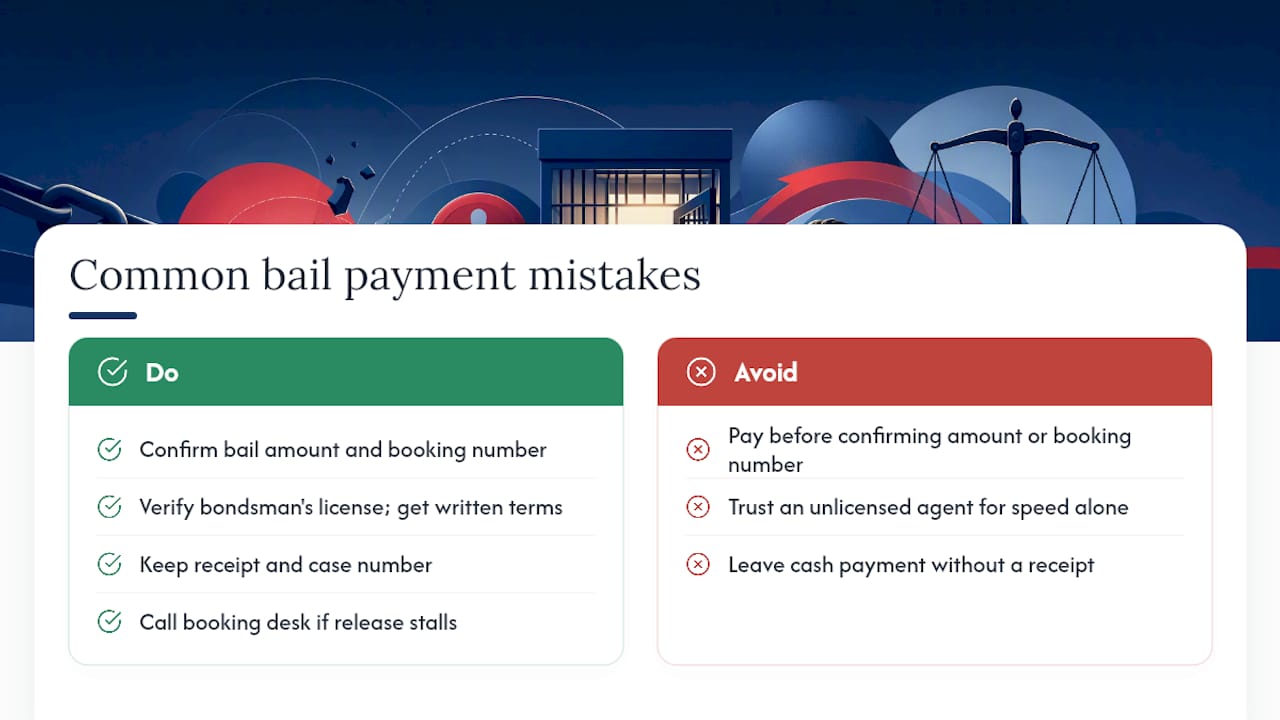
The second mistake is trusting an unlicensed agent because they answered the phone fast. Speed matters, but so does verifying the bondsman's license number before handing over any money. A legitimate agency will give you written terms for a payment plan without you having to ask twice. If someone hesitates to put fee terms in writing, that hesitation is the answer.
Cash payers make a different error: they walk away without a receipt, assuming the paperwork will sort itself out later. It won't. Courts process refunds against documentation, not memory. Keep the receipt, keep the case number, and if release stalls past the normal window, call the jail's booking desk with both in hand. That single habit resolves more delayed-release calls than anything else I've seen.
— Jake
Get Help Posting Bail Today
Cash bail and jail cashier windows work fine when you have the full amount sitting in your account, but most families calling at 2 a.m. don't have that luxury, and a slow bondsman search only adds to the wait. Jake Hernandez Bail Bonds is built for exactly this moment: licensed service across all 58 California counties, 24/7 bilingual phone support, and 0% down payment plans for qualified co-signers, so the size of the bail amount doesn't determine whether someone gets out tonight.
There's no call center routing you through three transfers before reaching someone who can act. You talk directly with the person handling the bond, and consultations are free before you commit to anything. If a case involves a federal bond, immigration hold, or a 1275 enhancement, that's already inside the agency's specialty, not an exception that gets punted elsewhere.
If someone you know is in custody right now, start with the bail bond cost calculator to see the estimated premium, then call Jake Hernandez Bail Bonds to confirm the exact number and get the release process moving the same day.
Verify Local Rules Before You Pay
Bail rules and portal availability vary by county, so confirm details on the sheriff's or court's own website before sending any payment. For general legal background, FindLaw's overview of posting bail and Nolo's explanation of how bail works both cover refund rules and bond premiums in plain language.
- Check the county sheriff or court website first, and confirm the domain before entering any payment details.
- Cross-reference general rules with FindLaw or Nolo, since local portals differ but the underlying legal principles don't.
This article is general information, not a substitute for advice from a qualified lawyer. Consult a qualified legal professional about your own circumstances before acting on anything here.
Sources
- Getting Out of Jail With Bail Money: Setting Bail, Posting Bail, Bond Agents, and Penalties - FindLaw
- How Does Bail Work? How Is Bail Set? - Nolo
- How do you pay for someone's bail online? - LegalClarity
- Form 8300 and reporting cash payments of over $10,000 - IRS