Attendance at a court hearing is usually mandatory, and missing your date can trigger immediate legal consequences before you even get a chance to explain why. Judges expect you in the room because the case cannot move forward fairly without you, and courts treat a no-show as a serious procedural failure, not a scheduling hiccup. Skip a hearing and you risk several things at once.
- A bench warrant for your arrest
- A default judgment entered against you, with no input from your side
- A new failure-to-appear charge or a bail increase in an existing case
Key Takeaways
Showing up to court is a legal obligation with immediate, case-specific consequences, and acting fast is the only reliable way to limit the damage once a hearing is missed.
| Point | Details |
|---|---|
| Attendance is mandatory, not optional | Courts need your presence to verify identity, hear testimony, and rule fairly on your case. |
| Consequences differ by case type | Criminal cases risk warrants and new charges; civil and family cases risk default judgments and enforcement orders. |
| Speed matters most after a miss | File a continuance or contact the clerk immediately; last-minute requests are often denied. |
| Documentation supports any fix | Medical records, proof of notice issues, or employer letters strengthen a motion to vacate or recall a warrant. |
| Jakehernandezbailbonds helps after arrest | Offers 24/7 licensed bail bond service statewide, with 0% down options and bilingual support for families facing a post-FTA arrest. |
Where to Verify Local Court Rules
Confirm your exact courthouse rules before assuming any general guidance applies to your case. State court self-help pages, official docket portals, and county self-help centers each explain local filing steps, confirm hearing formats, and let you check your case status directly, including through resources like the EOIR ACIS portal for immigration matters.
Table of Contents
- Why Appear at Court Hearings in the First Place?
- What Happens If You Miss a Hearing?
- Which Hearings Require You to Show Up in Person?
- Before You Go: A Pre-Hearing Checklist
- What Actually Happens Once You're in the Courtroom?
- What to Do If You Know You'll Miss a Hearing
- Already Missed a Hearing? Here's How to Fix It
- The Consequences That Outlast the Hearing Itself
- Do You Have Rights During the Hearing Itself?
- Can You Get Accommodations If You Can't Attend in Person?
- How a Bail Agent Helps After a Missed Hearing
- Frequently Asked Questions
- Sources
Why Appear at Court Hearings in the First Place?
Courts require your presence because a judge cannot fairly decide anything without live testimony, verified identity, and input from both sides. That is the whole point of a hearing.
The requirement usually comes from a specific order: a signed promise to appear on a traffic ticket, a subpoena, bail conditions, or a judge's direct verbal order at a prior hearing. Each of those carries legal weight on its own, separate from the underlying case.
The stakes differ by case type. In a civil dispute, skip your hearing and the other side can often win by default, with a judgment entered against you that you never got to argue against. In a criminal case, missing an arraignment or plea hearing does something worse: it can turn a manageable charge into an active warrant situation, on top of whatever you were already facing.
What Happens If You Miss a Hearing?
Consequences vary by case type, but every version of missing court carries real weight.
- Criminal cases: expect a bench warrant, a possible failure-to-appear charge filed separately from your original case, and bail revocation or a higher bail amount if you're later picked up. Penal Code 978.5 gives judges the authority to issue that warrant the moment you don't show.
- Civil cases: the court can enter a default judgment against you, and the winning party can refer the debt to collections without further notice.
- Family law: custody or support orders can be entered in your absence, and repeated no-shows can lead to contempt findings or enforcement action.
- Traffic and administrative matters: expect fines, a DMV license hold, or a decision made without you present, since missed deadlines commonly trigger civil assessments and license holds.
- Probation or parole: a missed check-in can be treated as a violation, sometimes leading straight to revocation.
If you're trying to undo any of this later, documentation matters. Medical records, proof the court notice never reached you, or evidence of a scheduling error all carry weight when you ask a judge for relief.
Which Hearings Require You to Show Up in Person?
Arraignments, trials, sentencing hearings, and custody hearings almost always require your personal presence. Judges want to address you directly, especially where a plea or a liberty decision is on the table.
Some hearings are more flexible. Routine civil motion hearings, minor traffic matters, and certain administrative reviews sometimes allow a written appearance or let your attorney stand in for you. That depends entirely on your specific notice and local court rules.
Read your paperwork closely for words like "appear," "attendance," "trial," or "arraignment," and check whether it specifies in-person or video format. When in doubt, call the clerk. Guessing wrong about the format is its own way of missing court.
Before You Go: A Pre-Hearing Checklist
Confirm the basics before you leave the house: the correct courthouse, courtroom number, exact time, and whether you're expected in person or by video.
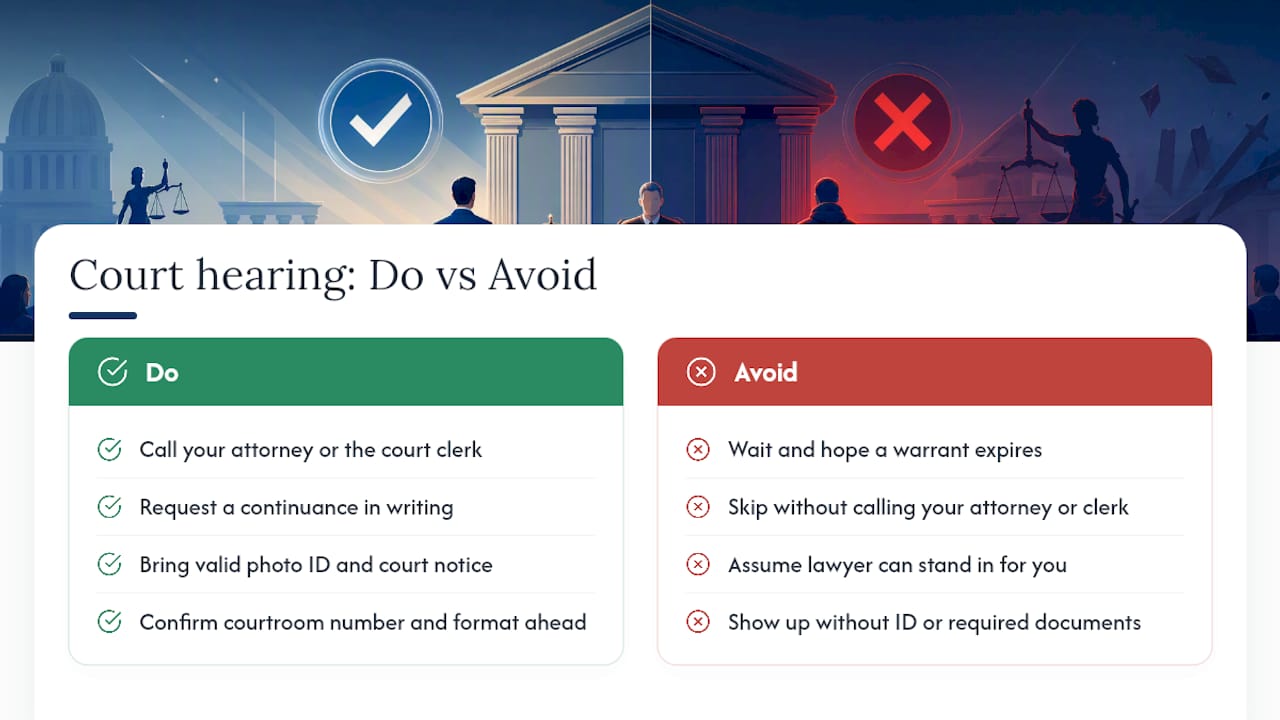
- Confirm the court location and courtroom number the day before
- Check the notice for remote appearance instructions
- Bring a government-issued photo ID and all court papers
- Bring copies of relevant documents and any proof of service or prior filings
- Save contact information for your attorney or the court clerk
Plan for parking, security screening, and enough buffer time to check in without rushing. Courthouses often have metal detectors and bag restrictions, and lines build fast during morning calendar calls.
Pro Tip: Arrive at least 30 minutes early. If security lines, childcare, or transportation are a real barrier, call the clerk's office in advance. Courts would rather hear about a logistics problem before your hearing than after you've missed it.
What Actually Happens Once You're in the Courtroom?
Expect check-in, a wait, the calling of cases in order, and then a short proceeding for most matters. It rarely takes as long as people fear.
A typical sequence looks like this: you check in with the clerk or bailiff, wait for your case to be called, step forward when the judge calls your name, and then the parties speak before the judge rules or sets a next step. Who goes first depends on the hearing. In most civil and criminal calendar hearings, the moving party or the prosecutor presents first. At an arraignment, the court usually addresses you directly and asks for your plea before anyone else speaks.
Dress reasonably, silence your phone, stand when the judge enters, and address the judge as "Your Honor." Courtroom etiquette isn't about performance. It signals to the judge that you're taking the process seriously, which can influence how much patience you get if something goes wrong.
What to Do If You Know You'll Miss a Hearing
Act immediately. Don't wait to see if the problem resolves itself.
- Contact your attorney or the court clerk as soon as you know you have a conflict.
- File a motion for a continuance, or ask whether the court will permit a remote appearance.
- If your attorney can appear on your behalf, get written confirmation of that arrangement before the hearing date.
File as early as you possibly can. Courts routinely view last-minute continuance requests with skepticism, and a request filed the morning of your hearing often gets denied outright.
Pro Tip: Document every attempt to reach the court, including email timestamps and call logs. Clearer notices and early communication measurably reduce failure-to-appear rates, and that same principle protects you if you ever need to prove you tried.
Already Missed a Hearing? Here's How to Fix It
If you've already missed a hearing, move now. Every day of delay tends to make the situation worse, not better.
First, find out whether a bench warrant was actually issued. Contact your attorney, and consider voluntarily surrendering with counsel present rather than waiting to be arrested, since a planned surrender combined with a motion to recall or quash the warrant tends to produce better outcomes than a random arrest. If a default judgment was entered against you, you can file a motion to vacate it, but you'll need documentation, like medical records, a police report, or an employer statement, to support your excuse.
One warning worth repeating: never walk into a courthouse with an active warrant without talking to counsel or a bonds agent first. Showing up unprepared can mean immediate arrest on the spot.
If Missing Court Leads to Arrest: Bail and Release Basics
An arrest following a failure to appear usually means booking, followed by a bail determination or a bail hearing. Bail is the amount set to secure your release; a bond is what a licensed agent posts on your behalf when you can't pay that amount outright.
An FTA on your record can push bail higher, since judges weigh prior no-shows heavily when setting new conditions. Voluntary surrender paired with a lawyer's intervention often improves that outcome. When release is urgent, licensed bail agents and defense attorneys are your fastest resources. Always verify licensing and fee terms before you sign anything.
The Consequences That Outlast the Hearing Itself
A missed hearing rarely stays contained to that one date. It tends to ripple through the rest of your case and sometimes your record for years afterward.
A failure-to-appear charge is its own independent offense in many jurisdictions, carrying penalties separate from whatever brought you to court in the first place. That charge doesn't disappear even if your original case gets resolved favorably. It sits on your record as a distinct conviction with its own consequences.
Judges also remember. If you're arrested again, or if you face a new case months or years later, a prior FTA shows up in your history and shapes how much trust the court extends you. Bail amounts run higher. Requests for release on your own recognizance get denied more often. Some judges impose stricter conditions like electronic monitoring specifically because a past no-show suggests you're a flight risk.
There's also the warrant itself to consider. A bench warrant does not expire. It sits active in law enforcement databases indefinitely until it's arrested on or formally recalled by a judge, which means a routine traffic stop years later can turn into an unexpected arrest. Employment background checks can also surface an old FTA charge, even after your underlying case closed. None of this is designed to punish you twice. It's simply what happens when a court loses the ability to reach you on the date it expected you.
Do You Have Rights During the Hearing Itself?
Yes, and knowing them changes how you handle the moment you're standing in front of a judge. The right to legal counsel is the most important one. If you're facing criminal charges and can't afford an attorney, the court will appoint a public defender, and you should ask for one immediately rather than trying to navigate the hearing alone.
You also have the right to remain silent. Anything you say to a judge, an officer, or opposing counsel before you've spoken with an attorney can be used against you later. That doesn't mean staying silent through the whole hearing. It means not volunteering explanations or admissions before your lawyer has had a chance to advise you.
You have the right to present evidence and to challenge evidence presented against you. That includes calling witnesses, submitting documents, and cross-examining anyone testifying on the other side. In civil and family matters, this is often where cases are actually won or lost, since a judge can only rule on what's put in front of them.
None of these rights protect you if you're not in the room to use them. A default judgment or an in-absentia ruling forecloses your chance to invoke any of this, which is a big part of why showing up matters more than most people realize until they've already missed their turn.
Can You Get Accommodations If You Can't Attend in Person?
Yes, in many circumstances, and asking early is the key to actually getting one. Courts routinely offer remote or telephonic appearances for people with documented disabilities, serious medical conditions, or other legitimate barriers to appearing physically.
If you have a disability, most courthouses have an ADA coordinator or accessibility office you can contact ahead of your hearing to request accommodations like a sign language interpreter, wheelchair-accessible courtroom access, or a remote appearance option. Ask as far in advance as possible; courts generally cannot arrange interpreters or special equipment on short notice.
For medical emergencies, hospitalizations, or other valid reasons you can't attend, courts have generally accepted documented excuses like a doctor's note, hospital records, or proof you never received notice of the hearing, while excuses like work conflicts or simply not wanting to go tend to fail. Military deployment and active incarceration elsewhere are also commonly recognized, but again, only with documentation attached.
If you're unsure whether your situation qualifies, call the clerk's office before your hearing date, not after. A quick phone call explaining your circumstance can open the door to a remote appearance or a continuance that a missed hearing simply can't undo after the fact.

A Publisher's Note on Court-Date Emergencies
The mistake we see most often is people freezing up instead of calling someone the moment they realize they'll miss a date. A short phone call to the clerk or a lawyer, and saving any proof you tried, usually prevents the situation from escalating into an arrest. If it's already too late and someone's in custody, moving fast on bail cuts down the time they spend locked up.
How a Bail Agent Helps After a Missed Hearing
If a missed hearing leads to an arrest, a licensed bail agent can often get your family member released faster than waiting for the next scheduled court date. That speed matters when someone is sitting in a jail cell over a paperwork problem rather than a serious new offense.

A bail agent posts the bond on your behalf, coordinates a voluntary surrender if a warrant is active, and walks you through the fees and paperwork before you commit to anything. Pair that with a call to a defense attorney, since a lawyer is who actually argues to recall the warrant or fix the underlying case. At Jakehernandezbailbonds, consultations are free, support runs 24/7, and the team works in Spanish, Hindi, and Arabic so language never slows down a release. If you're facing this right now, check the California bail bonds page to start the process, or use the bail bond cost calculator to see what a 0% down or payment plan option actually looks like for your situation.
Frequently Asked Questions
Why do I have to appear at my court hearing in person? Judges need you present to confirm your identity, hear directly from you, and make a fair ruling with input from everyone involved. Many hearings, including arraignments and trials, simply cannot proceed without you there.
What's the fastest way to fix a missed hearing before it becomes a warrant? Call your attorney or the court clerk the moment you realize you'll miss the date, and request a continuance in writing if possible. Courts weigh early requests far more favorably than last-minute ones.
Does a bench warrant expire if I wait long enough? No. A bench warrant stays active indefinitely until you're arrested or a judge formally recalls it, so waiting it out only increases your risk of a surprise arrest later.
Can my lawyer appear in court instead of me? Sometimes, but not always. Routine civil motions often allow an attorney to stand in, while arraignments, trials, and sentencing hearings in many jurisdictions require your personal presence regardless of counsel.
What should I bring to a court hearing to avoid problems? Bring a valid photo ID, your court notice, copies of relevant documents, and proof of service if applicable. Confirm the courtroom number and format ahead of time so you're not scrambling the morning of.
This article is general information, not a substitute for advice from a qualified lawyer. Consult a qualified legal professional about your own circumstances before acting on anything here.
Sources
- Penal Code 978.5 PC - Bench Warrant of Arrest in California
- Missed Deadlines | Superior Court of California | County of Trinity
- What happens if you miss a court date? How to handle an FTA
- Why So Many Americans Miss Their Day in Court