
Bail denial occurs when a court determines that no release condition can reasonably guarantee the defendant's appearance at trial or protect the safety of the community. This is the core legal standard behind why bail gets denied, and it applies in both state and federal courts. Under 18 U.S.C. § 3142, the government must prove flight risk by a preponderance of the evidence and danger to the community by clear and convincing evidence. Pretrial detention is not a punishment. It is a regulatory decision designed to manage risk until trial.
Why bail gets denied: the legal standards courts apply
The Bail Reform Act of 1984, codified at 18 U.S.C. § 3142, is the primary federal statute governing bail denial. It requires judges to weigh four specific factors before ordering detention. Those factors are the nature and seriousness of the offense, the weight of evidence against the defendant, the defendant's history and personal characteristics, and the danger posed to the community. No single factor controls the outcome. Judges weigh all four together.
Certain charges trigger what the law calls a rebuttable presumption of detention. Under 18 U.S.C. § 3142(e)(3), offenses including terrorism, major drug trafficking, and specific firearms crimes automatically shift the burden to the defendant. The defendant must produce at least some evidence to rebut the presumption. That threshold is minimal, but failing to meet it almost always results in detention.
The evidentiary burdens matter more than most families realize. Flight risk requires only a preponderance of the evidence, meaning the government must show it is more likely than not that the defendant will flee. Danger to the community requires clear and convincing evidence, a higher standard. That distinction shapes how prosecutors and defense attorneys build their arguments at every bail hearing.
Pro Tip: If your loved one faces charges in a category that triggers a rebuttable presumption, the defense attorney's first job is to produce evidence rebutting that presumption, not to argue innocence. Understanding this distinction helps you support the right strategy from day one.
What are the most common reasons bail is denied?
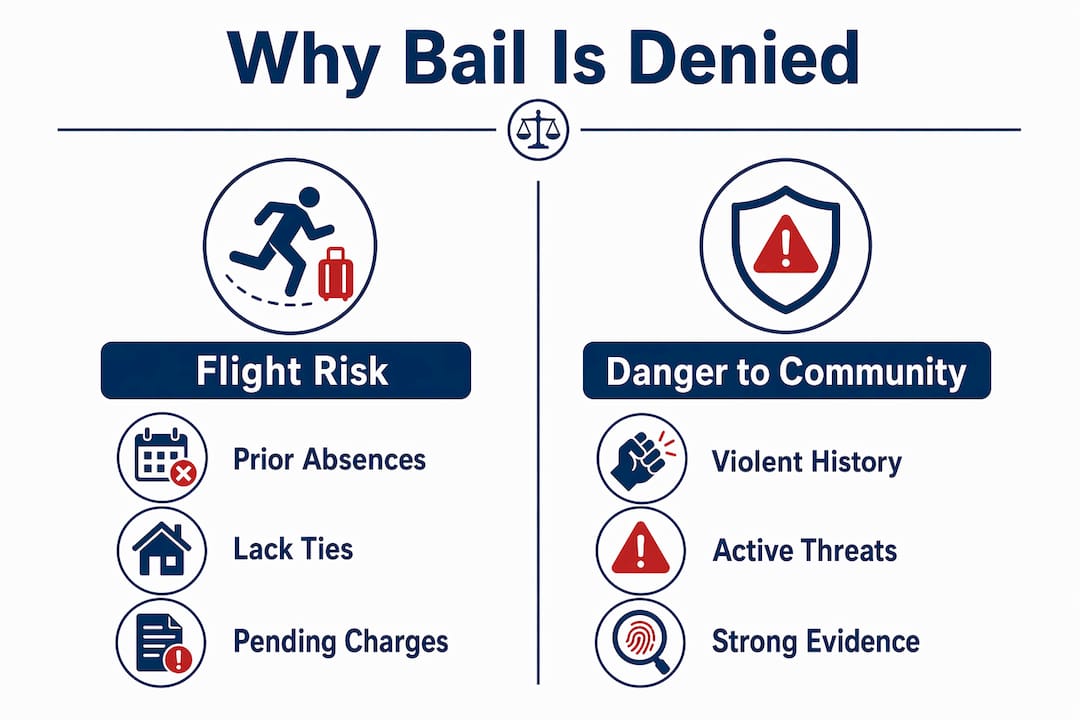
Flight risk is the most frequently cited reason for bail denial. Courts treat prior failures to appear in court, prior escape attempts, and lack of stable ties to the community as strong indicators that a defendant will not return for trial. A defendant with no local address, no employment, and no family in the area presents a profile that is difficult for any defense attorney to overcome without concrete documentation.

Danger to the community is the second major category. Judges look at violent criminal history, active threats made against witnesses or victims, and known gang affiliations. A defendant charged with a violent offense who has prior convictions for similar crimes faces a very high bar for release. The prosecution typically presents a Public Safety Report at the hearing, which summarizes prior offenses and active warrants, giving the judge a baseline risk profile before the defense speaks.
The weight of evidence against the defendant also plays a direct role. Strong physical evidence, recorded statements, or eyewitness testimony makes the court more likely to view the defendant as a genuine risk. Judges do not decide guilt at bail hearings, but they do consider how solid the prosecution's case appears. A weak evidentiary case gives the defense more room to argue for release.
Community ties, employment, and personal stability are the factors families can most directly influence. Courts treat these as concrete assurances of appearance. Stable employment, a signed lease, and close family relationships all persuade judges toward release. Physical documentation, such as employment letters and lease agreements, carries more weight than verbal assurances alone.
How do bail hearings work, and what should families do?
A bail hearing, also called a detention hearing in federal court, is typically brief. The judge hears arguments from both the prosecution and the defense, reviews any submitted evidence, and issues a ruling. Under 18 U.S.C. § 3142, defendants have the right to be represented by counsel, to present evidence, and to cross-examine witnesses. These procedural protections exist, but families should understand that hearings move quickly and preparation matters enormously.
Families play a real role in the outcome. Gathering documentation before the hearing gives the defense attorney something concrete to present. The most useful items include:
- A current employment verification letter from the defendant's employer
- A signed lease or mortgage statement showing stable housing
- Letters from community members, clergy, or employers attesting to character
- Documentation of any family dependents the defendant supports
- Records showing the defendant has no prior failures to appear
After a denial, the process does not end. Defendants can file a motion for bail reduction or appeal the detention order when circumstances change. New evidence, a weakened prosecution case, or a change in the defendant's personal situation can all support reconsideration. Families who understand this option avoid the mistake of treating the initial denial as a permanent outcome.
Pro Tip: Speed matters after an arrest. The faster your family gathers documentation and connects with a defense attorney, the stronger the presentation at the bail hearing. Learn more about why timing affects outcomes in bail cases.
What release conditions can replace full detention?
Judges are legally required to impose the least restrictive combination of conditions that will reasonably assure appearance and community safety. Full detention is the last resort, not the default. Courts have a wide range of release conditions available before reaching that conclusion.
The table below shows the most common conditions and what each one addresses:
| Condition | Purpose |
|---|---|
| Electronic monitoring | Tracks location to reduce flight risk |
| Travel restrictions | Limits movement to a defined geographic area |
| Third-party custodian | Places defendant in the supervision of a responsible adult |
| Drug and alcohol testing | Addresses substance abuse as a risk factor |
| Surrender of passport | Removes ability to leave the country |
| No-contact orders | Protects victims or witnesses from intimidation |
Demonstrating a willingness to comply with conditions strengthens the defense's argument for release. A defendant who proactively proposes conditions, such as agreeing to electronic monitoring or surrendering a passport, signals to the court that supervision is workable. Violating any condition after release results in immediate revocation and typically makes the next detention hearing far more difficult to win.
Key Takeaways
Bail denial is a legal risk management decision, not a punishment, and understanding the statutory standards and practical factors gives families the best chance to respond effectively.
| Point | Details |
|---|---|
| Two grounds for denial | Courts deny bail only for proven flight risk or danger to the community, each with distinct evidentiary burdens. |
| Rebuttable presumption | Charges like drug trafficking and terrorism shift the burden to the defendant under 18 U.S.C. § 3142(e)(3). |
| Documentation wins hearings | Employment letters, lease agreements, and character references give judges concrete assurance of appearance. |
| Denial is not final | Changed circumstances allow defendants to file bail reduction motions or appeal detention orders. |
| Conditions before detention | Judges must consider electronic monitoring, travel restrictions, and other conditions before ordering full detention. |
What I've learned about bail denial after years in this work
Most families walk into this situation believing bail denial means the system has already decided their loved one is guilty. That belief is understandable, but it is wrong. Pretrial detention is a procedural risk management decision, not a verdict. The judge is not saying the defendant is guilty. The judge is saying the current evidence suggests the defendant may not show up or may pose a risk. Those are two very different things.
What I have seen repeatedly is that families focus their energy in the wrong place. They want to argue innocence. Defense attorneys know that bail hearings are not the place for that argument. The hearing is about risk, not guilt. The most effective defense at a bail hearing focuses narrowly on appearance assurances and safety factors, not on disputing the charges. Families who understand this shift their energy toward gathering documentation instead of building a narrative about why the charges are wrong.
The other thing families consistently underestimate is the value of changed circumstances. An initial denial is not a closed door. If the prosecution's case weakens, if new evidence emerges, or if the defendant's personal situation changes, a motion for reconsideration becomes viable. I have seen families give up after the first denial when the right move was to regroup, gather stronger documentation, and go back. Understanding how bail hearings work as a family is one of the most practical things you can do right now.
— Jake
Jakehernandezbailbonds is ready to help your family right now
When bail is set and your family needs to act fast, Jakehernandezbailbonds provides licensed bail bond services across all 58 California counties, 24 hours a day, 7 days a week. There is no call center, no middleman, and no waiting until business hours.
Jakehernandezbailbonds handles bonds from $1,000 to $1,000,000, with 0% down options and payment plans available for qualified co-signers. Free consultations are available any time, and bilingual support means no family gets left without answers. If bail has been set and you need to move quickly, start with a free consultation to understand your options and get your loved one home.
FAQ
Why is bail denied at arraignment?
Bail is denied at arraignment when the judge finds the defendant poses a flight risk or a danger to the community that no release condition can adequately address. Charges that trigger a rebuttable presumption under 18 U.S.C. § 3142(e)(3), such as major drug trafficking or terrorism, make denial at arraignment significantly more likely.
Can bail be denied for a first-time offense?
Yes, bail can be denied for a first-time offense if the charge falls into a statutory presumption category or if the evidence strongly suggests the defendant is a danger to the community. The nature of the offense carries more weight than prior criminal history in those situations.
What is the difference between flight risk and danger to the community?
Flight risk means the court believes the defendant will not appear for future court dates. Danger to the community means the court believes the defendant poses a physical threat to others. The government must prove flight risk by a preponderance of the evidence and danger by the higher standard of clear and convincing evidence.
What happens after bail is denied?
After bail is denied, the defendant remains in custody until trial unless the defense files a motion for bail reduction or appeals the detention order. New evidence or changed circumstances, such as a weakened prosecution case or new documentation of community ties, can support reconsideration.
How do community ties affect bail decisions?
Strong community ties, including stable employment, local family relationships, and a fixed address, are among the most persuasive factors a defense attorney can present. Judges treat physical documentation of these ties, such as employment letters and lease agreements, as concrete assurances that the defendant will appear for trial.