County jail processing time varies because of staffing levels, booking volume, time of day, outstanding holds or warrants, medical and behavioral screenings, court scheduling, and whether the facility relies on manual paperwork or integrated digital systems. Most of those factors stack on top of each other, which is why a misdemeanor arrest on a Tuesday morning can resolve relatively quickly while the same charge on a Friday night might keep someone in custody much longer.
Realistic ranges, based on reported county data:
- Small county jail: 1–3 hours on a weekday under low volume and no holds
- Medium county jail: 2–6 hours under standard conditions
- Large metro jail: 8–24+ hours during peak periods, surges, or holds
Those ranges assume no outstanding warrants, no medical holds, and no cross-jurisdictional complications. Add any of those, and the clock resets. Even after bail is posted, physical release can take several hours depending on facility workload. Jakehernandezbailbonds handles the bond side of that equation 24/7 across all 58 California counties, but the facility always controls the final walk-out.
Table of Contents
- What actually happens after an arrest, step by step
- The main reasons jail processing times differ across counties
- How posting bail actually affects the release timeline
- Special holds that add hours or days to processing
- What realistic timelines look like across different scenarios
- What research says about reducing processing delays
- What to do when release is taking longer than expected
- How long can someone legally be held before seeing a magistrate?
- Key Takeaways
- What the waiting actually reveals about the system
- How a licensed bail agent fits into the process
- Authoritative sources and local resources to check
What actually happens after an arrest, step by step
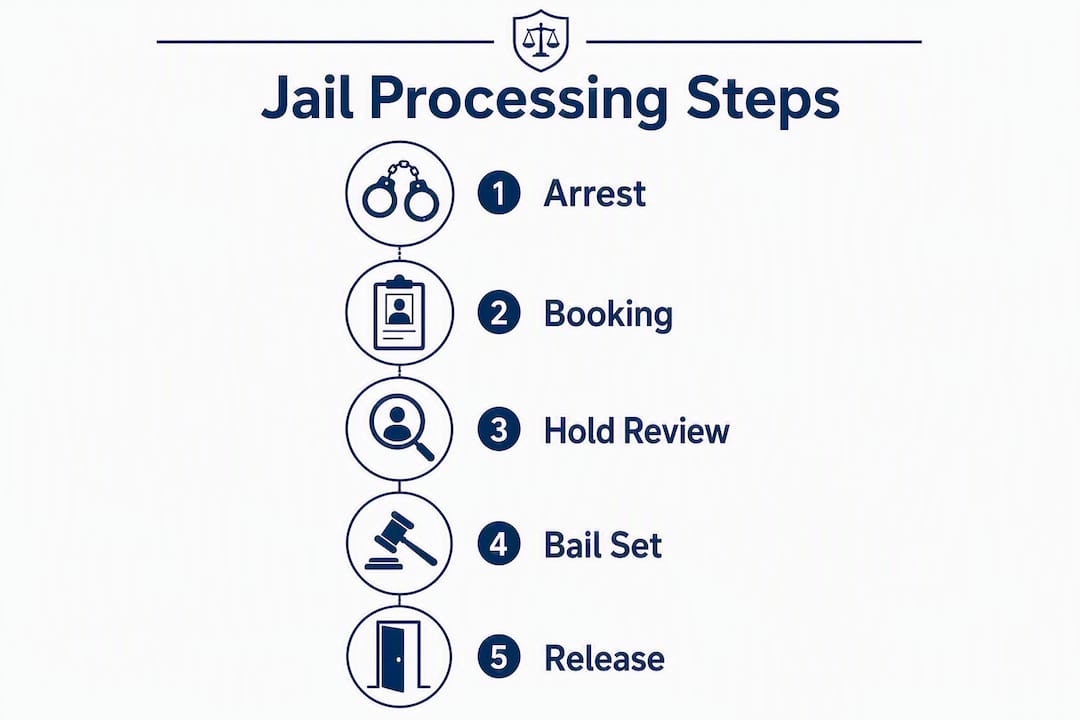
Understanding where time gets spent makes the waiting less confusing. Here is the sequence most county jails follow, with honest estimates for each stage.
-
Transport to the facility: Officers drive the arrestee to the booking facility. Distance, traffic, and whether multiple stops are made all affect this window.
-
Initial custody intake: Staff verify identity, conduct a pat-down search, and inventory personal property. A combative or uncooperative detainee gets segregated, which pauses the line for everyone behind them.
-
Fingerprints and photographs: Biometric data is collected and run through state and federal databases. Equipment failures or database timeouts add time here.
-
Arrest paperwork and charge entry: Officers complete charging documents; jail staff enter the data into internal systems. In facilities without integrated databases, arresting officers record details that jail staff must re-enter manually, creating handoff delays and occasional errors.
-
Medical and behavioral screening: Every detainee receives a health screening. Someone who is intoxicated, injured, or showing signs of a mental health crisis cannot be processed further until medically cleared. This single step can vary greatly in duration.
-
Classification and housing assignment: Staff determine where the person will be housed based on charge, criminal history, and safety considerations.
-
Warrants and background checks: Databases are queried for outstanding warrants, probation or parole status, and immigration holds. A hit on any of those pauses the process entirely.
-
Magistrate appearance or bail determination: In many jurisdictions, a magistrate must review the charges and set bail before the person can post bond. On weekends or holidays, this step can be the longest single delay.
-
Bond posting and verification: Once bail is set, the co-signer or bondsman submits payment. Staff verify the bond, confirm the bondsman's license, and run a final warrant check.
-
Out-processing and physical release: The final stage. The facility queues the release, returns property, and processes paperwork before the person walks out.
Pro Tip: Have the defendant's full legal name, exact date of birth, booking number, and the arresting agency's name ready before you call the jail or a bondsman. Missing even one of those details forces staff to run a broader search, which adds time at every stage.
The main reasons jail processing times differ across counties
Staffing and shift patterns
Jails run 24 hours a day, but administrative staffing does not. Booking officers, classification staff, and magistrates work in shifts, and the night shift on a Saturday is almost never as fully staffed as a Tuesday afternoon. Friday nights, weekends, and holidays consistently push processing into the 8–24+ hour range in busy counties because arrest volume spikes while the number of people available to process it drops.
Booking volume and surge events
A single arrest processed on a quiet afternoon moves quickly. A batch of 30 arrestees arriving from a large event, a DUI checkpoint, or a multi-agency operation creates an immediate queue at every step: intake, fingerprinting, medical screening, classification. Each person in line waits for the one ahead of them to clear. Batch transports create artificial surges at intake points that can generate multi-hour backlogs; smoothing transport schedules is one of the most effective operational fixes available, but most counties have not implemented it.
Technology and manual paperwork
Statistic callout: Facilities without integrated digital systems often report repeated manual verification and handoffs that create queueing across multiple intake steps. Research on jail intake bottlenecks identifies duplicate data entry as one of the highest-impact sources of delay, because the same information is recorded by the arresting officer, re-entered by jail staff, and sometimes entered again into a separate classification system.
Paper-based facilities move slower at every stage. A single missing form can hold up a release for hours while staff track down a signature or reprint a document.
Holds and cross-jurisdictional warrants
Outstanding warrants from another county or state, active probation or parole holds, and Immigration and Customs Enforcement (ICE) detainers all stop the release clock regardless of whether local bail has been posted. When background checks surface an outstanding warrant, release is paused until the other jurisdiction accepts or drops the hold, which can add days, not hours.
Court schedules and judge availability
Some charges require a judge to set bail rather than a standard bail schedule. If the magistrate is unavailable because of court closures, a holiday, or a backlog of cases, the detainee waits. A Bexar County evaluation study found that a "dual magistration" policy, where detainees are reviewed by two separate magistrates at different points in the process, added multiple hours to processing and produced large batch transfers that compounded backlogs at the receiving facility.
Facility design and physical flow
Larimer County Sheriff's Office documentation notes that combative detainees are segregated and that poor physical layout increases administrative delays. A cramped intake area where fingerprinting, medical screening, and property storage share the same hallway creates bottlenecks that no amount of staffing can fully overcome. Facility design is one of the least-discussed but most consistent contributors to processing time variance.
How posting bail actually affects the release timeline
Posting bail is not the finish line. It is closer to the halfway point.
Once bail is set, a co-signer or licensed bondsman submits the bond. Verification typically takes 30 minutes to 2 hours under normal conditions. Staff confirm the bondsman's license, match signatures, and run a final warrant check before accepting the bond. Electronic surety submissions and remote digital options reduce in-person bottlenecks and are especially useful when the co-signer is out of state or cannot appear in person.
After the bond clears, out-processing begins. That means returning personal property, completing release paperwork, and physically escorting the person out. That phase alone can take 1–8 hours under normal load and runs longer during surges or on weekends. The facility controls every minute of it.
Common verification steps that happen after payment:
- Bondsman license confirmation against state records
- Signature matching between the bond document and booking paperwork
- Final warrant and hold re-check across local, state, and federal databases
- Supervisor sign-off on the release order
- Property inventory reconciliation
Pro Tip: When calling a bondsman, have the defendant's full name, exact date of birth, and booking number ready. Also bring a valid government-issued ID and your payment method. Incomplete information forces the bondsman to run a broader search, which delays the paperwork they submit to the jail.
For a detailed walkthrough of the 24-hour bail bond process, including what happens at each handoff between bondsman and facility, that guide covers it step by step.
Special holds that add hours or days to processing
Most of the time, a straightforward booking moves through the system at a predictable pace. The outliers almost always involve one of the following:
- Outstanding warrants: A warrant from any jurisdiction, including another county or state, triggers a hold. The arresting county cannot release the person until the warrant is resolved or the issuing jurisdiction declines to extradite.
- Probation or parole holds: A probation or parole officer must be notified and may place a hold pending a violation hearing. That hearing does not happen at the jail.
- ICE detainers: Immigration and Customs Enforcement can place a detainer requesting that the facility hold the person for up to 48 hours beyond their release date. This is separate from the criminal charge and is not resolved by posting bail.
- Mental health holds: If a detainee is assessed as a danger to themselves or others, a psychiatric hold can pause processing until a mental health professional clears them.
- Medical holds: Serious injury, acute intoxication, or a medical emergency requires treatment before booking can continue. There is no fixed timeline for this.
- Court-ordered holds: A judge may issue a no-bail hold or a specific order that prevents release regardless of bond.
Transfers between facilities for felony cases or multi-jurisdiction holds add another layer. Some people move through two or three facilities before their case is resolved, and each transfer resets administrative timelines at the receiving end.
Important caveat: Hold policies, detainer procedures, and transfer protocols differ significantly by state and county. What applies in one California county may not apply in another, and federal holds operate under entirely separate rules. Check with the specific jail's information line or consult an attorney for the exact policies governing a particular case.
What realistic timelines look like across different scenarios
The ranges below reflect published county data and reported averages. They assume no holds, no medical complications, and standard staffing unless noted.
| Scenario | Estimated Range | Primary Variable |
|---|---|---|
| Small county, misdemeanor, weekday | 1–3 hours | Low volume, full staffing |
| Medium county, misdemeanor, weekday | 2–6 hours | Moderate volume, standard flow |
| Large metro, DUI, weekend night | 8–24+ hours | High volume, reduced staffing |
| Any county, felony requiring magistrate | — | Court availability, bail hearing |
| Any county, outstanding warrant or hold | Days | Other jurisdiction's timeline |

Scenario 1: Small county, misdemeanor, Tuesday morning. A person arrested for a low-level misdemeanor in a rural county with a small daily booking volume can realistically expect to be released within a few hours of arrival at the facility, assuming no holds and a bail schedule that allows immediate bond posting.
Scenario 2: Large metro, DUI, Friday night. The same charge in a large urban jail on a Friday night looks completely different. Peak arrest periods from Friday through Sunday, combined with weekend staffing shortages, commonly push processing into an extended range in busy counties. The queue at intake alone can run several hours before the person even reaches fingerprinting.
Scenario 3: Felony requiring a magistrate appearance. When bail cannot be set from a schedule and a judge must review the case, the timeline depends on when court is next in session. Weekend arrests on felony charges routinely result in Monday morning arraignments, meaning 48–72 hours in custody before bail is even set.
For more on how jail type affects the bail process, including differences between city jails, county detention centers, and state facilities, that breakdown is worth reading before you call.
What research says about reducing processing delays
The evidence on what actually shortens processing time points to a consistent set of operational changes, none of which are complicated in concept but all of which require institutional commitment to implement.
Research finding: The Bexar County Justice Intake & Assessment Annex evaluation identified dual magistration and uncoordinated batch transports as the two largest structural contributors to processing delays, with dual magistration alone adding an estimated six hours on average. Eliminating redundant magistration steps and coordinating transport schedules were the top recommended interventions.
Processing delays are usually the result of many small, manual inefficiencies stacking up rather than one catastrophic failure. The highest-impact improvements documented in facility research include:
- Single shared intake database: Arresting officers enter data once; jail staff access the same record rather than re-entering it. This eliminates the most common source of duplicate work.
- Electronic surety and remote bond submission: Digital surety reduces in-person bottlenecks and speeds verification, especially for out-of-state co-signers.
- Virtual magistration: Remote video hearings allow judges to review cases without requiring physical transport to a courtroom, cutting hours from the magistration step.
- Coordinated transport scheduling: Spreading arrests across intake windows rather than delivering large batches simultaneously reduces peak queueing at every downstream step.
- Integrated warrant and hold checks: Running database queries in parallel rather than sequentially cuts the background check window significantly.
Facilities that have adopted even a subset of these changes report measurable reductions in time-to-release. The gap between a well-integrated county jail and a paper-based one can be measured in hours per case.
What to do when release is taking longer than expected
Waiting without information is the hardest part. Here is a practical sequence for co-signers and family members.
-
Check the online inmate roster first. Most county jails publish a searchable roster updated every few hours. Confirm the person is in the system and note the booking number, charge, and bail amount before making any calls.
-
Call the jail's information line. Ask specifically: Has booking been completed? Has bail been set? Are there any holds or warrants? What is the estimated release queue time? Write down the name of the person you speak with and the time of the call.
-
Contact your bondsman with the booking information. A licensed bondsman can often get faster status updates through their existing relationships with jail staff. Give them the full name, exact date of birth, booking number, and arresting agency.
-
Ask about holds or warrants explicitly. If the jail confirms a hold, ask which agency placed it and what the process is for resolving it. That agency, not the jail, controls the timeline from that point.
-
Ask about magistrate or court scheduling. If bail has not been set, find out when the next magistrate session is scheduled. For weekend arrests, this is often the critical question.
-
Request supervisor escalation if you are getting no answers. Politely ask to speak with a shift supervisor if front-line staff cannot provide a status update after multiple calls.
-
Consult an attorney if the hold is complex. Probation holds, ICE detainers, and multi-jurisdiction warrants require legal intervention that a bondsman cannot provide. An attorney can file motions and communicate directly with the relevant agencies.
For after-hours situations, emergency bail services operate outside standard business hours and can begin the bond paperwork while you gather information from the jail.
How long can someone legally be held before seeing a magistrate?
There is no single national answer. The U.S. Constitution's Fourth Amendment requires a prompt judicial determination of probable cause after a warrantless arrest, and the Supreme Court's ruling in County of Riverside v. McLaughlin (1991) established that 48 hours is generally the outer limit for that determination. Most states set shorter statutory deadlines, often 24–48 hours, but the definition of "prompt" and the exceptions allowed vary considerably.
Key points on legal time limits:
- Most jurisdictions require a probable cause hearing or magistrate appearance within 24–72 hours of arrest, excluding weekends and holidays in some states.
- Court closures on weekends and holidays create practical delays even when statutory limits exist. A Friday night arrest in a jurisdiction that does not hold weekend court can result in a Monday morning appearance without technically violating the statute.
- Felony charges often carry different procedural timelines than misdemeanors, including separate arraignment requirements.
- Holds placed by other agencies (probation, parole, ICE) operate under their own legal frameworks and are not governed by the same timelines as the underlying criminal charge.
State and county rules vary significantly. The information above reflects general U.S. practice, not the specific statutes of any particular state or county. For the exact deadlines and procedures that apply to a specific case, check the county sheriff's or detention center's published booking policies, or consult a licensed attorney in the relevant jurisdiction.
For context on how judges set bail and what factors influence that decision, that guide covers the criteria most courts apply.
This article provides general information about jail processing procedures. It is not legal advice. Confirm current rules and timelines with the relevant county jail, sheriff's office, or a qualified attorney.
Key Takeaways
County jail processing time varies because staffing, booking volume, holds, court availability, and facility technology all compound, meaning a single factor rarely explains the full delay.
| Point | Details |
|---|---|
| Time of day and day of week matter most | Weekend and holiday arrests in large counties routinely take 8–24+ hours due to reduced staffing and higher volume. |
| Holds stop the clock entirely | Outstanding warrants, probation holds, and ICE detainers pause release regardless of whether bail has been posted. |
| Bond posting is not the finish line | After bond verification (30 minutes–2 hours), out-processing adds another 1–8 hours under normal load. |
| Manual systems compound every delay | Facilities without integrated databases repeat data entry at multiple steps, adding cumulative hours to each case. |
| Jakehernandezbailbonds covers all 58 California counties | Available 24/7 with 0% down options and bilingual support to handle bond paperwork as fast as the facility allows. |
What the waiting actually reveals about the system
Most people assume a long wait means something went wrong with their loved one's case. Usually, it means something went wrong with the facility's workflow, and those are very different problems.
The research on jail intake is consistent: the biggest delays are not caused by complex legal questions. They come from duplicate data entry, uncoordinated transport schedules, paper-based handoffs, and staffing gaps that have existed for decades. A person arrested on a minor charge can sit in a holding cell for eight hours not because their case is complicated, but because the facility is running the same manual process it ran in 1995.
That matters for families because it changes what you can actually do. You cannot speed up a magistrate's schedule or force a warrant to clear. But you can make sure the bondsman has complete information from the first call, which eliminates one of the most common avoidable delays on the paperwork side. You can call the jail with specific questions rather than general ones, which gets you better answers. And you can recognize when a delay signals a hold that needs an attorney rather than just more waiting.
The other thing worth understanding: a licensed bondsman does not control the jail's timeline, and anyone who tells you otherwise is not being straight with you. What a good bondsman does is handle their side of the process without adding to the delay, submit paperwork correctly the first time, and communicate clearly with both the family and the facility. That is the realistic value of the service, and it is a real one.
How a licensed bail agent fits into the process
When someone you care about is in custody, the bond paperwork is one piece of the process you can actually control. Jakehernandezbailbonds handles that piece 24/7 across every county in California, with no middleman and no call center between you and a licensed agent.
The practical advantages for families under pressure: 0% down options for qualified co-signers, bilingual support in Spanish, Hindi, and Arabic, and free consultations so you understand the fee structure before you commit. The statutory premium in California is set by law, and Jakehernandezbailbonds works within that framework with attorney and military discounts available. Bonds range from $1,000 to $1,000,000, including federal and immigration bonds for ICE detainer situations.
One honest note: even after the bond is submitted and verified, the facility controls when the person physically walks out. A bondsman who submits clean, complete paperwork on the first attempt removes one source of delay. The rest is the jail's timeline. Jakehernandezbailbonds will tell you exactly where things stand and what to expect at each step.
To get started or check coverage for a specific facility, visit California bail bonds 24/7 or use the bail bond cost calculator to estimate fees before you call.
Authoritative sources and local resources to check
Policies differ by state and county. Before drawing conclusions about a specific case, verify current procedures directly with the relevant facility. Look for magistration hours, bail schedule availability, and after-hours release procedures on the county sheriff's or detention center's official site.
- Miami-Dade County: What Happens After an Arrest: A clear county-published overview of booking steps and release factors, useful as a reference for how large metro jails describe their own process.
- Utah County Sheriff's Office Booking Process: Step-by-step booking documentation from a mid-size county sheriff's office.
- Bexar County JIAA Evaluation Study: A detailed operational evaluation of a large Texas county's intake process, with findings on dual magistration and transport scheduling.
- 365 Labs: Bottlenecks in Jail Intake: Research-backed analysis of where manual systems create the most delay and what integrated solutions look like.
- Larimer County Sheriff's Office Jail: Published facility documentation covering intake procedures and detainee handling policies.
- California jails covered by Jakehernandezbailbonds: A county-by-county list of facilities served, useful for confirming coverage before contacting a bondsman.
For any specific case, call the county jail's public information line directly and ask for the booking status, hold status, and next scheduled magistrate session. Those three questions will tell you more than any general guide can.