A phone consultation with a licensed bail agent is the fastest practical way to start posting bail without ever driving to the jail. In one call, an agent confirms the arrest, opens the paperwork, arranges payment, and dispatches someone to post the bond in person. If you have the right details ready and a co-signer who can move quickly, that phone call can set release in motion within minutes, not hours.
The one thing to do right now: call a licensed 24/7 bail agent. Jake Hernandez Bail Bonds and similar licensed agencies staff phones around the clock specifically for this moment.
What that first call actually does:
- Confirms the person is in custody and identifies which facility holds them
- Verifies whether bail has been set and for how much
- Starts the paperwork process, often through e-signature
- Arranges remote payment so an agent can head to the jail immediately
Key Takeaways
A phone consultation with a licensed bail agent is what actually starts the release process, because it verifies the arrest, arranges payment, and initiates paperwork before anyone drives to the jail.
| Point | Details |
|---|---|
| Call first, gather second | Not knowing the booking number shouldn't stop you from calling; agents can often locate detainees with just a name and date of birth. |
| Prepare co-signer documents | Have a photo ID, proof of address, and income information ready to speed the screening step. |
| Expect 2 to 8 hours | Release after posting typically takes 2 to 8 hours, longer with holidays, weekends, or serious charges. |
| Verify before you pay | Confirm the agent's license number through your state's Department of Insurance before sending any payment. |
| One point of contact | Designate a single family member to speak with the agent to avoid conflicting instructions that delay processing. |
| Jake Hernandez Bail Bonds | Offers 24/7 bilingual phone consultations statewide in California with payment plans for qualified co-signers. |
Table of Contents
- What Happens During an Emergency Phone Consultation
- Checklist: What to Have Ready Before You Call
- How Agents Post a Bond After the Phone Call Ends
- How Long Release Actually Takes After Bond Is Posted
- How to Verify a Bail Agent Is Legitimate
- Privacy and Confidentiality Concerns During Phone Consultations
- Legal Limitations of Phone Consultations Across Jurisdictions
- Where the Phone Call Fits Into the Full Bail Process
- Why the Phone Call Matters More Than People Assume
- How Jake Hernandez Bail Bonds Handles Your First Call
- Frequently Asked Questions
- Sources
What Happens During an Emergency Phone Consultation
The agent on the other end of the line is doing real verification work, not just taking a message. They need the detainee's identity confirmed, the facility name, and whatever booking information you have. This isn't small talk. It's the groundwork that has to happen before anyone can post a bond.
Here's roughly how the call unfolds:
- The agent asks for the defendant's name, date of birth, and the jail or facility holding them.
- They check whether a booking number and bail amount already exist, or if bail hasn't been set yet.
- They screen the co-signer, meaning you, for identification and payment capacity.
- They explain what collateral or payment plan options apply to this specific bail amount.
- They outline next steps and the rough timeline once paperwork and payment are done.
A phone consultation can promise action, but it can't finalize anything. Release only happens after signed paperwork and cleared payment, and the agent still has to physically post the bond at the facility. If bail hasn't been set yet, which is common right after an arrest, the agent will tell you what to expect and when to check back rather than quoting a number that doesn't exist yet.
Pro Tip: If the arraignment hasn't happened and bail isn't set, ask the agent to walk you through the county's typical timeline for setting bail on the specific charge. That single question saves you from calling every hour for an update.
Checklist: What to Have Ready Before You Call
Speed on the phone depends entirely on what you bring to the conversation. Agents can sometimes locate a detainee using just a name and date of birth when the booking number is missing, so don't let a gap stop you from picking up the phone. But the more you have ready, the faster this moves.
Defendant information:
- Full legal name and date of birth
- Jail or facility name
- Booking number, if you have it
- Charges, if known
- Bail amount, if already set
Co-signer information:
- Government-issued photo ID
- Current address
- Employer or income information for financial screening
- A working phone number and email for e-signature paperwork
Payment readiness:
- A credit card ready to go, or confirmation you can wire funds
- Willingness to discuss a payment plan if the full premium isn't available upfront
Having a defendant's full legal name, date of birth, jail location, and bail amount ready, along with the co-signer's own ID and income details, is what typically expedites an emergency bail bond request. One more thing that matters more than people expect: pick a single family member to be the point of contact. Multiple relatives calling with slightly different information is one of the most common causes of unnecessary delay in an already stressful process.
How Agents Post a Bond After the Phone Call Ends
Once the consultation ends, the work shifts from talking to processing. Here's the sequence most licensed agents follow:
- The agent contacts the jail directly to verify the arrest, the booking number, and the current bail amount using the details you provided.
- Paperwork gets completed electronically, typically through e-signature tools that let the co-signer sign from a phone or computer without visiting an office.
- Payment is collected, whether by card, wire, or an agreed payment plan, and a receipt is issued for the amount paid.
- Once payment clears, the agent physically travels to the facility and posts the bond with jail staff.
Online and mobile bail services increasingly let families start the entire process from a phone, with digital forms and payment links replacing what used to require an in-person office visit. While the agent posts the bond, your job is simple: stay reachable. Jails sometimes call back with a question about a name spelling or a document that didn't come through clearly, and a missed callback can add hours to a process that should take minutes. Keeping bail paperwork accurate the first time avoids a second round of signatures.
How Long Release Actually Takes After Bond Is Posted
Release timing after a bond is posted commonly runs 2 to 8 hours, though plenty of cases move faster and some take longer. That window depends on factors mostly outside the agent's control.
What tends to slow things down:
- Facility workload, especially at large county jails processing dozens of releases at once
- Arrests made late at night or over a weekend, when staffing is thinner
- Holidays, which can stretch even routine processing by several extra hours
- Serious charges that trigger additional review before release paperwork clears
What speeds things up: clean paperwork, a co-signer who responds to calls immediately, and an arrest that happened during regular business hours at a facility with steady staffing. If hours pass with no update, ask the agent for the exact status of the bond and whether the facility has confirmed receipt. You can also call the jail's booking desk directly to ask where the paperwork stands. For a deeper look at why county jail processing time varies so much from one facility to the next, it helps to understand the staffing patterns behind the numbers.
How to Verify a Bail Agent Is Legitimate
Emergencies attract scammers, and bail is no exception. Legitimate agents do not cold call families demanding money; if you receive an unsolicited call like that, treat it as a red flag immediately.
Run these checks before you pay anyone:
- Ask for the agent's license number and verify it through your state's Department of Insurance lookup tool.
- Call the company back using the phone number listed on its own official website, not the number that called you.
- Insist on a written contract and a receipt before or immediately after any payment.
- Never give a Social Security number or full bank account details to someone who contacted you first.
Pro Tip: If anything about the call feels rushed or the agent avoids giving you a license number, pause. Hang up, look up the company independently, and call back on a number you found yourself.
If something still feels off after you've verified, don't pay. Contact the jail directly to confirm the person is actually in custody there, or call a defense attorney for a second opinion before sending money anywhere.
Privacy and Confidentiality Concerns During Phone Consultations
A bail phone call involves sensitive information: full names, dates of birth, financial details, and sometimes the nature of the charges. Reputable agencies treat that information as confidential and use it only to process the bond, not to sell or share it.
Still, you should be deliberate about what you say and where you say it. Avoid discussing case specifics on speakerphone in a crowded waiting room or public space where strangers can overhear names, addresses, or financial details. If the agent asks for sensitive identity documents like a photo ID or proof of income, ask how that information will be transmitted and stored before sending anything over text or email.
A legitimate agency will also keep the co-signer's financial information separate from anything related to the criminal case itself. That separation matters because a co-signer's credit and payment details have nothing to do with the underlying charges and shouldn't be treated as part of the same file. If an agent seems to be gathering unrelated personal information beyond what's needed to write the bond, such as detailed questions about the alleged offense that go beyond confirming charges, that's worth a direct question about why they need it. Confidentiality concerns are a legitimate reason to ask an agent to explain their data handling before you hand over sensitive documents, not a reason to avoid the call altogether.
Legal Limitations of Phone Consultations Across Jurisdictions
A phone consultation can gather facts and start paperwork almost anywhere, but what happens next depends heavily on local law. Bail rules are not uniform, and an agent's ability to act on your call varies by state and even by county.
Some jurisdictions have moved away from cash bail entirely. In places that have eliminated cash bail for certain charges, there may be no bond to post at all, and the phone consultation's real value shifts toward connecting you with a defense attorney or pretrial services rather than arranging payment. Calling a bail agent in one of those situations still has value, since a knowledgeable agent will tell you plainly that a bond isn't the right tool and point you toward what actually applies.
Licensing also matters. A bail agent is typically licensed to operate within a specific state, and sometimes within specific counties inside that state. An agent licensed and experienced in one state generally can't post a bond in a different state's facility, even if they're happy to talk you through the process on the phone. If your family member was arrested while traveling, confirm the agent you're calling actually operates in that jurisdiction before you get too far into paperwork. Ask directly during the consultation. A legitimate agent will answer that question without hesitation.
Where the Phone Call Fits Into the Full Bail Process
The phone consultation is the front door, not the whole house. It's the part that happens fastest and remotely, but it connects directly to steps that still require someone physically present at the jail.

Think of it as three linked stages. First, the phone call handles fact gathering, screening, and initiating paperwork. Second, the electronic signing and payment happen, often within the same call or shortly after, using the tools described earlier for e-signatures and remote payment. Third, an agent has to physically go to the facility, hand over the necessary documents and payment confirmation, and wait for jail staff to process the release.
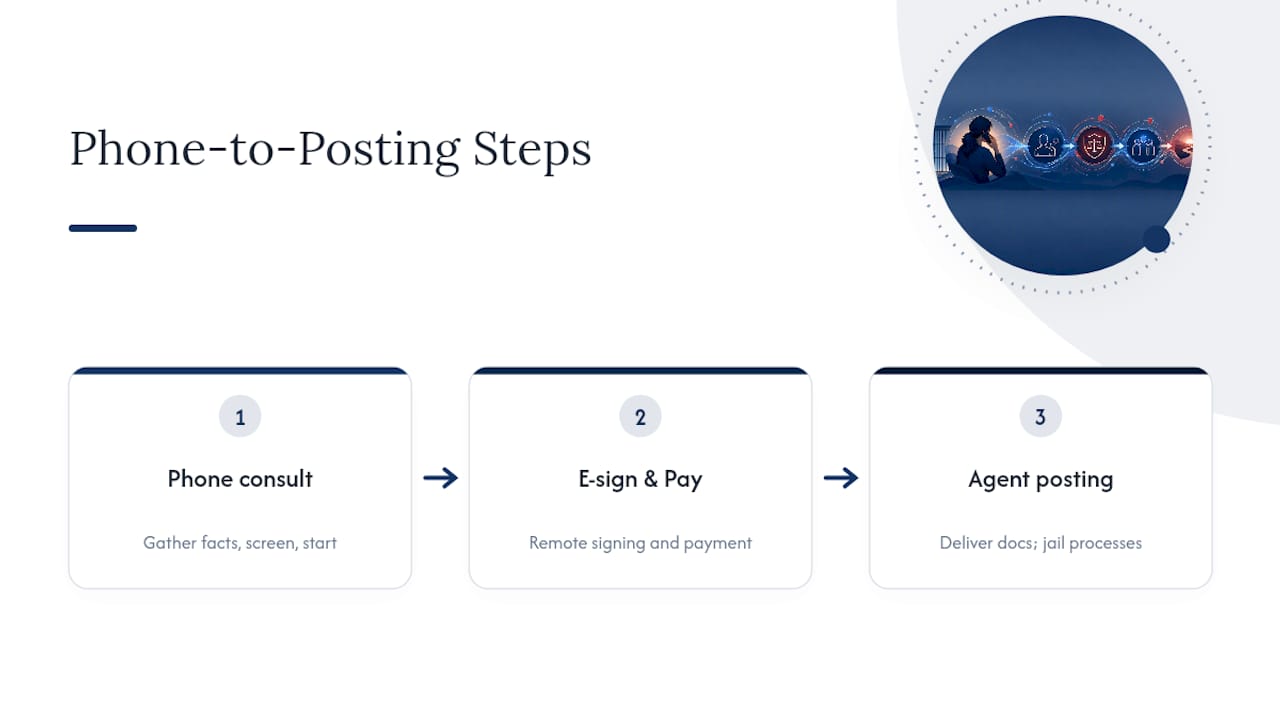
That third stage is the one that still runs on the jail's schedule, not yours or the agent's. No phone call, however smooth, changes how fast a specific facility processes its paperwork on a given Tuesday night. What the call does is eliminate every delay that would otherwise happen before that final in-person step, like driving to an office, filling out forms by hand, or waiting for a payment to be mailed. Understanding this handoff helps you know what to ask about at each stage: use the call to confirm details and speed and use follow-up questions with the agent to track the in-person posting once it's underway.
Why the Phone Call Matters More Than People Assume
Most advice about bail focuses on the money: how much it costs, what percentage you'll pay, whether you need collateral. That's real, but it undersells the actual bottleneck in most emergency cases, which is information, not cash. Families lose hours not because they can't afford a bond but because nobody has the booking number, three relatives are calling with different versions of the same story, and nobody thought to ask whether bail has even been set yet.
The conventional advice, "call a bail bondsman," treats the call as a formality before the real work starts. In practice, that call is the real work. A well-run five-minute consultation with accurate information can save more time than an extra thousand dollars in the co-signer's pocket. Agents can't post a bond faster than a jail processes it, but they can eliminate every unnecessary delay that happens before that point, and most delays are self-inflicted.
If there's one thing worth doing differently than instinct suggests, it's this: designate one person to talk to the agent before anyone else starts calling around. Chaos on your end doesn't speed anything up. Clarity does.
How Jake Hernandez Bail Bonds Handles Your First Call
Jake Hernandez Bail Bonds runs its phone consultations without a call center standing between you and someone who can actually act, which matters when every extra transfer costs you time you don't have. Coverage spans all 58 California counties, staff answer around the clock, and bilingual support in Spanish, Hindi, and Arabic means language never has to slow down a call that's already happening under pressure.
Here's what that first call looks like in practice. Once payment and signatures clear, an agent heads to the jail to post the bond and keeps you updated on status until release.
Before you call, have the defendant's name, date of birth, facility, and bail amount ready if you know it, along with your own photo ID. If you're near a specific facility, browse California jails covered statewide to confirm service in that county, or check the bail cost calculator to estimate the premium before you dial. When you're ready, call Jake Hernandez Bail Bonds directly and start the consultation now.
Frequently Asked Questions
Can a bail agent really start the process entirely over the phone? Yes, in most cases. Agents can verify the arrest, complete paperwork through e-signature, and collect payment remotely, then post the bond in person once everything clears.
What if I don't know the booking number? Call anyway. Agents can frequently locate a detainee using just a full legal name and date of birth, and the booking number often turns up once the agent contacts the jail directly.
How fast will my family member actually be released? Once the bond is posted, release commonly takes 2 to 8 hours, though facility workload, time of day, and the seriousness of the charges can extend that window.
How do I know a bail agent isn't a scam? Ask for their license number and verify it through your state's Department of Insurance. Call the company back using the number on its official website, not the number that called you, and always get a written contract before paying.
What happens if bail hasn't been set yet? The agent will explain the county's typical timeline for setting bail on that charge and tell you when to check back. A phone consultation can still gather information and prepare paperwork in advance so you're ready to move the moment bail is set.
Sources
- Can You Bail Someone Out Over the Phone? Here’s How - LegalClarity
- What to Say When Calling a Bail Bondsman at 2 AM (NC) - Sloan Bail Bonding
- Online Bail Bonds From Your Phone | Gear Bail Bonds