
Bail reinstatement is a court order that restores a previously forfeited or revoked bail bond to its original amount, allowing a defendant to be released under the same terms as before. According to USLegal and the Justia Legal Dictionary, reinstatement specifically reestablishes bail after it had been forfeited, exonerated, or reduced. It is a privilege, not a right, and courts grant it at their discretion.
If you are reading this because someone missed a court date, act now:
- Call a defense attorney immediately. The filing window for reinstatement motions varies by state and is often limited.
- Contact the bail bondsman or surety. The surety's written consent is usually required before a court will reinstate the bond.
- Gather documentation right now. Medical records, hospital bills, travel records, police reports, anything that explains the absence.
- Do not wait to see what happens. Deadlines are real, and missing the filing window can convert a fixable problem into a civil judgment.
Table of Contents
- How bail reinstatement differs from related remedies
- Why bail gets revoked in the first place
- Who can ask for reinstatement and who acts in practice
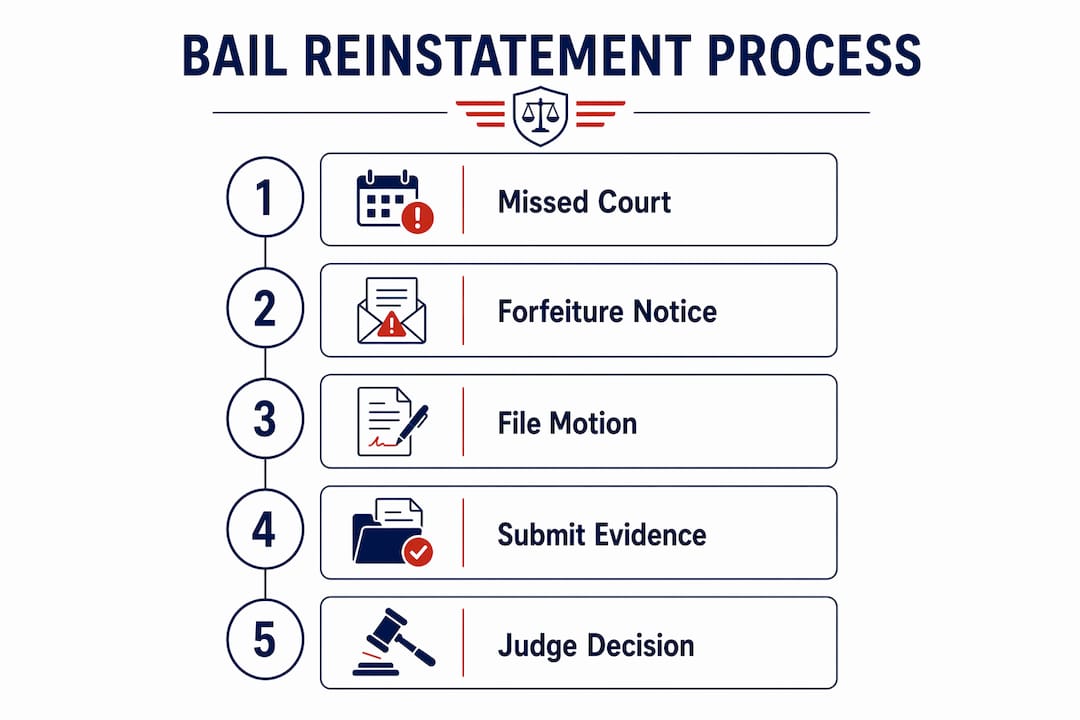
- How to reinstate bail: the step-by-step process
- What courts weigh when deciding whether to grant reinstatement
- Possible outcomes and what each means for you
- Timeline and costs: what to expect financially
- When reinstatement is unlikely and what to do instead
- How bail bondsmen help with reinstatement in practice
- Key Takeaways
- What I have seen after years of handling these cases
- Jakehernandezbailbonds is available 24/7 across California
- Useful sources and where to find local rules
How bail reinstatement differs from related remedies
Bail reinstatement restores the original bond and its conditions after forfeiture or revocation. The surety typically remains liable under the reinstated bond, which is the key distinction from other remedies.
Here is how the main options compare:
- Reinstatement: The court restores the original bond. The defendant is released under prior conditions. The surety stays on the hook unless the court separately exonerates them.
- Vacatur / set-aside forfeiture: The court erases the forfeiture as if it never happened. As LegalClarity explains, vacating a forfeiture exonerates the surety entirely, which is a materially better outcome for the bondsman than reinstatement alone.
- Remission: A partial refund of a forfeited amount after the discharge window has closed. Florida's statutes, for example, provide two separate paths: discharge under a short window and remission on a sliding scale when that window passes.
- Posting a new bond: The defendant or family secures a fresh bond after the old one is forfeited. This costs a new premium and does not recover anything from the original bond.
A concrete example shows why the choice matters. Suppose a surety posted a $50,000 bond and the defendant missed a court date. If the court grants reinstatement, the surety remains liable for $50,000 going forward. If the court grants vacatur, the surety is exonerated and owes nothing. Defense counsel must choose and plead the right remedy, because courts will not automatically grant the more favorable one.
Why bail gets revoked in the first place
Revocation or forfeiture almost always traces back to one of a handful of triggers. Knowing which one applies shapes the entire reinstatement strategy.
- Failure to appear (FTA): Missing a scheduled court date is the most common trigger. Courts issue a bench warrant and declare the bond forfeited.
- Violating release conditions: Travel restrictions, no-contact orders, curfews, GPS monitoring requirements. Any breach can prompt revocation.
- New arrest: Getting arrested on a new charge while out on bail is grounds for immediate revocation in most jurisdictions.
- False information on the bond application: If the defendant or indemnitor misrepresented facts to obtain the bond, the surety and the court can both move to revoke.
- Noncooperation with supervision: Skipping mandatory drug tests, failing to check in with a pretrial services officer, or removing an ankle monitor.
The circumstances behind the trigger matter enormously. A defendant hospitalized in the ICU on the day of a hearing, with admission records to prove it, presents a fundamentally different case than someone who simply did not show up and cannot explain why. Courts look at whether the nonappearance was willful or excusable, and that distinction drives the outcome more than almost anything else. Local statutes and court rules can also create technical triggers around notice requirements, so understanding how forfeiture proceedings work in your specific jurisdiction is worth doing early.
Who can ask for reinstatement and who acts in practice
Several parties have standing to seek reinstatement, but their practical roles differ.
- Defendant: Has the most direct interest but is often in custody and cannot act alone.
- Defense attorney: The person who actually drafts and files the motion in most cases. Choosing the right remedy (reinstatement vs. vacatur) is a legal strategy call.
- Bail bondsman / surety: Under California Penal Code §1305, the court can reinstate a bond only if the bail has been given prior notice and has not already surrendered the defendant. In practice, the surety's written consent or active participation is usually required.
- Indemnitor / co-signer: The person who financially guaranteed the bond. They have strong financial motivation to pursue reinstatement and can push the bondsman and attorney to act quickly.
- Court clerk / judge: The clerk receives and dockets the motion; the judge rules on it.
The surety's role is often underestimated by families. A bondsman who has already surrendered the defendant, or who refuses to consent to reinstatement, can effectively block the remedy. That is why contacting the bondsman at the same time as the attorney is not optional.
Pro Tip: After a missed court date, call your defense attorney and your bondsman within the same hour. The attorney needs the bondsman's position before drafting the motion, and the bondsman needs the attorney's timeline to decide whether to consent or surrender.
How to reinstate bail: the step-by-step process
The motion to reinstate is a formal court filing. The defendant bears the burden of proving statutory or equitable grounds. Here is the full procedural sequence:
- Identify the forfeiture notice date. The clock starts when the court issues the forfeiture order and serves notice. Missing the statutory window is fatal to the motion.
- Contact the surety immediately. Confirm the bondsman's position: will they consent to reinstatement, or have they already moved to surrender the defendant?
- Retain defense counsel if you do not already have one. This is not a motion most people should file pro se.
- Draft the motion to reinstate (or set aside forfeiture). The motion must include: case caption, statement of facts explaining the nonappearance, citation to the applicable statute or equitable authority, the specific relief requested, supporting affidavits, and a proposed order for the judge to sign.
- Attach all supporting evidence. Medical records, hospital admission and discharge summaries, travel itineraries, police reports, notarized affidavits from witnesses, and proof of the surety's consent or involvement.
- File with the clerk of the court where the criminal case is pending. Pay any required filing fee. Get a file-stamped copy.
- Serve required parties. Typically the prosecuting attorney and, in some states, the principal of the bond. Minnesota's rules, for example, require service in the manner specified by Minn. R. Civ. P. 4.03(e)(1).
- Request a hearing date. Some courts set this automatically; others require a separate request.
- Prepare for the hearing. The attorney should be ready to present the excusable-cause argument, demonstrate community ties, and address the prosecution's objections. Judges want to see remorse, a credible explanation, and evidence that the defendant is not a flight risk.
- Attend the hearing. The defendant's presence, when possible, signals good faith.
- Follow up on the written order. A verbal ruling from the bench is not enough. Get the signed order and confirm the bondsman and jail have received it before expecting release.
Sample motion structure
A well-drafted motion typically includes these sections in this order:
- Caption: Court name, case number, defendant's name, motion title.
- Introduction / statement of relief requested: One paragraph stating exactly what the defendant is asking the court to do.
- Statement of facts: Chronological narrative of the missed date, the reason, and corrective steps taken.
- Legal authority: The statute or case law authorizing reinstatement in that jurisdiction.
- Argument: Why the facts satisfy the legal standard (excusable neglect, no willful avoidance, surety consent, community ties).
- Supporting affidavits: Attached and incorporated by reference.
- Proposed order: A one-page draft order for the judge to sign, with blanks for conditions.
Evidence that actually moves courts
Courts expect contemporaneous documentation to support claims of excusable nonappearance. The strongest petitions include:
- Hospital admission and discharge records dated to the missed court date
- Prescription records or physician letters on letterhead
- Flight records, hotel receipts, or border-crossing documentation for travel emergencies
- Police reports if the defendant was detained or involved in an accident
- Notarized affidavits from witnesses with personal knowledge
- Proof of the surety's written consent
Pro Tip: Affidavits are most persuasive when they are specific and dated. "I was admitted to Riverside University Health System on [date] at [time]" is far stronger than "I was sick." Judges have seen every generic excuse; contemporaneous records are what separate credible motions from weak ones.
Timeline expectations vary by jurisdiction and court workload. Filing typically takes one to three days once the motion is drafted. Hearing scheduling runs one to four weeks in most California courts. A ruling usually comes from the bench at the hearing or within a few days after. Total elapsed time from missed court date to ruling: commonly two to six weeks, though complex cases or crowded dockets can stretch that.
What courts weigh when deciding whether to grant reinstatement
Judges do not grant reinstatement automatically, even when the motion is technically proper. The factors below are what actually drive the decision.
- Reason for nonappearance: Was it willful or excusable? A medical emergency with documentation is the strongest possible showing. A vague claim of confusion is the weakest.
- Seriousness of the charges: Courts are far less willing to reinstate bail on violent felonies. For charges involving domestic violence, reinstatement is often unlikely regardless of the explanation.
- Criminal history and flight risk: Prior failures to appear, prior forfeitures, or a history of absconding weigh heavily against the defendant. Strong community ties, stable employment, and family roots in the jurisdiction cut the other way.
- Public safety: If the underlying charge involves violence or the defendant poses a risk to a victim or witness, courts will weigh that against release.
- Surety's position: A bondsman who actively supports reinstatement and agrees to remain liable signals to the court that a responsible party is watching the defendant.
- Promptness of corrective action: How quickly did the defendant and counsel respond after the missed date? Waiting weeks to file looks like indifference.
- Documentation quality: Thin or unverifiable documentation undermines even a sympathetic story.
The contrast between a strong and weak case is stark. A defendant hospitalized for emergency surgery, with admission records, a surgeon's letter, and a bondsman who consents to reinstatement, has a genuinely strong motion. A defendant who missed court, waited three weeks to contact anyone, and offers only a verbal explanation has a very weak one. The factors judges consider when setting bail overlap significantly with reinstatement factors, so understanding that framework helps.
Possible outcomes and what each means for you
Courts have several options when ruling on a reinstatement motion, and the financial and practical consequences differ significantly.
- Full reinstatement: The original bond is restored at its original amount. The defendant is released under the prior conditions. The surety remains liable. This is the best outcome for the defendant and family.
- Reinstatement with new or stricter conditions: The court reinstates the bond but adds conditions, such as electronic monitoring, increased check-ins, or a higher bond amount. The surety must agree to the new terms.
- Setting aside / vacating the forfeiture: The forfeiture is erased. The surety is exonerated and no longer liable. The defendant may or may not be released depending on whether a new bond is required.
- Denial of relief: The forfeiture stands. The court enters a civil judgment against the surety for the bond amount. The indemnitor becomes personally liable to the surety for that amount under the indemnity agreement they signed.
- Remission or partial refund: Available in some states after the discharge window closes. The court returns a percentage of the forfeited amount based on a statutory formula. Florida's statutes provide this mechanism explicitly.
- Requirement to post a new bond: The court releases the defendant only on a fresh bond, at a new premium. The original bond is not recovered.
For indemnitors, the denial scenario is the most financially damaging. When a surety pays a forfeiture judgment, they have the right to pursue the indemnitor for the full amount. That civil liability can include the entire bond value, not just the premium. Whether the defendant was released on a cash deposit or a surety bond also affects how refunds work: cash bail deposited with the court is subject to the court's forfeiture order directly, while a surety bond involves the insurance company's claim process.
Timeline and costs: what to expect financially
Planning around reinstatement requires understanding both the time pressure and the potential financial exposure.

| Stage | Typical Time Range |
|---|---|
| Forfeiture notice issued after missed court date | Same day to 5 business days |
| Statutory filing window (varies by state) | 30–180 days from forfeiture order |
| Motion drafting and filing | 1–3 days with counsel |
| Hearing scheduling | 1–4 weeks after filing |
| Court ruling | Same day as hearing to 1 week after |
| Civil judgment enforcement (if denied) | 30–90 days after judgment |
Costs vary widely, but the categories are consistent:
- Lost premium: The bail bond premium (typically 10% of the bond amount in California) is generally non-refundable regardless of outcome.
- Forfeiture penalty: If reinstatement is denied, the full bond amount is forfeited. For a $50,000 bond, that means a $50,000 civil judgment against the surety, which flows to the indemnitor.
- Sliding-scale penalties for late petitions: Some states impose mandatory minimums. Under Minnesota's court rules, a petition filed between 90 and 180 days from the forfeiture order requires a minimum penalty of at least 10% of the forfeited bail as a condition of reinstatement.
- Attorney fees: Motion drafting, hearing representation, and follow-up typically run several hundred to several thousand dollars depending on the market and complexity.
- Filing fees: Modest but real; varies by court.
- New bond premium: If a fresh bond is required, a new 10% premium applies.
Pro Tip: Start a dedicated folder the moment someone is arrested. Keep every receipt, every medical record, every travel document, and every communication with the court or bondsman. If reinstatement becomes necessary, that folder is your motion. If it does not, you lose nothing by having it.
When reinstatement is unlikely and what to do instead
Reinstatement is not always the right move, and sometimes it is simply not available.
- Motion for remission: When the discharge window has closed but some time remains, a remission petition can recover a portion of the forfeited amount. It does not restore the bond or release the defendant, but it limits financial damage.
- Motion to vacate / set aside forfeiture: Strategically better than reinstatement when the surety wants to be exonerated. Requires meeting statutory grounds but eliminates ongoing liability.
- New bail hearing or bail reduction motion: When reinstatement is denied or the original bond is too high to restore, a fresh bail hearing can reset the terms. Bail reduction hearing practices in California follow specific procedural rules worth reviewing before filing.
- Voluntary surrender of the defendant: If the surety locates the defendant and surrenders them to custody before the forfeiture judgment is entered, the surety can often be exonerated or have the penalty significantly reduced. This is the fastest way to stop the financial bleeding.
- Negotiating a new bond or payment plan with the surety: When the original bond is gone, some sureties will write a new bond with modified terms, especially if the indemnitor has a strong payment history.
The right alternative depends on timing. If the statutory window for discharge is still open, pursue vacatur. If it has closed, remission is the fallback. If the defendant is still at large, surrender may be the most practical path. Defense counsel and the bondsman need to coordinate on this, because the attorney's strategy and the surety's financial interest do not always align automatically.
How bail bondsmen help with reinstatement in practice
A bondsman's involvement in reinstatement goes well beyond writing a check. Here is what a competent bail bond professional actually does when a client misses a court date.

Immediate triage: The bondsman verifies the forfeiture notice, confirms the date it was issued, and checks whether the statutory notice requirements were followed. In California, Penal Code §1305 imposes specific mailing and notice duties on the court toward the surety. If those duties were not followed, the surety may have grounds to challenge the forfeiture entirely, which is a stronger outcome than reinstatement.
Document coordination: The bondsman contacts the indemnitor to collect medical records, travel documents, and any other evidence of excusable cause. They know what courts in their jurisdiction expect to see.
Filing support: Bondsmen can draft and file supporting affidavits, liaise with the court clerk on procedural requirements, and coordinate with defense counsel on the motion timeline.
Locating the defendant: If the defendant is at large, the bondsman has both the legal authority and the financial motivation to locate them. Returning the defendant to custody before the forfeiture judgment is entered can preserve reinstatement as an option.
Financial coordination: If a new bond is required, the bondsman can arrange funding quickly, including payment plan options for qualified indemnitors.
California-specific note: California's statutory deadlines under Penal Code §1305 are strict. The court must mail notice of forfeiture to the surety within 30 days of the missed appearance. If that notice is defective or late, the surety can move to vacate the forfeiture on procedural grounds. Missing this window is a common and costly mistake. Families dealing with a California case should ask their bondsman to verify notice compliance on day one.
Key Takeaways
Bail reinstatement is a court-ordered restoration of a forfeited bond, and it requires a timely formal motion, solid documentation, and active surety involvement to succeed.
| Point | Details |
|---|---|
| Reinstatement is discretionary | Courts grant it based on excusable cause, documentation quality, and surety consent — never automatically. |
| Filing deadlines are hard limits | Statutory filing deadlines vary across jurisdictions, and missing them forecloses the remedy. |
| Documentation drives outcomes | Medical records, travel logs, and notarized affidavits are what separate granted motions from denied ones. |
| Alternatives exist when reinstatement fails | Vacatur, remission, voluntary surrender, and new bail hearings each fit different timing and case scenarios. |
| Jakehernandezbailbonds provides 24/7 help | Across all 58 California counties, Jakehernandezbailbonds assists with bond coordination, documentation, and immediate triage after a missed court date. |
What I have seen after years of handling these cases
Most families who call after a missed court date make the same mistake: they wait. They hope the problem will resolve itself, or they are afraid to call the bondsman because they think it will make things worse. It almost never resolves itself, and calling the bondsman early almost always makes things better.
The cases that end well share a pattern. Someone acted within 24 to 48 hours. They called the attorney and the bondsman at the same time. They had documentation, or they moved immediately to get it. The motion was filed while the statutory window was still wide open, not in the final days before it closed.
The cases that end badly also share a pattern. Weeks passed. The forfeiture notice sat unopened. The indemnitor assumed the attorney was handling it, and the attorney assumed the bondsman was handling it. By the time anyone filed, the window had narrowed to the point where a minimum penalty was unavoidable, or it had closed entirely.
Reinstatement is not a guarantee. Courts have discretion, and some judges in some jurisdictions are simply not inclined to grant it on certain charges. But the difference between a case that had a real chance and one that never did is almost always timing and documentation. Those are things families can control.
Jakehernandezbailbonds is available 24/7 across California
When bail is forfeited and the clock is running, the last thing a family needs is a call center that takes messages. Jakehernandezbailbonds works directly with clients across all 58 California counties, with no middleman and no waiting until business hours.
The team handles the immediate triage: verifying the forfeiture notice, checking California Penal Code §1305 compliance, coordinating documentation, and connecting families with defense counsel when needed. Bond amounts from $1,000 to $1,000,000 are covered, with 0% down and payment plan options available for qualified co-signers. Consultations are free, support is bilingual, and the team is reachable around the clock.
Jakehernandezbailbonds assists with bail bonds and coordination, not legal representation. For the legal strategy on your motion, you need a defense attorney. For everything else, including locating an inmate, understanding your financial exposure, and moving quickly on a new or reinstated bond, call Jakehernandezbailbonds now and have your documentation ready when you do.
Useful sources and where to find local rules
Rules on bail reinstatement vary significantly by state and county. These are the most reliable places to find jurisdiction-specific details:
- California Penal Code §1305: The governing statute for bail forfeiture and reinstatement in California, including notice requirements and procedural deadlines.
- California Courts — Find My Court: Locate the specific court clerk handling your case for filing addresses, local rules, and fee schedules.
- California Rules of Court, Rule 4.102: Covers bail procedures and conditions in California criminal cases.
- Minnesota Court Rules, Rule 702: A clear example of how sliding-scale penalty windows work in practice, useful for understanding how other states structure reinstatement timelines.
- LegalClarity — Motion to Set Aside or Vacate Bail Forfeiture: Practical procedural guidance on drafting and filing reinstatement and vacatur motions.
- USLegal — Reinstated Bail Definition: Authoritative legal dictionary definition of reinstated bail.
- Justia Legal Dictionary — Reinstated Bail: Secondary definitional source for the core term.
The fastest way to get local procedural details is to call the court clerk directly and ask about the forfeiture notice date, the filing deadline, and the hearing calendar. For legal strategy, consult a licensed defense attorney in the jurisdiction where the case is pending. For immediate bond assistance in California, the Jakehernandezbailbonds blog covers forfeiture mechanics and procedural steps in plain language.
This article is general information, not legal advice. Bail reinstatement rules vary by jurisdiction. Confirm current deadlines and procedures with the court clerk or a licensed attorney in your state before taking action.