
Most people who miss a court date aren't running from the law. They're stuck at a bus stop, calling out sick without paid leave, or holding a summons they genuinely couldn't decipher. Research consistently backs this up: nearly half of those surveyed cited transportation trouble, and more than two-thirds pointed to childcare conflicts. The dominant reasons are logistical and informational, not defiant.
The short list of what actually causes missed dates is:
- Transportation — no car, unreliable transit, or a suspended license
- Work conflicts — hourly jobs with no paid leave and no flexibility
- Childcare or caregiving — no backup for a sick kid or an aging parent
- Confusing paperwork — a summons that buries the date, time, and courtroom in dense legal text
- Scarcity and mental health — juggling too many crises to track one court date
Skip a date and the consequences escalate fast: a bench warrant, a suspended license, added charges, sometimes a defaulted case. The good news is that almost every one of these barriers has a known fix, and we'll walk through them below.
Table of Contents
- Why Defendants Miss Court Appearances: The Full Picture
- What Mechanisms Actually Drive a Missed Court Date?
- What Happens Legally After a Missed Court Date?
- What Do the Studies Actually Show?
- How Court Systems Themselves Contribute to the Problem
- How to Avoid Missing Court (and What to Do If You Already Did)
- What Reforms Are Jurisdictions Actually Trying?
- What I've Learned Helping Families Through This
- Take Immediate Action if You've Missed or Will Miss a Court Date
- Frequently Asked Questions
- Sources
Why Defendants Miss Court Appearances: The Full Picture
Before diving into mechanisms, it helps to see the reasons side by side. People rarely cite just one. A parent with an unreliable car might also be working a shift job with no sick days, meaning two or three barriers stack on top of each other for the same missed hearing.
Here's the pattern that shows up across surveys and court reports:
- Transportation difficulty — reported by many respondents in one large survey, often tied to no personal vehicle or a license already suspended from a prior missed date
- Dependent care obligations — cited by a majority of the same group, covering kids, elderly parents, or disabled family members with no one else to step in
- Inflexible work schedules — 49% of employed respondents said they couldn't get time off, especially in hourly or gig-based jobs where an absence means lost pay or a lost job
- Confusing or undelivered notices — summonses that list court information in small print at the bottom of the page, or mail that never reaches someone between addresses
- Life instability — housing insecurity, lost phones, and mental health crises that make tracking any appointment harder
A Lake County study found a majority of participants named "life responsibilities" as their primary barrier, and many reported at least one separate logistical or technical obstacle on top of that. These reasons for missing court rarely travel alone.
What Mechanisms Actually Drive a Missed Court Date?
Notice and information failures
A lot of summonses read like insurance contracts. The court date is buried under case numbers, statute citations, and legal boilerplate, and the average person skims past it. Mail also fails: someone moves between an arrest and a court date, a shared mailbox gets confused, or a notice sits unopened for weeks. The National Guide to Improving Court Appearances documents how unclear notices compound every other barrier on this list, because a person who doesn't know exactly when and where to show up can't plan around it.
Logistics: getting there is half the battle
Rural defendants sometimes face hour-long drives with no public transit option. Urban defendants face buses that don't run on court schedules. And here's the cruel irony: a license suspended for a prior missed date often removes the only way someone had to get to the next one.

Competing responsibilities
Picture a single mother working retail with no paid leave. Missing a shift risks her job; missing court risks a warrant. She has to choose, and survival usually wins that trade-off in the moment. That's not evasion. It's triage.
Housing, phones, and technology gaps
People without stable housing often lose mail, lose phones, and lose the reminder calls and texts that middle-class defendants take for granted.
Mental health, scarcity, and cognitive bandwidth
Behavioral researchers describe "scarcity" as the mental tax of juggling too many urgent problems at once, rent, custody, a medical bill, which crowds out the working memory needed to track a date weeks away. The National Guide ties this directly to housing instability and untreated mental health conditions.
Pro Tip: If you know a court date is coming and any of these barriers apply to you, call the clerk's office before the date, not after. Courts routinely have more flexibility than defendants assume, but only if you ask ahead of time.
What Happens Legally After a Missed Court Date?
The immediate response is almost always a bench warrant, a judge's order authorizing your arrest for failing to appear. From there, consequences branch out fast:
- A new failure-to-appear (FTA) charge, sometimes a separate misdemeanor or felony
- Bail forfeiture if you posted bond, meaning the full amount becomes due
- License suspension via DMV reporting in many states
- Contempt of court findings
- Default judgment in civil matters, meaning the other side wins automatically
State law varies more than most people expect. At least 29 states authorize automatic warrant issuance, while others build in grace periods or require judges to weigh intent before acting. Some states treat a missed traffic hearing almost identically to a missed felony arraignment; others don't. There's no single national standard, so what happens to you depends heavily on where the case is filed.
If you've already missed a date, act now:
- Call your attorney or the court clerk immediately and explain what happened.
- Gather documentation — a doctor's note, an employer email, a broken-down car receipt, anything proving the miss wasn't willful.
- Consider a motion to recall or quash the warrant rather than waiting for police to find you.
- Ask about voluntary surrender, which courts often view far more favorably than an arrest.
- Contact a bail agent if bond was forfeited and release is needed again. Reviewing what happens during bail bond execution helps you understand what a bondsman actually does at this stage.
What Do the Studies Actually Show?
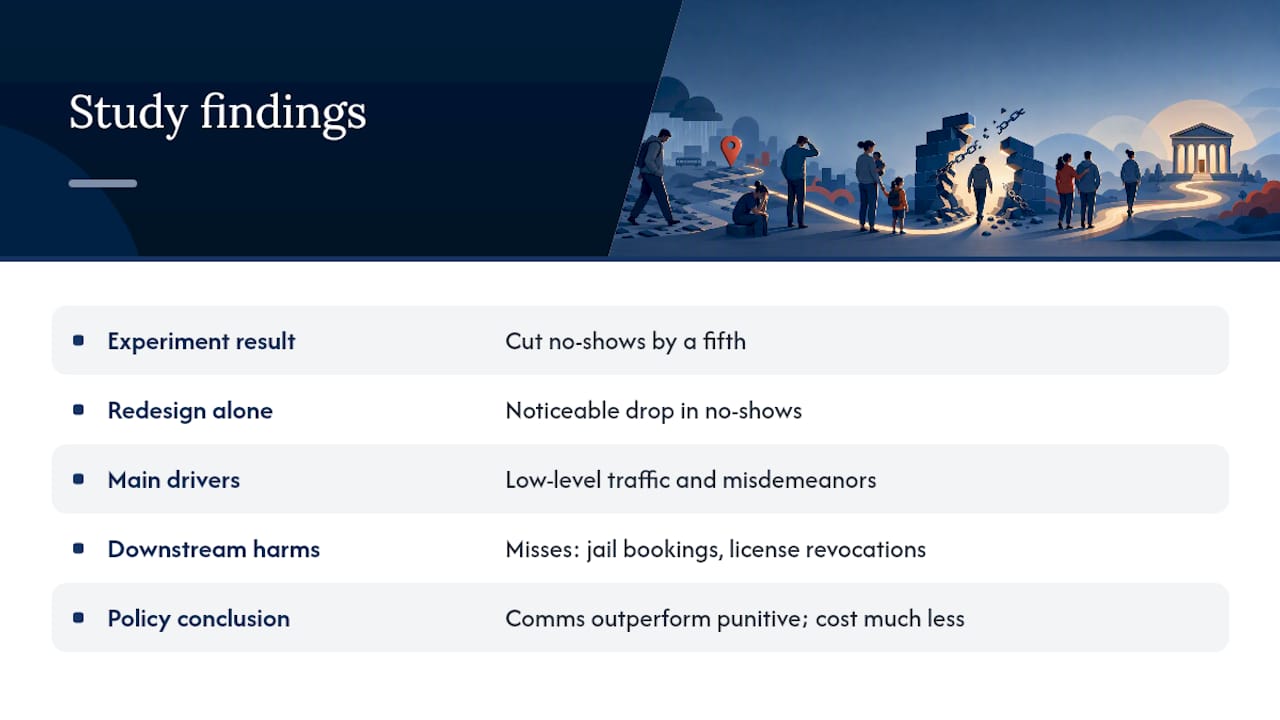
The most compelling evidence against the "defendants are dodging court" narrative comes from a controlled experiment, not a survey. Researchers redesigned summons forms to put the court date, time, and address at the top instead of buried in legalese, and paired that with text message reminders. The result: failures to appear dropped noticeably from the redesign alone and even more with text reminders added, preventing many arrest warrants over multiple years in the New York City courts studied.
If a form redesign and a text message can cut no-shows by a fifth, the original problem was never really about willingness to comply. It was about whether people had clear, timely information.
State-level data backs this up. North Carolina's Statewide Court Appearance Project found that a notable share of criminal cases had at least one missed court date, with low-level traffic and misdemeanor cases driving most of that volume, not violent felony defendants skipping town. The same report tied missed appearances directly to jail bookings and license revocations at the county level, showing how one missed date can cascade into multiple downstream costs for both the defendant and the court system.
The Crime and Justice Institute's review of this literature reaches a consistent conclusion: communication fixes tend to outperform punitive ones, and they cost a fraction as much.
How Court Systems Themselves Contribute to the Problem
Courts aren't just responding to missed dates. Their own scheduling practices often manufacture them. Stacking dozens of cases onto a single morning docket means anyone whose case gets called late has already burned half a workday waiting. Business-hours-only hearings guarantee conflict for anyone without a flexible job.
The dynamic compounds: someone jailed for a missed date often loses the job or housing that would have let them make the next one, sinking their odds even further. Some drivers of court delay have nothing to do with defendants at all. A Philadelphia analysis of 341,417 cases found that police officers, witnesses, and private attorneys missed scheduled hearings more often than defendants did, and those absences were a bigger driver of case delays than a defendant's criminal history or charge type.
Court-administration researchers point to fixable culprits:
- Overbooked calendars with too many cases per session
- Rigid morning-only or weekday-only hearing blocks
- Limited notice periods that leave no room for rescheduling around work
- Punitive default responses that escalate rather than de-escalate the situation
How to Avoid Missing Court (and What to Do If You Already Did)
Before your date arrives, take these steps:
- Confirm the exact date, time, and courtroom with the clerk's office, not just the paperwork you were handed.
- Update your contact information with the court the moment you move or change your phone number.
- Set at least two reminders on different devices or with a friend or family member as backup.
- Request leave from your employer in writing as early as possible, and save that communication.
- Line up childcare or transportation a week ahead, not the night before.
If something goes wrong on the day itself, call the court clerk and your attorney immediately, before the hearing time passes. A short phone call explaining a flat tire or a sick child, backed later by documentation, changes how a judge views the miss entirely.
After a missed date, keep every piece of evidence: text messages, medical records, employer emails, anything showing the miss wasn't willful. That paperwork is often the difference between a warrant getting quashed quietly and an arrest at your next traffic stop. Understanding what to expect at a bail hearing also helps you prepare if the case moves that direction.
Pro Tip: Screenshot everything the moment it happens. A text to your attorney sent at 8:47 a.m. saying "car broke down, on my way" carries more weight in front of a judge than the same story told from memory three weeks later.
What Reforms Are Jurisdictions Actually Trying?
The evidence-backed fixes are neither expensive nor complicated:
- Redesigned summons forms that put the date and location at the top in plain language
- Text message and email reminders sent a few days before the hearing
- Virtual appearance options for low-risk traffic and misdemeanor matters
- Administrative traffic sessions that don't require a full in-person hearing
- Capped calendars limiting how many cases get scheduled per session, reducing wait times and cascading delays
North Carolina's court project recommended several of these operational changes directly, arguing that courts control their own scheduling practices and can reduce missed dates without touching statute at all. The trade-offs are real: text reminders require accurate phone numbers on file, virtual hearings require reliable internet access that not every defendant has, and capped calendars mean courts need more session slots overall. None of that erases the core finding that low-cost communication changes reduce failure-to-appear rates more reliably than tougher penalties ever have.
What I've Learned Helping Families Through This
Working with families in the hours after an arrest, I've seen the same pattern repeat: someone misses a date because their car died, not because they wanted to disappear. By the time they call us, they're already dealing with a warrant, a spooked family, and a bail amount that just got harder to manage.
If you're reading this because you or someone you love has a court date coming up, or already missed one, use the checklist above and call the court clerk or your attorney today. If bail is part of the picture, understanding why speed matters can save you real time and stress. We're available 24/7 if you need help sorting out next steps.
Take Immediate Action if You've Missed or Will Miss a Court Date
Most missed court appearances trace back to transportation, work, childcare, or confusing paperwork, not intentional evasion, and clear communication with the court fixes far more than punishment does.
| Point | Details |
|---|---|
| Logistics drive most misses | Transportation, childcare, and inflexible work schedules account for the bulk of reported barriers. |
| Notice design matters | Redesigned summons and text reminders cut failure-to-appear rates by around a fifth in field trials. |
| Consequences escalate fast | A missed date can trigger a bench warrant, license suspension, or new charges within days. |
| Call before you're late | Contacting the clerk or your attorney ahead of a missed date changes how courts respond. |
| Courts share responsibility | Overbooked calendars and business-hours-only hearings create conflicts courts could fix administratively. |
If bail becomes part of your situation, Jake Hernandez Bail Bonds offers 24/7 support statewide, including 0% down payment options for qualified co-signers navigating a bond after a missed date.
Frequently Asked Questions
Are most missed court appearances intentional? No. Research consistently shows most defendant absences stem from transportation, work, and childcare barriers rather than deliberate avoidance.
What's the very first thing that happens after a missed date? A judge typically issues a bench warrant, though timing and automatic triggers vary significantly by state.
Can I fix a missed court date without going to jail first? Often, yes. Voluntary surrender or a motion to quash the warrant, especially with documentation showing the miss wasn't willful, frequently avoids arrest entirely.
Does a missed date always mean a bail bond gets forfeited? Not automatically, but it can trigger forfeiture proceedings depending on the bond agreement and jurisdiction. Reviewing how bail bond execution works clarifies what's at stake.
What can courts do to reduce missed appearances? Evidence points to redesigned summons forms, text reminders, virtual hearings for low-risk cases, and capped court calendars as the most effective, lowest-cost fixes.
This article is general information, not a substitute for advice from a qualified lawyer. Consult a qualified legal professional about your own circumstances before acting on anything here.
Sources
- Behavioral nudges reduce failure to appear for court (Fishbane et al.)
- Understanding and reframing an individual’s failure to appear in court
- Statewide Court Appearance Project Final Report (North Carolina Administrative Office of the Courts)
- National Guide to Improving Court Appearances (NCSC / court education)
- Getting to court as scheduled: Reframing 'failure to appear' (Justice System Partners — Lake County report)
- Statutory responses for failure to appear (NCSL)