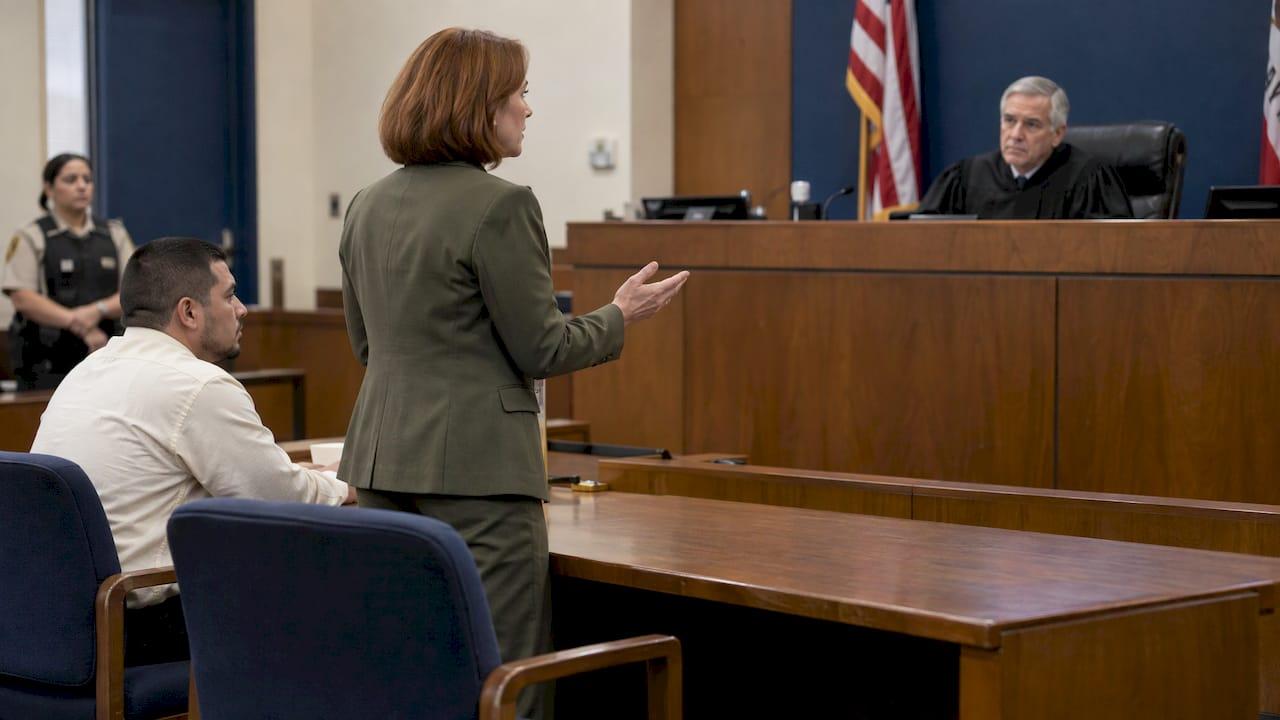
A public defender and a bail bond do two different jobs. The public defender is the court-appointed lawyer who defends the case and can argue at the bail hearing for release or a lower amount. Bail is the money that gets someone out once a judge sets it, and a bail bond is how most families pay it. If the judge sets a bail amount, the two work side by side: the lawyer fights the case, and we help you post the bond so your loved one can fight it from home. This guide explains who decides what, when a public defender enters the picture, and how to move quickly without mixing up the two.
TL;DR
- A judge, not a lawyer, decides whether someone is released and on what terms, usually at the first court appearance within a day or two of arrest.
- A public defender is appointed if the person cannot afford a lawyer, and can speak for them at that bail hearing. The public defender does not post bail.
- When a judge sets a secured bail amount, a licensed bail bond is the way families post it. In California our premium is 10% of the bail, or 8% for attorney-referred cases.
- Eligibility for a public defender looks at income, necessities and even the cost of bail, so needing a bond does not stop someone from qualifying.
- You can call us 24/7 for a free consultation while the hearing is being scheduled.
Table of Contents
- Who decides on bail: the judge at the first appearance
- Is there a right to bail?
- What a public defender does at the bail hearing
- How to get a public defender
- Why the bond and the lawyer work together
- What a bond costs in California
- What to do in the first hours
- Alternatives the judge may consider
- Our take on public defenders and bail
- Get the bond moving while the lawyer works
- FAQ
- Sources
Who decides on bail: the judge at the first appearance
After an arrest and formal charge, the person is brought before a judge quickly. In the federal system, the Department of Justice explains that this happens the same day or the day after arrest and charging, at an initial hearing before a magistrate judge. That judge arranges for an attorney and decides whether the person is held or released until trial, after hearing facts such as where the person lives, family ties, criminal record and any danger to the community.
State courts follow their own timelines. Colorado's public defender office, for example, says the first court appearance comes within 48 hours of arrest and charge, and that a public defender or other court-appointed lawyer is provided at that appearance. Your state's rules may differ, but the pattern is the same everywhere: a quick first hearing, a lawyer appointed if needed, and a judge's decision on release.
In the federal system the law starts from release. Under 18 U.S.C. § 3142, the judge must order release on a promise to appear or an unsecured bond unless that will not reasonably assure the person returns to court or will endanger someone. Where the judge sets conditions that include a secured amount, that is where a bond comes in.
Is there a right to bail?
Not an absolute one. The Constitution bars excessive bail, but the Supreme Court has held that the government may deny release in some cases. The Congress.gov Constitution Annotated explains that in United States v. Salerno the Court upheld the federal preventive-detention provisions and that there is no absolute right to bail in all cases.
What that means for a family in practice:
- Most defendants are offered some form of release, but the judge can detain someone charged with certain serious offenses or considered a flight or safety risk.
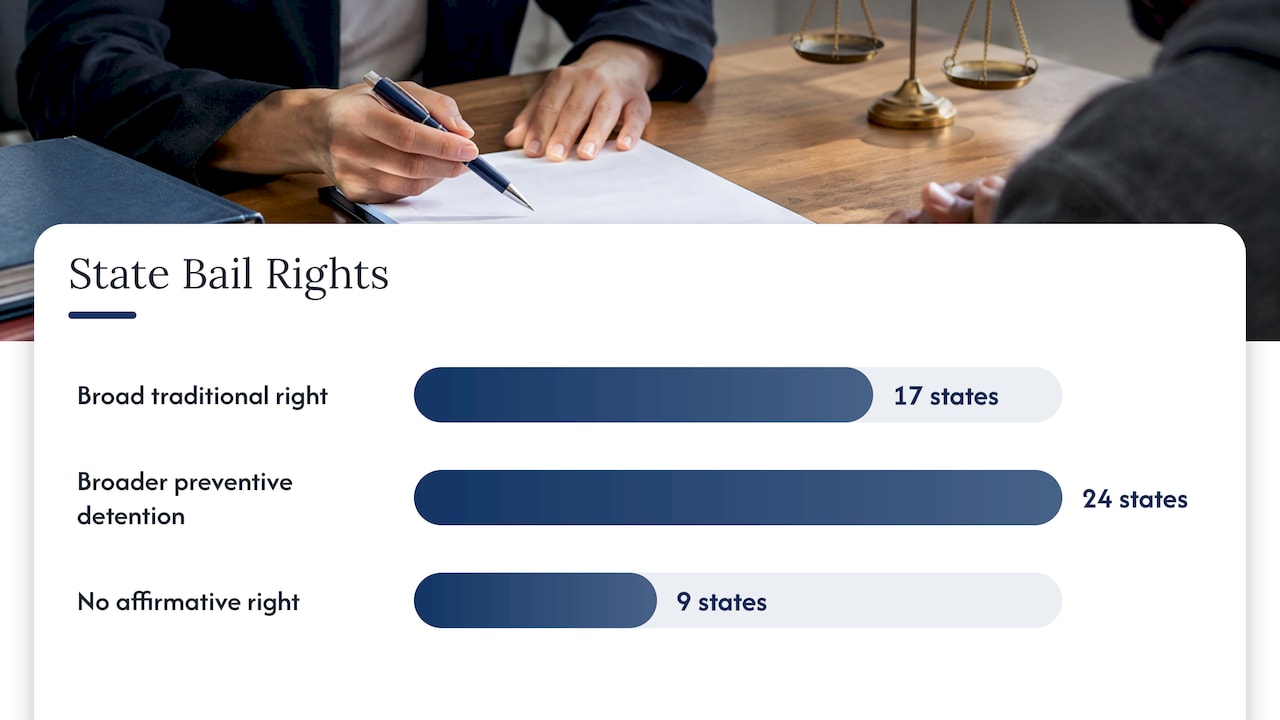
- States differ. The National Conference of State Legislatures reports that 17 states have a broad traditional right to bail, 24 have amended it to allow broader preventive detention, and 9 have no affirmative right but mirror the federal excessive-bail clause (page updated March 2026).
- In federal court, the Congressional Research Service notes that a rebuttable presumption of detention applies to certain charges, such as serious drug offenses or firearm offenses tied to a crime. A lawyer can argue against that presumption at the hearing.
This is exactly why having a lawyer in the room at the first appearance matters. The decision is made fast, and it shapes everything after it.
What a public defender does at the bail hearing
A public defender is a lawyer paid by the government to represent people who cannot afford one. At the bail stage, the lawyer can present your loved one's ties to the community, job, family and record, and argue for release, for conditions short of jail, or for a lower amount.
The federal rules give a sense of how central this role is. Under the Criminal Justice Act, appointed counsel represents the person at every stage from initial appearance through appeal, although the court may substitute counsel in the interests of justice. The Federal Judicial Center's 2026 Benchbook adds that counsel should be appointed in time to represent the person at the initial appearance, where the decision on a detention hearing is made, and that the Bail Reform Act is too complex for a defendant to navigate alone.
Research backs the value of early counsel. A practice guide from the Center for Effective Public Policy says that counsel at first appearance affects release decisions, reduces pretrial incarceration and helps keep release conditions to the least restrictive necessary.
Two practical points:
- The bail-hearing lawyer may not be the trial lawyer. In busy courts the defender covering that day's calendar often handles the hearing. Ask the court clerk or the defender's office who will carry the case forward.
- A public defender argues for release, but does not pay it. Once the judge sets a dollar amount, someone has to post it. That is a separate step, and it is the one we handle.
If you want to understand the wider range of lawyers involved after an arrest, this overview of what a criminal defense lawyer does is a good companion read.
How to get a public defender
You do not hire a public defender. The court appoints one after looking at the person's finances.
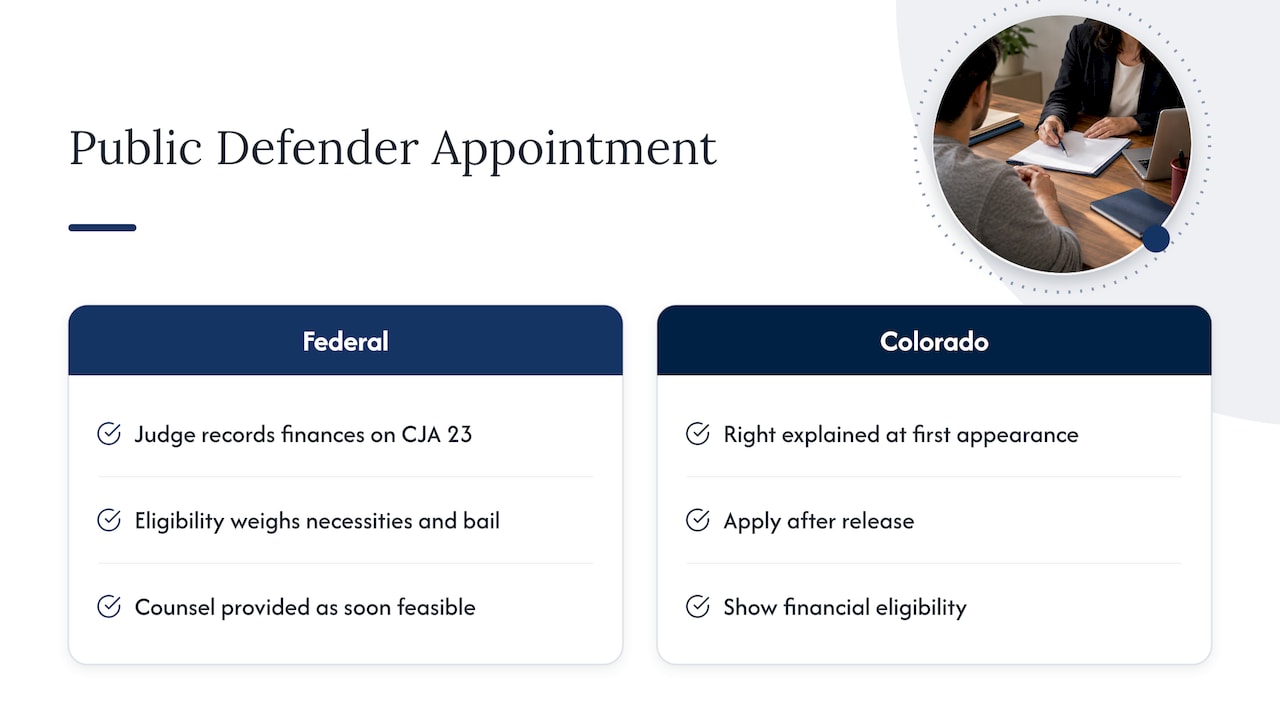
In federal court, the court or magistrate judge makes the inquiry and the details are recorded on a financial affidavit, Form CJA 23. The U.S. Courts' Guide to Judiciary Policy says a person qualifies when net financial resources and income are not enough to obtain qualified counsel, taking into account the necessities of life and the cost of bail bonds, and that doubts are resolved in the person's favor. The same guide says counsel should be provided as soon as feasible after the person is taken into custody, at the first appearance, or when charged, whichever comes first.
The statute adds a safeguard: when someone appears without a lawyer, the judge must explain the right to counsel, and the appointment can be made retroactive.
State systems vary. In Colorado, the public defender office explains that a person is advised of the right to request a defender at the first appearance and must apply and show they qualify once released. If your loved one is in a state or county jail, ask at the first hearing how to apply, and ask the jail or court clerk for the application.
A point that surprises many families: the eligibility test counts bail costs. Paying a bond premium does not automatically disqualify someone from a public defender, because the courts weigh what is left after necessities and bail.
Why the bond and the lawyer work together
Think of it as two tracks running at the same time.
| Public defender | Bail bond | |
|---|---|---|
| What it is | Court-appointed defense lawyer | Money posted so the person can leave jail |
| Main job | Defends the case, argues for release terms at the hearing | Secures release once bail is set |
| Who arranges it | The court, after a financial review | A co-signer, family member, friend or attorney |
| What it costs | No fee to the defendant if appointed | A premium, a percentage of the bail |
| Timing | Appointed at or before the first appearance | Posted after the judge sets the amount |
Being out of jail also helps the defense. The Supreme Court has long said that freedom before conviction permits unhampered preparation of a defense and avoids punishment before a verdict. A client who is home can meet the lawyer, gather documents, keep a job and show the court a stable life. Our guide on how bail reduces jail time walks through that for families.
What a bond costs in California
In California, a bail bond premium is 10% of the bail amount. If we are working with an attorney, our attorney discount brings that to 8%. Here is a worked example for a bail set at $50,000:
- At the 10% premium: $5,000
- At the 8% attorney discount: $4,000
That is the premium for the bond, not the full bail amount. We also offer 0% down options and payment plans for qualified co-signers, plus $500 down bail bonds in California for families who need to start with a smaller upfront payment. You can run your own numbers with our bail bond cost calculator, and read more in how much a bail bond costs in California and how the attorney discount works.
If a lawyer, public or private, is already on the case, tell us when you call. The attorney discount is part of how we serve counsel and their clients.
What to do in the first hours
- Get the booking details. Note the full legal name, date of birth, jail location and booking number. These let us look up the charge and the bail amount.
- Find the bail amount or the hearing time. For many charges the amount comes from a county bail schedule. For others the judge sets it at the first appearance. Our piece on factors judges consider when setting bail explains what moves the number.
- Make sure counsel is lined up. If your loved one cannot afford a lawyer, they should tell the judge at the first appearance and ask for a public defender. If a private attorney is retained, share their contact with us.
- Decide who will co-sign. The co-signer is the person who takes responsibility that the defendant returns to every court date. Choose someone who can stay in touch and get the person to court.
- Call us. Consultations are free and support is available 24/7, and we serve all 58 California counties. Our team works in English and also offers bilingual support in Spanish, Hindi and Arabic.
If the case is federal, the process has its own timelines and pretrial services interview. Our guides on the federal bail process for families and what co-signers should know about federal pretrial services cover them, and we handle federal bonds as well as state ones.
Alternatives the judge may consider
Some people are released without a secured amount at all, on their own promise to appear or under supervision conditions. The federal statute makes that the starting point. Which option fits depends on the charge, the record and the court. Our overview of pretrial release alternatives to bail explains each type. Your public defender is the right person to push for these at the hearing, and if the judge sets a secured amount instead, a bond is the next step.
Our take on public defenders and bail
Families call us at the worst hour, and they often ask the same thing: do we need a lawyer or a bond? The answer is both, and they do not compete.
The lawyer is how a person gets a fair hearing. The bond is how that person gets home while the case moves. We built our practice so that you talk to a licensed professional directly, not a call center, and so the price is clear: 10% premium, 8% when an attorney is involved, and 0% down and payment plan options for qualified co-signers.
When a public defender is on the case, we work around the court calendar, not against it. We stay with you through every court date, because a defendant who shows up, with a lawyer beside them, has the best chance at the best outcome.
Jake
Get the bond moving while the lawyer works
If a judge has set bail and you are ready to post it, our California bail bonds cover every county, every jail type and both felony and misdemeanor charges. We also handle federal bonds, immigration bonds and 1275 holds. You can start online through our online bail bonds page, or call us at any hour for a free consultation.
For charge-specific help, see our pages on felony bail bonds and misdemeanor bail bonds. Hidden costs worry many co-signers, so we also explain bail bond fees to watch for before you sign.
FAQ
Can a public defender get my bail lowered?
A public defender can ask the judge to lower bail, set release conditions, or release the person without a secured amount. The judge makes the final call after weighing flight risk, safety and the person's ties to the community. Early counsel at the first appearance is linked to better-matched release conditions.
Does a public defender post bail for me?
No. A public defender represents the person in court. Bail has to be posted by the defendant, a family member, a friend or through a bail bond. We can walk you through a bond in a free consultation at any hour.
Can I still get a public defender if I paid for a bond?
Yes, it can still be possible. In the federal system, the eligibility review looks at net income and resources after the necessities of life and the cost of bail bonds, and doubts go in the person's favor. State courts set their own tests, so ask the judge or clerk how to apply.
Will the same public defender handle my whole case?
Not always. In busy courts the defender covering the day's calendar may handle the bail hearing, and another may take the case afterward. Ask the court or the defender's office who is assigned and how to reach them.
Who decides whether bail is allowed?
A judge or magistrate judge decides at the first appearance. There is no absolute right to bail in every case, and some serious charges allow the judge to order the person held. In those cases, your lawyer can argue for release conditions.
Sources
- U.S. Attorneys, Initial Hearing / Arraignment (U.S. Department of Justice)
- Bail and Pretrial Release (Colorado State Public Defender)
- 18 U.S. Code § 3142, Release or detention of a defendant pending trial
- Modern Doctrine on Bail, Constitution Annotated (Congress.gov)
- Statutory Framework of Pretrial Release (NCSL)
- Bail: An Abridged Overview of Federal Criminal Law (CRS R40222)
- 18 U.S. Code § 3006A, Adequate representation of defendants
- Benchbook for United States District Courts, Seventh Edition (Federal Judicial Center, 2026)
- Counsel at First Appearance (Center for Effective Public Policy, 2023)
- Guide to Judiciary Policy, Vol. 7A, Ch. 2 (U.S. Courts)
- U.S. Constitutional Limits on State Money-Bail Practices (CRS R45533)
- What Does a Criminal Defense Lawyer Do?