
Pretrial detention means being held in jail after an arrest while your case works through the courts, before any verdict has been reached. You are legally presumed innocent the entire time. If someone you care about has just been arrested: contact a defense attorney or public defender immediately.
Here is what you need to know right now:
- Why it happens: A judge finds the person poses a flight risk, a danger to the community, or they simply cannot afford to post bail.
- How common it is: More than 400,000 people are held pretrial in U.S. jails on any given day.
- What it costs defendants: Lost jobs, housing instability, and intense pressure to accept a plea deal just to get out.
- The legal default: Under U.S. law, release is supposed to be the norm. Detention is the exception.
Table of Contents
- What is pretrial detention and why U.S. law allows it
- How the pretrial process works from arrest to release or detention
- What happens at a detention hearing and what rights you have
- What alternatives to detention courts can offer
- Who decides whether someone is detained and how risk tools factor in
- How common pretrial detention is and what it costs
- How pretrial detention affects case outcomes and daily life
- What the strongest research actually shows
- What to do right now if a loved one is detained
- Key Takeaways
- Why rapid release matters more than most families realize
- Jakehernandezbailbonds is available 24/7 for rapid release across California
- Useful sources and further reading
What is pretrial detention and why U.S. law allows it
The federal legal foundation for pretrial detention sits in the Bail Reform Act of 1984 and its codification at 18 U.S.C. §3142. That statute lays out every available release condition, the rules for detention hearings, and the standard a judge must meet before ordering someone held without bail.
The statute's starting point is a presumption of liberty. Courts have consistently framed this as a constitutional baseline:
Congress passed the Bail Reform Act partly in response to concerns that the prior 1966 law gave judges too little authority to detain genuinely dangerous defendants. The 1984 Act introduced "preventive detention," allowing a judge to hold someone not just because they might flee, but because no condition of release would reasonably protect the community. That was a significant shift. Before 1984, federal law treated flight risk as the only legitimate basis for detention.
State systems vary considerably. Most states rely heavily on money bail and published bail schedules, meaning a defendant's release often turns on whether they can afford the amount set, not on an individualized risk finding. A handful of states have moved toward more structured preventive-detention statutes modeled loosely on the federal approach. California, for instance, has its own statutory framework and a history of contested bail reform efforts. The practical result is that the federal system tends to be more procedurally rigorous at the detention hearing stage, while many state systems still filter release through the ability to pay.
How the pretrial process works from arrest to release or detention
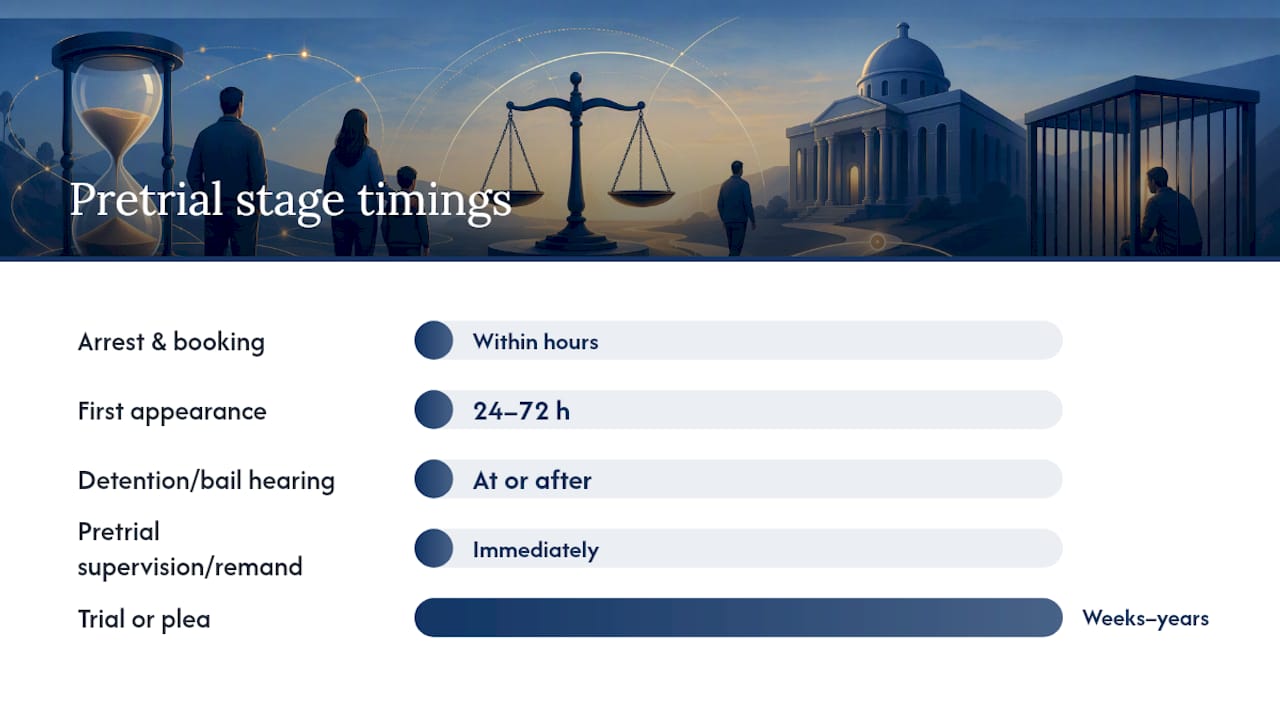
After an arrest, the path to either release or continued detention follows a fairly predictable sequence, though timing varies by jurisdiction and charge severity.
| Stage | What happens | Typical timing |
|---|---|---|
| Arrest and booking | Police take the person into custody; fingerprints, photos, and charges are recorded | Within hours of arrest |
| First appearance / arraignment | Judge informs defendant of charges; bail or release conditions may be set | Within 24–72 hours (federal: usually 24 hours) |
| Detention or bail hearing | Formal hearing on whether to release or detain; both sides present arguments | At or shortly after arraignment; federal law requires "promptly" |
| Pretrial supervision or remand | Defendant is either released under conditions or held pending trial | Immediately after hearing |
| Trial or plea | Case resolves; time served credited toward any sentence | Weeks to years later |
One thing families often misunderstand: statutory "speedy trial" deadlines do not mean cases resolve quickly. The Speedy Trial Act (18 U.S.C. §3161) sets a 70-day federal trial deadline, but that clock pauses for motions, continuances, and other "excludable" periods. In practice, a detained defendant can sit in jail for many months before trial, even when the nominal deadline looks short on paper.
A second operational barrier: even when a judge orders release or bail is posted, an administrative hold from another agency can keep someone locked up. Immigration and Customs Enforcement (ICE) detainers, probation or parole holds, and outstanding warrants from other jurisdictions all work this way. Checking for holds is one of the first things a defense attorney or family member should do.
Key terms to know:
- Arraignment: The court appearance where charges are formally read and an initial plea is entered.
- Bond: A financial guarantee (cash or surety) that the defendant will appear for future court dates.
- Release on own recognizance (ROR): Release with no money required, based solely on a promise to appear.
- Secured bond: Requires actual money or collateral before release.
- Unsecured bond: The defendant promises to pay a set amount only if they fail to appear; no upfront payment.
Documents and information to have ready for a bail or detention hearing:
- Government-issued ID and proof of address
- Employment records or a letter from an employer
- Evidence of family ties (children, dependents, long-term residence)
- Prior court history and any record of appearing as required
- Character references from community members, clergy, or employers
- Information about any treatment programs or supervision the defendant is willing to accept
What happens at a detention hearing and what rights you have
The detention hearing is where a judge decides whether the defendant goes home or stays in jail while the case proceeds. The immediate consequence is binary: release under some set of conditions, or remand into custody.
At a federal detention hearing, the government bears the burden of proving either that no condition will reasonably assure the defendant's appearance (by a preponderance of the evidence) or that no condition will protect the community (by clear and convincing evidence). That "clear and convincing" standard for dangerousness is a meaningful legal bar, though critics argue it is not always applied rigorously in practice.
The hearing itself is less formal than a trial. A pretrial services officer typically presents a report summarizing the defendant's background, criminal history, and risk level. The prosecutor argues for detention or specific conditions. Defense counsel responds with evidence of community ties, employment, family responsibilities, and any proposed supervision plan. Witnesses can be called, though it is uncommon. Hearsay is admissible.
Defendant rights at a detention hearing:
- Right to be represented by counsel (appointed if the defendant cannot afford one)
- Right to present witnesses and evidence on their own behalf
- Right to cross-examine witnesses the government calls
- Right to be heard personally by the judge
- Right to a written statement of reasons if detention is ordered
- Right to appeal a detention order
Judges and prosecutors typically probe questions like: Does the defendant have ties to the community that make flight unlikely? Are there prior failures to appear? Does the charge involve violence or weapons? Is there a history of substance abuse that supervision could address? Understanding these angles helps defense counsel frame the strongest possible argument for release. For a detailed breakdown of the factors judges weigh, see what judges consider when setting bail.
What alternatives to detention courts can offer
Courts do not have to choose between full detention and unsupervised release. Federal law under §3142 and most state statutes require judges to consider the least restrictive condition that will reasonably assure appearance and safety. A full overview of these options is available at pretrial release alternatives to bail.
The main noncustodial options:
- Cash bail: — A set dollar amount deposited with the court; returned if the defendant appears as required. The practical problem is that most defendants cannot afford it, which means detention by default rather than by judicial finding.
Pro Tip: When asking the court for nonfinancial conditions, have a concrete supervision plan ready before the hearing. A specific proposal, such as daily check-ins with pretrial services, a named third-party custodian, or enrollment in a treatment program, is far more persuasive than a general promise to comply. Judges respond to specifics.
Who decides whether someone is detained and how risk tools factor in
Three actors shape the detention decision: the judicial officer (judge or magistrate), the pretrial services officer, and the prosecuting attorney. Defense counsel is the fourth voice, and often the most consequential one for the defendant.
Pretrial services officers conduct an interview with the defendant after arrest, verify background information, and prepare a report for the judge. That report typically covers criminal history, prior court appearances, employment, residence stability, substance use history, and a risk score. In the federal system, the Pretrial Risk Assessment (PTRA) is the primary empirical tool used to generate that score.
The PTRA predicts the likelihood of failure to appear or new criminal activity during the pretrial period. It draws on factors like age, prior record, and prior failures to appear. The federal judiciary uses it to inform, not replace, judicial discretion.
What the PTRA does well and where it falls short:
- It introduces consistency and reduces purely subjective decision-making.
- Validated on federal populations, it has reasonable predictive accuracy for flight risk.
- Critics point out that any tool trained on historical data can encode existing racial and socioeconomic disparities, since those patterns are embedded in prior arrest and conviction records.
- The score is a recommendation, not a mandate. Judges can and do deviate from it.
What defense counsel should do with a pretrial services report:
- Review it before the hearing and correct any factual errors (wrong address, outdated employment info, misrecorded criminal history).
- Challenge the weight given to prior arrests that did not result in conviction.
- Supplement the report with independent documentation of community ties, employment, and any proposed supervision conditions.
How common pretrial detention is and what it costs
More than 400,000 people are held in U.S. jails on any given day awaiting trial. Pretrial detainees account for the majority of the total jail population, and that share has grown substantially since the 1980s, driven largely by the spread of money bail and the inability of low-income defendants to pay even modest amounts.
| Metric | Figure | Source |
|---|---|---|
| Estimated daily pretrial jail population | More than 400,000 | Prison Policy Initiative |
| Share of jail population held pretrial | A large majority | Prison Policy Initiative |
| Typical daily cost of jail incarceration | Significantly higher than supervision | Policy research consensus |
| Typical daily cost of pretrial supervision | Much lower than incarceration cost | Policy research consensus |
More than 400,000 people are sitting in U.S. jails right now who have not been convicted of anything. Most are there because they cannot afford bail, not because a judge found them dangerous.
The fiscal gap between detention and supervision is wide. Jailing someone pretrial costs taxpayers far more per day than electronic monitoring or check-in supervision. For families, the cost is different but just as real: lost wages, childcare disruptions, and the pressure to accept a plea deal simply to get out and return to work.
How pretrial detention affects case outcomes and daily life
The evidence is consistent: pretrial detention makes worse outcomes more likely, across charge types, jurisdictions, and study designs. The mechanisms are not mysterious.
Why detention increases plea pressure and impairs defense:
- Defendants lose income immediately, making it harder to retain private counsel or gather resources for defense.
- Attorney access in jail is limited, reducing time for case preparation.
- Detained defendants face the concrete choice between pleading guilty now (and going home) versus waiting months in jail for a trial that might result in acquittal.
- Families face housing and childcare crises that create pressure on the defendant to resolve the case quickly regardless of guilt.
- Mental and physical health deteriorate in custody, affecting decision-making capacity.
A Harris County study of misdemeanor cases found that detained defendants were 25% more likely to plead guilty and 43% more likely to be sentenced to jail compared to similarly situated defendants who were released. Those are not small effects. They represent thousands of people each year accepting convictions they might have fought, or receiving harsher sentences, simply because they could not get out of jail while their case was pending.
The downstream harms extend beyond the case itself. A conviction record affects employment, housing eligibility, professional licensing, and immigration status. For defendants who were detained and then acquitted or had charges dismissed, the time served is gone. There is no refund.
"Pretrial detention does not just affect the outcome of a case. It restructures the entire decision-making environment for a defendant, making the rational choice often indistinguishable from the coerced one."
This framing from Advancing Pretrial's research summary captures why reformers argue that money bail functions as a punishment imposed before any verdict.
Understanding the plea implications matters when someone is weighing their options. The difference between a no-contest plea and a guilty plea, for instance, carries its own strategic considerations, which a criminal defense attorney can explain in context.
What the strongest research actually shows
Detained defendants are, on average, more likely to plead guilty, more likely to be convicted, and more likely to receive a custodial sentence than defendants who were released pretrial. Three bodies of work anchor this finding.
The Harris County misdemeanor study cited above uses detailed administrative data to document the 25% and 43% effect sizes for guilty pleas and jail sentences respectively. A judge fixed-effect instrumental variable study published in the Journal of Experimental Criminology goes further, using variation in judicial assignment to isolate the causal effect of detention from the selection effects that plague simpler comparisons. The finding: any period of pretrial detention causally increases guilty pleas, convictions, and carceral sentences. A systematic review and meta-analysis synthesizing findings across multiple jurisdictions and study designs confirms the pattern holds broadly, though effect sizes vary.
Why the methodology matters:
- Simple comparisons between detained and released defendants are biased because judges detain higher-risk defendants to begin with.
- Instrumental variable approaches exploit the fact that which judge a defendant is randomly assigned to affects detention probability, allowing researchers to estimate the effect of detention itself rather than the effect of being high-risk.
- This design gets closer to a causal answer than observational data alone.
Honest limits of the research:
- Most high-quality studies focus on misdemeanors or specific jurisdictions; felony findings are less consistent.
- Effect sizes vary by charge type, defendant demographics, and local court culture.
- Long-term outcomes (recidivism, employment years later) are harder to measure and less studied.
- Jurisdictional variation means findings from one court system may not transfer directly to another.
What to do right now if a loved one is detained
Speed matters. The first 24–72 hours after an arrest are when the most consequential decisions get made, often without adequate preparation.
-
Find out where they are held. Use the jail's online inmate locator or call the booking facility directly. Confirm the full legal name, booking number, and which facility has custody. Check immediately for any holds from other agencies (ICE, probation, other jurisdictions) that could prevent release even after bail is posted. The inmate search tool can help locate someone quickly.
-
Contact defense counsel. If the person cannot afford a private attorney, request the public defender's office immediately. Do not wait. The attorney needs time before the first appearance to review charges and prepare arguments for release conditions.
-
Request the pretrial services report. Defense counsel can review this before the hearing and correct errors. A wrong address or outdated employment record can make a defendant look like a higher flight risk than they are.
-
Gather documentation of community ties. Employment letters, lease agreements, utility bills, and family photos all help establish that the defendant has roots in the community and reasons to appear for court. Collect these before the hearing.
-
Understand the bail amount and your options. If bail is set, you have three paths: pay the full amount in cash to the court (returned if the defendant appears), work with a licensed bail bondsman who posts the full amount for a non-refundable premium (typically 10% in California), or ask the court to reduce bail or modify conditions at a hearing. For a step-by-step walkthrough of posting bail, see how bail reduces jail time.
-
Request a bail review or detention modification hearing if needed. If the initial bail is unaffordable or conditions seem excessive, defense counsel can request a hearing to modify them. In California, this is a formal process with specific procedural requirements. See bail reduction hearing best practices in California for jurisdiction-specific guidance.
-
Verify time-served credit. If the case eventually results in a custodial sentence, time spent in pretrial detention is normally credited toward that sentence. Errors in these calculations are common. Defense counsel should verify the credit calculation at sentencing.
Key Takeaways
Pretrial detention is a legal holding status, not a punishment, but its real-world consequences often function like one, making rapid release and strong legal representation the two most important variables for anyone facing it.
| Point | Details |
|---|---|
| Definition and legal default | Pretrial detention means held in jail before trial; U.S. law presumes release and requires detention to be the exception. |
| Main reasons detention is ordered | Flight risk, danger to the community, or inability to afford bail are the three primary drivers. |
| Scale of the problem | Over 400,000 people are held pretrial in U.S. jails daily, most because they cannot pay bail. |
| Documented consequences | Detained defendants are more likely to plead guilty and receive jail sentences in misdemeanor cases. |
| Jakehernandezbailbonds | For families in California needing rapid release, Jakehernandezbailbonds offers 24/7 bail bond services across all 58 counties, with 0% down options for qualified co-signers. |
Why rapid release matters more than most families realize
Pretrial detention is one of those topics where the legal theory and the lived reality are far apart. The law says detention is the exception. The data says hundreds of thousands of people are sitting in jail right now, not because a judge found them dangerous, but because they could not come up with a few hundred dollars.
What I find most troubling about the research is not the headline statistics. It is the mechanism. A detained defendant is not just inconvenienced. Their entire decision-making environment changes. They lose income, lose access to their attorney, and face a concrete daily calculation: fight the case from jail and wait, or plead guilty and go home. For someone with a job, kids, or a lease on the line, that calculation often has only one rational answer, regardless of actual guilt.
The bail system, as it currently operates in most of California and across most of the country, does not sort people by dangerousness. It sorts them by wealth. That is not a political opinion. It is what the data consistently shows, from the Prison Policy Initiative's population counts to the Harris County misdemeanor study's effect sizes.
Families who call me are not thinking about policy. They are thinking about getting their person out before they lose their job or their apartment. That urgency is completely legitimate. Getting someone out quickly is not just about comfort. It is about preserving their ability to fight their case from a position of strength rather than desperation.
I am not a lawyer, and nothing here is legal advice. If someone you care about is detained, the first call is always to a defense attorney.
Jakehernandezbailbonds is available 24/7 for rapid release across California
When bail is set and every hour in custody costs someone their job or their housing, the speed of the release process is not a minor detail. Jakehernandezbailbonds posts bail across all 58 California counties, 24 hours a day, seven days a week, with no middleman and no call center. Bonds start at $1,000 and go up to $1,000,000, with 0% down payment options available for qualified co-signers and flexible payment plans for families who need them. Consultations are free, bilingual support is available in Spanish, Hindi, and Arabic, and the team handles everything from standard county holds to federal and immigration bonds.
If someone you know has been arrested anywhere in California, contact Jakehernandezbailbonds now for a free consultation and same-day release assistance. Jakehernandezbailbonds does not provide legal representation. For legal advice, contact a licensed defense attorney.
Useful sources and further reading
The sources below are the primary references for this article. Each one serves a different purpose.
-
Bail Reform Act of 1984, H.R. 5865 (Congress.gov): — The legislative text and history behind the modern federal detention framework. Useful for understanding why Congress created preventive detention and what it was meant to address.
-
Pretrial Release and Detention in the Federal Judiciary (uscourts.gov): — Federal court guidance explaining how pretrial services work, what the PTRA measures, and how the federal system approaches the presumption of release.
-
The Downstream Consequences of Misdemeanor Pretrial Detention (UGA Law): — The Harris County study documenting 25% higher guilty plea rates and 43% higher jail sentence rates for detained defendants. Peer-reviewed empirical research.
These sources fall into two categories: statutes and court guidance (legal standards) and empirical research (what the evidence shows about outcomes and costs). Both matter. The statute tells you what the law requires; the research tells you what actually happens.